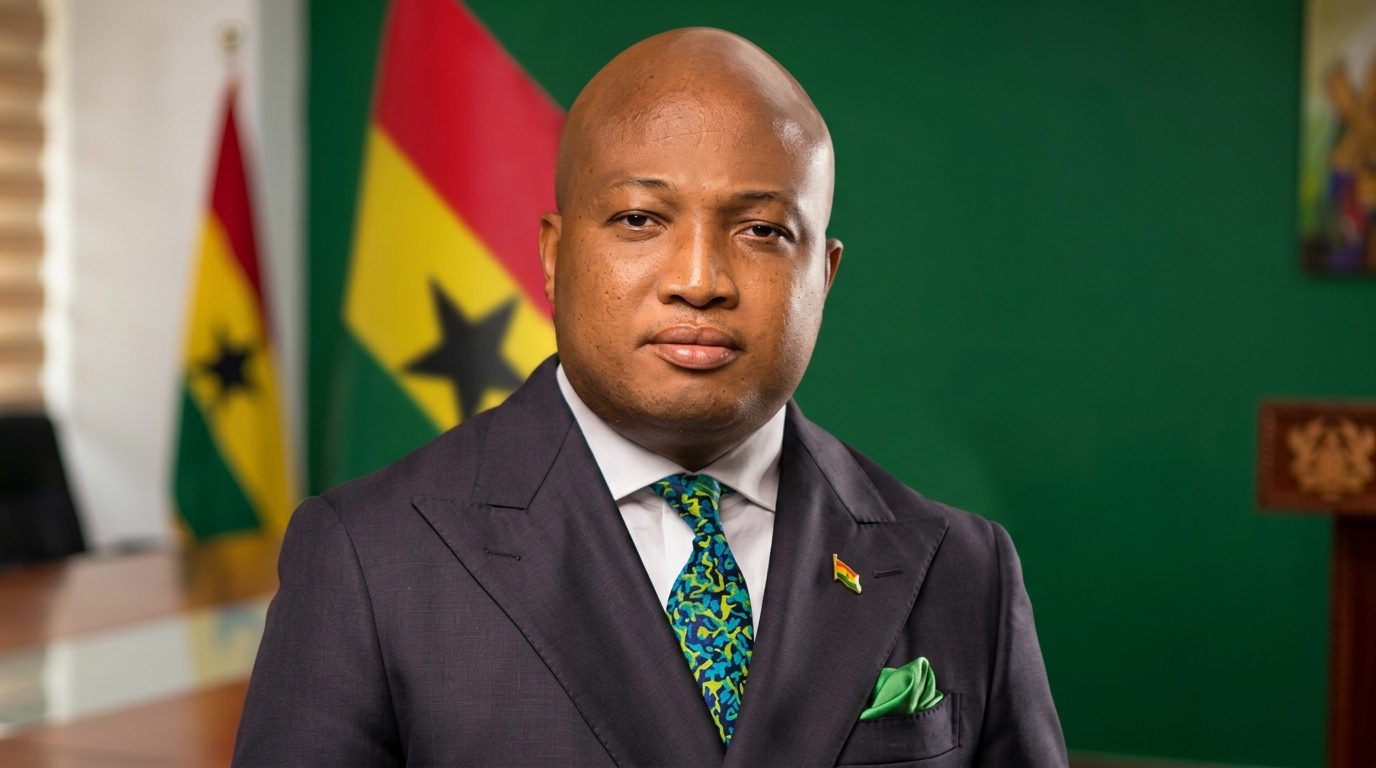
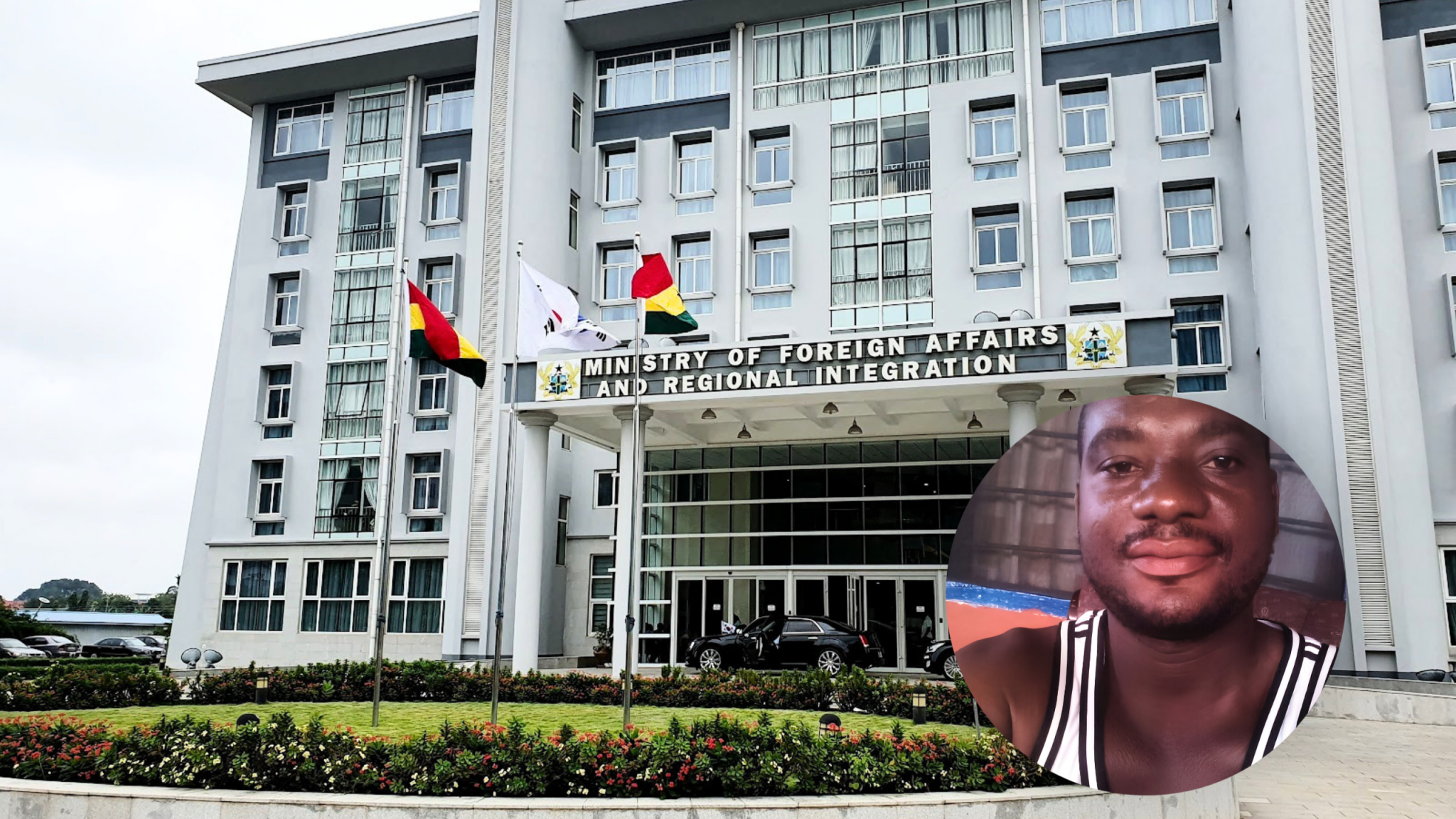
The Ministry of Foreign Affairs says it is introducing reforms to digitize the payment of fees for document attestation services offered by the Ministry to eliminate the human interface that is susceptible to extortion.
“Reforms are being pursued to make the payment process cashless, and digital platforms are being developed to anchor the entire attestation process and drastically reduce human interface,” it said in a statement.
The Ministry’s statement followed The Fourth Estate’s latest investigation, which exposed how applicants for document attestation services at the Ministry are being fleeced to pay exorbitant fees for services between GHS 900 and GHS 1200 for services that should cost GHS 200.
The findings from the investigations have triggered a response from the Ministry of Foreign Affairs, which says the “reforms will produce desirable outcomes similar to what we have achieved with Passport Administration in Ghana.”
Ministry of Foreign Affairs commends Fourth Estate for its investigations on the attestation process.
We confirm that the gentleman engaged in the alleged nefarious activities is not a member of staff of our ministry and that he is facing sanctions, further investigation and… pic.twitter.com/Z7QsVOEP1B
The Ministry commended The Fourth Estate for the investigation and said the findings would help improve governance and accountability.
However, the Ministry insists it does not tolerate middlemen or third-party facilitators in attestation services. It says any such practice runs against its own standards of integrity and transparency.
The statement placed the blame squarely on what it called unscrupulous middlemen. It says these individuals who take advantage of vulnerable citizens have no official link with the Ministry.
“We reiterate that the parliamentary approved fees for attestation is GHS200 which is collected by officials of the Controller and Accountant-General who issue the appropriate receipts,” it said. “No one should engage the services of middlemen — it is strictly illegal. Citizens with relevant information, enquiries or complaints are encouraged to call: +233 240913284/ +233 240793072.”
Middleman sanctioned, reported to police
The Ministry confirmed that the man implicated in the investigation has been sanctioned. It said he has been reported to law enforcement for further investigation and prosecution.
“The said gentleman has also been prohibited from entering the premises of the Ministry of Foreign Affairs,” the statement said.
The Ministry had told The Fourth Estate during the investigations that Michael Gomeh, the man who demanded GHS 900 from its undercover, to facilitate a fraudulent attestation, was not its employee.
However, The Fourth Estate found that Mr Gomeh is in fact a staff member seconded to the Ministry from National Security.
The statement does not name Mr Gomeh or say which institution has sanctioned him.
Reforms promised
The Ministry said it has been working on reforms to its consular and attestation services even before the investigation. It said it is moving toward a cashless payment system. It also said digital platforms are being built to reduce human contact in the attestation process.
The Ministry reiterated that the approved fee for attestation is GHS200. It also said this fee is collected only by officials of the Controller and Accountant General, who issue proper receipts.
The statement noted that the attestation process involves several institutions across different arms of government. It said work has been ongoing for months to improve coordination and credibility across these institutions.
Unanswered questions remain
The Ministry’s statement does not address how forged documents were successfully attested during The Fourth Estate’s undercover test. It also does not explain why front desk staff routinely directed applicants to unofficial facilitators inside the building.
Background
Ghana’s Ministry of Foreign Affairs charges GHS200 for attesting and validating travel documents, a service some embassies require before they process visa applications.
But The Fourth Estate investigation found applicants were paying far more than that, sometimes as much as GHS1,200, through unofficial middlemen operating inside the Ministry itself.
The investigation focused on document validation needed for certain embassies in Ghana, including the Egyptian Embassy, which since October 2025 has required bank statements and invitation letters to be validated by the Ministry before granting visas.
Victims said front desk staff at the Ministry routinely directed them to men in suits inside the building who offered to speed up the process for a fee.
To test this, The Fourth Estate reporter went undercover with a forged invitation letter for an event in Egypt.
The receptionist referred the reporter to Michael Gomeh, who wore a Ministry staff tag.
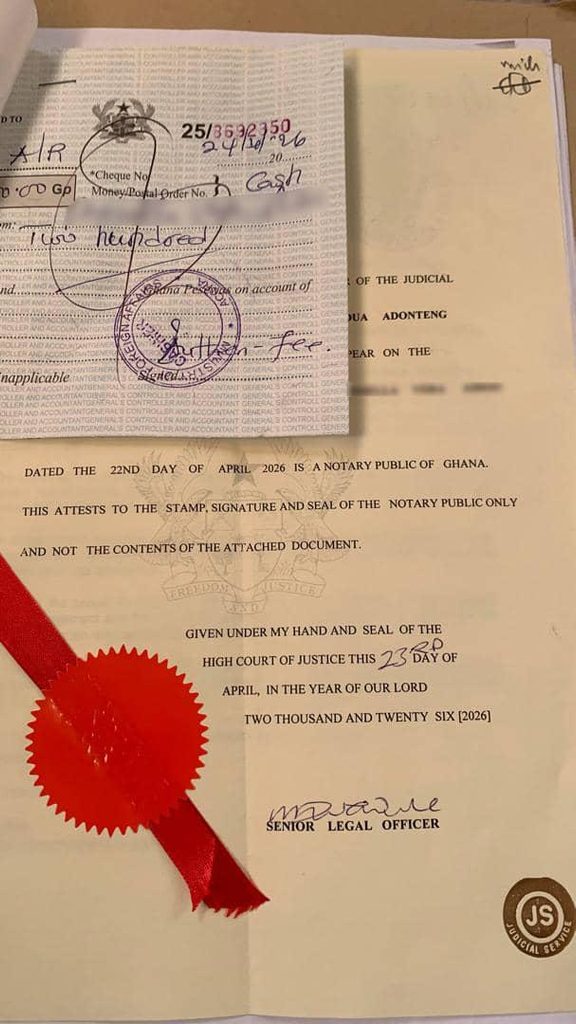
Gomeh charged GHS900 to handle the attestation. A week later, the reporter received validated documents along with an official receipt showing only GHS265 had been paid.
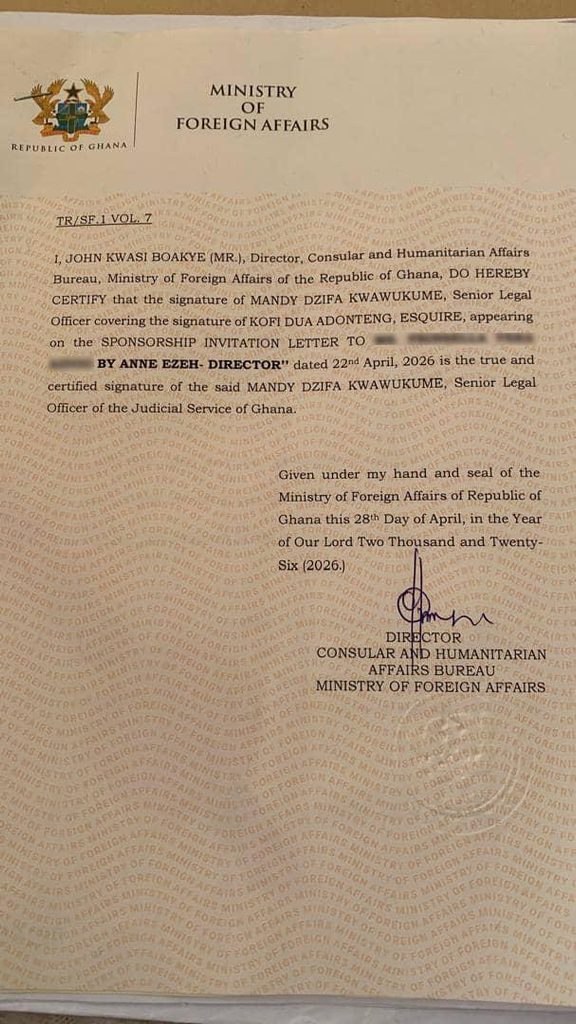
Despite using forged paperwork, the documents came back endorsed on official Ministry letterhead, signed by the Director of the Consular and Humanitarian Affairs Bureau.
In January 2025, when President Mahama explained why the Information Ministry had been placed under the Office of the President, he said it was part of the strategy to downsize and to ensure easy access to government information.
“That’s how come we have the minister in charge of government communications,” he said. “And then [we are going] to make sure we are able to anchor it with a string of strong communication professionals in the most critical sectors so that we are able to guarantee as much information flow to the public as possible.”
The government’s promise to ensure access to information was anchored in the NDC’s resetting agenda manifesto, which stated that they will be “fully implementing and operationalising the Right to Information Act, 2019 (Act 989).”
But about 17 months after coming into power, The Fourth Estate has observed a trend of critical public institutions denying journalists and the public access to information.
The Fourth Estate has counted 21 institutions, including the Ministry of Finance, the Office of the Attorney-General and Minister of Justice, the Ministry of Roads and Highways, and the Ministry of Lands and Natural Resources, that are flouting the Right to Information Act in their reluctance or sheer refusal to release information to the public.
The RTI law, passed in 2019 after sitting on the shelves of Parliament for about 20 years, enjoins public institutions and officers to release information to citizens, as it is a fundamental and constitutionally guaranteed right with limited exception.
The list of public institutions that denied access to information
From January 2025 to July 2026, 21 government institutions failed to release information to journalists from The Fourth Estate in 24 separate RTI requests.
In June 2025, The Fourth Estate requested information from the Ministry of Local Government, Chieftaincy and Religious Affairs on the full list of dumpsites Zoomlion Ltd. was said to have excavated through a multi-million-cedi contract with the government. The ministry failed to respond despite an internal appeal to the then minister, Ahmed Ibrahim.
In the same month, the Ministry of Lands and Natural Resources failed to release information on the list of companies President Akufo-Addo had granted permits under the LI2462 to mine in forest reserves that had been designated as globally significant biodiversity areas.
In September 2025, the National Communications Authority (NCA) refused to release information on how much KGL Technologies had received through its USSD platform for the 5/90 online lottery. The information was necessary for The Fourth Estate’s investigations into the terrible NLA-KGL deal, but the NCA did not budge.
In March 2026, the Ghana Highways Authority (GHA) promised that it would make available copies of the government’s flagship Big Push project in two weeks. But after five months, the GHA appears to have reneged on its promise. The Fourth Estate, through the Media Foundation for West Africa (MFWA), has submitted a petition to the RTI Commission for a review.
The GHA, in May 2026, again failed to release information on abandoned prefabricated bridges Ghana procured through a 43 million-pounds loan, despite an internal appeal to the Acting Chief Executive Officer, Mallam Issah Ishak.
The Finance Ministry oversees fund disbursement to all government institutions, but when The Fourth Estate requested information on its budgetary allocations and disbursements in April 2026, it chose not to respond. An internal appeal has been sent to the minister, Cassiel Ato Forson. Still, the Ministry has failed to provide the information.
The Finance Ministry has also decided to close the door on information on the details of the work of the technical committee established by President Mahama to investigate the NLA-KGL contract. In May 2026, an application requesting a copy of the full report of the committee was sent to the Office of the Attorney-General and Minister of Justice. The Attorney-General’s office said the MFWA should check with the Office of the President. The Office of the President, in turn, said the MFWA should contact the Finance Ministry for it. But the Finance Ministry has gone quiet, despite a follow-up appeal to the Minister.
The Attorney-General’s office has also refused to disclose information on how much the state has recovered from the Republic vs. Kwabena Duffour and 7 others case. An appeal has been sent to Attorney-General Dr Dominic Ayine, but that has changed nothing.
(The full list of public institutions denying access to information under the Mahama administration is at the bottom of the story)
Experts call for sanctions
Anti-corruption and Right to Information activists have called for sanctions against public institutions that deliberately deny access to information to journalists under the RTI law.
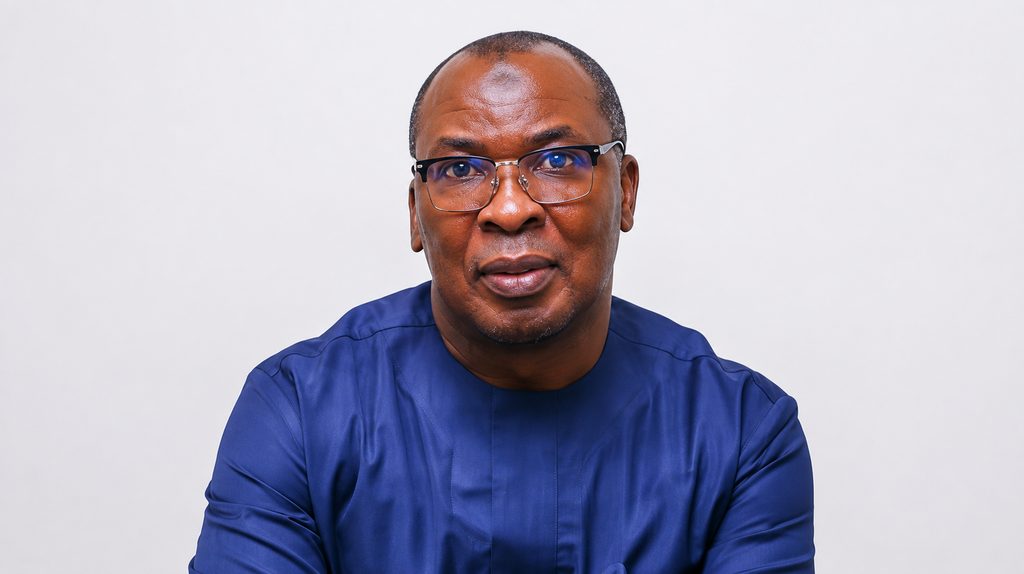
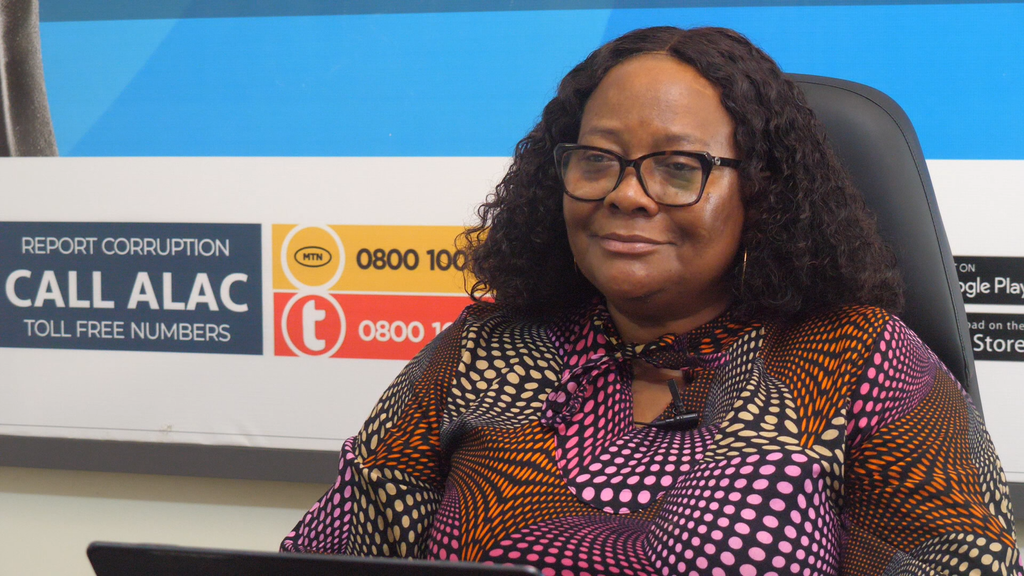
Zakaria Tanko Musa, private legal practitioner, and Mary Awelana Adda, Executive Director of Transparency International Ghana
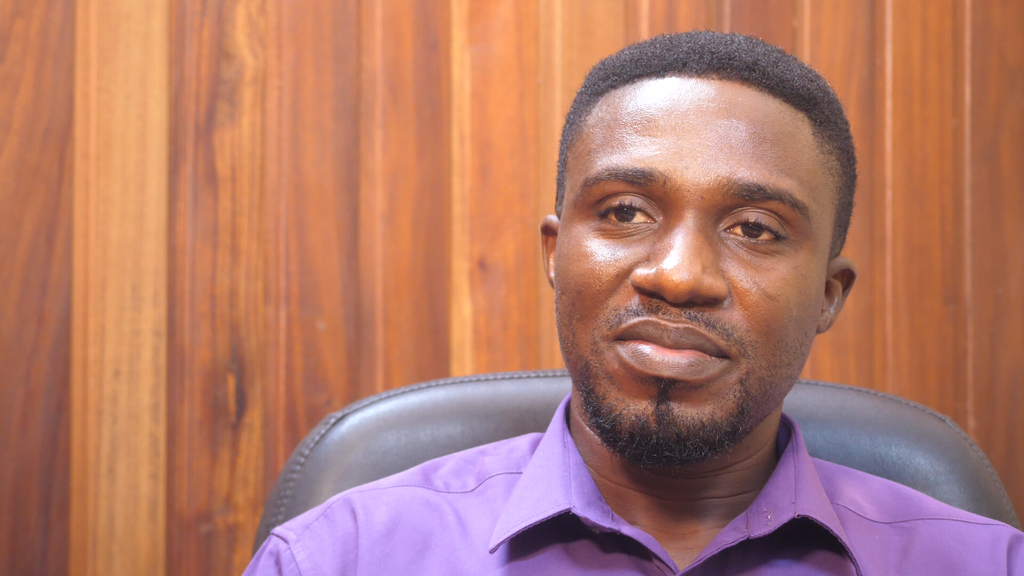
For Zakaria Tanko Musa, a private legal practitioner and media lecturer, journalists do not ask for information for their own sake but for public scrutiny. Therefore, to deny journalists access to information that is not exempt under the RTI law is to deny the public access to information they need for informed decision-making.
“Failure or refusal to release information should come with consequences,” he said. “Unfortunately, those are the things that are lacking, and that is why we are seeing the ignoring of the [request for] information with impunity.”
The Executive Director of Transparency International (TI) Ghana, Mary Awelana Adda, also believes that cracking the whip can cause a change.
“If sanctions are meted out, then people will comply. Then the bureaucracy and the unnecessary red tape will be reduced,” she said at the launch of TI Ghana’s report on access to information in June.
Government says it is committed to transparency, despite tall list of information denials
Despite what appears to be a deliberate attempt by many public institutions to deny access to information, Felix Ofosu Kwakye, Minister in charge of Government Communications, in response to a request for a comment, insisted that the government is committed to openness, transparency, and accountability.
Felix Ofosu Kwakye, Minister in charge of Government Communications
“As a government, there’s no policy of concealment,” he noted. “We do not have a policy that says that various government agencies in various sectors should conceal information because we are uncomfortable or anything.”
Mr. Ofosu Kwakye also cautioned that there are instances where the information being requested may be exempted under the law, in which case the government is restricted from divulging it.
“We believe that the law has inbuilt mechanisms to provide remedies for persons who are aggrieved by the conduct of public institutions regarding their unwillingness, or if you like, inability to disclose information that is requested for,” he said.
He reiterated that the government is committed to working with any institution to ensure a smoother implementation of the RTI law.
What should cost GHS200 at Ghana’s Ministry of Foreign Affairs is allegedly costing desperate visa applicants as much as GHS1,200 through unofficial middlemen.
An investigation by The Fourth Estate found that applicants seeking attestation and validation of documents at the Legal Department of the ministry – a requirement for some visa applications – were being routed to individuals charging fees inflated far above the official rate under the guise of providing expedited services.
“The receptionist directed me to a man in a suit claiming to be in the legal department to work on my documents,” a victim of the scheme says. “He charged me GHS1,000 and told me that my documents would be ready in a week. But when I got my documents, only a GHS200 receipt was issued.”
The investigation focused on document attestation services required by some embassies in Ghana, including the Egyptian Embassy, which, as of October 2025, required visa applicants to have bank statements and invitation letters validated through the Foreign Affairs Ministry.
Victims told The Fourth Estate that applicants arriving at the ministry were routinely directed by front-desk staff to “men in suits” within the ministry, who offered to “facilitate” the process.
To test the claims, The Fourth Estate sent a disguised reporter to the ministry with a forged invitation letter to attend an event in Egypt.
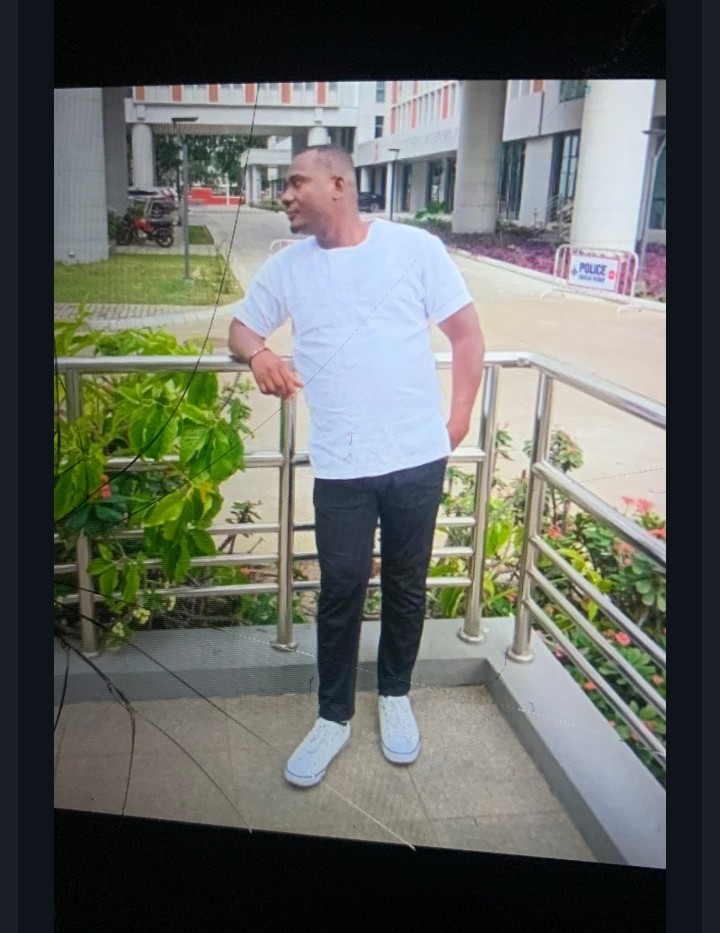
Michael Gomeh posing for a photo at the premises of the Foreign Affairs Ministry
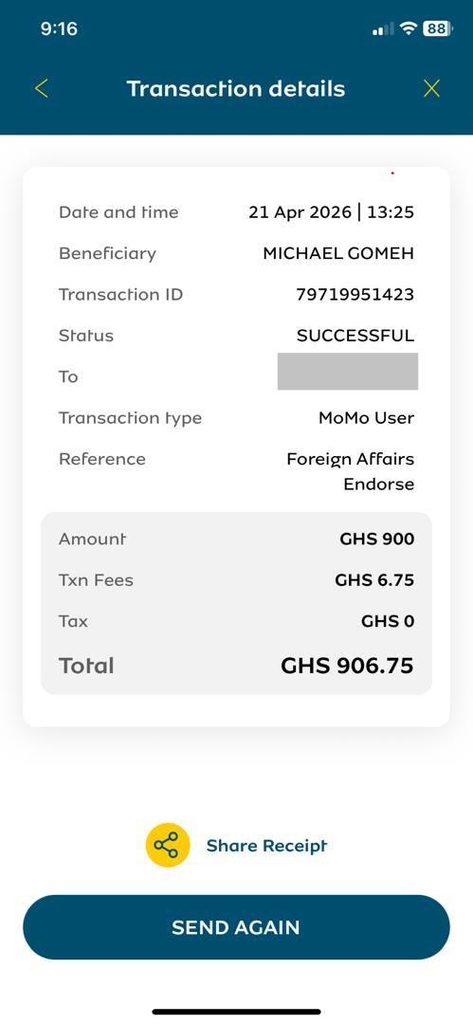
At the front desk, the receptionist referred the applicant to one Michael Gomeh, who ostensibly wore a staff tag of the Foreign Affairs Ministry. Mr Gomeh charged our applicant GHS900 to facilitate the attestation of the visa application documents. The validated documents were eventually delivered within a week, accompanied by an official receipt showing a payment of just GHS265.
Evidence of payment made to Mr Michael Gomeh of the Foreign Affairs Ministry
Even with forged documents, the undercover applicant still received endorsed papers on the official letterhead of the Ministry of Foreign Affairs, signed by John Kwasi Boakyi, the Director of the Consular and Humanitarian Affairs Bureau.
Attestation from the Ministry of Foreign Affairs
The findings appeared to confirm allegations that unofficial charges were being imposed on applicants while only the approved fee was formally receipted.
Ministry distances itself from unofficial payments
The Ministry, in a letter dated May 12, 2026, and signed by Audrey Naana Abayena, Director of Legal and Treaties Bureau, said the approved fee for attestation and validation services remained GHS200 under the Fees and Charges Regulations, 2025.
“Any payment made to unauthorised persons, intermediaries, facilitators, or third parties was neither sanctioned nor recognised by the ministry,” the letter stated.
The ministry also acknowledged receiving complaints about excessive charges and said preliminary investigations suggested many of the incidents involved “third parties”. It further said it had introduced safeguards, including the publication of approved fees, issuance of official receipts, and complaint channels for reporting suspected misconduct.
In another letter to The Fourth Estate dated August 7, 2026 and signed by Chief Director Khadija Iddrisu, for the Minister, the Ministry of Foreign Affairs explained that the primary responsibility for confirming the authenticity of a document rests with the issuing authority, and the Notary Public or Commissioner of Oaths.
The documents, the ministry said, are subsequently forwarded to the Judicial Service for attestation of signatures and seals affixed by the Notary Public or Commissioner of Oaths.
“The Ministry’s attestation process only goes to verify the genuineness of the seals and signatures affixed by the Judicial Service to the document submitted to the Ministry for attestation,” the letter stated.
The Ministry also stated that Mr Michael Gomeh is not their employee. But The Fourth Estate, through its engagement with the Ministry, realised that he is a staff member seconded from the National Security.
The Ministry says that it convened a consultative meeting on August 6, 2026, with stakeholders to harmonise data-sharing and establish a cross-institutional verification network. The meeting, according to the Ministry, was held among institutions including the Judicial Service, Ghana Police Service, the Birth and Death Registry, Office of the Registrar of Companies, and the Accra Metropolitan Assembly.
Still, the investigation leaves troubling questions unanswered.
How were phony documents successfully endorsed? Why were applicants being openly redirected to unofficial facilitators from within ministry premises? And how did a fee of GHS200 evolve into a lucrative underground operation charging applicants up to five times the approved amount?
Systemic failures
Anti-corruption advocates say the situation points to deeper systemic failures.
Commenting on The Fourth Estate’s findings, Mary Awelana Addah, the Executive Director of Transparency International, Ghana, said, “No citizen should be compelled, directly or indirectly, to pay unofficial fees to access public services.”
She questioned where the excess money collected from applicants was going and warned that the allegations suggested possible collusion, abuse of office, and breaches of public trust. She called for tighter supervision, stronger internal controls, and clearer public communication on official charges.
***
The reporter, Prinsella Vera Aidoo, is a 2026 Fellow of the Next Generation Investigative Journalism Fellowship (Cohort 8) at the Media Foundation for West Africa.
For five years, The Fourth Estate has pursued one simple mission: to investigate matters of public interest, expose wrongdoing and help citizens hold power to account.
Now, we are opening a new chapter by launching The Fourth Estate Membership Programme. Members are a community of people who believe that independent, public-interest journalism is worth sustaining.
Since our launch in 2021, our investigations have helped put accountability issues firmly on the national agenda. Our reporting and campaigns have contributed to hundreds of public officials complying with asset declaration requirements; cancellation or review of controversial multi-million contracts; and reforms to many sectors including the administration of government scholarships and the National Service Scheme enrolment and management.
We have also investigated questionable public procurement, destruction of forest reserves, misuse of state resources and other issues affecting the lives of ordinary Ghanaians.
Behind these stories is a team of journalists, activists and advocates committed to following the evidence wherever it leads.
But journalism like this requires a community that believes and supports it. So as we look to the future, we want to build a broader community of people who value independent journalism and want to play a part in keeping it strong.
Members can contribute in diverse ways and will have access to benefits including a members-only newsletter, early access to selected investigations, support in using Ghana’s Right to Information law, and The Fourth Estate Connect, a network of members, journalists and changemakers.
The membership is really not about the benefits. It is about standing behind journalism that asks difficult questions, investigates how public resources are used and insists that those entrusted with power remain accountable.
“The Fourth Estate was created because we believed Ghana needed a newsroom that could devote itself to accountability journalism without being driven by commercial or political interests. Five years on, that need has become even more important and we have to keep it going,” said Sulemana Braimah, Executive Director of the Media Foundation for West Africa.
Join us now and be part of The Fourth Estate. Click here to join our community.
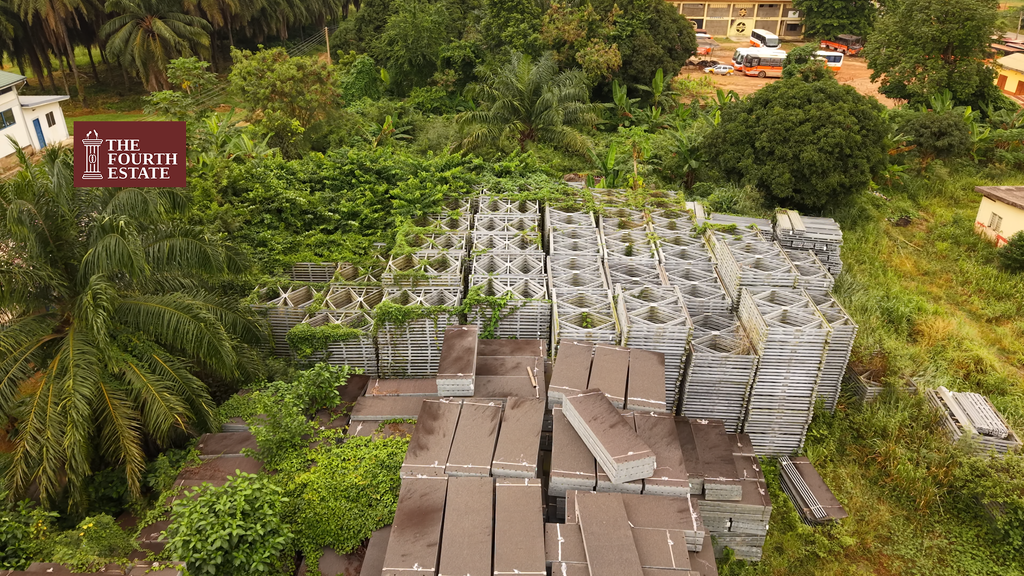
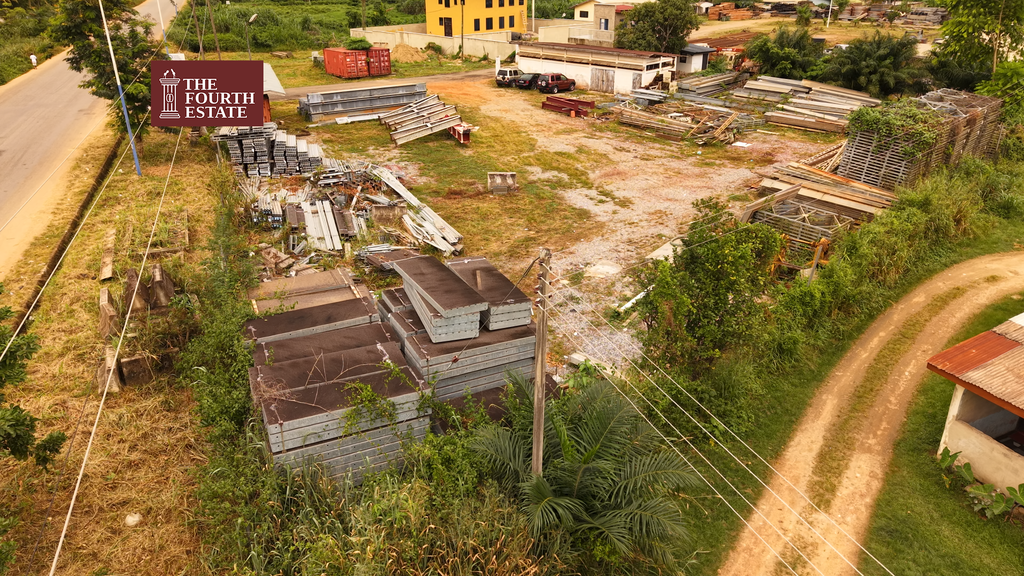
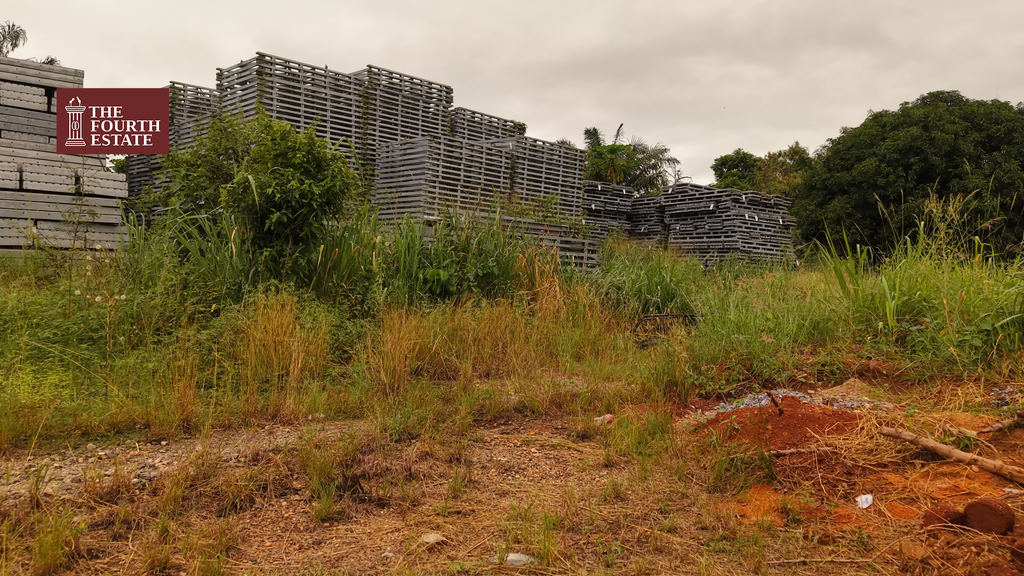
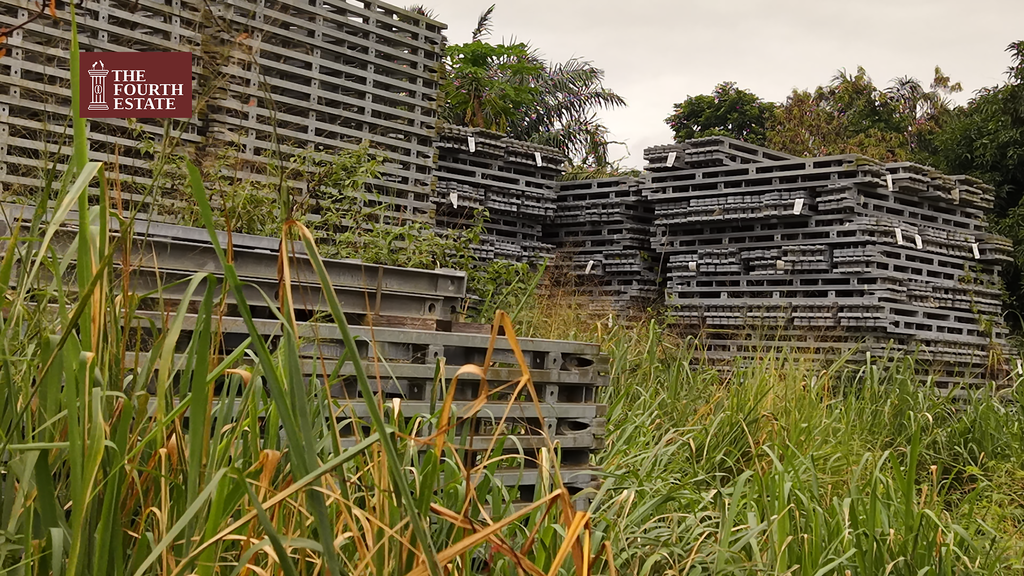
Prefabricated components capable of constructing at least 25 bridges have been left unused at two government facilities in the Eastern Region, an investigation by The Fourth Estate has found.
The steel components form part of 89 prefabricated bridges procured through a £43m loan approved by Parliament in 2020.
The bridges were intended to reconnect isolated communities, reduce travel times and improve access to schools, farms, markets and health facilities.
Prefabricated bridge components abandoned at the Road Safety Authority’s office in Koforidua.
Instead, components for about 20 bridges remain stacked at the National Road Safety Authority’s office in Koforidua, while parts for another five are being kept at the Ghana Highway Authority’s Bridge Management Unit in Kukurantumi.
Prefabricated bridge components abandoned at the Ghana Highway Authority’s Bridge Management Unit in Kukurantumi in the Eastern Region.
A source familiar with the project, who asked not to be identified, said only 15 of the 89 bridges had been installed across the country.
That leaves questions about the location and status of the remaining 49 bridges, including whether all the components have been delivered to Ghana.
Prefabricated bridge components abandoned at the Road Safety Authority’s office in Koforidua.
The Fourth Estate submitted a request to the Ghana Highway Authority on June 8, 2026, seeking details of how many prefabricated bridges had been received and where they had been installed.
The Authority has not yet provided the information. It has also not responded to our request for comment.
The Ministry of Roads and Highways, which oversees the Ghana Highway Authority, was also asked for an interview on July 22, 2026. It had not responded at the time of publication.
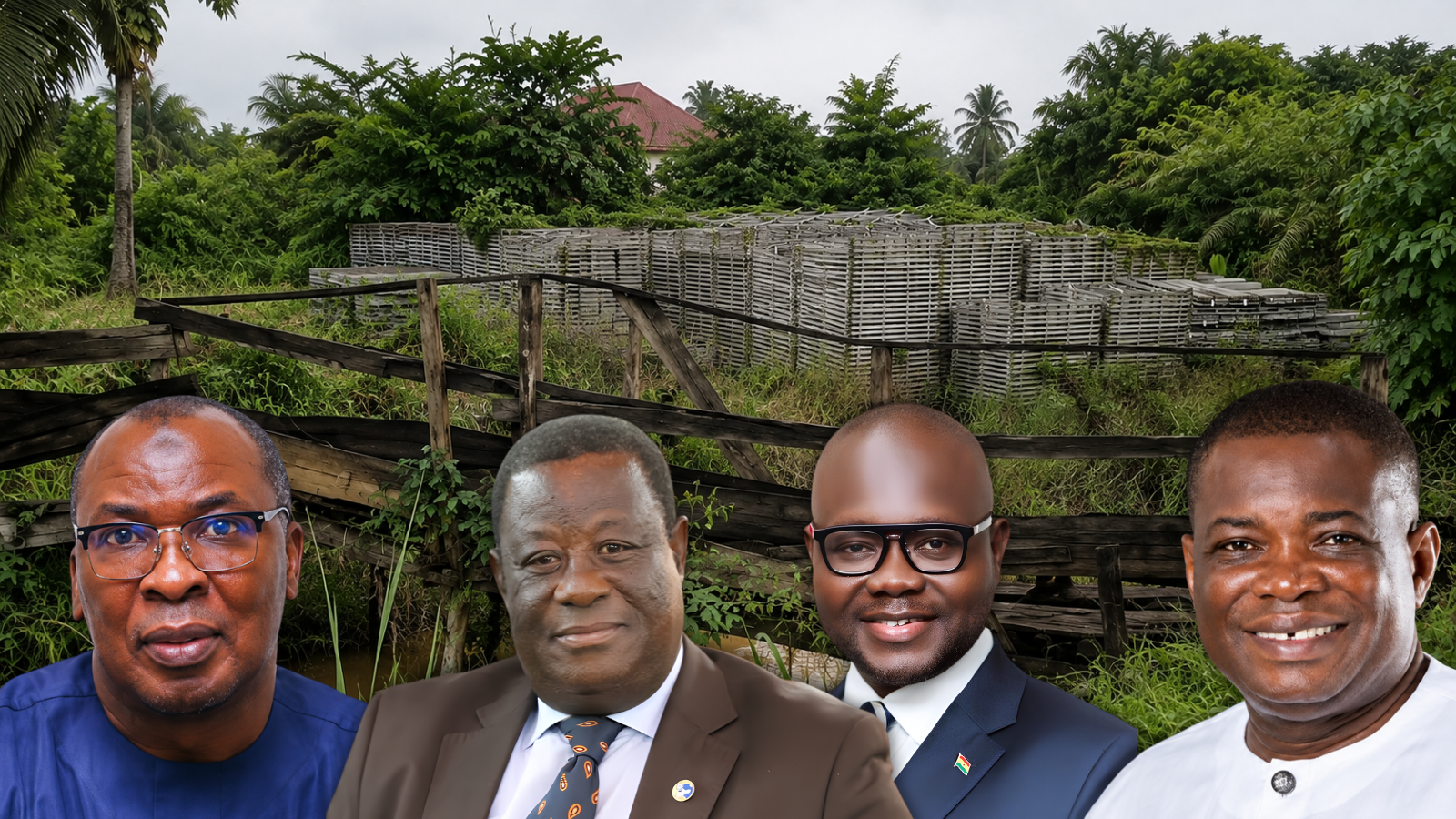
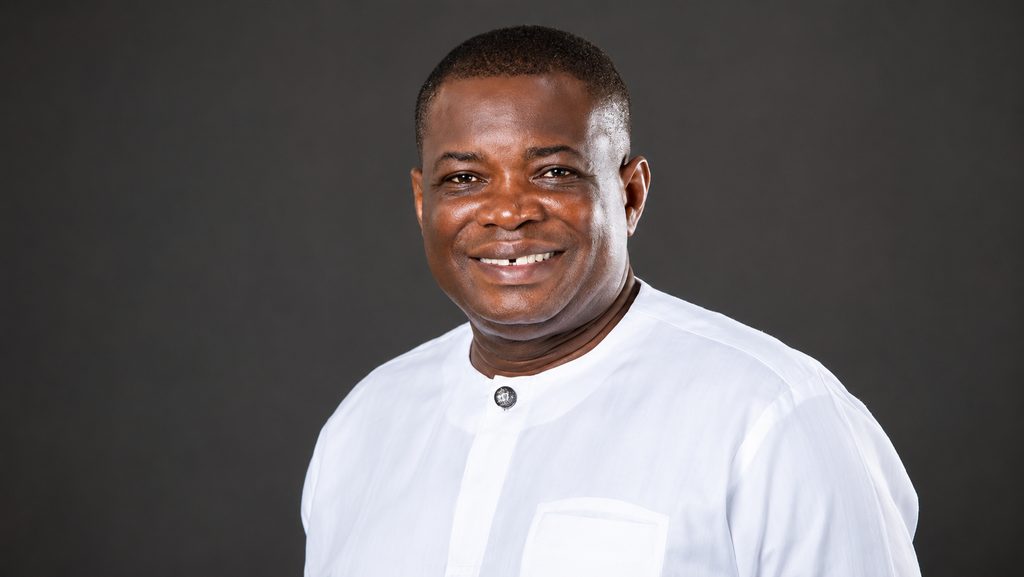
Minister of Roads and Highways, Kwame Governs Agbodza
The unused components remain in storage as people in several communities continue to cross rivers and streams without permanent bridges – putting their lives at risk.
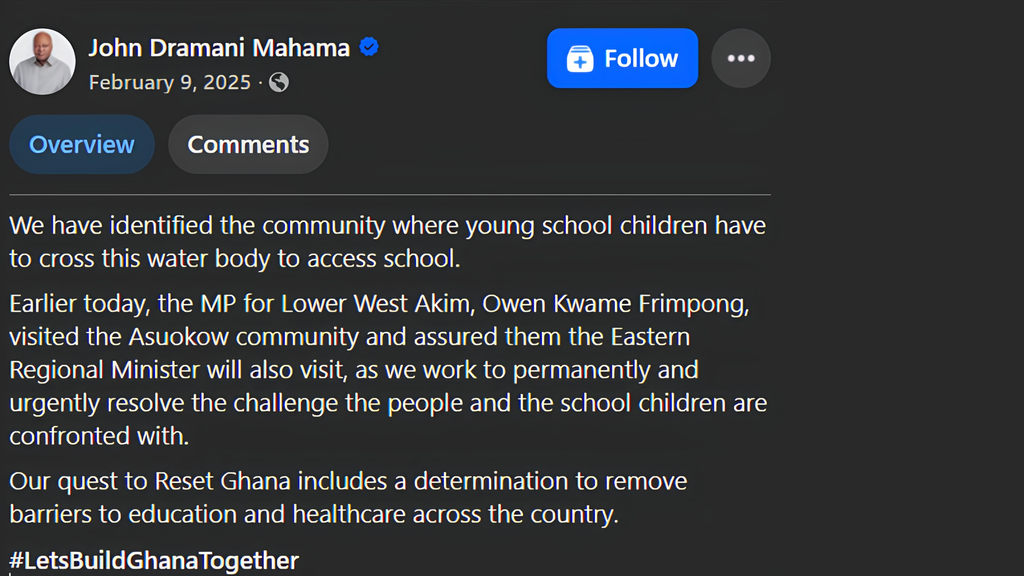
In February 2025, President John Mahama promised to construct a bridge for Asuokaw in the Eastern Region after a video showing a schoolboy carrying a younger pupil across the Ayensu River was widely shared online.
A Facebook post by President John Dramani Mahama
A month and two days after taking office, the President said on Facebook that his administration was working to “permanently and urgently resolve the challenge the people and the school children are confronted with.”
In Neberehi in the Ashanti Region, residents have also been demanding a bridge across the Offin River.
In 2018, a resident, Haruna, lost his father and brother after their boat capsized while they were travelling to their farm.
Residents say a bridge is needed to protect schoolchildren and farmers who regularly cross the river.
Ngleshie Amanfro has experienced similar incidents.
In 2024, two people drowned while attempting to cross the Agyei River. One was a seven-year-old boy who was swept away while returning from an errand. An adult had died in similar circumstances a few months earlier.
Residents said a makeshift wooden bridge they had built was later washed away, leaving the community without a safe crossing.
The Executive Director of Transparency International Ghana, Mary Addah, questioned why infrastructure intended to save lives had been allowed to remain unused.
“Is there no supervising engineer who was supposed to ensure that these prefabricated bridges which were procured are put in the right places?” she asked.
Executive Director of Transparency International Ghana, Mary Addah
Mrs Addah also questioned whether a change of government had disrupted the project.
“Is it because there was a change of government and for that matter, the process truncated? And if it’s truncated, haven’t we gone over 16 months?” she asked.
She called for an investigation into the procurement and the reasons the bridge components had not been installed.
A civil engineer, Sampson Agudze, who has more than 15 years of experience, said the bridges could have been installed if the project had been treated as a priority.
Civil Engineer, Sampson Agudze
“It can be between 6 months to one year. But it can still even be three months,” he said.
However, Mr Agudze said the components should first be inspected before any installation begins.
“First of all, the government needs to get a team to do inventory. To confirm whether the parts that have been delivered are intact,” he said.
Such an assessment would establish whether all the necessary components remain available and whether years of storage have affected their structural integrity.
The prefabricated bridges were procured to make journeys safer for communities divided by rivers and streams. But while steel components remain unused in government yards, residents continue to rely on boats, temporary wooden structures or dangerous crossings on foot.
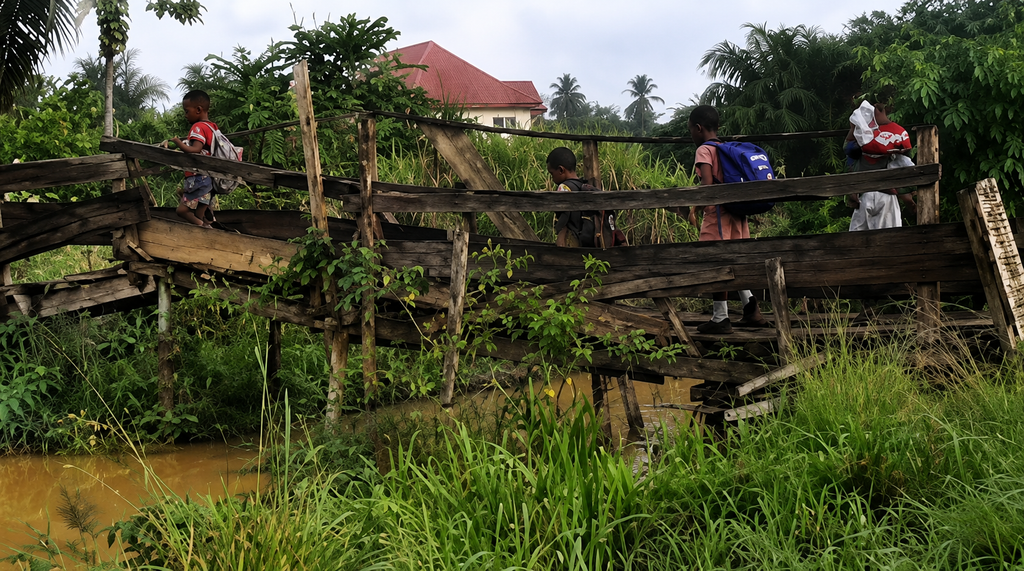
School children crossing a dilapidated wooden bridge in Owenso near Ankwa Doboro Nsawam Adoagyiri in the Eastern Region.
Until the components are installed in the communities they were intended to serve, the promise of safer travel will remain unfulfilled.
The Media Foundation for West Africa (MFWA) has dragged the Controller and Accountant General’s Department (CAGD) to the Right to Information Commission (RTIC).
This is because the CAGD has denied the MFWA’s investigative journalism project, The Fourth Estate, information on salary deductions paid into the Ghana Medical Trust Fund, known as Mahama Cares.
The Fourth Estate had asked the Department for information, including the names of appointees who lost three months’ salary for failing to declare their assets and the total amount paid by the defaulters to the State’s coffers.
The request was filed under Article 21 of the 1992 Constitution and Section 18 of the Right to Information Act, 2019 (Act 989).
In a response, the Deputy Controller in charge of Finance and Administration, Emelia Osei Derkyi, said the Department could not release the information.
Although she admitted the request was in the public interest, she was quick to add that the details of individuals affected were supplied to the Department in confidence.
She cited Section 11 of Act 989, explaining that the section protects information that would reveal financial or labour-related data given to a public body in confidence, adding that the disclosure could stop other institutions from receiving similar information in future.
Ms. Derkyi said releasing the names and figures paid could break the trust under which the information was given. She added that disclosure could hurt the interests the law was designed to protect.
“Accordingly, pursuant to Section 11(1)(d) of Act 989, the requested information is exempt from disclosure,” she wrote to The Fourth Estate.
She claimed the decision followed careful review of the law and the confidentiality tied to the information.
Background
President John Mahama announced the salary deductions in May 2025. He was speaking at the launch of a new Code of Conduct for his appointees.
The announcement followed a Fourth Estate investigation which revealed that fifty-five appointees and staffers had missed a March 31, 2025 deadline to declare their assets and liabilities. The deadline had been set by the President himself in February that year.
At the launch, Mr Mahama said all appointees who missed the deadline would lose three months’ salary. He said the money would go into a new fund named Mahama Cares. The fund was set up to support treatment for chronic illnesses. These include cancer, diabetes, heart disease, and kidney failure.
Mr Mahama also said appointees who missed the deadline would, in effect, pay four months’ salary. This included one extra month that all appointees were asked to donate voluntarily.
Mahama also warned that any appointee who still had not declared assets by May 7, 2025 would be dismissed.
He described the asset declaration regime as one of the most important tools against corruption. He said it was anchored in Article 286 of the Constitution and the Public Office Holders Act, Act 550.
The MFWA’s argument
The MFWA argued that Ghanaians have not been told how much money the Mahama Cares Fund has collected from defaulting appointees. They also do not know who among the fifty-five defaulters eventually complied, or how much each one paid.
The Fourth Estate’s April 2025 investigation had named several high-profile defaulters. These included Larry Gbevlo-Lartey, Special Envoy to the Alliance of Sahelian States; Nathan Kofi Boakye, Director of Operations at the Presidency; Charles Kipo, Director of the National Investigations Bureau; Nana Yaa Jantuah, a presidential staffer; Alhassan Suhuyini, Deputy Minister of Roads and Highways; Gizella Tetteh-Agbotui, Deputy Minister of Works and Housing; and John Dumelo, Deputy Minister of Food and Agriculture.
Without the requested data, it remains unclear whether the decision described by many as “punishment” announced by the President was actually enforced. It is also unclear how much has been raised for a fund meant to support ordinary Ghanaians battling chronic disease.
Meanwhile, the commission has acknowledged receipt of the petition.
When the Nana Addo Dankwa Akufo-Addo administration centralised property rate collection through a digital platform in 2023, the decision was hailed as an attempt to seal leakages, increase local revenue mobilisation and modernise a struggling system that assemblies had long battled to manage.
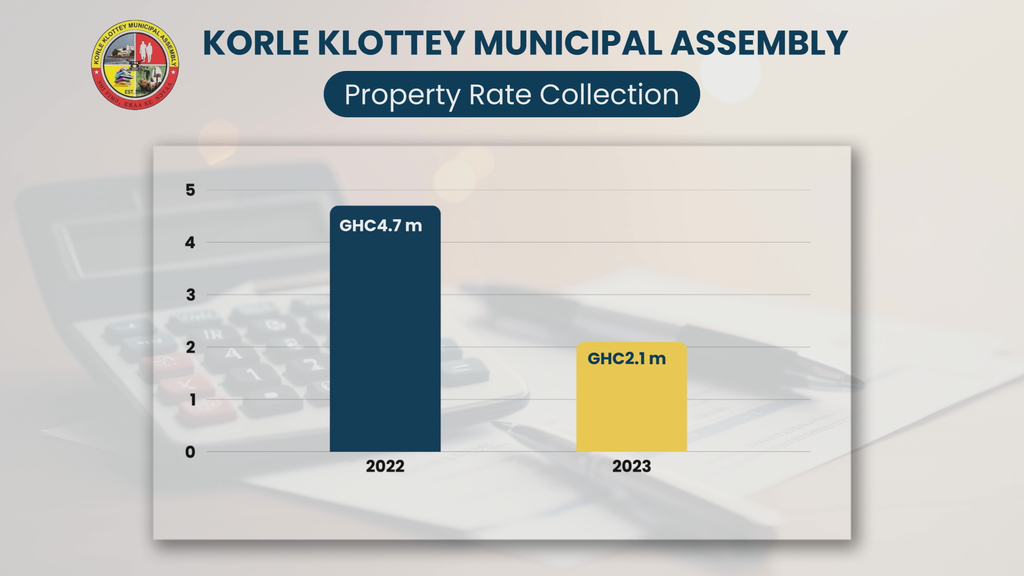
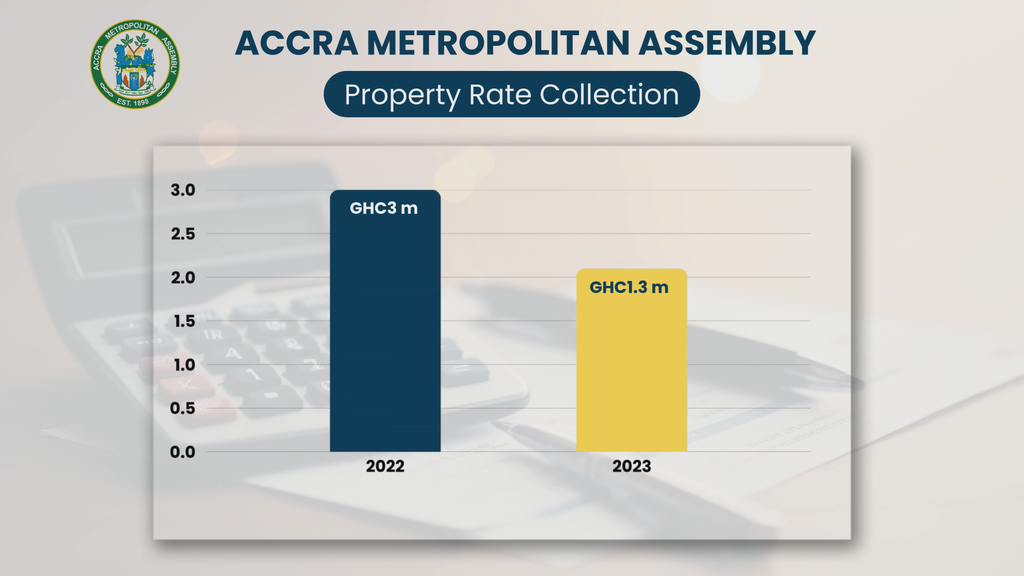
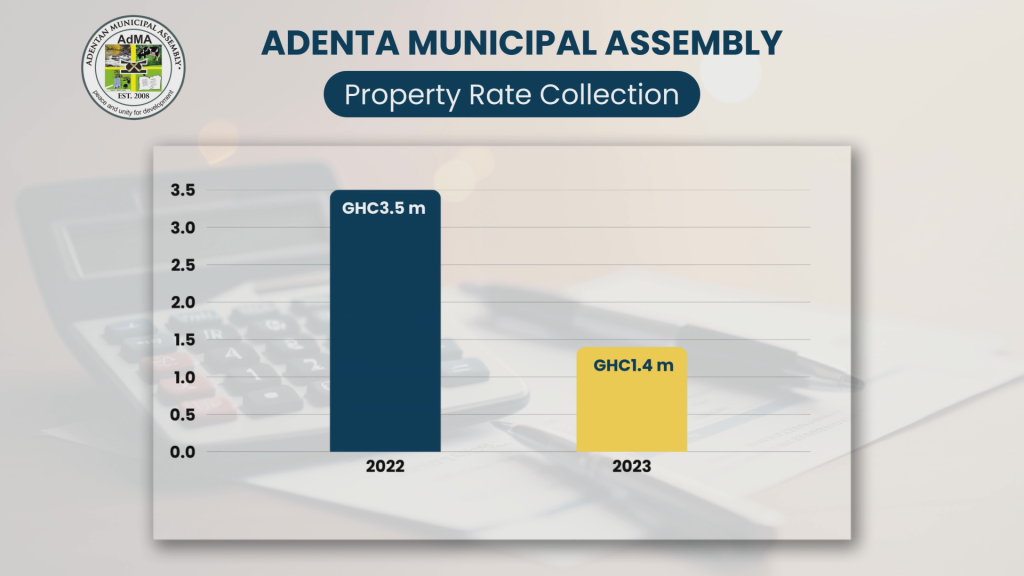
Instead, an investigation by The Fourth Estate has revealed that the policy caused a sharp decline in revenue collection across metropolitan, municipal and district assemblies (MMDAs), and raised questions over how much money was collected and transferred to the assemblies under the system.
The policy shifted responsibility for property rate collection from district assemblies to a centralised platform managed by a private company called Digital City Solutions.
Before the transition, some assemblies had already begun implementing their own digital property rate systems under a pilot programme funded by the German International Development Agency (GIZ). The Kumasi Metropolitan Assembly (KMA), for instance, had developed a property and business database to improve local revenue mobilisation.
But those initiatives were halted following the government’s directive.
“We started collecting property rates from commercial properties, but before we rolled out the residential part, we were asked to hand over to GRA,” Eric Nunoo, the KMA Deputy Director of Budget, told The Fourth Estate.
Eric Nunoo, KMA Deputy Director of Budget
Digital City Solutions, the company at the centre of the implementation of the new idea, was awarded the contract on May 16, 2022, roughly 10 months after it was incorporated.
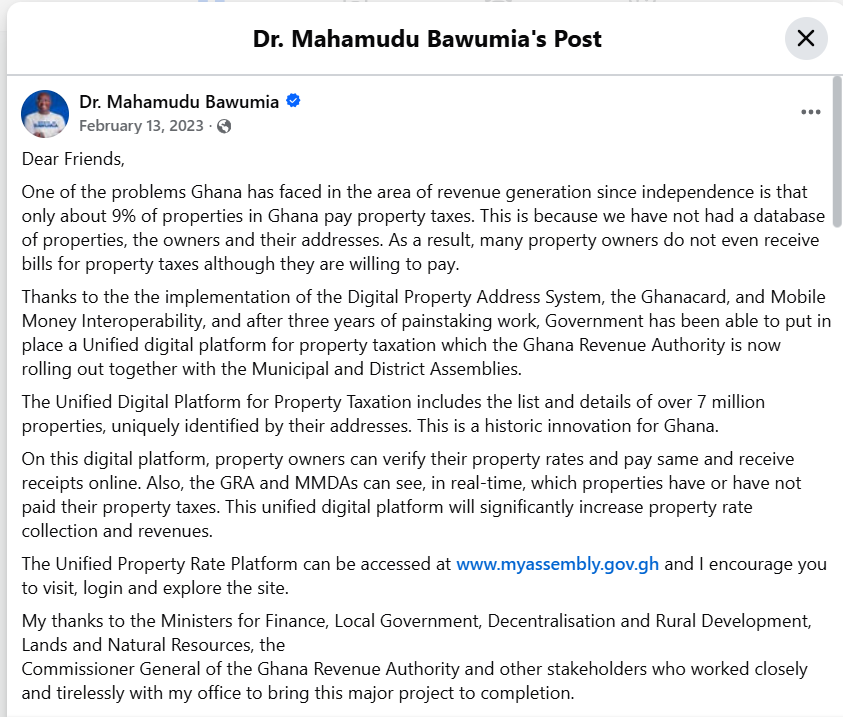
The then Vice-President Dr Mahamamudu Bawumia took to Facebook to announce the new digitalisation initiative to be known as the Unified Property Rate Platform.
The platform was expected to rely on a database of about seven million properties nationwide.
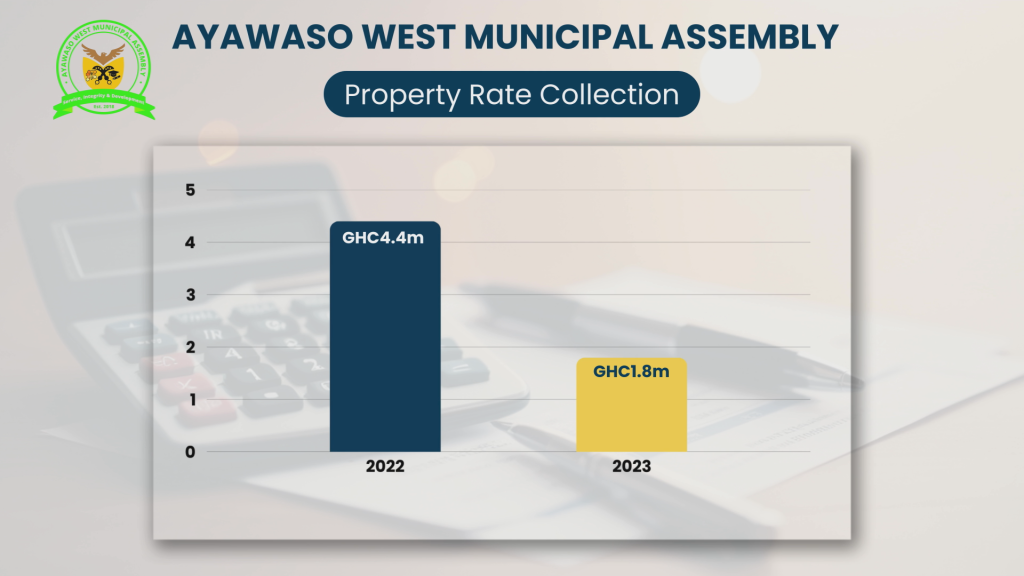
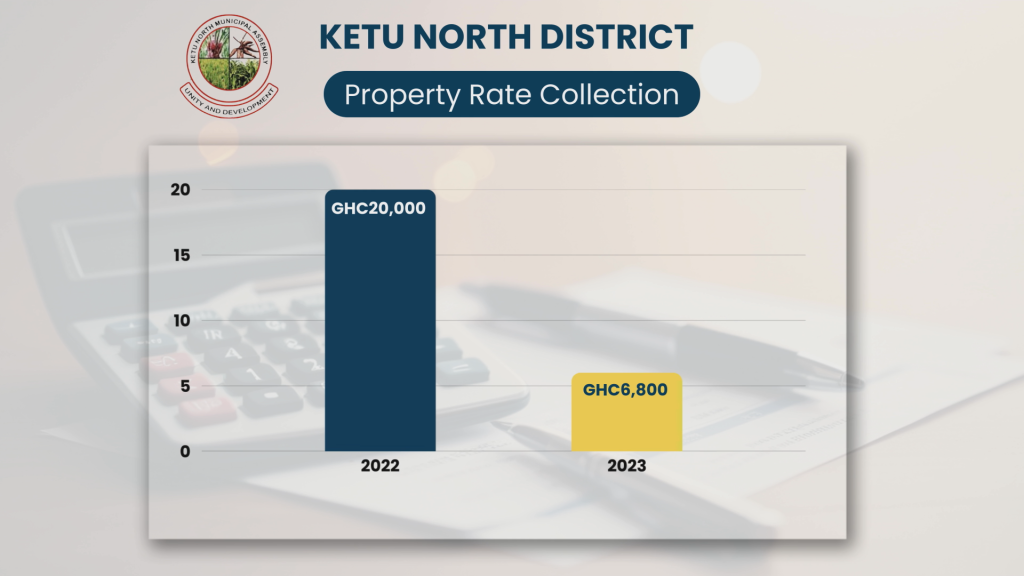
However, data obtained by The Fourth Estate through Right to Information requests from some assemblies showed that revenues dropped sharply after the centralised system took effect.
Officials at some assemblies said the figures were far below previous collections. Eric Nunoo, Deputy Director of Budget at KMA, said the assembly had received less than GHS 400,000 under the arrangement by the third quarter of 2023.
The revenue decline occurred even as some property owners reported significantly increased bills. A resident of Teshie-Nungua Estate, Emelia Quarshie, told The Fourth Estate her property rate jumped from GHC250 in 2022 to GHC850 under the new system.
“I feel cheated,” she said. “Other residents within the estate are also complaining.”
Despite mounting concerns from assemblies, the GRA publicly touted the programme as successful. However, several assemblies questioned why the reported collections were not reflected in transfers to them.
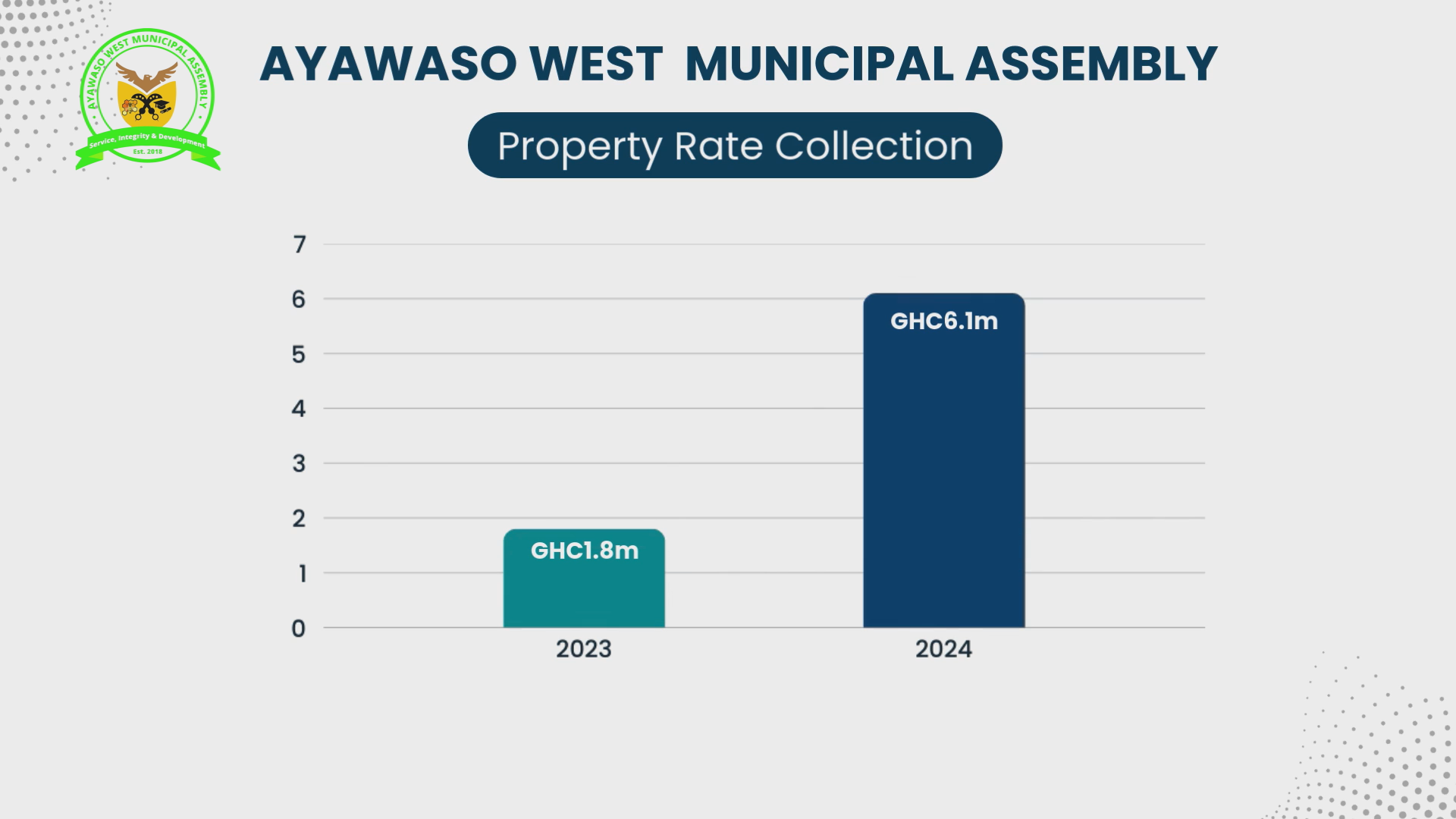
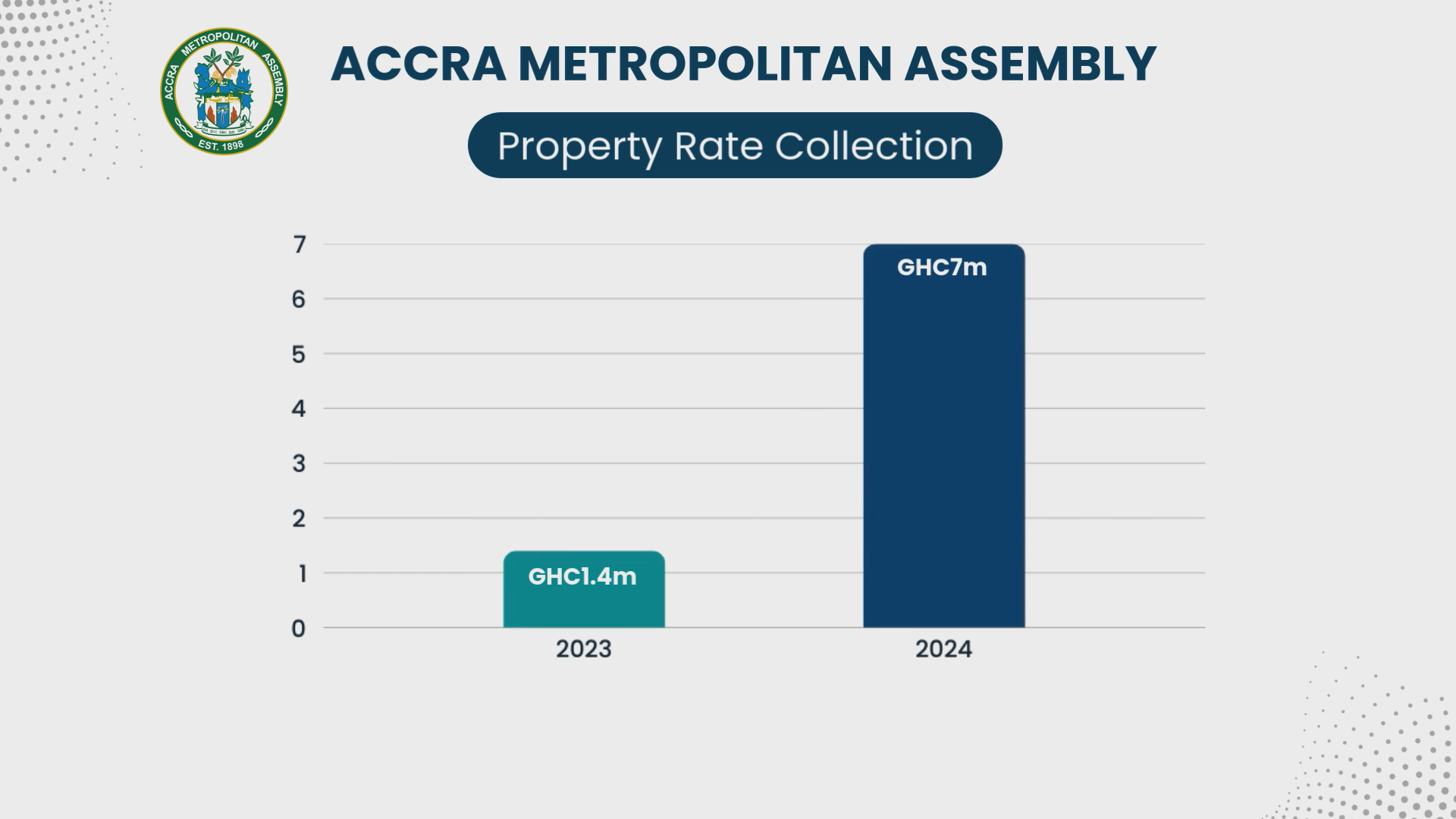
As frustrations intensified, assemblies publicly called for the reversal of the arrangement. The government eventually returned the responsibility for property rate collection to the assemblies.
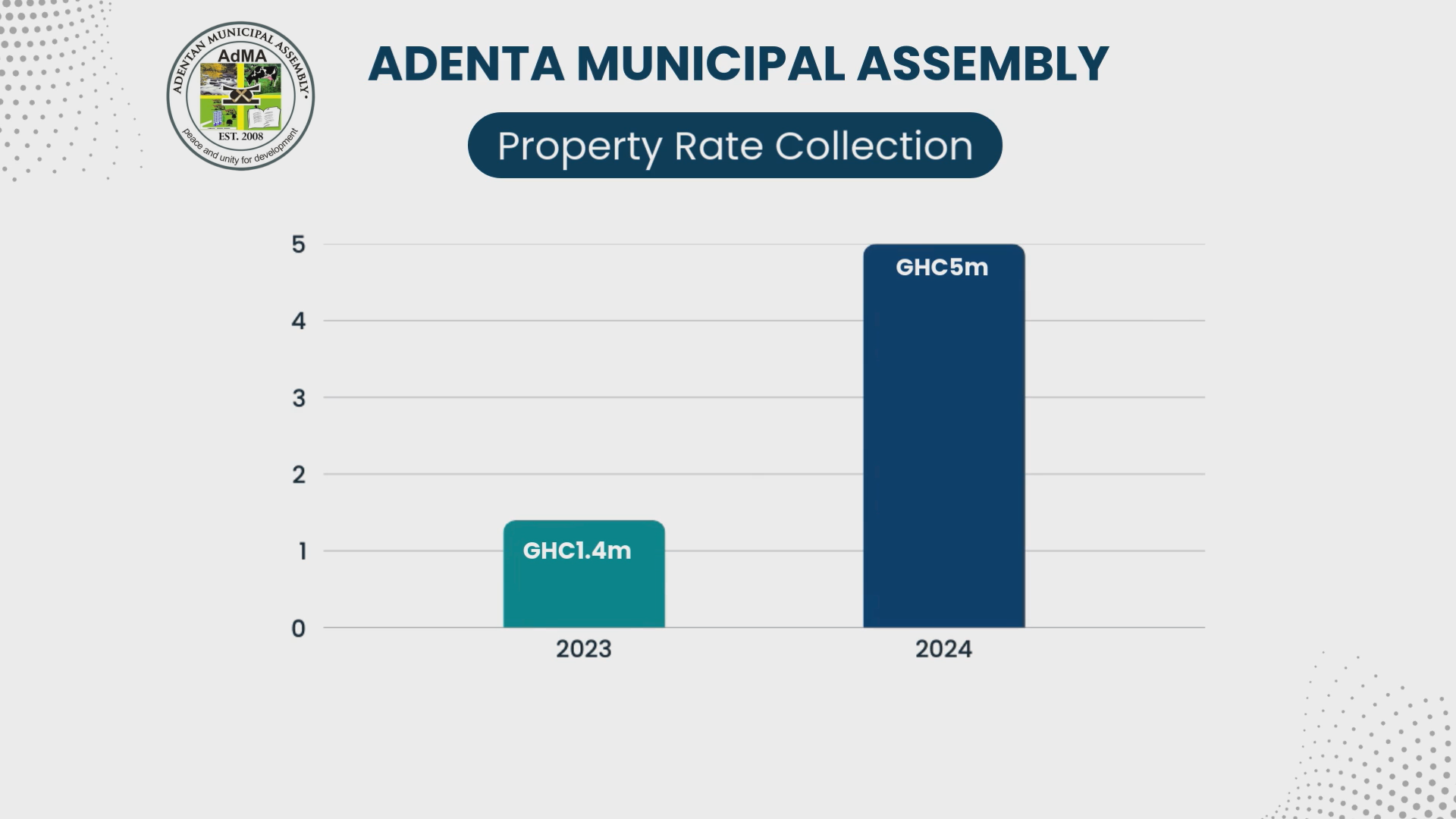
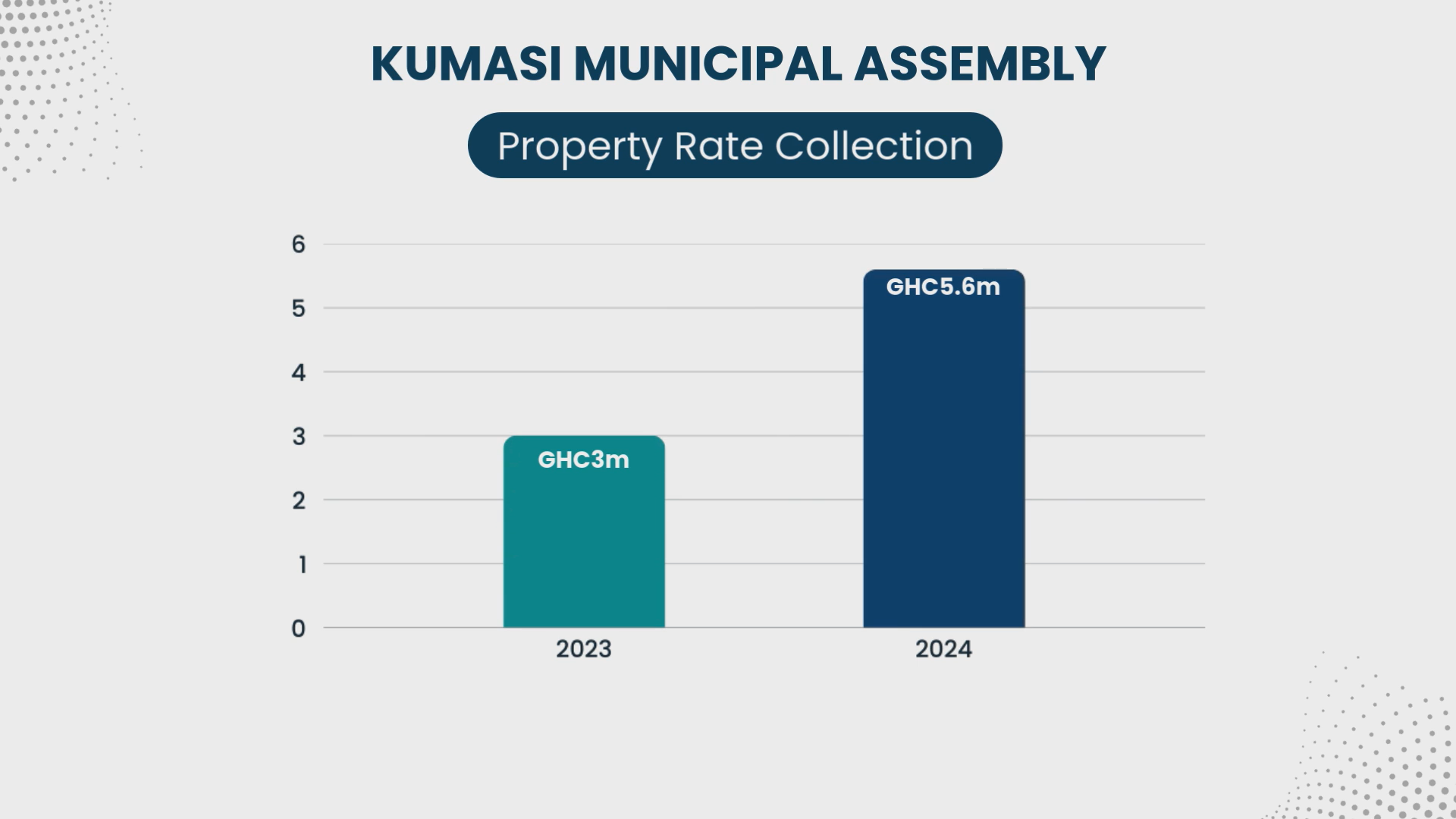
That decision resulted in a significant turnaround for revenue collection by the MMDAs.
The controversy later surfaced in Parliament during the vetting of then Local Government Minister-designate Martin Adjei-Mensah Korsah. During questioning by then Minority Leader, now Finance Minister, Cassiel Ato Forson, Mr. Korsah acknowledged challenges with the system and pledged to recover outstanding funds owed to assemblies.
The Fourth Estate subsequently requested a breakdown of all revenues collected on behalf of the assemblies from the GRA, as well as copies of contracts with Digital City Solutions.
The GRA initially declined the requests, arguing that disclosure of the contract could harm the company’s “legitimate commercial and competitive interests” under Ghana’s Right to Information law.
Months later, under compulsion from the Right to Information Commission, GRA released the data, which showed that the then Commissioner-General, Ammishadai Owusu-Amoah, signed the contract with the Managing Director of Digital City Solutions on May 22, 2022.
Under the terms of the agreement, the platform set up by Digital City Solutions was to collect all the revenues and deposit them into the account of the Ministry of Local Government, Rural Development and Decentralisation.
The assemblies were entitled to 70% of the gross revenue, with 15% going to Digital City Solutions and the remaining 15% to the government.
Faces behind Digital City Solutions
Investigations by The Fourth Estate found that Joseph Siaw Agyepong is listed as the sole beneficial owner of Melchia Investments Ghana Limited, a company holding 25 per cent shares in Digital City Solutions.
The remaining 75 per cent shares are held by Casantey Business Solutions Group Limited, owned by Christian Asante, who is one of the beneficial owners of Digital City Solutions.
When The Fourth Estate visited the company’s listed address in North Legon, Accra, there was no visible sign of Digital City Solutions operating there. Occupants at the premises said the office space was now being used by subsidiaries of the Jospong Group.
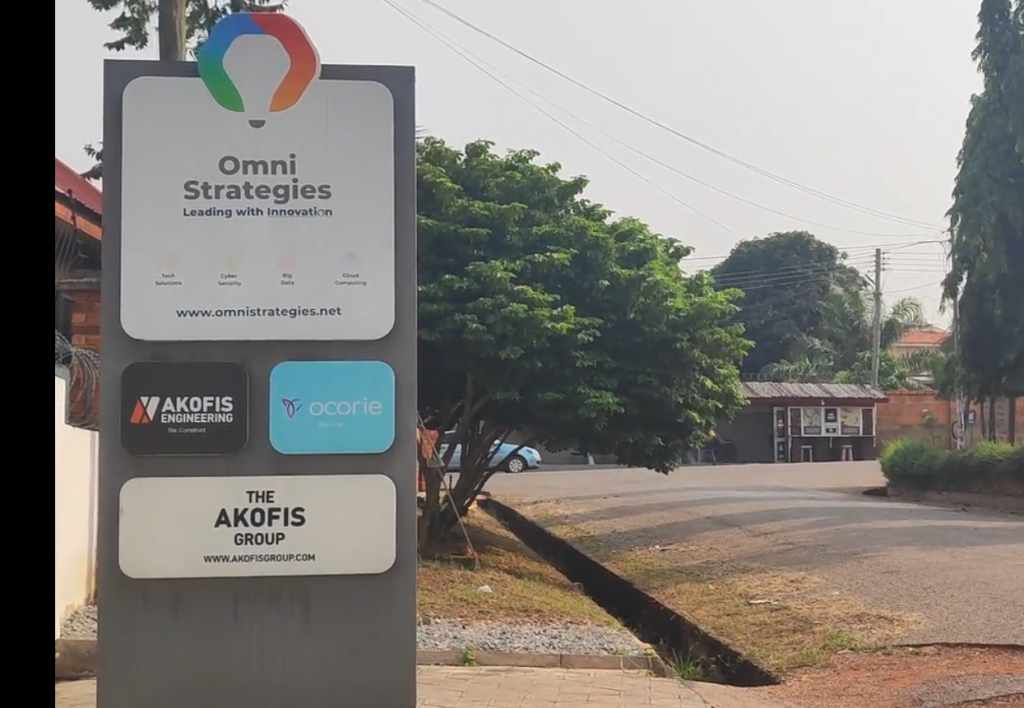
The GRA did not respond to requests for interview. Casantey Business Solutions Group Limited also did not respond to requests for comment. Interview requests sent to Omni Strategies, a subsidiary of the Jospong Group operating at the listed address, also received no response.
Officials from several district assemblies told The Fourth Estate they are yet to receive a full reconciliation of accounts showing how much money was collected on their behalf under the centralised system and how much was ultimately transferred to them.
“What GRA collected, we never had the returns for to help us do the 2024 collection,” Mr Nunoo of the KMA said. “Because at the end of the day, you need to know who is owing, how much you collected from this or that person,” he said.
He added that GRA never shared the database of revenue collected from the assemblies.
This is in spite of Mr Adjei-Korsah’s promise to recover the funds for the assemblies.
The President of the Chamber of Local Governance, Dr Richard Fiadomor, told The Fourth Estate that the GRA was a smokescreen.
“We had picked signals that the GRA was just a cover-up or a veil for a company called Digital City Solutions. But at that time, because the government was behind, it was difficult getting information,” he said. “When we saw it, we were like, what? No, this is an outright illegality, because even the Ministry of Local Government and Decentralization then cannot sign a contract for and on behalf of MMDAs. So, we started fighting it.”
Tax expert Nii Addo said the centralisation ignored the assemblies’ local knowledge and weakened the collaboration necessary for effective revenue mobilisation.
“It is the hunter that knows the forest,” he said. “It is the assemblies that know the areas designated to them. It is not the terrain of the GRA.”
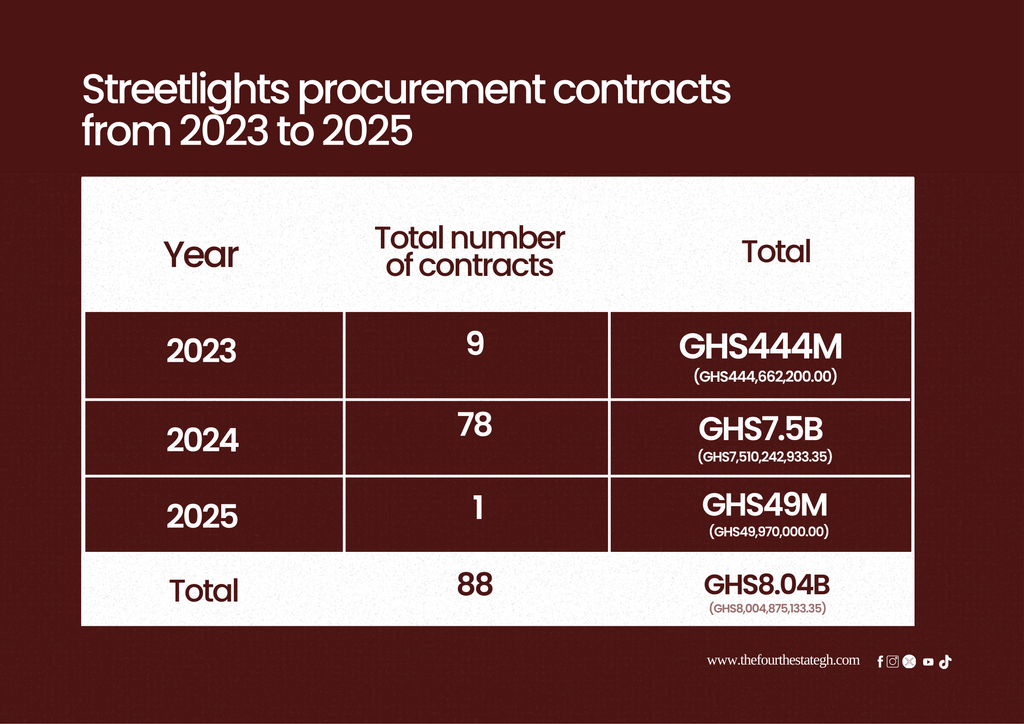
Between 2023 and 2025, the Ministry of Energy and Green Transition awarded contracts worth eight billion cedis to several companies to supply streetlights.
In those three years, the Ministry awarded 88 separate contracts to 25 companies. On average, each contract cost about GHS90 million, yet they were all awarded through single-source tendering.
According to data from the Ministry of Energy and Green Transition, made available to The Fourth Estate through a right to information request, the government awarded nine contracts for the supply of streetlights in 2023 at a total cost of GHS400 million.
In 2024, the number of contracts increased to 78 at a cost of GHS7.5 billion. As of December 2025, the current government had awarded one contract at GHS 49 million.
Billions spent, darkness persists
Despite spending eight billion cedis on nighttime public lighting in just three years, many streetlights are not functioning, and the streets are still dark in the evenings, negatively affecting public safety and security as well as whether the projects have delivered value for money.
In an interview with The Fourth Estate in 2024, the then Director-General of the National Road Safety Authority, David Osafo Adonteng, said that night crashes were very significant in Ghana’s road accident data, pointing out that people were driving into disabled vehicles on major roads at night “because they are unable to see ahead of them.”
The 2024 Accra Road Safety Report also noted that the majority of road traffic fatalities occurred in weekend crashes between 8 p.m. and 12 a.m.
“This pattern may be attributed to high vehicular speeds and reduced nighttime visibility,” the report said. The report recommended visibility interventions to improve lighting at night.
Similarly, a 2024 report by the Kumasi Metropolitan Assembly noted that “improving street lighting, especially when visibility is inadequate, can help to protect vulnerable road users.”
Meanwhile, energy-sector analysts are questioning why many roads remain dark despite the billions of cedis committed to streetlight projects.
For Dr Charles Gyamfi Ofori, Policy Lead for Climate Change and Energy Transition at the Africa Centre for Energy Policy (ACEP), “poor project deliveries and contract variations” are the reason why the country is spending so much on streetlights but has little to show for it.
In his view, Ghana has too many leakages in budget execution processes that facilitate substandard project delivery, mismanagement, and limited supervision.
Auditor-General cites multiple infractions of streetlight procurement
Consistent with Dr Ofori’s view about mismanagement are reports by the Auditor-General (A-G) on procurement and installation of streetlights in Ghana. The A-G’s reports have over the years cited ministries, district assemblies, and government agencies for multiple infractions.
In the report on the public accounts of Ghana as at December 31, 2025, the Auditor-General cited the Electricity Company of Ghana (ECG) for procuring 300,000 units of 120W LED streetlights and 9,620 km of aluminum conductors at a total cost of $127 million—an expenditure that was not included in the approved procurement plan of the company.
A separate audit of the government’s outstanding claims and commitments as of 31 December 2024 found that the Energy Ministry had duplicated GHS399 million in claims for electrical materials, including LED streetlights, arms and bulbs.
The duplication created the risk that the ministry could have paid twice for the same items but for the intervention of the Audit Service.
In the same report, the Auditor-General observed that the Ministry had added to its arrears and commitments as of December 31, 2024, an amount of GHS3.2 billion for the supply and installation of electrical materials under the National Electrification Project. But the audit found that 85% of that amount had already been paid between 2020 and 2024.
Experts believe that the recurrence of these infractions and poor supervision of procurement and installation of streetlights will continue to keep Ghana’s streets dark, even though billions of cedis have been and continue to be spent annually.
The Office of the Attorney-General and Ministry of Justice has refused the Media Foundation for West Africa (MFWA) access to information requested under the Right to Information (RTI) law, Act 989.
The MFWA filed the request on May 28, 2026, seeking answers to three questions relating to the case of The Republic vs. Kwabena Duffour and Seven Others.
The request specifically sought information on recoveries made by the state in connection with the case.
On July 22, 2025, the Attorney-General’s office filed a nolle prosequi, effectively ending the case tied to the collapse of UniBank, in which an estimated GHS5.7 billion in depositors’ funds was allegedly misappropriated.
The case was initiated under the Akufo-Addo government but was discontinued by the Attorney-General when the National Democratic Congress (NDC) administration came to power.
The accused faced charges including stealing, willfully causing financial loss to the state, and money laundering, following the Bank of Ghana’s revocation of UniBank’s license in 2018 over insolvency and serious regulatory breaches.
More than two months after the request was filed, the Office of the Attorney-General and the Ministry of Justice had neither supplied the information nor given reasons for the delay.
This is contrary to the RTI law, which requires a public institution to respond to a request within 14 days, failing which the application is deemed refused.
Section 23(5) of Act 989 states that, “where an information officer fails to determine an application within fourteen days after the application is received by the public institution, the application is deemed to have been refused and the applicant has the right to seek redress under sections 31 to 39.”
On July 29, 2026, the MFWA appealed to the Attorney-General and Minister of Justice, Dr Dominic Akuritinga Ayine, to exercise his authority as head of the institution and ensure the release of the requested information, invoking Section 31 of Act 989:
“Except as otherwise provided in this Act, a person aggrieved by a decision of the information officer of a public institution may submit an application for internal review of that decision to the head of the public institution.”
As of the time of publication, the Attorney-General and Minister of Justice had not responded to the internal appeal sent to his office.
The Office of the Attorney-General’s refusal to release information adds to a long trail of public institutions denying The Fourth Estate or its parent organisation, MFWA, access to information.
In February 2026, the Acting CEO of the Ghana Highway Authority (GHA) promised to release a copy of the Big Push contracts. As at August, after nearly six months, the GHA had failed to honour its promise. The MFWA has petitioned the RTI Commission to compel the GHA to release the information.
In July, The Fourth Estate appealed to the Finance Minister after the RTI officer of the ministry refused to release information about the ministry’s budgetary allocation disbursement.
In the same month, The Fourth Estate petitioned the RTI Commission over the Public Procurement Authority’s refusal to release information regarding road contract procurement approval requests that the Authority had received from the Ghana Highway Authority, the Department of Urban Roads, and the Department of Feeder Roads since January 2025.
In May 2025, The Fourth Estate dragged Parliament to the RTI Commission after the legislature failed to release information on expenditure on foreign medical travels of the Speaker.
Similarly, in December 2025, The Fourth Estate took the Youth Employment Agency (YEA) to the RTI Commission. This was after YEA refused to provide a list of contracts the Agency had signed with Zoomlion Company Limited from 2017 to 2024. Others include the Commission on Human Right and Administrative Justice (CHRAJ) and the Ghana Police.
The Director-General of the Ghana Broadcasting Corporation, Prof Amin Alhassan, has challenged the 2023 African Games Auditor-General’s report findings, including allegations of engaging companies without contracts made against the state broadcaster.
According to Prof Alhassan, the auditors did a shoddy job and ignored evidence submitted to them through management responses, resulting in a skewed report.
The report highlighted alleged infractions, including the engagement of service providers without contracts, delayed procurement approval, the use of GBC staff for third-party contracts, an irregular training contract, and poor broadcast rights management.
However, documents The Fourth Estate has obtained show that some information submitted by the Management of GBC in response to audit queries did not reflect in the final report.
The contracts
In a February 2, 2026 query letter, auditors said GBC had engaged The Production Room (TPR), Silicon House Productions, and Broadstem Company Limited without written contracts in spite of the financial commitments involved.
The letter, therefore, directed GBC’s Director-General to, among other things, “provide documentary evidence of any contracts/agreements governing the above engagements” as well as “provide details of services delivered, acceptance documentation, and evidence of value received for each engagement.”
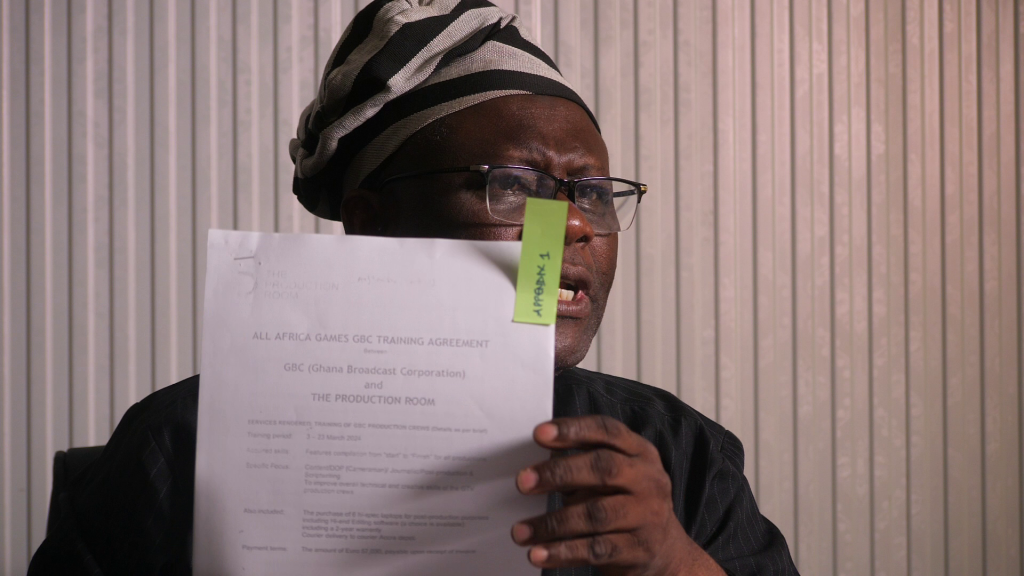
GBC’s February 6, 2026, response included signed contracts for all three companies.
The contracts show that while TPR was contracted on February 22, 2024, to train GBC staff to supply six high-spec laptops and editing software, Silicon House was contracted on February 22, 2024, to provide outside broadcast vans for the Games. The third company, Broadstem Company Limited, signed a contract with GBC on March 15, 2024, to provide satellite services.
Despite receiving the contracts, the Auditor-General’s report maintained that the service providers were engaged without contracts.
The Director-General of GBC, Prof Amin Alhassan, told The Fourth Estate that the findings lacked credibility.
“[On]the issues of the contracts, I provided them; she [lead auditor] refused to acknowledge them in the report,” Prof Amin told The Fourth Estate. “When they requested for it, we gave it to her [Jemima Arthur, lead auditor]. She signed and took it.”
Prof aLHASSAN holding the three contracts
Advance payment claims disputed
The Auditor-General’s letter also stated that TPR received 100 percent advance payment. But payment records reviewed by The Fourth Estate show otherwise.
The first payment, worth a little over GHS69,000 ($4,876), was made on March 22, 2024, a day to the end of the Games, while the largest payment, $52,133, was made on February 18, 2025, nearly a year after the Games.
Prof Alhassan told The Fourth Estate that the auditors assumed that the money was paid as stipulated in the very contract they failed to include in the final report.
“The game in auditing is evidence. If the evidence I submitted did not speak to the auditor’s issues, the auditor is under an obligation to discount my evidence and tell me why. But you can’t ignore it and go write some Ananse story about GBC.”
Training and laptops verified
The Fourth Estate found that although the training for some GBC crew and journalists was done, it was held online during the Games. While 19 participants were listed, the Course Lead from GBC, Emmanuel Ashley, said attendance averaged about 10 people a day because participants were also working during the Games.
At least two staff members mentioned as participants in a report submitted to the Director-General told The Fourth Estate that they were not part of the training.
Through GBC’s store voucher, dated May 6, 2025, The Fourth Estate verified that GBC received eight Dell laptops from TPR. We saw three of those laptops at the editing and digital units of the corporation. The remaining five were said to have been issued to journalists, who were unavailable at the time of The Fourth Estate’s visit.
Prof Alhassan said he found it weird that he was being surcharged for the training and for the laptops, although the auditors were provided evidence of the training programme, the laptops, and the editing software.
Broadcast rights row
The Auditor-General’s letter criticised GBC for granting broadcasting rights to DSTV’s SuperSport channels for free despite spending about $3.6 million on production.
Auditors said only two licensing deals generated revenue, bringing in $45,000. The Fourth Estate found that the national broadcasters of Botswana and DR Congo paid the money. Local and other international television stations used the feeds from the Games for free.
The auditors therefore asked the GBC Director-General to “justify the granting of free broadcast rights to SuperSport (DSTV), including evidence of approval and assessment of foregone revenue. Additionally, GBC was, among other things, asked to provide the broadcast rights marketing and pricing strategy adopted for the Games or explain its absence.” The auditors claimed that the poor handling of the broadcast rights cost the country GHS 59.4 million.
But Prof Amin said the decision was approved by Local Organizing Committee (LOC) Chairman, Dr Kwaku Ofosu-Asare, and argued that selling broadcast rights was not GBC’s responsibility.
“It was not our job to sell the rights. It’s the Ministry or LOC’s responsibility to appoint a marketing agency to sell the rights,” he said.
Contacted by The Fourth Estate, Dr Ofosu-Asare declined to comment, saying he is yet to be served with the report and that he would respond at the appropriate time.
However, The Fourth Estate found a WhatsApp conversation between SuperSport’s Head of Production, Docky Dockrat, GBC’s acting Director of Marketing, George Lomotey, and Dr Ofosu-Asare.
From the message trail, Mr Dockrat had sent a message to Mr Lomotey saying, “My understanding is that SuperSport is being offered the All-African Games. If this is the case, we will consider it if it comes at no cost to us…”
Mr Lomotey then forwarded the message to Dr Ofosu-Asare, asking him to confirm if the signal was being given to SuperSport at no cost.
In response, Dr Ofosu-Asare said, “Yes, let’s do it.”
Staff deployment
The auditor’s letter to the state broadcaster also indicated that GBC staff performed roles that contracted service providers were supposed to handle, resulting in a loss to the broadcaster. According to the Auditor-General, the decision cost the public purse more than GHS 40.7 million.
GBC was asked to, among other things, quantify the cost of GBC staff time and resources deployed in support of the PGS and Quality Media Producciones (QMP) contracts and indicate how such costs were recovered. The Audit Service also demanded that GBC explain the deployment of GBC staff in roles contractually assigned to PGS and QMP.
Prof Amin rejected the claim, saying staff were attached to the production teams for training purposes, not as labour.
“The staff who were embedded were to learn, and that was all it was. We didn’t deploy labour, so I cannot cost it. And the imagination of the auditors was to cost something that didn’t exist,” he said.
Delayed procurement ratification
Auditors further faulted GBC for procuring services under single-source procurement only to seek PPA ratification months after the Games had ended, and queries were raised at the Public Accounts Committee of Parliament.
Based on this, auditors asked GBC to, among other things, provide a detailed explanation for seeking PPA ratification only after the Games had ended, notwithstanding the early execution of contracts in February 2024. GBC was also directed to submit documentary evidence supporting the justification for single-source procurement for each service provider.
In response, GBC provided evidence of PPA ratification and explained that while it had engaged the LOC as far back as 2022 to initiate the required procurement of production equipment and train personnel, the discussions did not yield much, only for the corporation to be brought into the picture barely a few weeks before the games. The contract with PGS, the production company for the games, was signed just two days before the games.
However, the final report still had issues with how long it took for GBC to seek ratification at the PPA.
Prof Alhassan explained to The Fourth Estate that the delay in ratification was because it took time to reconcile all the needed documents.
“PPA subsequently gave us an official ratification, which means that after their thorough investigation, they agreed that we acted rightly,” he stated.
He said GBC could have refused to take up the assignment because of the timing. But accepted the task for fear of public backlash and national embarrassment.
He said that given the timelines, it was nearly impossible to advertise and complete the procurement process in six weeks.
No exit meeting
Although the audit process required that the two parties—GBC and the auditors—met to clear outstanding issues from the management response, Prof Alhassan insisted that no such meeting happened.
“I challenge the Audit Service to produce minutes from the exit meeting we had before they issued the report,” he said.
He accused the auditors of using the report as an attempt to witch-hunt him.
Audit Service’s response
When The Fourth Estate sought the auditor’s response, Audit Service declined to comment.
“The report on the 13th African Games has been duly submitted to Parliament in compliance with Article 187 of the Ghanaian Constitution,” the Audit Service’s Assistant Director of Audit/Information Officer, Frederick Lokko, said. “The report is yet to be deliberated upon by the Public Accounts Committee of Parliament, and therefore, it is deemed very necessary by the Service to allow this process to be completed; after which your request for an interview regarding aspects of the report mentioned herein can be granted.”
What was supposed to be a forensic audit of the 2023 African Games expenditure has instead become a credibility contest between GBC and the Auditor-General. It is now up to Parliament’s Public Accounts Committee to determine who is telling the public the truth.