
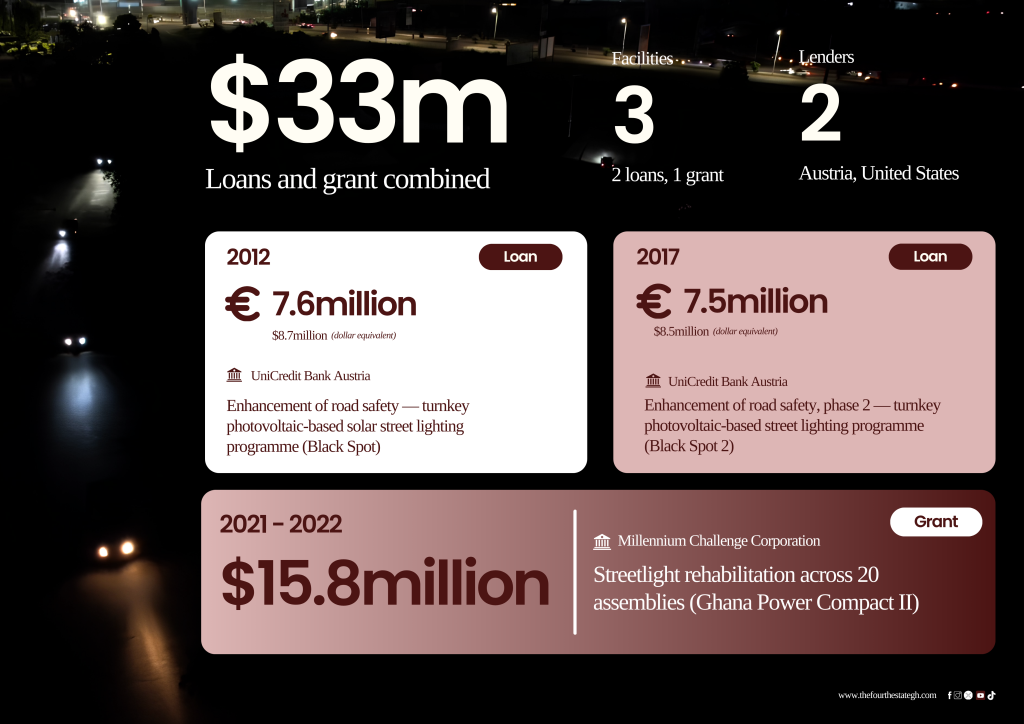
In December 2012, Ghana’s parliament approved a €7.655 million credit facility to finance the “Black Spot Project.” The project was to install streetlights at major junctions, at bridge approaches, and in communities along trunk roads.
“An analysis of the road traffic accidents indicates that most of the fatal accidents occur at night where visibility is [low]. The analysis further indicates that 80% of the night-time fatal accidents occur on sections of the road without streetlights,” a report from the Parliamentary Joint Committee on Finance and Mines and Energy justified the credit facility and recommended its approval.
The credit facility was obtained from UniCredit Bank of Austria and included a 7.5-year grace period and a 17-year maturity. This means that Ghana was expected to start paying for the facility in 2019 and complete payment by 2029.
In June 2015, the Ministry of Roads and Highways and the Ghana Highway Authority announced the completion of the Black Spot project after they said they had installed 1,207 solar-powered streetlights along 10 trunk road sections and five major intersections in eight regions.
But in 2017, before the country would begin paying for the €7.655 million loan, the government of Ghana went back to the Austrian government for another €7.5 million credit facility.
The 2017 loan was to finance the same project the previous facility was meant for—installing streetlights at major junctions, at bridge approaches, and in communities along trunk roads. The loan began Phase 2 of the Black Spot Project.
“The Committee observed that about 40% of the street lights from Phase 1 of the project were not working across the country,” a 2018 report by the Parliamentary Joint Committee on Roads and Mines and Energy explained why another loan had become necessary.
“The Committee was informed that, the situation was as a result of inadequate supervision and water table level rising to cover the chamber where the battery and connectors are kept, as well as activities of rodents who feed on insulated cables.”
The design for the new streetlights to be installed for Phase 2, according to the Joint Committee, had been improved to remedy the challenges observed in Phase 1.
In 14 years, from 2012 to 2026, Ghana has borrowed over $17 million to install streetlights. The country has also received a $15.8 million grant for the same purpose.
Despite spending millions, there’s still darkness
In all, Ghana has obtained over $32 million through loans and a grant over the last 14 years for street lighting. These are different from the funds collected under the Public Lighting Levy (PLL), a 3% tax on every kilowatt of electricity consumed.
In the last five years, from 2020 to 2024, the PLL has accrued over GHS1.1 billion
But despite spending these funds, concerns persist that the streetlights are not functioning and the streets are still dark at night, negatively affecting public safety and security.
In 2024, the then Director-General of the National Road Safety Authority, David Osafo Adonteng, told The Fourth Estate that night crashes were very significant in Ghana’s road crash data, pointing out that people were driving into disabled vehicles on major roads at night “because they are unable to see ahead of them.”
The 2024 Accra Road Safety Report also noted that between 2020 and 2024, the majority of road traffic fatalities occurred during weekend crashes between 8p.m. and 12a.m.
“This pattern may be attributed to high vehicular speeds and reduced nighttime visibility,” the report said. The report recommended visibility interventions to improve lighting at night.
Similarly, a 2024 report by the Kumasi Metropolitan Assembly noted that “improving street lighting, especially when visibility is inadequate, can help to protect vulnerable road users.”
In the meantime, analysts are demanding explanations for why so much has been borrowed and spent on street lighting while much of the country is plunged into darkness at night.
Dr Charles Gyamfi Ofori, Policy Lead for Climate Change and Energy Transition at the African Centre for Energy Policy (ACET), told The Fourth Estate that despite spending so much, the country has little to show for the streetlights because of “poor project deliveries and contract variations.”
In his view, there are too many leakages that exist within the country’s budget execution processes that facilitate substandard project deliveries, mismanagement and limited supervision.
The 2018 report by the Parliamentary Joint Committee on Roads and Mines and Energy that recommended the approval for Phase 2 of the Black Spot Project noted that “most solar streetlights on our roads suffer poor maintenance which results in most of the bulbs [being] faulty and batteries not functioning properly.” It added that poor streetlighting in the country can be attributed to the fact that there are so many government agencies with some responsibility but limited and varied mandates for maintaining streetlights.
The report recommended a policy dialogue between the Parliamentary Joint Committee on Roads and Mines and Energy, the Local Government and Rural Development, and the respective ministries and relevant agencies to “find a lasting solution to the maintenance of streetlights.”
In 2026, eight years after the recommendation, streetlight maintenance remains a problem. The streets are still dark, increasing the risk of fatal road traffic accidents at night.