Author: Kwaku Krobea Asante

  • Transparency in words, Secrecy in practice: How MDAs are betraying Gov’t’s transparency pledge

    Transparency in words, Secrecy in practice: How MDAs are betraying Gov’t’s transparency pledge

    In January 2025, when President Mahama explained why the Information Ministry had been placed under the Office of the President, he said it was part of the strategy to downsize and to ensure easy access to government information.

    “That’s how come we have the minister in charge of government communications,” he said. “And then [we are going] to make sure we are able to anchor it with a string of strong communication professionals in the most critical sectors so that we are able to guarantee as much information flow to the public as possible.”

    The government’s promise to ensure access to information was anchored in the NDC’s resetting agenda manifesto, which stated that they will be “fully implementing and operationalising the Right to Information Act, 2019 (Act 989).”

    But about 17 months after coming into power, The Fourth Estate has observed a trend of critical public institutions denying journalists and the public access to information.

    The Fourth Estate has counted 21 institutions, including the Ministry of Finance, the Office of the Attorney-General and Minister of Justice, the Ministry of Roads and Highways, and the Ministry of Lands and Natural Resources, that are flouting the Right to Information Act in their reluctance or sheer refusal to release information to the public.

    The RTI law, passed in 2019 after sitting on the shelves of Parliament for about 20 years, enjoins public institutions and officers to release information to citizens, as it is a fundamental and constitutionally guaranteed right with limited exception.

    The list of public institutions that denied access to information

    From January 2025 to July 2026, 21 government institutions failed to release information to journalists from The Fourth Estate in 24 separate RTI requests.

    In June 2025, The Fourth Estate requested information from the Ministry of Local Government, Chieftaincy and Religious Affairs on the full list of dumpsites Zoomlion Ltd. was said to have excavated through a multi-million-cedi contract with the government. The ministry failed to respond despite an internal appeal to the then minister, Ahmed Ibrahim.

    In the same month, the Ministry of Lands and Natural Resources failed to release information on the list of companies President Akufo-Addo had granted permits under the LI2462 to mine in forest reserves that had been designated as globally significant biodiversity areas.  

    In September 2025, the National Communications Authority (NCA) refused to release information on how much KGL Technologies had received through its USSD platform for the 5/90 online lottery. The information was necessary for The Fourth Estate’s investigations into the terrible NLA-KGL deal, but the NCA did not budge.

    In March 2026, the Ghana Highways Authority (GHA) promised that it would make available copies of the government’s flagship Big Push project in two weeks. But after five months, the GHA appears to have reneged on its promise. The Fourth Estate, through the Media Foundation for West Africa (MFWA), has submitted a petition to the RTI Commission for a review.

    The GHA, in May 2026, again failed to release information on abandoned prefabricated bridges Ghana procured through a 43 million-pounds loan, despite an internal appeal to the Acting Chief Executive Officer, Mallam Issah Ishak.

    The Finance Ministry oversees fund disbursement to all government institutions, but when The Fourth Estate requested information on its budgetary allocations and disbursements in April 2026, it chose not to respond. An internal appeal has been sent to the minister, Cassiel Ato Forson. Still, the Ministry has failed to provide the information.

    The Finance Ministry has also decided to close the door on information on the details of the work of the technical committee established by President Mahama to investigate the NLA-KGL contract. In May 2026, an application requesting a copy of the full report of the committee was sent to the Office of the Attorney-General and Minister of Justice. The Attorney-General’s office said the MFWA should check with the Office of the President. The Office of the President, in turn, said the MFWA should contact the Finance Ministry for it. But the Finance Ministry has gone quiet, despite a follow-up appeal to the Minister.

    The Attorney-General’s office has also refused to disclose information on how much the state has recovered from the Republic vs. Kwabena Duffour and 7 others case. An appeal has been sent to Attorney-General Dr Dominic Ayine, but that has changed nothing.

    (The full list of public institutions denying access to information under the Mahama administration is at the bottom of the story)

    Experts call for sanctions

    Anti-corruption and Right to Information activists have called for sanctions against public institutions that deliberately deny access to information to journalists under the RTI law.

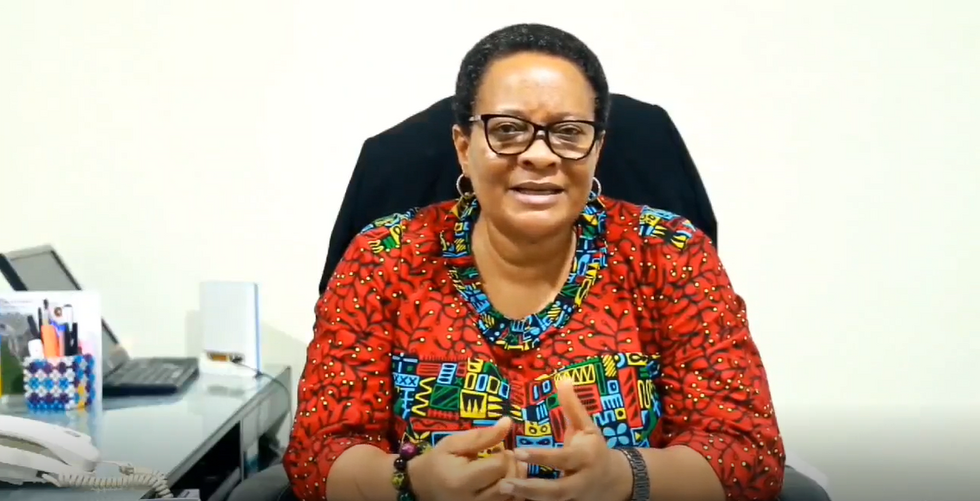
    Zakaria Tanko Musa, private legal practitioner, and Mary Awelana Adda, Executive Director of Transparency International Ghana

    For Zakaria Tanko Musa, a private legal practitioner and media lecturer, journalists do not ask for information for their own sake but for public scrutiny. Therefore, to deny journalists access to information that is not exempt under the RTI law is to deny the public access to information they need for informed decision-making.

    “Failure or refusal to release information should come with consequences,” he said. “Unfortunately, those are the things that are lacking, and that is why we are seeing the ignoring of the [request for] information with impunity.”

    The Executive Director of Transparency International (TI) Ghana, Mary Awelana Adda, also believes that cracking the whip can cause a change.

    “If sanctions are meted out, then people will comply. Then the bureaucracy and the unnecessary red tape will be reduced,” she said at the launch of TI Ghana’s report on access to information in June.

    Government says it is committed to transparency, despite tall list of information denials

    Despite what appears to be a deliberate attempt by many public institutions to deny access to information, Felix Ofosu Kwakye, Minister in charge of Government Communications, in response to a request for a comment, insisted that the government is committed to openness, transparency, and accountability.  

    Felix Ofosu Kwakye, Minister in charge of Government Communications

    “As a government, there’s no policy of concealment,” he noted. “We do not have a policy that says that various government agencies in various sectors should conceal information because we are uncomfortable or anything.”

    Mr. Ofosu Kwakye also cautioned that there are instances where the information being requested may be exempted under the law, in which case the government is restricted from divulging it.

    “We believe that the law has inbuilt mechanisms to provide remedies for persons who are aggrieved by the conduct of public institutions regarding their unwillingness, or if you like, inability to disclose information that is requested for,” he said.

    He reiterated that the government is committed to working with any institution to ensure a smoother implementation of the RTI law.

    The full list of the institutions is below

  • Ghana spent 8 billion cedis on streetlights in 3 years, yet darkness prevails

    Ghana spent 8 billion cedis on streetlights in 3 years, yet darkness prevails

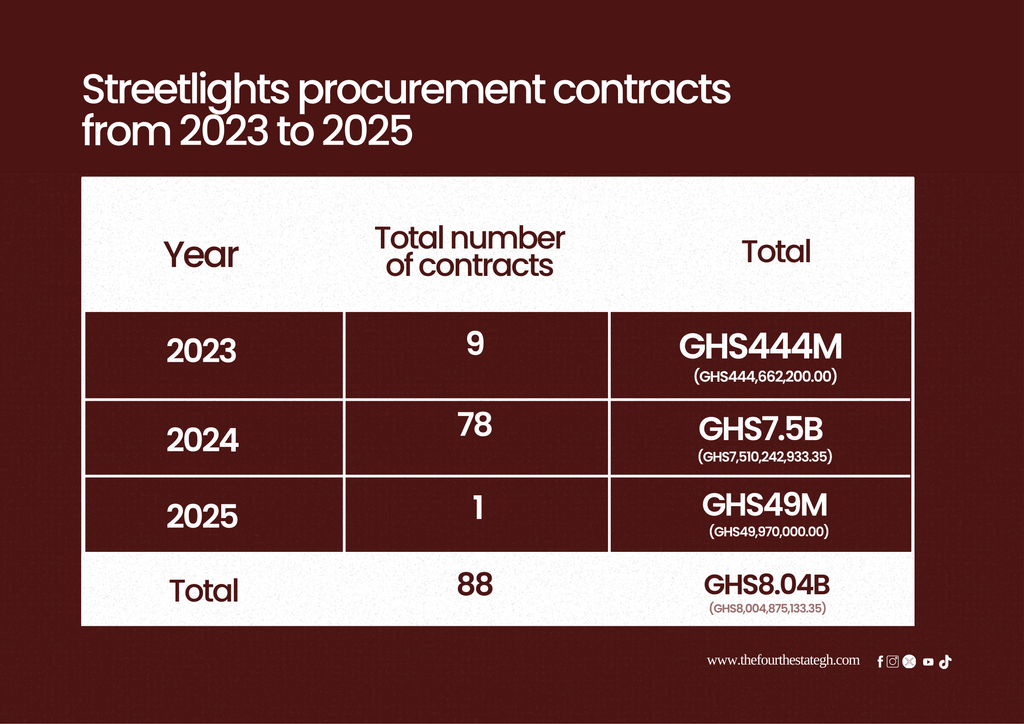
    Between 2023 and 2025, the Ministry of Energy and Green Transition awarded contracts worth eight billion cedis to several companies to supply streetlights.

    In those three years, the Ministry awarded 88 separate contracts to 25 companies. On average, each contract cost about GHS90 million, yet they were all awarded through single-source tendering.

    According to data from the Ministry of Energy and Green Transition, made available to The Fourth Estate through a right to information request, the government awarded nine contracts for the supply of streetlights in 2023 at a total cost of GHS400 million.

    In 2024, the number of contracts increased to 78 at a cost of GHS7.5 billion. As of December 2025, the current government had awarded one contract at GHS 49 million.

    Billions spent, darkness persists

    Despite spending eight billion cedis on nighttime public lighting in just three years, many streetlights are not functioning, and the streets are still dark in the evenings, negatively affecting public safety and security as well as whether the projects have delivered value for money.

    In an interview with The Fourth Estate in 2024, the then Director-General of the National Road Safety Authority, David Osafo Adonteng, said that night crashes were very significant in Ghana’s road accident data, pointing out that people were driving into disabled vehicles on major roads at night “because they are unable to see ahead of them.”

    The 2024 Accra Road Safety Report also noted that the majority of road traffic fatalities occurred in weekend crashes between 8 p.m. and 12 a.m.

    “This pattern may be attributed to high vehicular speeds and reduced nighttime visibility,” the report said. The report recommended visibility interventions to improve lighting at night.

    Similarly, a 2024 report by the Kumasi Metropolitan Assembly noted that “improving street lighting, especially when visibility is inadequate, can help to protect vulnerable road users.”

    Meanwhile, energy-sector analysts are questioning why many roads remain dark despite the billions of cedis committed to streetlight projects.

    For Dr Charles Gyamfi Ofori, Policy Lead for Climate Change and Energy Transition at the Africa Centre for Energy Policy (ACEP), “poor project deliveries and contract variations” are the reason why the country is spending so much on streetlights but has little to show for it.

    In his view, Ghana has too many leakages in budget execution processes that facilitate substandard project delivery, mismanagement, and limited supervision.

    Auditor-General cites multiple infractions of streetlight procurement

    Consistent with Dr Ofori’s view about mismanagement are reports by the Auditor-General (A-G) on procurement and installation of streetlights in Ghana. The A-G’s reports have over the years cited ministries, district assemblies, and government agencies for multiple infractions.

    In the report on the public accounts of Ghana as at December 31, 2025, the Auditor-General cited the Electricity Company of Ghana (ECG) for procuring 300,000 units of 120W LED streetlights and 9,620 km of aluminum conductors at a total cost of $127 million—an expenditure that was not included in the approved procurement plan of the company.

    A separate audit of the government’s outstanding claims and commitments as of 31 December 2024 found that the Energy Ministry had duplicated GHS399 million in claims for electrical materials, including LED streetlights, arms and bulbs.

    The duplication created the risk that the ministry could have paid twice for the same items but for the intervention of the Audit Service.

    In the same report, the Auditor-General observed that the Ministry had added to its arrears and commitments as of December 31, 2024, an amount of GHS3.2 billion for the supply and installation of electrical materials under the National Electrification Project. But the audit found that 85% of that amount had already been paid between 2020 and 2024.

    Experts believe that the recurrence of these infractions and poor supervision of procurement and installation of streetlights will continue to keep Ghana’s streets dark, even though billions of cedis have been and continue to be spent annually.

  • Presidency investigations into Big Push sole-sourcing: Did Valerie Sawyerr Committee deliberately put out false information to clear Ministry or it was misled?

    Presidency investigations into Big Push sole-sourcing: Did Valerie Sawyerr Committee deliberately put out false information to clear Ministry or it was misled?

    In March 2026, when The Fourth Estate revealed how the Ministry of Roads and Highways had literally become a factory for sole-sourcing under the government’s Big Push initiative, it also exposed how contracts had also been awarded to companies with questionable capacity and experience.

    One of the companies that was cited as not having demonstrable experience and capacity and yet was awarded a major contract under the Big Push initiative is a company called GROWTH 82 Global Ltd. The Fourth Estate’s probing revealed that the company was less than one year old at the time it was awarded a major, multi-million-cedi contract for the construction of the Dodo Pepeso-Nkwanta road. 

    The Fourth Estate further revealed that at the time GROWTH 82 Global Ltd was awarded the major contract worth GHS 683 million, the company did not have the required classification to qualify for such a contract.

    Following our publication, President John Mahama set up a committee led by his Senior Presidential Advisor, Dr Valerie Esther Sawyerr, to investigate the concerns raised in the report, including the issues about GROWTH82 Global Ltd.

    The Valerie Sawyerr Committee subsequently released a 72-page report containing its findings and recommendations.

    The Fourth Estate has, however, established that the President’s Committee fell short in conducting the expected investigations. It essentially treated issues raised by The Fourth Estate as allegations and responses from the Ministry of Roads as facts. The report is thus laden with falsehood and misleading findings.

    On the specific issue of when GROWTH 82 Global Ltd was registered, the Valerie Sawyerr report said: “Evidence shows that the company Growth 82 Global Limited was registered on August 18, 2020.” 

    On the issue of the capacity and classification of the company by the Ministry of Roads and Highways, the Committee said: “Evidence shows that the company Growth 82 Global Limited was registered on August 18, 2020; received A3B3 certificate on September 6, 2024; received A2B2 certificate on March 19, 2025; and received A1B1 certificate on August 14, 2025.”

    Where and how the President’s Committee obtained the evidence to draw the conclusions above remain a wonder. This is because official records expose what the Valerie Sawyer Committee put out as evidence to be completely false.

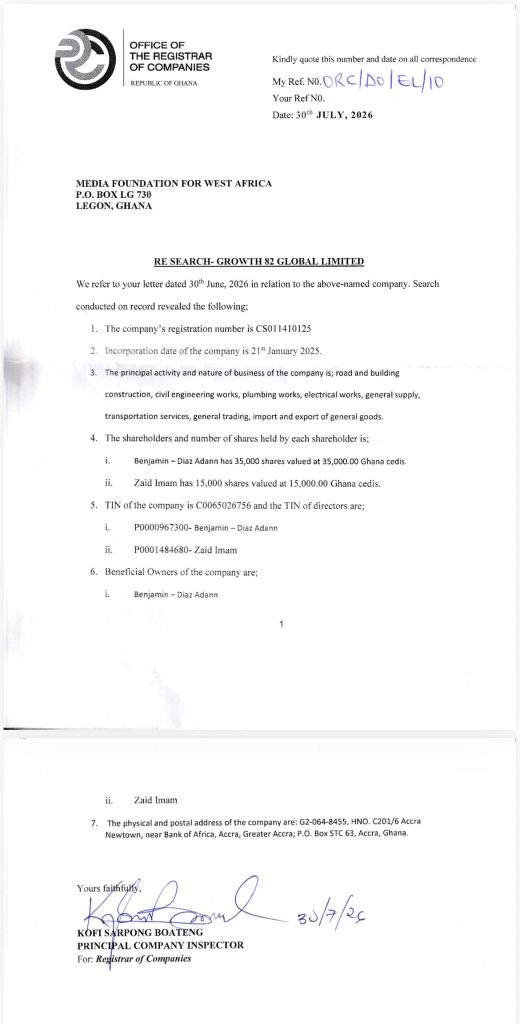
    The Fourth Estate applied for and received an official report from the Office of the Registrar of Companies (ORC) on the incorporation and ownership of GROWTH 82 Global Limited.

    According to the ORC, the company was indeed registered on January 21, 2025, which is exactly two weeks after the current NDC government was sworn into power.

    Official records from the ORC show that Growth 82 Global LTD was incorporated on january 21, 2025

    So the question is, where did the Valerie Sawyerr Committee get the August 18, 2020, company registration date from?

    The classification data presented by the Committee also raises the question of how a company that was incorporated in January 2025 could have obtained the Ministry of Roads’ classification in 2024, as claimed by the Valerie Sawyerr Committee.

    Experts at the Roads Ministry have also confirmed that it is highly unusual for a road construction company to move from an A3B3 certificate on September 6, 2024, to A2B2 in March 2025; and then to A1B1 by August 2025. 

    “For a company to graduate from one class to the other, it must demonstrate experience and track record of other works. They should tell the people of Ghana which projects were delivered by Growth 82 Global Limited to justify any such quick upward classifications,” a source familiar with the classification system at the Roads Ministry told The Fourth Estate. 

    The ministry states on its website that, among others, for a company to be upgraded to A1B1, it must demonstrate proof of major road and related civil engineering contracts executed in the last five years.

    The eligibility for A1B1 classification was further affirmed by the President of the Ghana Institution of Engineers (GhIE), Ludwig Annang Hesse, in an interview with The Fourth Estate. He explained that the classification process takes time, especially when a company is new. 

    Mr. Hesse indicated that a company classified as A1B1 must satisfy the specified guidelines, which include producing audited financial statements over three years and GRA certification, demonstrating five years of experience in handling major projects, with about 55 experienced personnel and the right equipment.

    How then did GROWTH 82 Global Limited receive A1B1 classification in August 2026, when it was just seven months old? And what kind of investigations were done by the Valerie Sawyerr Committee?

    Indeed, as at March 2026, when The Fourth Estate published its investigative findings on the Big Push initiative, the latest classification report published by the ministry on its website was dated February 3, 2026. In that report, GROWTH 82 Global Ltd was classified as A2B2M2.

    Who owns GROWTH 82 Global Ltd?

    According to records from the ORC, the company is owned by one Benjamin-Diaz Adann, who holds 70% of the shares. The remaining shares are owned by one Zaid Imam.

    Further checks revealed that Benjamin-Diaz Adann is the founder and CEO of ADB Ghana Medicals Limited, a company awarded contracts by the Ghana Medical Trust Fund (Mahama Cares) for the restoration of the Catheterisation Lab at the National Cardiothoracic Centre at Korle Bu. It also has another contract for works at the Cardiothoracic Centre at Komfo Anokye Teaching Hospital, in Kumasi, through Mahama Cares.

    Other issues on the capacities of companies awarded the Big Push contracts

    The Fourth Estate had also revealed that there were companies whose official records in the contract signed indicated they had few workers.

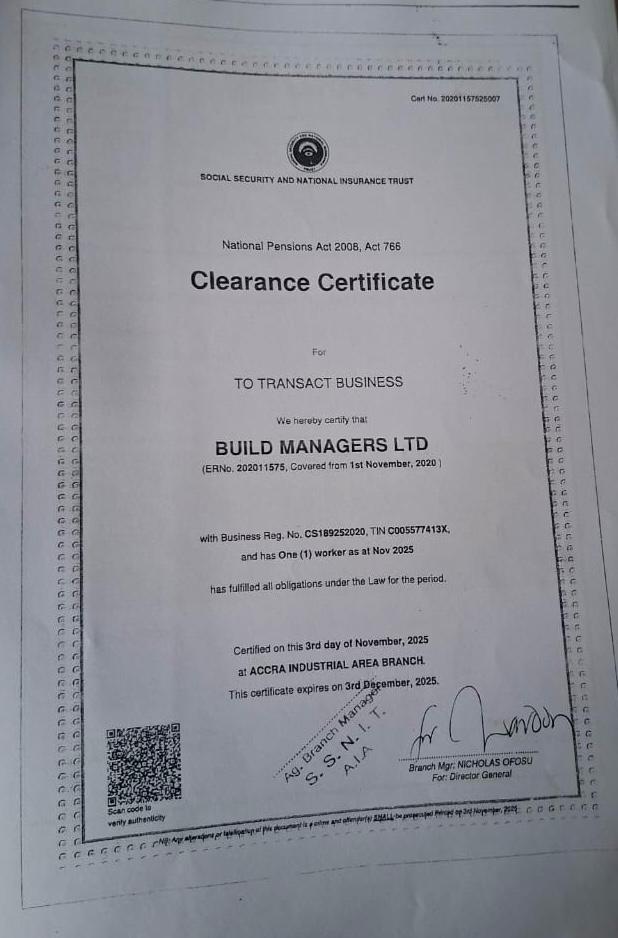
    In the case of Build Managers Ltd, awarded one of the contracts under Big Push, the contract documents indicated it had one worker. Despite evidence within the signed contract, the Valerie Sawyerr Committee indicated the company had 20 staff as at January 2025.

    Below is the SSNIT clearance certificate within the signed contract.

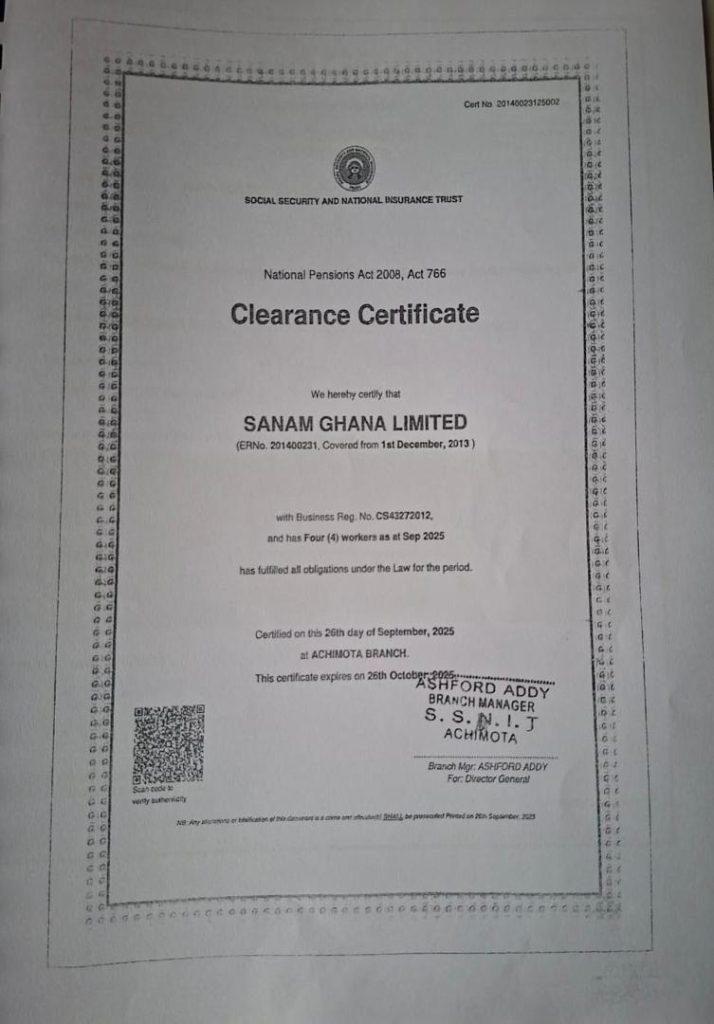
    We also indicated that the SSNIT clearance certificate of Sanam Ghana Ltd showed it had four workers. Again, despite clear evidence in the signed contract document, the Valerie Sawyerr committee said it had 25 staff members.

    Below is the SSNIT clearance certificate as it is contained in the signed contract.

    These and more issues raise questions about where the Valerie Sawyerr Committee got their figures and whether the committee deliberately put out false information or it was misled.

  • $33 million loans, grants spent on streetlights in 14 years, yet darkness prevails

    $33 million loans, grants spent on streetlights in 14 years, yet darkness prevails

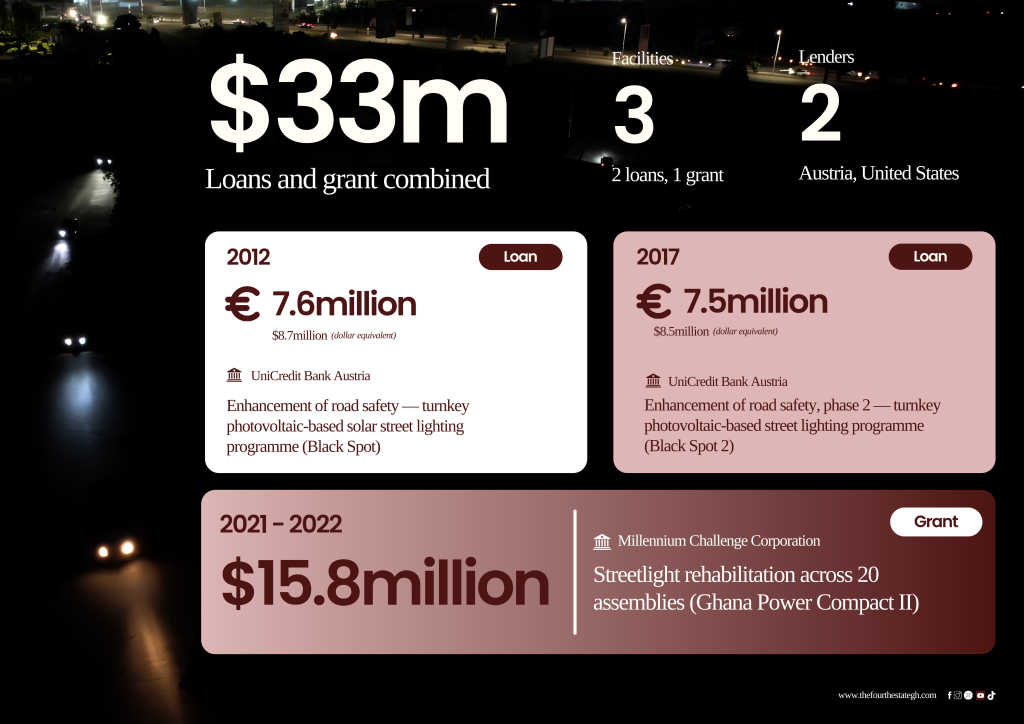
    In December 2012, Ghana’s parliament approved a €7.655 million credit facility to finance the “Black Spot Project.” The project was to install streetlights at major junctions, at bridge approaches, and in communities along trunk roads.

    “An analysis of the road traffic accidents indicates that most of the fatal accidents occur at night where visibility is [low]. The analysis further indicates that 80% of the night-time fatal accidents occur on sections of the road without streetlights,” a report from the Parliamentary Joint Committee on Finance and Mines and Energy justified the credit facility and recommended its approval.

    The credit facility was obtained from UniCredit Bank of Austria and included a 7.5-year grace period and a 17-year maturity. This means that Ghana was expected to start paying for the facility in 2019 and complete payment by 2029.

    In June 2015, the Ministry of Roads and Highways and the Ghana Highway Authority announced the completion of the Black Spot project after they said they had installed 1,207 solar-powered streetlights along 10 trunk road sections and five major intersections in eight regions. 

    But in 2017, before the country would begin paying for the €7.655 million loan, the government of Ghana went back to the Austrian government for another €7.5 million credit facility.

    The 2017 loan was to finance the same project the previous facility was meant for—installing streetlights at major junctions, at bridge approaches, and in communities along trunk roads. The loan began Phase 2 of the Black Spot Project.

    “The Committee observed that about 40% of the street lights from Phase 1 of the project were not working across the country,” a 2018 report by the Parliamentary Joint Committee on Roads and Mines and Energy explained why another loan had become necessary.

    “The Committee was informed that, the situation was as a result of inadequate supervision and water table level rising to cover the chamber where the battery and connectors are kept, as well as activities of rodents who feed on insulated cables.”

    The design for the new streetlights to be installed for Phase 2, according to the Joint Committee, had been improved to remedy the challenges observed in Phase 1.

    In 14 years, from 2012 to 2026, Ghana has borrowed over $17 million to install streetlights. The country has also received a $15.8 million grant for the same purpose.

    Despite spending millions, there’s still darkness

    In all, Ghana has obtained over $32 million through loans and a grant over the last 14 years for street lighting. These are different from the funds collected under the Public Lighting Levy (PLL), a 3% tax on every kilowatt of electricity consumed.

    In the last five years, from 2020 to 2024, the PLL has accrued over GHS1.1 billion

    But despite spending these funds, concerns persist that the streetlights are not functioning and the streets are still dark at night, negatively affecting public safety and security.

    In 2024, the then Director-General of the National Road Safety Authority, David Osafo Adonteng, told The Fourth Estate that night crashes were very significant in Ghana’s road crash data, pointing out that people were driving into disabled vehicles on major roads at night “because they are unable to see ahead of them.”

    The 2024 Accra Road Safety Report also noted that between 2020 and 2024, the majority of road traffic fatalities occurred during weekend crashes between 8p.m. and 12a.m.

    “This pattern may be attributed to high vehicular speeds and reduced nighttime visibility,” the report said. The report recommended visibility interventions to improve lighting at night.

    Similarly, a 2024 report by the Kumasi Metropolitan Assembly noted that “improving street lighting, especially when visibility is inadequate, can help to protect vulnerable road users.”

    In the meantime, analysts are demanding explanations for why so much has been borrowed and spent on street lighting while much of the country is plunged into darkness at night.

    Dr Charles Gyamfi Ofori, Policy Lead for Climate Change and Energy Transition at the Africa Centre for Energy Policy (ACEP), told The Fourth Estate that despite spending so much, the country has little to show for the streetlights because of “poor project deliveries and contract variations.”

    In his view, there are too many leakages that exist within the country’s budget execution processes that facilitate substandard project deliveries, mismanagement and limited supervision.

    The 2018 report by the Parliamentary Joint Committee on Roads and Mines and Energy that recommended the approval for Phase 2 of the Black Spot Project noted that “most solar streetlights on our roads suffer poor maintenance which results in most of the bulbs [being] faulty and batteries not functioning properly.” It added that poor streetlighting in the country can be attributed to the fact that there are so many government agencies with some responsibility but limited and varied mandates for maintaining streetlights.

    The report recommended a policy dialogue between the Parliamentary Joint Committee on Roads and Mines and Energy, the Local Government and Rural Development, and the respective ministries and relevant agencies to “find a lasting solution to the maintenance of streetlights.”

    In 2026, eight years after the recommendation, streetlight maintenance remains a problem. The streets are still dark, increasing the risk of fatal road traffic accidents at night.

  • Procurement on Big Push: PPA refuses to release information to The Fourth Estate

    Procurement on Big Push: PPA refuses to release information to The Fourth Estate

    The Public Procurement Authority (PPA) has denied The Fourth Estate access to information on procurements under the government’s flagship Big Push programme.

    In a letter dated May 29, 2026, and signed by the PPA’s Acting Director Legal, the Authority stated that the “PPA is unable to provide the requested breakdown of road sector procurement approval requests submitted between 1st January 2025 and 28th February 2026 by the Ghana Highway Authority, Department of Urban Roads, and Department of Feeder Roads, together with the related follow-ups.”

    The letter was in response to an internal appeal The Fourth Estate submitted to the Chief Executive Officer of the PPA on May 13, 2026, requesting a review of the institution’s Information Officer’s decision to deny the team the requested information. 

    On February 16, 2026, The Fourth Estate submitted a right to information (RTI) application requesting road contracts approved by the PPA under the Big Push programme. The PPA responded on March 3, stating that it is unable to provide the information because the Authority does not approve contracts.

    In March 2026, The Fourth Estate, in an updated application, requested from the PPA information on road contract procurement approval requests that the Authority has received from the Ghana Highway Authority, Department of Urban Roads, and Department of Feeder Roads since January 2025. But the Information Officer of the PPA refused to respond to the application. Under the Right to Information Act 2019, Act 989, it is deemed a refusal when an information officer fails to respond to an application.

    Subsequently, The Fourth Estate, through an internal appeal, petitioned the CEO of the PPA, in line with Section 31 of the law and in the hope that the head of the institution would make a different determination from the Information Officer.

    But the May 29 response to the team further affirmed the PPA’s decision to deny The Fourth Estate access to information on their approvals of road contract procurements.

    The PPA’s defence for refusing to release the information is that the “Authority does not approve contracts”, the same as the response to the February 16 request.

    The PPA’s justification is inconsistent with The Fourth Estate’s application, which requested information on procurement approval requests on road contracts (not approval of road contracts), which lies with the Authority.  

    Under the procurement law, any public entity seeking to use single-source procurement must write to the Authority and justify why they want to use the uncompetitive method, or where the method is used, the entity must seek ratification from the PPA.

    The PPA’s refusal to release information adds to a recent trend of public institutions denying The Fourth Estate’s RTI requests.

    In May 2025, The Fourth Estate dragged Parliament to the RTI Commission after the legislature failed to release information on expenditure on foreign medical travels of the Speaker.

    Similarly, in December 2025, The Fourth Estate took the Youth Employment Agency (YEA) to the RTI Commission. This was after YEA refused to provide a list of contracts the Agency had signed with Zoomlion Company Limited from 2017 to 2024.

    The Fourth Estate’s quest for information on procurement approvals on road contracts follows its latest investigation, which revealed how the Ministry of Roads and Highways had resorted mainly to the award of contracts under the Big Push programme through single-sourcing.

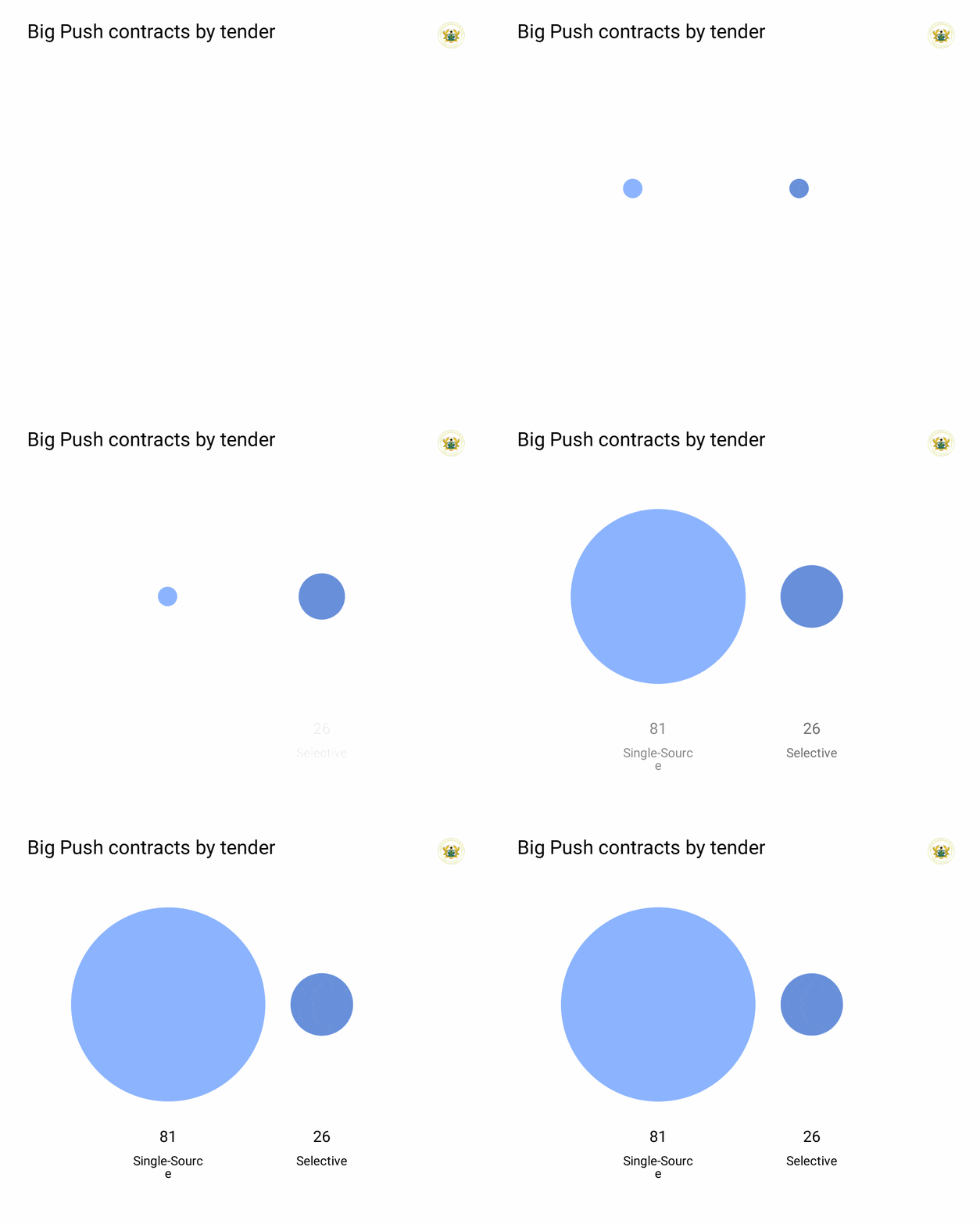
    The investigation revealed that out of 107 road contracts awarded under the Big Push programme, 81 were singled-sourced, and the remaining 26 were awarded on a restricted tendering basis, with none awarded under competitive tendering.

    The story also showed a glaring contrast between the promises and pledges made by President Mahama and other key officials of the governing National Democratic Congress (NDC) when they were in opposition about limiting the abuse of single-sourcing and what’s currently happening under their supervision in government.

    After the story, President Mahama requested The Fourth Estate to submit a full report on the matter to his office. He also directed the Minister for Roads and Highways, Kwame Governs Agbodza, to respond to the allegations contained in the report.

    The Presidency is yet to release its findings.

    YOU MAY ALSO WANT TO READ:

    https://thefourthestategh.com/2026/03/disregard-for-presidents-vow-for-prudence-ministry-awards-81-sole-sourced-contracts-worth-over-ghs73-billion-in-7-months/

    https://thefourthestategh.com/2026/04/the-fourth-estate-submits-report-on-big-push-investigation-to-office-of-the-president/

    https://thefourthestategh.com/2026/03/full-disclosure-list-of-big-push-sole-sourced-contracts/
  • Mahama demands answers from Roads Minister over sole-sourced contracts

    Mahama demands answers from Roads Minister over sole-sourced contracts

    President John Dramani Mahama has directed the Minister of Roads and Highways, Kwame Governs Agbodza, to respond to concerns over sole-sourced contracts under the Big Push programme. The directive follows The Fourth Estate’s latest investigative report and requires a detailed response including a breakdown of contracts for the Presidency.

    “Although we have seen snippets of the investigation from the media, I have instructed my office to obtain the full detailed report from the Fourth Estate and to conduct a study of the various allegations presented in the report,” the President said during a dialogue with civil society organisations at the Jubilee House in Accra, on Monday.

    According to the President, while sole-sourcing is allowed under certain circumstances by the country’s procurement laws, “we would all agree that open, transparent tenders are always preferable for achieving competitive pricing and value for money.”

    The President also said the procurement law would be reviewed to limit the use of sole-sourcing.

    The President’s directive follows The Fourth Estate’s latest publication, which showed how the Ministry of Roads and Highways under Kwame Governs Agbodza had resorted mainly to the award of contracts under the Big Push programme through sole-sourcing.

    The Fourth Estate revealed that out of 107 road contracts awarded under the Big Push programme, 81 were on a sole-sourcing basis and 26 on restricted tendering, with none awarded under competitive tendering.

    The story also questioned past rhetoric of some members of the current administration, including Mr Agbodza, who criticised the Akufo-Addo administration for using sole-sourcing to fleece the state. In contrast, the current road minister supervised the award of 76% of contracts under sole-sourcing. 

    Subsequent reports also questioned the cost per kilometre of road contracts awarded under the Big Push Programme, particularly the 46-kilometre Dodo Pepesu-Nkwanta Road, which was initially constructed at the cost of €25.9 million but has now shot up to more than €63 million for rehabilitation.

    The Fourth Estate also raised issues about how Growth 82 Global Ltd, a company registered in January 2025, and was awarded a multi-million-euro Dodo Pepesu-Nkwanta road for rehabilitation in December 2025.

    That is not all. Build Managers, the company awarded the contract to upgrade the nine-kilometre Apegusu–Mpakadan feeder road at a cost of more than GHS146 million, indicated on its Social Security and National Insurance Trust (SSNIT) clearance certificate that it had only one employee.

    Similarly, Sanam Ghana Limited, which is undertaking the upgrade of the Todome–Toh Kpalime–Dzemeni feeder road and the Dzemeni town roads, listed just four employees on its SSNIT clearance certificate—raising questions about the pre-contract qualifications of some of these companies.

    Ministry’s response to the story

    In response to The Fourth Estate’s findings, the Minister of Roads and Highways, Kwame Governs Agbodza, told Parliament that the ministry had awarded more than 400 road contracts, including those under the Big Push programme, through competitive bidding—without providing evidence to support the claim.

    In an apparent attempt to discredit the story, the ministry published a list of 54 road contracts it had awarded, but notably omitted the procurement methods used.

    An analysis of the published contracts shows that seven were awarded through selective tendering, while a staggering 47—representing 87%—were sole-sourced.

    The report has triggered demand for accountability among a section of the public and civil society organisations, who are questioning the government’s commitment to limiting the use of sole-sourcing for government procurement.

    While key figures in the current administration, including Sammy Gyamfi, then National Communications Officer of the National Democratic Congress (NDC); North Tongu MP Samuel Okudzeto Ablakwa, and the Minister of Roads and Highways, Kwame Governs Agbodza, previously condemned sole-sourcing as a breeding ground for corruption, the President, in two State of the Nation Addresses, committed his government to using the method only in rare instances.

    YOU MAY ALSO WANT TO READ

    Disregard for President’s vow for prudence: Ministry awards 81 sole-sourced contracts worth over GHS73 billion in 7 months

    Big Push: Here’s how much we’re paying for every kilometre of road

    Full disclosure: List of Big Push sole-sourced contracts

  • Big Push: Here’s how much we’re paying for every kilometre of road

    Big Push: Here’s how much we’re paying for every kilometre of road

    The Fourth Estate on Wednesday published a full list of road contracts published under the government’s Big Push Programme – an initiative aimed at transforming Ghana’s road sector.

    The publication scrutinised the procurement methods used by the Ministry of Roads and Highways in awarding 81 contracts through sole-sourcing, a method the National Democratic Congress heavily criticised in the past, but has now indulged in.

    The Fourth Estate provides an analysis of cost per kilometre for these contracts worth over GHS 80 billion, according to data from the Ministry of Roads and Highways. More than 73 billion of this went to contracts from sole-sourcing.

    Some of these roads have been divided into multiple lots and given to either one contractor or multiple contractors, which the Minister of Roads and Highways, Kwame Governs Agbodza, has said was meant to ensure early completion of the projects.

    What goes into cost per kilometre?

    According to experts in the road construction industry, who asked for anonymity, the cost per kilometre for roads is affected by multiple factors, including topography, road classification and width, drainage and bridge requirements, land acquisition, compensation for landowners, and the distance materials must be hauled to the site. Additionally, the cost of labour and equipment costs, regulatory compliance, and project management costs.

    To determine the cost of each road project, the contract sum of each project has been divided by the number of kilometres of the road.

    Using this calculation, the dualisation of a 25-kilometre road, awarded to M.A & Constant Company Ltd on September 29, 2025, at a cost of GHS 3.86 billion, translates into approximately GHS 154.4 million per kilometre (about $14.2 million).

    The same company is handling another 24-kilometre stretch of the same road, also awarded in September 2025, for GHS 1.87 billion—bringing the cost per kilometre down to about GHS 78.2 million (approximately $7.2 million).

    Similarly, the rehabilitation of the 18.3-kilometre Tema–Aflao road, awarded in September 2025 to First Sky Limited for GHS 1.47 billion, works out to about GHS 80.7 million per kilometre (around $7.4 million).

    The reconstruction of the 24.8-kilometre Dodowa–Afienya–Dawhenya road in the Greater Accra Region, along with selected town roads, was awarded in September 2025 to Oswal Investment Ltd for GHS 1.1 billion—equivalent to about GHS 45 million per kilometre (approximately $4.1 million).

    In the case of the 32.6-kilometre Techiman–Nkonsia–Wenchi road, awarded to Volta Impex in November 2025 for nearly GHS 1.2 billion, the cost per kilometre is estimated at GHS 36.4 million (about $3.3 million).

    The upgrading of the 8.6-kilometre Kabonwule–Blajai road in the Northern Region, awarded in August 2025 to Aawerco Construction Limited, has a total contract sum of GHS 270.3 million, translating into approximately GHS 31.4 million per kilometre (around $2.9 million).

    Meanwhile, the rehabilitation of the 17.5-kilometre Atimpoku–Asikuma Junction Road, awarded in September 2025 to Ussuya (GH) Limited, costs nearly GHS 25 million per kilometre, with a total contract value of GHS 433.7 million.

    Cost of roads per kilometre in the past

    In June 2021, the Ministry of Roads and Highways released a statement clarifying the cost of roads per kilometre. The figures were pegged as follows:

    • Surface dressed costs $300,000- $9000,000 per km (depending on the number of seals and base material).
    • Asphalt overlay costs $200,000 -$250,000

    Below is a full list of the cost per kilometer for other roads under the Big Push

  • Disregard for President’s vow for prudence: Ministry awards 81 sole-sourced contracts worth over GHS73 billion in 7 months

    Disregard for President’s vow for prudence: Ministry awards 81 sole-sourced contracts worth over GHS73 billion in 7 months

    During his first State of the Nation Address (SONA) on February 27, 2025, President John Mahama pledged to prioritise Ghana’s infrastructure to address the “pressing backlog of poor roads.” He announced the “Big Push” programme as the flagship initiative to deliver the promise.

    He vowed his government, unlike previous ones, would do things differently in the award of contracts under the Big Push programme. The President promised that his government will “Minimise sole-source procurement to encourage competitive bidding and enhance public transparency in procurement processes.”

    Four days later, the President made this vow again while addressing the National Economic Dialogue (NED) in Accra. He described the excessive abuse of sole-sourcing of public sector contracts as an act that leads to inflated contracts and causes a major drain on the country’s finances. 

    “Single-source procurement must be the rare exception rather than the norm,” President Mahama said. 

    One year into his administration, he remained committed to his vow, at least in words. At the 2026 SONA, he repeated his vow and commitment to ending the practice of excessive and unjustified awards of government contracts through sole-sourcing.

    “Mr Speaker, we are bringing legislation to this House to tighten our procurement processes by banning sole-sourced contracts, except in exceptional circumstances,” the President told Parliament.

    The promise to stop the abuse of sole-source procurement is one that President Mahama and his governing NDC party have been making since they were in opposition.

    In the 2020 People’s Manifesto, the NDC pledged to “make single-sourced procurement (sole-sourcing) an exception and not the rule.” The pledge was repeated in the 2024 Reset Agenda Manifesto.

    But in what appears to be a bold and complete disregard and defiance of the President’s vow and promises to the nation, the Ministry of Roads and Highways has literally become a factory for sole-sourced road contracts. The Ministry has been churning out what translates into almost 12 sole-sourced contracts per month.

    Not a single one of the 107 contracts was awarded based on competitive tendering

    Data available to The Fourth Estate indicates that in the last seven months, the ministry has awarded 107 road contracts. Contrary to the President’s promise to ensure competitiveness and transparency in the awarding of public contracts, not a single one of 107 contracts was awarded based on competitive tendering.

    A whopping 81 out of the 107 road contracts worth over GHS73 billion were awarded through sole-sourcing. The remaining 26 contracts worth about GHS8 billion were awarded through selective tendering. This means over 90% of the amount of money expected to be spent on roads under the Big Push programme so far was given out through sole-sourcing.

    Despite this glaring contrast, the majority leader and leader of government business in Parliament, Mahama Ayariga, audaciously proclaimed to Parliament on March 11, 2026, that “let it be known, the era of the sole-sourced contract is dead.”

    Minister’s response

    When asked how contracts under the Big Push programme were awarded, the Minister of Roads and Highways, Kwame Governs Agbodza, said they resorted largely to selective tendering.

    “Contracts were procured predominantly through restrictive tendering to ensure rapid project commencement,” he said. “Before procurement, the Ministry and agencies conducted extensive engineering studies, including feasibility studies and seal of quality and commitment authorisation for each project.”

    Mr Agbodza’s claim that the contracts were mainly awarded through restrictive tendering, however, is counter to data obtained from his Ministry and the Ghana Highway Authority. The data available to The Fourth Estate, obtained through Right to Information (RTI) requests, reveals that about 76% of the contracts awarded from September 2025 to January 2026 were through sole-sourcing. 

    The Minister does not believe that the manner in which the contracts have been awarded contradicts his party’s avowed position of avoiding the abuse of sole-sourcing.

    “Contracting under the Big Push fully aligns with the National Democratic Congress (NDC) manifesto and government policy. Public contracts are awarded to competent, experienced, and well-resourced contractors, prioritising Ghanaian firms to build local capacity,” he said.

    It is instructive to note that, while in opposition and serving as the Ranking Member of Parliament’s Roads and Transport Committee, Mr Agbodza was an ardent critic of sole-sourcing of road contracts.

    In 2021, he addressed a major press conference on the issue of sole-sourcing and proclaimed: “Part of the reason why the government is unable to build more roads is because of the use of sole-sourcing in the award of road projects, [which] inflates the cost of such contracts.”

    What the Public Procurement Law says

    Ghana’s public procurement law (Act 663) frowns on the regular and unjustified use of sole-sourcing or single-source procurement. It only permits it under exceptional circumstances.

    Section 40 (1) of the law prescribes exceptional cases to include circumstances where goods, works, or services are only available from a particular supplier or contractor who has exclusive rights to them.

    The law also makes room for sole-sourcing only when there is an urgent need for the goods, works, or services during catastrophic moments or emergencies during which using other procurement methods would be impractical.

    Many, therefore, wonder the circumstances that justify the overwhelming resort to sole-sourcing in the award of road projects under the Big Push initiative.

    Civil society leaders react

    Multiple civil society leaders who spoke to The Fourth Estate condemned the ministry’s over-reliance on the sole-sourcing as it undermines transparency and value for money, and betrays the President’s promises.

    Mary Addah, Executive Director of Transparency International Ghana

    Mary Addah, Executive Director of Transparency International Ghana, bemoaned that despite the existence of a law and a procurement authority, public officers continue to flout procurement rules.

    “It’s sad, and the double standards are just too many. And it’s becoming worrisome for those of us who do this on a daily basis.  It’s sad that people who stand on the pulpit to say one thing carry on and do other things.”

    She added that these breaches continue to happen because public officers believe they will not be penalised when they do it.

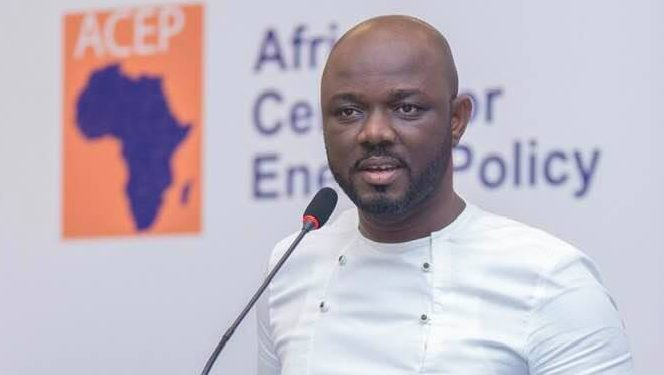
    Ben Boakye, Executive Director of the Africa Centre for Energy Policy

    The Executive Director of the Africa Centre for Energy Policy, Ben Boakye, shared similar views, noting that the findings were not what Ghanaians were promised.

    He said it has become obvious that those in charge now did not condemn sole-sourcing in the past out of concern for the public interest, but because they were not the decision-makers and beneficiaries at the time; now, they are benefiting from it.

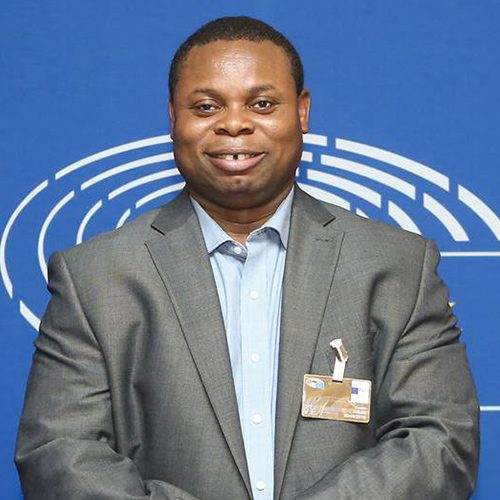
    franklin cudjoe, president of imani africa

    Imani Africa’s president, Franklin Cudjoe, decried that it had become increasingly clear that the current public procurement system is a major revenue leakage point for the government.

    “We know the integrity of the procurement process has been compromised by weak institutional and regulatory frameworks, inefficient quality assurance measures, and a cultural tolerance for abuse and unethical behaviour of public officials,” he said.

     “We were hoping that these abuses were going to be curtailed in this new reset agenda. With these dizzying numbers, we are lost.”

    vitus azeem, anti-corruption crusader

    Anti-corruption crusader Vitus Azeem told The Fourth Estate that it was disappointing to see that the findings contradict President Mahama’s pledge in the State of the Nation Address to introduce legislation that reduces sole-sourcing.

    Mr Azeem noted that “it’s surprising that just one year into power, such situations exist. Because, you see, the procurement law talks of competitive bidding. And sole-sourcing or restricted bidding is not a norm.”

    NDC’s past rhetoric on sole-sourcing

    Samuel okudzeto (l) ablakwa and sammy gyamfi criticised the previous administration for abusing sole-sourcing

    While in opposition, some leading members of the NDC deplored the Akufo-Addo administration’s abuse of sole-sourcing.

    In May 2024, MP for North Tongu, Samuel Okudzeto Ablakwa, now Foreign Affairs Minister, said Dr. Mahamudu Bawumia had engaged in “deplorable conduct” on the allegation that a contract had been awarded to a company said to belong to the former Vice President’s siblings on a sole-source basis.

    Sammy Gyamfi, CEO of GoldBod, who was then the National Communications Officer of the NDC, reiterated Agboza’s concern that inflated sole-sourcing contracts were causing Ghana to lose billions of cedis. He made this claim in one of his moments of truth series on TV in August 2024.

    A year into the Mahama administration, the government’s sole-sourcing record in the road sector alone shows the government may be copying from the very script NDC officials criticised and condemned.

  • NSS Scandal: Acting National Service Boss Felix Gyamfi reassigned to Finance Ministry

    NSS Scandal: Acting National Service Boss Felix Gyamfi reassigned to Finance Ministry

    The Acting Director-General of the National Service Authority (NSA), Felix Gyamfi, has been reassigned to the Ministry of Finance after serving in the post for seven months.

    Mr Gyamfi was appointed in January 2025 at a time when information about The Fourth Estate’s investigations had raised public concerns about the existence of ghost names in the NSA database and doubts about the institutional integrity of the CSMP/Metric App used in recruiting service personnel.

    The decision to reassign Mr Felix Gyamfi follows what appeared to be a disagreement between him and the Minister for Youth Development and Empowerment, George Opare Addo, about the propriety of the NSA’s CMSP/Metric App, which was reported by The Fourth Estate.

    The Minister had issued a fresh directive for the immediate termination of the system, which has been embroiled in the ghost names scandal. But the acting Director-General, in response, said the system is suitable for the NSA to continue using it.

  • NSS Scandal: Methuselahs and toddlers were paid GH¢ 1.97 million as service personnel– Audit report

    NSS Scandal: Methuselahs and toddlers were paid GH¢ 1.97 million as service personnel– Audit report

    The recent audit report into the “ghost names” scandal at the National Service Authority (NSA) makes damning revelations of how persons whose ages could not have made them national service personnel were registered and paid.

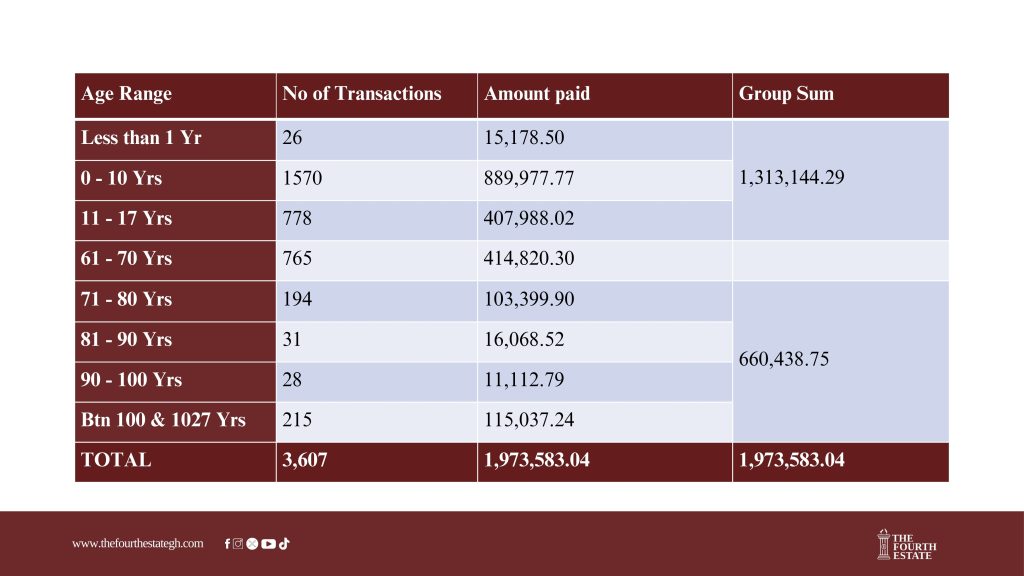
    According to the report, exclusively seen by The Fourth Estate, personnel aged over 100 years, and some as old as 1027 years, were paid a total of GH¢ 115,037.24. Others between zero and 10 years were paid a total of GH¢ 889,977.77 through 1570 transactions. Cumulatively, persons aged between zero and 17 years were a total of GH¢1,313,114.29. While those aged between ages of 61 and 100 years were paid GH¢ 545,401.51

    “Records showed negative ages, such as -3,968 years, enrolled and paid allowances,” the audit report revealed.

    The table below presents the specifics of the age groups, number of transactions per age group, amount paid per age group and group summaries of total payment.

    Source: NSA Audit Report

    These findings from the audit report confirm the details of The Fourth Estate’s investigations published some months ago, which reported that the NSA’s database was inflated with over-aged persons who had been registered and posted as service personnel.  

    For instance, the investigations revealed that 93-year-old Nimatu Salifu was listed as a UDS graduate. She deployed to Kpiyagi D/A Primary School in the Upper West Region in the 2022/2023 service year. In the same service year, 91-year-old Ruth Abdulai, supposedly a Development Studies graduate from UDS, was posted to Adakura Primary School in the Upper East Region.

    Following the investigations, the then leadership of the NSA mounted a spirited defence against The Fourth Estate’s findings.

    For example, the authority issued a statement on December 16, 2024, debunking the allegations of ghost names in the NSA database. The statement said, among other things:

    “Following the series of publications with bizarre allegations against the Authority, the Management of the Authority conducted a quick review of the system and found all the allegations to be untrue.”

    A former Deputy Executive Director of the NSA, who served between February 2017 and September 2018, Henry Nana Boakye, moved from one media house to another, accusing The Fourth Estate of having done a “shoddy work” and “lazy journalism”. This, according to him, was because, contrary to the claims by The Fourth Estate, the NSA system was capable of preventing the claims of ghost names as revealed by the publication.

    Background

    The Fourth Estate’s exposé on the NSS Scandal, published earlier this year, revealed the padding of ghost names in the NSA database and manipulation of posting processes, which caused the government to pay millions of cedis to service personnel that only existed on paper. Beyond revealing the existence of ghost names in the NSA database, the publication raised critical questions about value-for-money, data security, and institutional integrity of the CSMP/Metric App.

    The findings from The Fourth Estate’s investigations prompted the Office of the Attorney General and Minister of Justice to conduct their own investigations, which revealed that the top-level executives of the NSA and their private sector vendors, in a scheme, had mismanaged over 548 million Ghana cedis through Ghost names. The investigation prompted public demand for probity and accountability.

    In response, the Office of the President, through the Ministry of Youth and Empowerment, directed an immediate suspension of the CMSP/Metric App to allow for a comprehensive technical and forensic review.