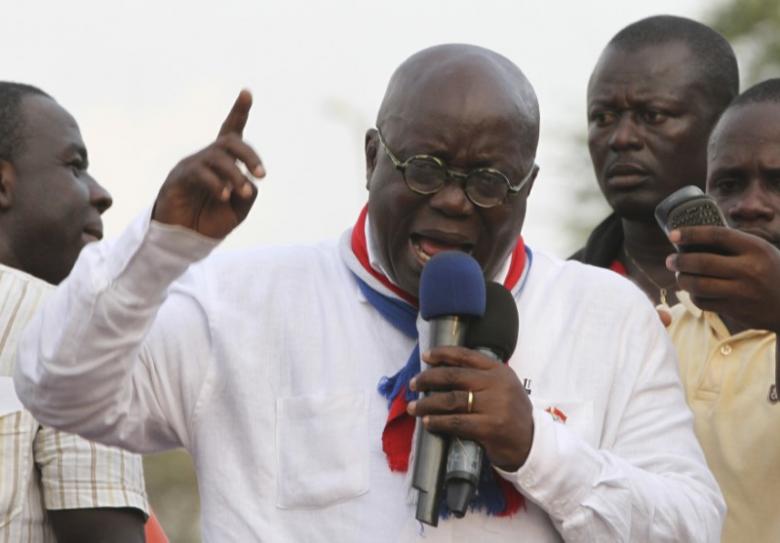
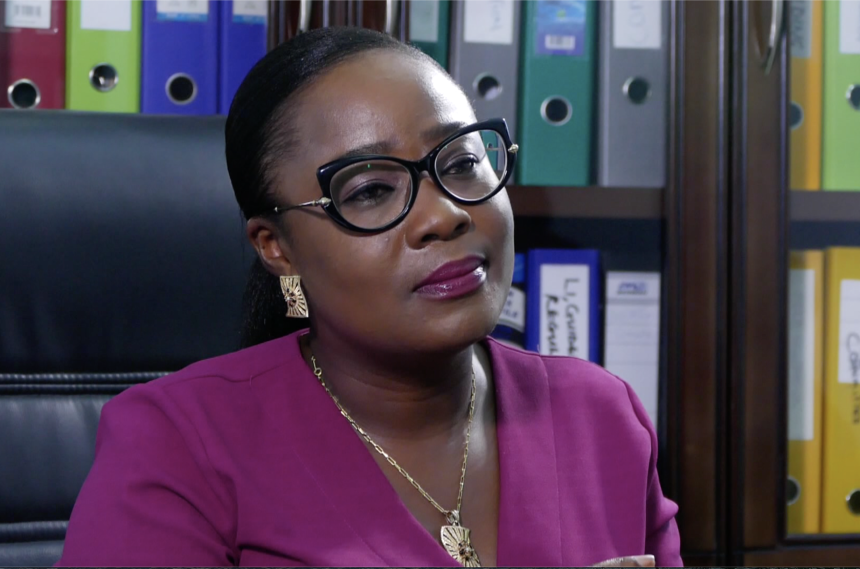
The Minister of Food and Agriculture, Dr Owusu Afriyie Akoto, has challenged the assertion that the prices of food have increased.
The minister says data available to the Ministry of Food and Agriculture does not support the claim that food prices are rising.
“That is a wrong perception. The statistics that we compile in this ministry do not support that [claim]. The size of Kenkey you are talking; this is our fifth year of planting for food and jobs, nobody complains about the reducing size of kenkey until this.” Dr Akoto said responding to claims of hiking food prices at the swearing-in ceremony of the newly appointed members of the Irrigation Company of Upper Region (ICOUR).
Last year, in April, Dr Owusu Afriyie Akoto made a similar argument of food prices dropping when people complained of price hikes following the outbreak of the COVID-19 pandemic.
The Minister’s recent statement has occasioned a debate across various media platforms where many are divided on the issue.
Akufo Addo’s agric minister said, there’s no increment in prices of foods, size of kenkey has not reduced but it’s the perception of Ghanaians.
agric minister be funny man, we we dey buy the beans say the thing come make expensive but you say your statistics dey show otherwise, statistics 3ma protein??
Traders in some selected markets in Accra who were interviewed by the media have labelled the minister’s claim as false.
“The Minister is lying, it’s not true. If you want to know the truth, he should enter into the market you will see what I am talking about. The margarine [measuring cup] of beans is 6 cedis first was 3 cedis; with red oil, it is 16 cedis, the yellow one is 20 cedis but first it was 15, now it is very expensive,” a trader at Kwasia Dwaso in Accra told a journalist of Accra-based TV3.
The General Secretary of the General Agricultural Workers Union (GAWU), Edward Kareweh, who waded into the conversation also said food prices are high on the market, even though Ghana is in a harvest season.
“We should expect prices to go up further. We are in a harvest season and so ordinarily, food prices should have been down. But we are not experiencing that,” he said.
In contrast, the PRO of the Ministry of Food and Agriculture, Bagbara Tanko, has assured that prices of food are going to reduce.
“Reports received from our regional directors on the participation from the Planting for Food and Jobs and even commercial participation show that there will be a bumper harvest. We will not be hungry and the increased harvest is sure to reduce price of food because we will soon be in the midst of plenty. Northern Ghana has started harvesting and the crop season has been excellent. The floods didn’t have a significant effect on crop harvest,” Mr Tanko said.
Fact-Check Ghana has verified the claims about the food prices and presents the facts below.
Data from the ministry of agriculture indicate rising food prices
Data from the Statistics, Research and Information Directorate (SRID) of MOFA available to Fact-Check Ghana indicate a rising trend in the prices of commodities across markets in Ghana.
SRID of MODA compiles weekly prices for some agricultural commodities across selected cities/towns in Ghana. These commodities include maize (white), maize (yellow), millet, sorghum, rice local (perfumed), rice local (non-perfumed), rice imported (perfumed), and rice imported (non-perfumed), Yam (white), Yam (puna), cocoyam, cassava, plantain (apentu), and plantain (apem).
The prices are compiled from 20 markets across the country. These markets include Agogboloshie (Greater Accra Region), Tema (Greater Accra Region), Takoradi (Western Region), Cape Coast (Central Region), Koforidua (Eastern Region), Kumasi (Ashanti Region), Sunyani (Bono Region), Kintampo (Bono East Region), Tamale (Northern Region, Techiman (Bono East), Bolgantanga (Upper East), Wa (Upper West and Yendi (Northern Region).
Below is a table showing the average weekly wholesale prices of some selected commodities from January to October 2021
Source: MOFA, 2021
From the Table above, comparing prices of some of the selected food items from the beginning of the year (January) to October, prices have generally increased for all the food items. Plantain (Apentu) and Plantain (Apem) recorded the highest hike with 74% and 73% increments in prices, respectively.
This is inconsistent with the Agriculture minister’s claim that the statistics available to the ministry does not support the rise in prices of food.
However, comparing the prices of the selected food items in the month of September with October, the data indicate a general drop in food prices. Tomato (Navrongo) recorded the highest drop with 54%. Thus, the data indicate that the Minister’s claim is not entirely false as indeed prices for some of the food items have dropped, just for the month of October.
Finance Minister admits to rising prices
The Finance Minister, Ken Ofori-Atta, at the reading of the budget statement for the 2022 financial year on November 17 admitted that prices of food items have gone up in the last two months. The hike in food prices, according to him, has accounted for the rise in inflation.
The finance minister outlines farming input supply challenges, delay in harvest and climate-related factors as reasons for the rise in prices of food. Mr Ofori-Atta said this in paragraph 33 of the budget statement.
“Mr. Speaker, headline inflation declined sharply from 10.4 percent in December 2020 to 7.5 percent in May 2021, broadly reflecting well-anchored inflation expectations, exchange rate stability and favourable food prices. However, inflation picked up to 10.6 percent in September 2021 on account of shocks from domestic fuel price adjustments and increasing domestic food prices arising partly from climate-related factors, input supply bottlenecks, delayed harvests, and world food price increases,” he said.
“I don’t care where the letter is coming from. Drop it in that box and leave. There is COVID-19. I will not sign anything!”
With those words uttered in very harsh tones, a receptionist at the Ministry of Education dismissed a journalist from The Fourth Estate.
No amount of explanation, including the fact that the letter was a right to information (RTI) request and needed to be acknowledged, would make her budge that afternoon of March 29, 2021.
She ranted, insisting no letter was moving beyond the airconditioned reception on a day the sun was at its fiery worst.
The letter was one of 36 requests The Fourth Estate made to 33 public institutions. Those requests were a test of the efficacy of the Right to Information (RTI) law, which had been described as an antidote to corruption.
Needless to say, the Ministry of Education, where the receptionist works, is one of the institutions that refused The Fourth Estate access to information 14 days after the letter was submitted.
When Parliament passed the RTI law in 2019, its main advocates–the media, civil society groups and anti-corruption campaigners–touted it as another arsenal to crush corruption. They said it would increase transparency in the government, ensure proactive disclosure of information and set rules for requests and responses.
Passing Ghana’s RTI law did not come easy. It had triggered political promises and failures before and after elections.
From the outset, it appeared successive governments did not want to open up for scrutiny through the RTI. But civil society organisations moved from push to shove. And finally got it done.
The journey
In 1996, a leading governance think tank in Ghana, the Institute of Economic Affairs (IEA), wrote to the Bank of Ghana (BoG) to request information. The IEA made the request in the exercise of its fundamental right to information as enshrined in Article 21 (1) (f) of the 1992 Constitution. The request was to test a law that hadn’t been given the opportunity to even fail.
That request triggered what has been arguably the longest advocacy for the passage of a law (the RTI law) in recent years. It would take 19 years for Ghana to pass a law that Sweden approved in 1776.
The IEA drafted the RTI Bill in 1999. It was reviewed in 2003, 2005 and 2007, and presented to Parliament in 2010.
The bill gathered momentum in the dying embers of the Mahama administration in 2016 but hit a snag. Members of the opposition New Patriotic Party (NPP) protested the timing of the intended passage of the bill. The NPP had won the 2016 elections and suspected that the outgoing government wanted to set traps with the law.
However, in 2019, after another round of sustained pressure from civil society, the Akufo-Addo administration passed the law. Ghana joined a global league of more than 100 countries that had passed the RTI law.
Fifty-six (56) days after the passage of the bill, on May 21, 2020, President Akufo-Addo assented to it within 24 hours of receiving the law. The assent was broadcast on national television.
“I am very happy that this law has finally been passed, and I did make the commitment that, when it was brought to me, I would give my assent to it right away. It was, in fact, brought to me yesterday afternoon,” the President said.
“But, on second thought, I felt that I should sign it in the plain view of the Ghanaian people, for you to know that this long, winding parliamentary process has finally come to an end,” he added.
The passage and assenting of the RTI law (Right to Information Act, 2019, Act 989) drew commendations from many local and international stakeholders and civil society organisations.
The law, which took effect on January 2, 2020, is expected to make it easier for the public to request and receive information from public institutions in Ghana.
But it is beginning to dawn on civil society and the media that the celebrations were premature. Very few people are using the law and very few institutions are willing to release information.
Testing the law
Between March and July 2021, The Fourth Estate put the Right to Information Act to a litmus test. The objective was to assess how effective the legislation was being implemented in public institutions.
The Fourth Estate made 36 requests for information from 33 ministries departments and agencies (MMDAs) working under the three arms of government –-the executive, legislature and judiciary. The Fourth Estate purposively selected MMDAs that are related to the functioning of the RTI law
There was also a focus on institutions that have recently engaged in key activities or projects of crucial concern to national development. In some cases, one institution received more than one request for information.
The following institutions received The Fourth Estate’s requests for information:
Nearly 60% of the applications by The Fourth Estate were refused access to information
The RTI law emphasises time and feedback. It stipulates that an information officer of a public institution must respond to an applicant within 14 days of receiving the request for information. The response must indicate if the information requested is available and whether access will be granted or not.
“Where an information officer fails to determine an application within fourteen days after the application is received by the public institution, the application is deemed to have been refused and the applicant has the right to seek redress under sections 31 to 39.” Section 23 (5) of the RTI law states.
At the end of 14 days after making the requests, 52% (17 out of the 33) institutions failed to acknowledge or respond. In RTI terms, they refused The Fourth Estate access to information.
Even though 16 other institutions provided feedback to The Fourth Estate’s applications, not all of them followed up with granting us access to the information. Many of them merely acknowledged the requests but failed to provide the information.
However, the following institution must be separated for commendation. They did not only respond to The Fourth Estate’s application but granted access to the information within 14 days.
Internal review
In the case of refusal and neglect to provide the information requested, Section 31 of the law provides a pathway—application for internal review:
“Except as otherwise provided in this Act, a person aggrieved by a decision of the information officer of a public institution may submit an application for internal review of that decision to the head of the public institution.”
The Fourth Estate followed the process and made an application to the heads of all the institutions whose information officers did not respond to the requests or failed to give us the information requested.
The heads of the institutions included sector ministers, the Speaker of Parliament, CEOs and managing directors of state-owned enterprises. Some of the institutions provided the information following the appeal. In the case of Parliament, The Fourth Estate did not only write an internal review after the initial application, but it also wrote a reminder letter.
This means The Fourth Estate wrote three times to the institution that passed the RTI law before the information was finally granted, a case of the priest not believing in his own sermon.
Some of the responses received following the internal appeal to the heads of institutions revealed the lack of awareness and understanding of the RTI law among public institutions. They also underscored the general aversion to transparency and how the internal communication structures of the civil service are set up to block such requests.
A general aversion to releasing information despite the existence of the RTI law
The spirit of the RTI law encourages proactive disclosure of information. The law stipulates that public institutions must publish periodically a manual providing key and specific pieces of information relating to their work. The manual has not been produced by any public institution yet.
Section 18 (5)] of the RTI law envisages that institutions guide applicants in making their requests as they may not have detailed knowledge about the work of the institution:
“Where an application does not sufficiently describe the information required, the public institution to which the application is made shall so inform the applicant and offer the applicant the necessary assistance to identify the information.”
GETFund
The Fourth Estate wrote to the GETFund requesting the list of scholarship beneficiaries and the amount disbursed to them under the Fund for 2019 and 2020. The request also included a list of education infrastructure the Fund had sponsored from 2016 to 2020.
The GETFund, after failing to make a determination on the request within 14 days, hand-delivered a letter signed by its Administrator to the premises of The Fourth Estate.
“The response to your letter is ambiguous,” the letter said.
But a lecturer at the Ghana Institute of Journalism and RTI advocate, Zakaria Tanko, differed with the GETFund.
“These are all legitimate requests, and the request is going to a public institution. I can confidently say none of this is exempt [not supposed to be released] information,” lawyer Tanko said.
Similar responses were received from many institutions.
Ministry of Sanitation and Water Resources
The Fourth Estate requested a copy of the contract on the regional waste recycling plant from the Ministry of Sanitation and Water Resources. It made the request following news reports that the contract was between the Government of Ghana (GoG) and Jospong group, hence stated that the Ministry provided it “contracts for the construction of regional waste recycling plants between the Government of Ghana and the Jospong Group.”
However, the Ministry, in a letter signed by Anthony Komla Dovlo, responded blankly stating that “there is no contract between the Ministry of Sanitation and Water Resources, and for that matter, Government of Ghana, and Jospong.”
The ministry ignored provisions of section 18 (5) of the RTI law. It was not interested in providing any further detail on the said contract or either guide The Fourth Estate to know where to access the information.
Ghana National Fire Service
The Ghana National Fire Service denied The Fourth Estate a request for reports on the Accra Atomic Junction Gas explosion, the June 3 fire disaster, and the fire outbreak at the Ghana Revenue Authority office near the Kwame Nkrumah Circle in 2020. The fire service cited ethical constraints.
“Fire reports involving institutions and individuals cannot be made available to you. Legally, we are not bound to release such reports until permission has been granted by such institutions and individuals concerned,” is aid.
“The ethics of our profession does not entreat us to divulge such information to a third party who was directly involved in [the] said incident,” the service added.
Ministry of Works and Housing
The Ministry of Works and Housing declined to release a copy of the Ghana Institution of Surveyors audit report on the Saglemi Housing Project. It also did not grant our request to know the government’s contribution to developing the Saglemi Housing Project since 2017.
The head of RTI at the ministry, Zakaria Musah, said in a letter that the matter was under investigation at the CID and that the request would only be ready after the investigations.
Mr Tanko did not understand what the ministry meant when they say the matter was under investigation.
“For that Saglemi Housing, I don’t know whether the case has gone to court, nobody has been arrested,” he said.
“If you make that request to the police, then the police could say it is subject of investigations. But even that, if the subject is made aware of the content of the information, then you are entitled to receive the information as well. I’m not too sure what level of investigation they are talking about.”
General observations on RTI law’s functionality
Aside from the general unwillingness on the part of public institutions to release information, The Fourth Estate made some other observations based on the responses received from the institutions.
There appears to be a widespread low understanding of the law and the principles on which it functions. Specifically, many of the institutions were conflicted on whether RTI law overrode their Acts, which also guide them on how to release information.
The Ghana National Fire Service provided The Fourth Estate information on fire outbreaks and locations in Ghana from 2016 to 2020 and charged GHs 150.00. They explained that it was the standard fee they charged for the information requested, and so requesting for information under the RTI law was no different. Meanwhile, Section 78 of the RTI law indicates that an applicant only pays for the reproduction of the information requested.
Also, the RTI Commission, in a landmark ruling, directed the Minerals Commission to charge GHs 1.90 instead of the equivalence of $1,000 the Minerals Commission had asked The Fourth Estate to pay based on one of their establishing Acts.
Poor internal communication
The Fourth Estate also observed that poor internal communication channels and red tapeism that characterise the civil service are a major blockade to the functioning of the RTI law. Many of the institutions including the DVLA, GNFS, and EOCO, provided feedback to The Fourth Estate that they did not receive the initial application for information.
Meanwhile, for every application, The Fourth Estate ensured that the officers, mostly front desk officers, who received the request signed or stamped a copy as evidence that the request has been filed. Interestingly, many of these institutions would later find the application after the appeal to the heads of the institutions.
There also appears to be no clearly defined structure or destination in some of the institutions where applications were supposed to go. Indeed, a considerable number of the front desk officers who liaised between the general public and institutions did not know a thing about the RTI law and who must be the recipient of the applications.
Therefore, based on their own discretion, the front desk officers directed the requests to whichever department they were convinced must deal with the request. This creates a high possibility of an RTI application getting missing in a public institution.
The RTI law indicates that an applicant must state in which means they want the information delivered to them. In all the requests, The Fourth Estate indicated that the information be sent to it via email or that we should be invited to pick it up.
More than half of the institutions that granted access invited us to pick up the letters in person even when we had suggested the information should be scanned and sent to us via email. In fact, the EPA’s initial response to The Fourth Estate’s request was sent through the post office box without notifying the news portal that it has been sent.
Law passed, let’s make it work
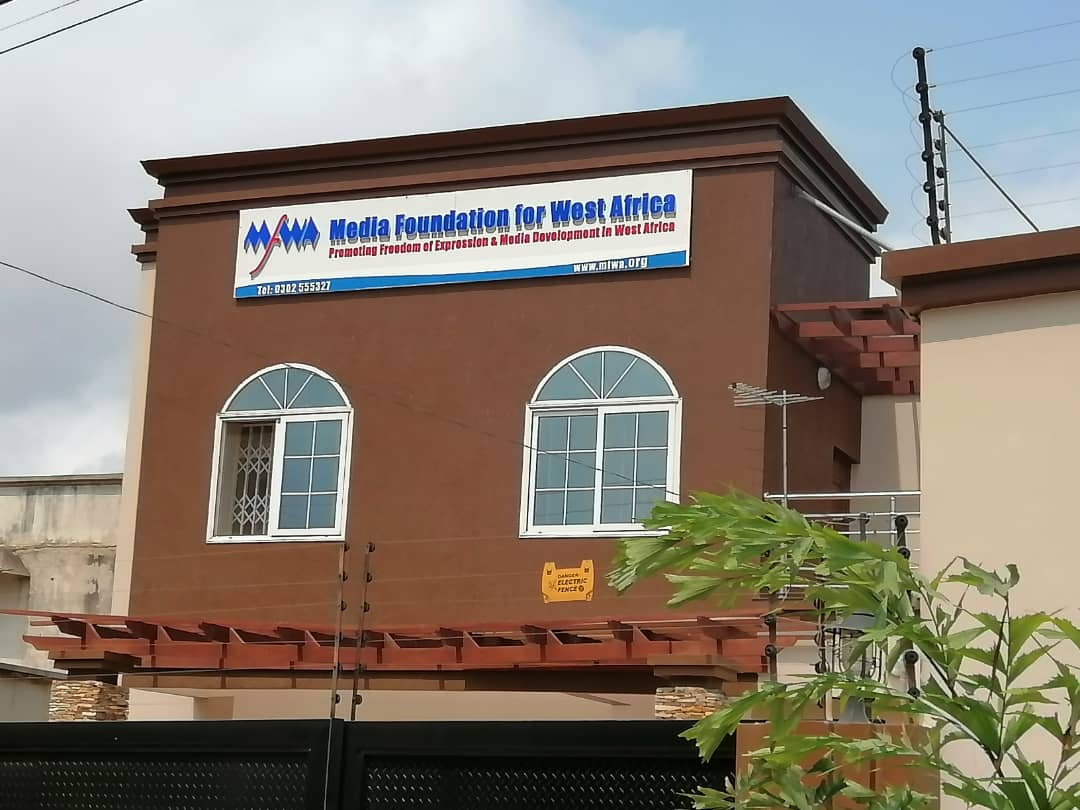
With these teething problems to grapple with, a Programmes officer at the Media Foundation for West Africa, Adiza Moro Maiga, did not mince words.
“Passing the law is not enough. The challenge is getting it running, and effective. If we don’t put in the structures to make sure it is working well and serve the purpose for which it is passed, then it becomes problematic,” she said.
Ms Maiga, who has been on the frontline training CSOs, journalists and community activists on the RTI law, said the challenge has moved from having the law passed to “having it work.”
RTI Commission’s Reviewing
In what is supposed to be the last stage of the appealing process, after the heads of institutions failed to respond, The Fourth Estate wrote to the RTI Commission. The requests were the first the Commission received since it was established in October 2019.
In all, The Fourth Estate made 11 appeals at the Commission against 11 institutions that had either failed to provide full disclosure of information or didn’t respond to our requests at all. Some of the institutions had also transferred our request to other institutions but had failed to follow it up.
At the time of filing this report, the Commission had written to all of these institutions requesting an explanation or justification for denying The Fourth Estate information.
In the cause of the appeals, the Ministry of Education and Legal Aid Commission released partial information to The Fourth Estate.
In an interview with The Fourth Estate, the Executive Secretary of the commission, Mr Yaw Sarpong Boateng, said the challenges with the release of information had been because in the past civil servants swore the oath of secrecy before taking office to protect information within the system.
“This is a novel situation we find ourselves in. Hitherto, people who have operated with secrecy are being confronted with disclosure. We obviously will have some challenges. But with education and time, we will cross the bridge,” he said.
Mr. Zakaria Tanko, who is also a member of the RTI Coalition, said, “The more you make information available to people, the more they want to hold you accountable. The more they will feel empowered, the more you will be called upon to be transparent and open in your affairs and the more issues about corruption will be in the spotlight.”
He continued: “If you want to find out why it was difficult to pass the right to information law, it is because of the fear of the unknown. It is like you are arming your enemies. During training with some MMDCEs, they were clearly angry with the government for passing the RTI law because even without the right to the information, they claimed they were being harassed by journalists and now the media is being given ammunition.”
There was the usual cacophony at noon—a cocktail of voices hurling the names of their wares at passersby, pockets of people haggling over the prices of goods, and the occasional blaring of horns from vehicles to warn those who spilled carelessly into the narrow streets.
But these scenes were not new to Thomas, 23. His full name, Thomas Partey, immediately brings to mind the Arsenal and Black Stars midfielder. They are cousins.
Like his cousin the footballer, Thomas was used to noise and chants as he worked to earn his daily bread. While Thomas, the soccer star, delivers passes in boots to the satisfaction of football fans, Thomas Partey, a courier, delivered goods in a wheelbarrow from the market to the destinations of his customers.
At about an hour past noon at the Krobo Odumase market on May 22, 2019, he delivered some goods to a client near the district assembly building. While returning to the market, he was met with a deafening uproar of voices, clamouring, yelling and chanting at the same time. This was louder than what he was used to at the market. A teeming group of young people, clad in red, was heading towards the district assembly.
The crowd was protesting what residents considered high electricity charges in the Lower Manya Krobo municipality. The electricity distribution company, PDS, in the company of the police, had commenced a power disconnection exercise of some communities in the municipality because of unpaid bills.
The young people were marching to the office of the municipal chief executive to press home their grievance when they clashed with the police. They threw stones and sticks while the police returned with live bullets.
Thomas, who had dropped out of school to focus on his dream of becoming a businessman, pressed on to get to work in the market despite the mayhem. But he was already caught up in the police-protesters exchange. And he would never get to the market again.
A policeman shot him.
“He shot him in the back and the bullet appeared at the chest,” Wilfred Sam Partey, retired educationist and father of Thomas Partey, told The Fourth Estate how his son died.
“I don’t know much about guns, but the distance between where the boy was standing and where the police fired the gun was about 80 to 100 metres,” Sam Partey added.
In a provisional report on the shooting signed by Superintendant Michael H. Addae, the police explained the incident, without admitting they shot Thomas.
“The police tried several times preventing the youth from entering the assembly premises, but they resisted and rather attacked the police by throwing stones, bottles and other dangerous objects at the police, with others armed with machetes and knives advancing fiercely, threatening life and property, amidst the firing of guns,” the report said.
“In the process, the police also fired warning shots to disperse them, but they refused to retreat and were still firing. Later, it was detected that a man, aged about 23 years, who was among the protestors, sustained serious injuries in the chest. But the name of the victim was not immediately known,” the report concluded the report without naming Thomas Partey.
Thomas Partey was rushed to St Martin De-Porres Hospital at Agormenya for treatment but was pronounced dead on arrival. His body was deposited at the morgue of the same hospital for preservation and autopsy.
Thomas Partey had a dream of becoming a prominent businessman through his courier work
An autopsy report dated May 25, 2019, and signed by Chief Superintendent Dr O. Owusu Afriyie of the Police Hospital, confirmed that Thomas died from a gunshot fired at a close range. The report said he died from a “severe chest injury and haemorrhagic shock”.
Aside from Thomas Partey, seven others were severely wounded.
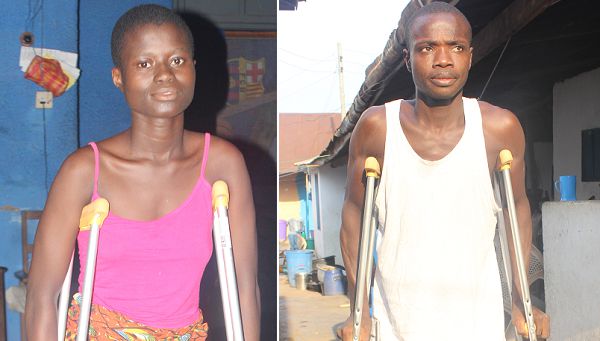
Ruth Mankattah, an 18-year-old student of the Odumase-Krobo Anglican Junior High School (JHS), who was preparing to write the Basic Education Certificate Examination (BECE), was shot in the right knee. Her left leg suffered a minor injury from another bullet.
Her right leg was later amputated.
Ruth Mankattah, 18, (left), now an amputee, and Kortey Tetteh are two surviving victims of the shooting at Manya Kpongunor in Odumase-Krobo
Sam Partey, Thomas’ father, said apart from some GH₵ 9,000 he received from the district assembly to cater for the funeral, he hasn’t received any form of compensation or communication from the government, despite having written to the Office of President, The Inspector General of Police, the Minister of Energy and the Commission on Human Rights and Administrative Justice (CHRAJ).
According to Sam Partey, the then Energy Minister, Peter Amewu, ordered the PDS to act on his petition. But he heard nothing from the company.
“I wrote to the offices that they should seek justice for my son,” he said.
Sadly, not only has Sam Partey been denied justice, he doesn’t even know which officer pulled the trigger on his son.
The killing of Thomas Partey in this manner is not an isolated case. A committee of enquiry is currently sitting to establish the killing of two unarmed civilians and injuries to four others who were wounded by a joint police-military team at Ejura in the Ashanti Region.
They were shot when the youth of the area protested the murder of their colleague, Mohammed Ibrahim, aka Kaaka, by unknown assailants. Kaaka had been threatened for continuously broadcasting on social media broken systems and infrastructure and calling state institutions and the government to fix them.
The killing of the protestors in Ejura adds up to numerous reported cases of police and military brutalities that have claimed the lives of unarmed and mostly innocent civilians.
The Fourth Estate has tracked such incidents of fatal police and military brutality as reported in the media in the last five years. We tracked relatives of some of the deceased for interviews.
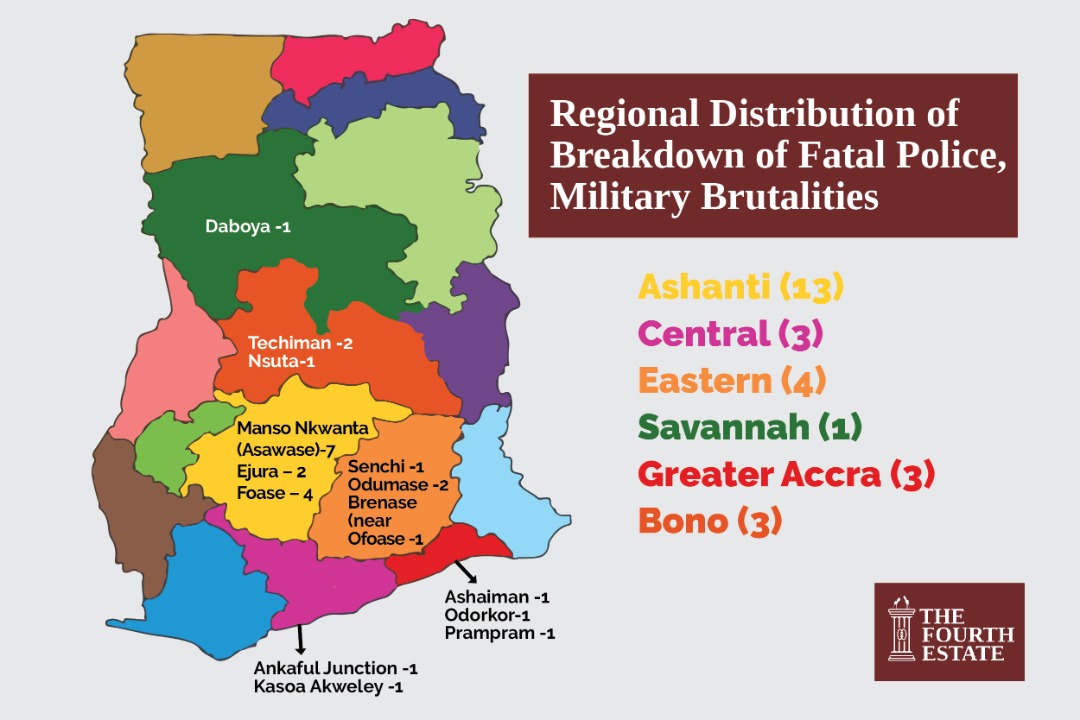
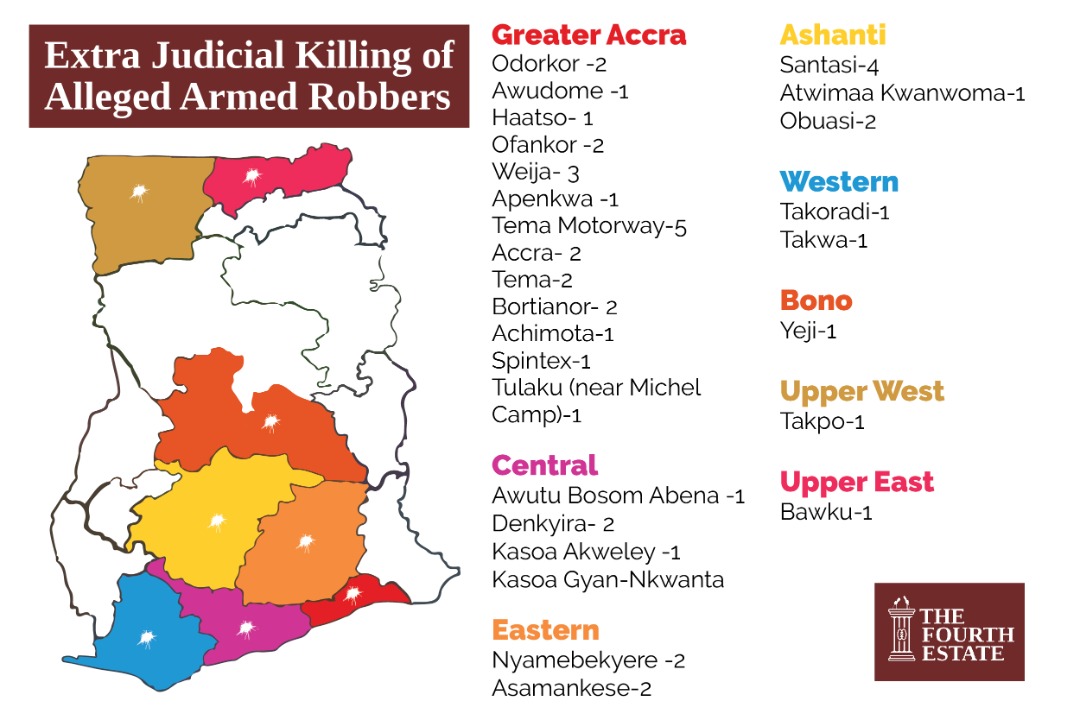
The Fourth Estate counted at least 72 extrajudicial killings by either the police or the military since 2017. More than 120 persons recorded severe injuries from such brutalities within the same period, ranging from broken limbs to amputations.
Twenty-three (23) of these victims were killed when the police or/and the military-controlled protestors, or by stray bullets from the security. Some were also killed mistaken for criminals. In one instance, the killer was identified as a national security operative.
The rest were alleged to be armed robbers who were killed either during “gunfire exchanges” with the police or when they were conducting an arrest.
The number of citizens killed by the police and military may be more in a wider and more comprehensive search.
Below are details of the 23 who were killed by police and military brutalities in the last five years.
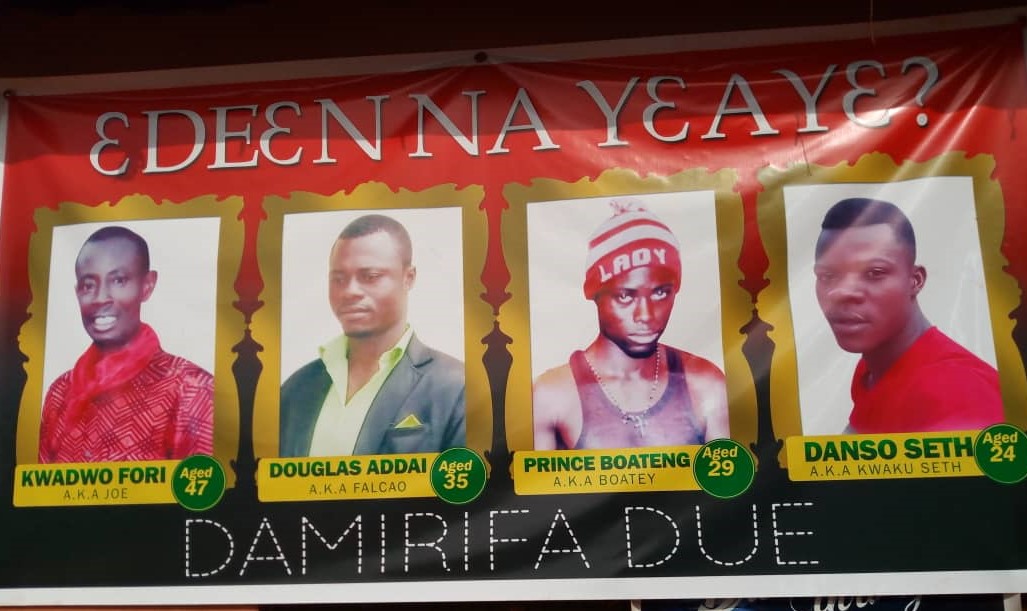
The Foase Four: Kwadwo Fori, 47; Douglas Addai, 35; Prince Boateng, 29; and Danso Seth 24, killed at Foase in the Ashanti Region, on February 7, 2017
These four were allegedly shot and killed by a joint police/military force which fired into a crowd of protestors
The four died after a joint police-military force allegedly opened fire on a crowd protesting against the siting of Atwima Kwanwoma District capital at Twedie instead of Foase. Thirty-two other victims suffered injuries. The government paid GHc 1.4 million as compensation to the families.
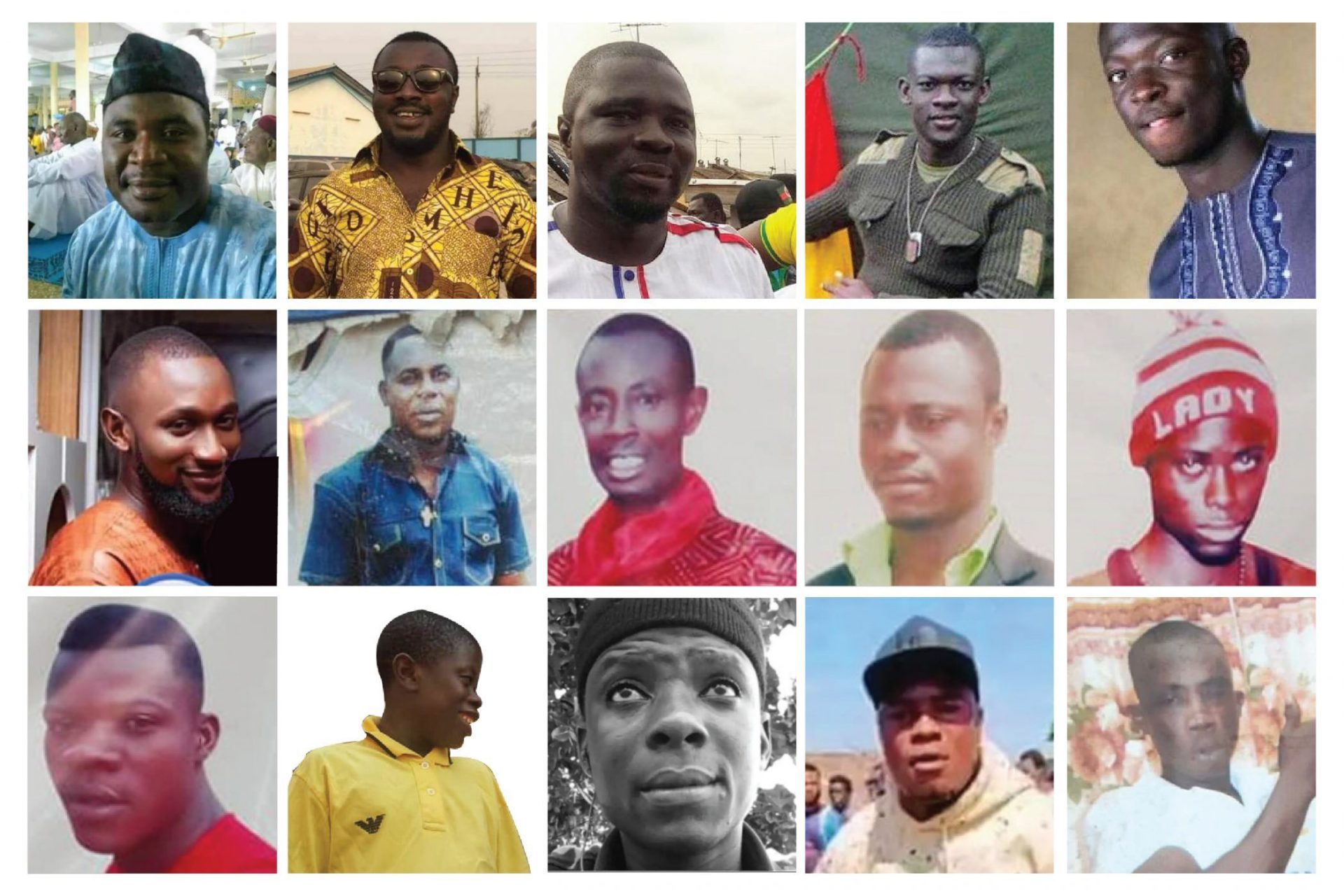
The Asawase Zongo Seven: Musah Seidu, Mohammed Bashir Musah, Mohammed Kamal, Babonte Farar, Razak Sulley, Oliver Konlang and Abdul Hanan Bashir; killed at Manso Nkwanta, Ashanti Region, on July 7, 2018.
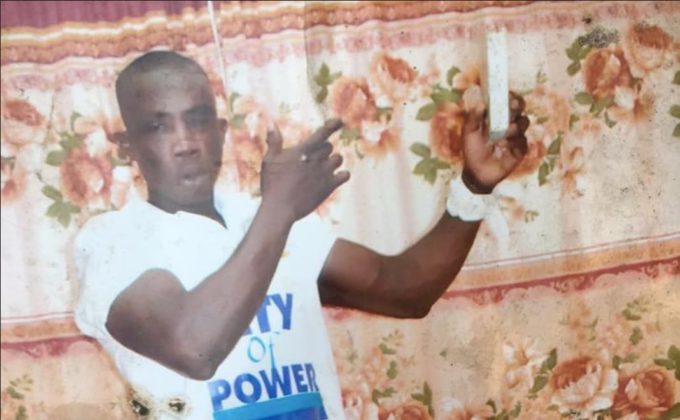
Photos of five of the seven killed in Asawase. Police said they were robbers but there was no evidence to support the allegation.
A police patrol team shot the seven young men in Manso Nkwanta. The Ashanti Regional Police command alleged that they were armed robbers killed during a gunfire exchange with the police. This was sharply contested by leaders of the Zongo communities where the seven resided.
The incident occurred days after a policeman, Lance Corporal Daniel Teiku, while on duty, was shot dead by suspected armed robbers at Ayirebikrom, near Manso Nkwanta. The killing of the seven was therefore believed to be a reprisal by the police. The situation sparked agitation in Zongo communities in the Kumasi metropolis.
A seven-member committee led by Justice Obeng Deawuo, which was set up to investigate the killings, reported that there was no evidence that the seven were armed robbers. The committee’s finding was reported to have led to the interdiction of the 21 police officers involved in the operation. But the 21 are yet to face the law.
The Government paid Ghs 1.750 million as compensation to the families of the seven. Each family received GHc 250,000, but they say that is not enough. They are still calling for justice, three years after the incident.
“The absence of our brother has affected the financial, economic and social wellbeing of our family,” a spokesperson for the family of Musah Seidu told The Fourth Estate.
“He left behind five children, a wife, and two aged parents. His mother died 62 days after he was killed because of the emotional and psychological torture following the gruesome murder of her child,” he said.
The wife of the late Musah Seidu, Humu Abubakar, says she’s still in grief and has had to deal with the torture of her growing children who occasionally ask about their father.
“Three years after his death, my kids continue to inquire about the whereabouts of their dad. I have had to lie to them that he’s travelled. I lock myself and cry anytime the children ask me about him. I have left everything to God because, in Ghana, there’s no justice,” she shared her pain with The Fourth Estate.
“When I saw the killings in Ejura, I remembered my dear husband and the way they put his remains in a pick-up truck, took pictures of him and shared them on Facebook. I know the families of the deceased in Ejura are going through what I have been experiencing,” Humu added.
Emmanuel Osae, 36, killed in Brenase (near Ofoase), Eastern Region, on April 30, 2021
Police shot into protestors who were demanding that a motor rider who rammed into the motorcycle of a teacher in the town should repair the damage. A 36-year-old man, Emmanuel Osae, died after he was hit by a bullet. Three others sustained gun-shot wounds. Residents of Brenase accused the police of firing, unprovoked and indiscriminately.
The Techiman South Killings: Abdallah Ayarick, 18, and Mohammed Kajuden, 41, at Techiman, Bono Region on December 7, 2020
Eighteen-year-old Abdallah Ayaric was allegedly shot to death by the military during the 2020 elections
The two were killed when the military shot at unarmed citizens who had suspected some malpractices in the collation of electoral results in their area and gone to the collation centre to protest. Nine others were recorded to have sustained various degrees of injuries following the shootout.
Abudulai Mustapha, 32, at Daboya, Savanna Region, killed on November 14, 2019
Mustapha was reported to have been shot and killed by the police after he allegedly stabbed another police officer. He was alleged to be of unsound mind.
Mary Aboagye, 38, at Ankaful Junction, Central Region, killed on January 10, 2019
Mary was killed by a stray bullet during a crossfire between the police and alleged armed robbers. Her husband, Aboagye Okyere, 47, and one other person were also hit but survived.
Nyable Mordzifa, 25, at Senchi, Eastern Region, killed on September 29, 2019
Nyable Mordzifa was accidentally shot by a police officer at the Senchi Police Station in the Asuogyaman District. She was in the company of a group of angry youth who had stormed the Senchi Police Station to demand the release of two members of their community. The two were reported to have attempted to disarm some policemen.
Eric Ofotsu, 28, at Ashaiman, Greater Accra Region, killed on April 5, 2020
A soldier shot Eric Ofotsu to death in Ashaiman during the lockdown
Eric Ofotsu, aka ‘No Yawa’, who, according to reports, was homeless and mentally challenged was shot dead at the Ashaiman market by a soldier during the enforcement of the Covid-19 lockdown protocols.
Eyewitnesses alleged that the soldier had earlier attempted to hit Ofotsu with a stick, but he grabbed it and threw it away and both went their separate ways after onlookers’ intervention. The soldier allegedly rallied his friends later and shot Ofotsu in the head. The Ghana Armed Forces, however, claimed he was shot for trying to disarm the soldier.
Unnamed killed at Odumase Krobo, Eastern Region on July 21, 2018
An unnamed bullion van driver met his untimely death when a police officer who was guarding the money-hauling van shot and killed him accidentally at Manya Kpongnor.
Eyewitnesses said the bullion van driver met rowdy mourners in a funeral procession on the main Odumase Krobo road. In an attempt to clear the road, the police officer, Constable Amidu Osman, fired warning shots. A bullet from his rifle hit the driver and killed him instantly.
A national security officer shot Abass to death at a Collation Centre in Accra during the 2020 election
Ibrahim Abass, a national democratic congress (NDC) activist, was shot and killed at the Odorkor Police Church, which served as the Ablekuma Central election collation centre. His assailant, Collins Quarcoo, alias Kola, was later identified as a national security operative.
Abass died a day later at the Korle-Bu Teaching Hospital, where he was receiving treatment for gunshot wounds.
Richard Aheheto, 36, Akweley Kasoa, Central Region, killed on April 1, 2019
Richard Aheto was reportedly killed by an Ak-47-wielding police officer who was attempting to arrest him. News reports that quoted an eye-witness said the officer chased Richard to his house and engaged in a heated argument with him, which ended in his (Richard’s) killing.
However, a statement released by the police indicated that a patrol team came to restore order in the area but were attacked by a mob including others who tried to disarm an officer.
Muntala Mohammed, 26, Abdul Nasir Yussif (aka Di Maria), at Ejura (Ashanti Region), killed on June 28, 2021
The brutal killing of these two, Murtala Mohammed (left) and Nasir Yussif, in Ejura is the latest incident to rake the conscience of the nation
The two were killed when a joint police-military force opened fire on the youth who were protesting the murder of their colleague, Ibrahim Mohammed Iddrisu (Kaaka), a social media activist. Four other people sustained serious injuries. A 16-year old boy had his leg amputated as a result.
On July 3, 2021, a delegation led by Vice President Dr Mahamudu Bawumia visited Ejura to commiserate with the families of the deceased. The delegation included National Security Minister, Albert Kan-Dapaah, and the Ashanti Regional Minister, Simon Osei-Mensah.
On behalf of the government, the vice president presented a cash amount of GH¢20,000 to each of the three bereaved families (including Kaaka’s) to help them in the performance of funerals of the deceased.
The government has instituted a 3-member committee that is probing the situation that led to the killings in Ejura.
A cross-section of Ghanaians and civil society organisations have expressed concerns about what they call the worrying line of questioning by the committee. The committee’s concentration on the media reports as the possible cause of the protests instead of the killing of the protesters has led many Ghanaians to conclude that nothing much would come out of it.
And it doesn’t appear such killings would stop, especially because the perpetrators are often left unpunished.
The June-17 mid-morning judgement by Justice Gifty Agyei Addo on the MFWA-NCA RTI case was the second time the high court judge was dealing with a ‘ghost’ that is likely to haunt again in the near future.
The Right to Information Law Act 989 was brought to life two years ago but without some enabling parts that must ensure the Act functions as the ‘living document’, which the law is. These missing parts are tending to be a haunting ghost.
A year ago, on July 21, 2020, Justice Gifty Agyei Addo ruled on a case on the law brought to her by a lawmaker.
Ernest Norgbey, MP for Ashaiman, had written to the Electoral Commission under the RTI law requesting information on the procurement procedure used by the commission to hire the services of two consultants—Dr Ofori-Adjei, an IT Consultant and Mr A. Akrofi, a procurement consultant. The two were noted to be very instrumental in the EC’s purchase of a biometric voter management system (BVMS). Mr Norgbey wanted to know whether the hiring of the services of the two consultants was in line with the Public Procurement Act, 2003 (Act 663), if indeed the EC hired them.
The EC agreed to provide the information, in principle. But it hedged, in practice. The election management body prevaricated with one of the disabling parts of the RTI law—fees and charges for providing information to applicants.
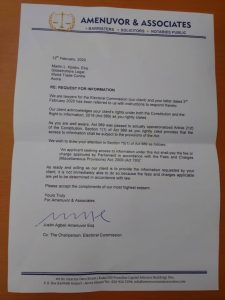
“As ready and willing as our client is to provide the information requested by your client, it is not immediately able to do so because the fees and charges applicable are yet to be determined in accordance with law,” the EC lawyer, Justin Agbeil Amenuvor, wrote to Martin Kpebu, Ernest Norgbey’s lawyer, who had requested the information on the lawmaker’s behalf.
The EC agreed to provide the information, in principle but hedged, in practice | Photo: Citinewsroom
It was a clever move by the EC to uphold the law and undermine it at the same time. Ernest Norgbey would call the move “bogus”, adding “it just shows clearly that the EC wants to hide behind some technicalities and perpetuate the illegality.”
Escape window on the law expected to be air-tight to ensure transparency
The passage of the RTI law was hailed by many anti-corruption campaigners to be the perfect instrument to strengthen the call for transparency and accountability in public service. It was going to enjoin public servants to disclose information proactively, first; and reactionary, second. But the law, which is expected to be an air-tight legal instrument for ensuring transparency, has come with escape windows that may be sealed with time. One of such windows is the fees and charges.
Section 75(1) of the law states:
“An applicant seeking access to information under this Act shall pay the fee or charge approved by Parliament in accordance with the Fees and Charges (Miscellaneous Provisions) Act, 2009 (Act 793).”
However, Parliament is yet to approve the fees and charges under the Law. This was the window the EC attempted to jump away through. The same is what National Communication Authority (NCA) absconded through against the Media Foundation for West Africa (MFWA).
The Judge deals with the Ghost
The MFWA had requested four pieces of information from the media regulator, National Communication Authority, NCA.
The full list of all authorised FM stations as of the second quarter of 2020, indicating the dates of first authorisation, dates of last authorisation renewals, locations, and operational status (on air or off air).
The full list of all authorised television stations as of the second quarter of 2020, indicating dates of first authorisation, dates of last authorisation renewals, locations and operational status.
An explanation for the recent replacement of your published 2020 second quarter report titled: “List of Authorised VHF-FM Radio Stations in Ghana as it Second Quarter 2020” which contained columns for date of first authorisation and date for last authorisation renewal, with one that now excludes the datesof first authorisation and dates of last authorisation renewals.
The full list (name of company, name of radio station, location and frequency number) of all FM radio stations that were shut down following the 2017 FM spectrum audit and in line with the 2018 decision of the Electronic Communications Tribunal.
Like the EC, the NCA invoked the ghost of fees and charges, this time justifying it with one of its enabling statutes, Electronic Communications Act, 2008, Act 775.
“Please be informed that you are required to pay an amount of Two Thousand Ghana Cedis (GHc2000), as per Section 82 (1) (b) of the Electronic Communications Act, 2008, Act 775 to enable us to generate the search report,” the NCA letter, dated August 20, 2020, and signed by its acting director of legal, Dr Poku Adusei, stated.
Dr Poku Adusei signed the letter that requested GHs 2,000 from the MFWA | Photo: NCA
The MFWA disagreed and filed a suit on November 27, 2020, challenging the decision of the NCA. The suit averred that the NCA’s decision was “unconscionably, unjustifiably, unreasonably, unfairly and arbitrarily in breach of specific provisions of Act 989”.
The case would be adjourned to 31st March 2021, and be heard at the Human Rights Court 1.
At the same Human Rights Court a year before, Tuesday, July 21, 2020, Justice Gifty Agyei Addo dealt with the ghost of fees and charges on the Ernest Norgbey vrs EC matter. The court ordered the EC to release the information to its registry within 30 days for the benefit of Mr Norgbey, but the MP should pay Ghs 1,500.
“The inaction of parliament should not prevent the realization of constitutional rights of a person,” the judge said.
Ernest Norgbey, MP for Ashaiman, won his case against the EC, but was requested to pay GHs 1,500 for the information | Photo: Daily Guide
Yesterday, June 17, 2021, on the MFWA vrs NCA case, Justice Gifty Agyei Addo emphasised that specific legislation overrides general provisions of a law and the specific legislation on the matter of fees and charges is the RTI Act 2019, Act 989, section 75. She reiterated her July-21-2020 ruling.
“In the absence of any amount specified by parliament in respect of fees payable by an applicant who seeks access to information, I will refer to my earlier decision in the case of Ernest Norgbey and the Electoral Commission,” the Judge ruled.
But the treatment by the judge is only temporary. The window of fees and charges still remains gapingly opened for any public institution willing to jump. Until the parliament makes the enactment, it is the easiest and perhaps the commonest escape plan for public offices to deny citizens’ fundamental right to information under the law. The only change now is that the RTI Commissioner’s office is functioning and able to address such matters even before the need for the intervention of the court.
Paragraphs 1, 2 and 4 upheld, 3 exempted
The court also made a determination on whether the four requests made by the MFWA were admissible under the RTI law which would therefore mean the NCA would be enjoined to respond.
Justice Gifty Agyei Addo ruled that request numbered 1, 2 and 4 were valid. The 3rd wasn’t.
“I, therefore, conclude that the applicant has the right to be furnished with the information contained in paragraphs 1, 2 and 4 of this request, with paragraph 3 exempted,” she said.
On paragraph 3, Justice Gifty Agyei Addo explained that “from my reading of section 13 (1) [exempt information under the RTI law] vis-à-vis paragraph 3 of the applicant’s request, it is clear that what the applicant seeks is not an information but rather an explanation on the basis of the respondents change in operation.”
“This to my mind does constitute eliciting for an opinion with regards to the internal operations of the respondent and access to information within the context of Article 21 (1)(f) of the 1992 Constitution.”
The explanation needed was not an opinion. The NCA had deleted two columns from its report that suggested an unfair application of the law that led to the closure of some radio stations. The MFWA wanted to know why those columns were taken off after the NCA deleted a report that initially had those columns.
The ultimate victory which cannot be celebrated
The plaintiff, Media Foundation for West Africa, arrived at the courts on the wheels of principle and not necessarily practice. The arrival of the MFWA at the courts was going to cost the organisation more than the $350 (GHs 2,000) the NCA was demanding. But it was a matter of principle and setting a good precedent.
The MFWA emphasised in a statement that it was “convinced that the amount the NCA is demanding is prohibitive and liable to set a bad precedent, and a breach of the fundamental right to access information.”
It, therefore, went to the court to ultimately pray the court declares the NCA’s request for GHs 2,000 as inconsistent with the RTI law, and that the media regulator cannot arbitrarily use their own law to charge fees under the RTI.
“A declaration that the amount demanded is not only unlawful but unconscionably exorbitant in breach of the letter and spirit of Act 989 and Applicant’s fundamental rights to information,” the writ said.
Justice Gifty Agyei Addo granted the plaintiff’s request, in principle.
“Clearly the framers of Act 775 did it [Electronic Communication Act, 2009 (Act 775)] not intend it to be the Right to Information Act. That is why specific legislation was provided for in the Right to Information Act, Act 989,” she ruled.
“The respondent has therefore misconceived the applicability of fees and charges intended for the objects of their enabling statutes as if it is also applicable to request for information under Act 989.”
But the plaintiff wanted more than that. The MFWA wanted the court to establish a fee that would cover only the cost of reproducing the information.
“A declaration that the information requested by the Applicant is not subjected to a charge/fee; or in the alternative, a declaration that if Applicant were liable to a charge/fee, same ought to be an ascertainable amount to cover the actual cost of reproduction or photocopy of the information sought only,” the MFWA averred in its suit.
On this, the court ruled:
“So I come to the conclusion that, the fees payable cannot be under section 82 [Electronic Communication Act, 2009 (Act 775)] but under section 75 of Act 989 [Right to Information Act, 2019]. In any event, there are no prescribed fees as they are supposed to be provided by parliament. Their inaction cannot however deny somebody’s right to information. Therefore, going by the precedent in the Norgbey case, I state that the applicant pays 1,500 for the production of the information it seeks.”
Thus, Justice Agyei Addo scrapped the NCA’s justification of Ghs 2,000 which the regulator had based on section 82(1) of the Electronic Communication Act. She thereafter instituted another fee—one guided by the precedent of the Ernest Norgbey’s case—Ghs 1,500.
In effect, the MFWA has won a principled victory. But the organisation is worried that a 25% reduction of the original cost requested by the NCA is not the good precedent they sought to set for the new law.
“While we can pay the GHC1,500 fees decided by the court, it is important to underline the fact that the right to access public information under the RTI law accrues to all Ghanaians including the lowest income earners. This precedent, can, therefore, discourage or disenable a certain class of Ghanaians from exercising this,” the MFWA registered their displeasure in the ruling.
From this case, it is clear the NCA wanted to use its own law to dictate the fees, which the MFWA should pay. That law, according to the judge, does not apply to the RTI so the NCA lost.
The MFWA is however not happy that in using her discretion, the judge still stated a fee that defeats the purpose of the RTI law. Not many people or institutions can pay so much to request information from public institutions.
The ghost haunts again
They say lightning does not strike the same place twice, but that’s just lighting. The ghost of fees and charges does. Before Justice Gifty Agyei Addo could deal with the second appearance of the ghost of fees and charges between MFWA and NCA on June 17, the ghost came haunting again—this time with more ferocity.
The Minerals Commission repliedThe Fourth Estate’s (of the MFWA) request for information under the RTI Law with a letter, dated June 7, 2021, signed by the acting CEO, Martin K. Ayisi.
“Kindly be informed that in accordance with section 75 of Act 989, Section 103 of the Minerals and Mining Act, 2006 (Act 703)…the application fee payable is the Ghana Cedi equivalent of five hundred US Dollars (US $500) per request. Thus, the applicable fee payable for the above information is the Ghana Cedi equivalent of one thousand US Dollars (US$1000),” the letter stated.
Martin Ayisi, acting CEO of the Minerals Commission, signed the letter requesting The Fourth Estate to pay the equivalence of $1,000 | Photo: graphic.com.gh
The Fourth Estate had requested information on companies licensed to undertake mining in Ghana between January 2013 and May 2021, and companies whose licenses have been revoked or suspended within the same period.
Until Parliament comes out with the right fees and charges, this ghost will continue to haunt and render the RTI law meaningless.
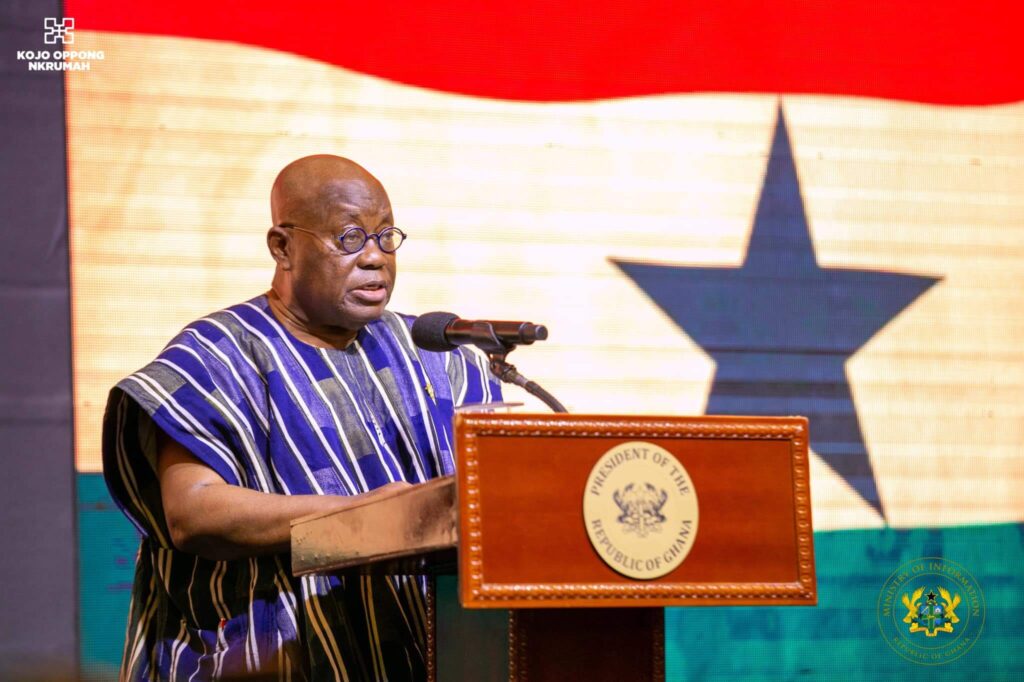
At mid-afternoon on March 9, 2021, President Nana Addo Dankwa Akufo-Addo stood on the floor of parliament and spoke for nearly two hours, reading from about a 26-page document. He was delivering the first State of Nation Address (SONA) in his second term and his sixth SONA since he was first sworn in as President of the Republic of Ghana on January 7, 2017.
Akufo-Addo’s speech elaborated on the achievements of his government across many sectors in his first term. It also outlined a litany of promises his government would deliver in the next four years.
The State of Nation address was elaborate, but it wasn’t long enough to cover something many Ghanaians consider the most crucial variable in the governance and development equation of Ghana—corruption—a word Akufo-Addo was very fond of as opposition leader.
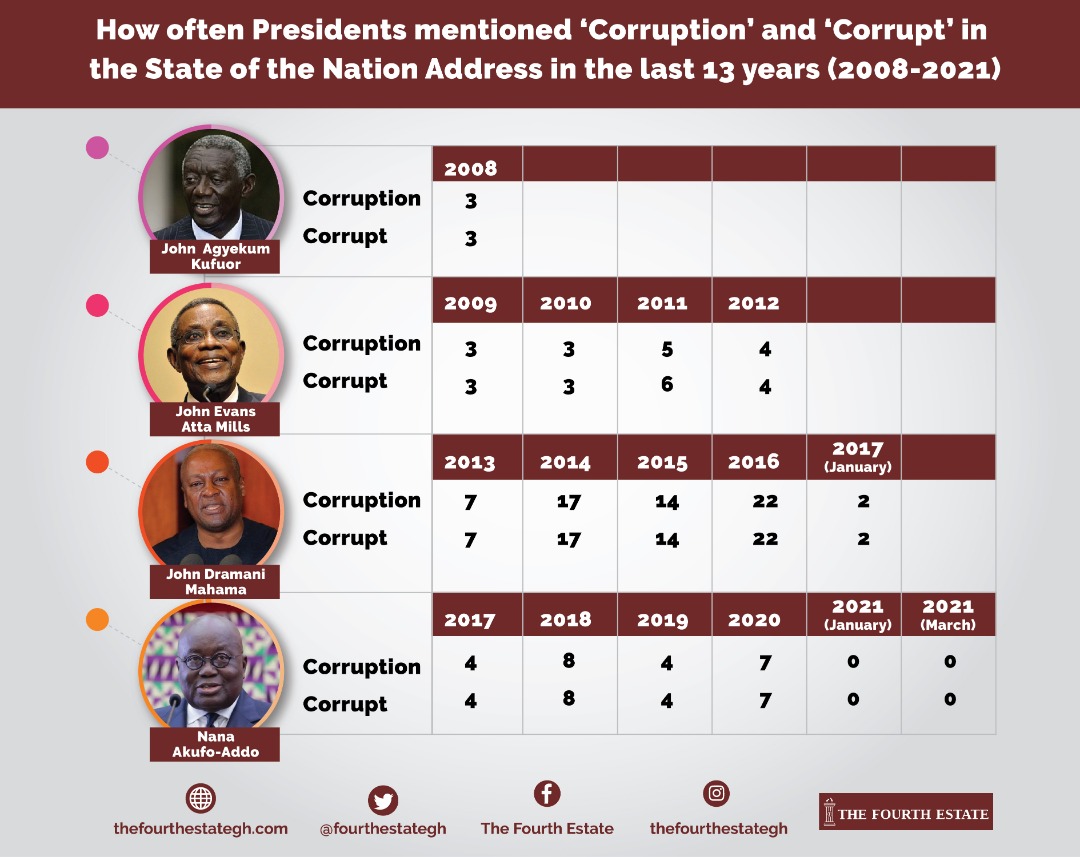
In the over 9,400-word speech, the words “corruption”, “corrupt”, “anti-graft” or “graft” were absolutely absent. And that wasn’t the first time those words were missing in a SONA speech by President Akufo-Addo.
Two months earlier, on January 5, when he visited Parliament to deliver the last SONA in his first term as president, his over 3,500-word speech also failed to address corruption or even mention the word.
This year’s SONA was the first time in 13 years that a president of Ghana had failed to mention the word corruption while giving the State of the Nation Address. Below is a breakdown of the number of times Ghana’s Presidents have mentioned corruption or corrupt in their State of Nation address since 2008.
In the two SONAs, Akufo-Addo delivered this year, the closest the president has come to addressing the theme of corruption is the repetition of the claim that he had increased or doubled the budgetary allocation of some accountability institutions like the Commission on Human Rights and Administrative Justice (CHRAJ) (even though accountability is not necessarily same as corruption). However, Fact-Check Ghana has debunked the president’s claim of doubling the funding of CHRAJ as completely false, stating that the government has barely increased funding for the Commission compared to the allocations in previous years.
The president’s seeming neglect of corruption in the State of Nation address, his government’s impasse with the Auditor-General, the acrimonious resignation of the Special Prosecutor and the rising complaints of intolerance against the government by journalists and anti-corruption civil society organisations have added to the perception that corruption in Ghana is rising.
High Corruption Perception
While the President seems to be shutting up on corruption, which is projected to cost Ghana an average of $3 billion every year, the perception of corruption in the government is rising.
As opposition leader, Akufo-Addo heavily deplored the erstwhile John Mahama administration on the account of corruption and built the 2016 campaign that brought him into power on the subject of corruption. However, the annual corruption perception index (CPI) by Transparency International, which ranks countries/territories based on how corrupt a country’s public sector is perceived, tells a different story.
The report indicates that the worst CPI score under the Mahama-led government is the best CPI score under the Akufo-Addo-led NPP government. Below is Ghana’s CPI score from 2013 – 2020.
Year
Score
Rank
2013
46
63/180
2014
48
61/180
2015
47
56/180
2016
43
70/180
2017
40
81/180
2018
41
78/180
2019
41
80/180
2020
43
75/180
The CPI uses a scale of 0-100, where zero (0) is the highest corrupt perception and 100 is no corruption perception. 1stis the lowest rank of corruption perception among of 180 countries. John Mahama was president from July 2012 to January 7, 2017.
Today, 53%of Ghanaians say the level of corruption in the country has risen over the past year, according to the Afrobarometer. The recent Afrobarometer results also reported that 80% of Ghanaians think either some, most, or all of the President and officials in his office are involved in corruption.
Nana Akufo-Addo built the 2016 campaign that brought him into power on the subject of corruption. Photo Credit: REUTERS/Luc Gnago
Loud corruption rhetoric
In the 2016 election campaign that brought Akufo-Addo into office, corruption was the main weapon with which he slayed the John Mahama administration. He tagged his predecessor’s administration as “incompetent and corrupt”. In the 2016 manifesto of the NPP, Akufo-Addo said his vision for Ghana was one that would combat corruption and build a government different from the erstwhile NDC government.
“Our nation is in crisis: a crisis created and sustained by the mismanagement, incompetence, and corruption of the Mahama-led National Democratic Congress (NDC) government. Economic conditions are worsening by the day and there is so much suffering in the land. But Ghana does not have to be like this. Ghana deserves the best!” Akufo-Addo said in the NPP 2016 manifesto.
He continued, “I have dedicated my life to public service to change Ghana for good. As President, with the help of the Almighty God, I will be committed to a different kind of government, one that governs in the national interest, not for private gain.”
He promised in the manifesto that one of the earliest transformations that would be witnessed in his government was the end to corruption and mismanagement in Ghana. Akufo-Addo had also promised to adopt investigative journalist Anas Aremeyaw Anas’ principle to expose corrupt officials within his government.
“The measures are going to be difficult but there has to be a variety of them…including what I consider the ‘Anas Principle’. Setting up highly motivated professional groups of young people who will work as if you like [as it were] undercover to unearth examples of corruption wherever they can find them and thereby allow the authorities to deal with the issue.
“And not only expose the corruption but you will actually deal with it in terms of sending people to court [and] prosecuting them and hopefully the courts will cooperate and make sure the culprits are found guilty and sanctions appropriately enforced,” Akufo-Addo said in a presidential debate in 2012.
Among other promises to fight corruption, candidate Akufo-Addo promised to amend relevant sections of the Criminal Offences Act, 1960 (Act 29) to make corruption a felony [rather than a misdemeanour] and establish the Office of the Special Prosecutor, which would be independent of the Executive, to investigate and prosecute certain categories of cases and allegations of corruption against political officeholders and politicians.
Akufo-Addo and the fight against corruption
On November 14, 2017, the Parliament of Ghana passed the Special Prosecutor Act for the establishment of the Office of the Special Prosecutor. Two months later, President Akufo-Addo appointed anti-corruption crusader, Martin A.B.K. Amidu, who was a one-time Attorney General when the NDC was in government.
President Akufo-Addo (right) in a photo with Mr. Amidu (middle) and Vice-President Dr. Mahamudu Bawumia (left) Photo credit: Starr
The appointment of Martin Amidu, who had demonstrated an unwavering commitment and earned a towering reputation in fighting corruption in the Woyome judgment debt saga, received a lot of applause from both local and international governance and anti-corruption institutions.
The United Nations Association of Ghana, for instance, said the appointment was a “feather in the cap of the executive” and “evidence that Ghana has really come of age in political tolerance”. The Media Foundation for West Africa (MFWA) also commended the President for the appointment.
“We consider the appointment as a big step forward in the fight against corruption and wish to commend the President for choosing the right man for the job. Mr. Amidu’s nomination is ample demonstration of the President’s true commitment to the fight against corruption,” the MFWA said in a statement.
Two years later, the Akufo-Addo government pushed for the passage of a potentially game-changing law for accountability and transparency. It was the Right to Information Law, a bill that had spent about 20 years on the shelves of parliament gathering dust.
Also, true to Akufo-Addo’s promise, in October last year, Parliament passed the Criminal Offences (Amendment) Bill 2020, categorising the offence of corruption as a felony. This meant that any person found guilty of corruption would go to jail for not less than 12 years and not more than 25 years.
Ghana’s Parliament passed the Criminal Offences (Amendment) Bill 2020 on October 19, 2020 Photo credit: Citi Newsroom
The then Attorney-General and Minister of Justice, Gloria Akuffo, who was present at the third reading of the Amendment said: “The passage of the bill will strengthen the anti-corruption regime in the country and will lead Ghana’s international commitment in the fight against corruption.”
But critics of the president’s anti-corruption efforts have said laws alone cannot win the battle against graft. And some actions taken by the President and the government subsequent to the legislative efforts appear to prove the critics right.
Akufo-Addo nicknamed “Corruption Clearing Agent”
Contrary to the words of the Attorney General, the passage of the laws appeared to be just on paper and did not lead to any greater commitment to fighting corruption.
In the first four-year term of the government, several allegations of wrongdoing were levelled against appointees of the president. They included but are not limited to:
Allegations of bribery by the Minister-Designate for Energy, Boakye Agyarko, at his parliamentary confirmation hearings.
Corruption allegation against the two deputy chiefs of staff at the Office of the President by Kwame Asare Obeng, popularly called Kwame A Plus.
Allegation of corruption against the MD of the Bulk Oil Storage and Transportation(BOST) for the sale of 5 million litres of contaminated fuel to an unlicensed company Movepiina and Zup Oil. This deal was said to have caused Ghana to lose 7 million Ghana Cedis in revenue.
Conflict of interest allegations against Finance Minister Ken Ofori-Atta on the issuance of $2.25 billion bonds.
Visa Scandal issue at Australia 2018 21st Commonwealth Games involving the Deputy Minister of Sports, Pius Hadzide, Director-General and Officers of the National Sports Authority.
Allegations of extortion of $2.6 million from expatriates by the Trade Ministry to offer seats close to the President at the Ghana Expatriate Business Awards (Cash for Seat Saga).
With the state security apparatus seen by many as an appendage of the government and governing party, the National Investitions Bureau (NIB) and the police have struggled to justify the credibility of their investigations after several accused appointees were cleared of wrongdoing.
Apart from the finance minister’s and the Public Procurement Authority CEO’s issues, which were investigated by the Commission on Human Rights and Administrative Justice, the others were handled in ways that drew criticism from the public and civil society as lacking transparency and shielding the culprits.
This perceived lack of independent investigations has seen critics especially, the opposition NDC, tag the president as a “clearing agent”, a tag the president vehemently opposes.
“It is not my job to clear or convict any person accused of wrongdoing or of engaging in acts of corruption. My job is to act on allegations of corruption by referring the issue or issues to the proper investigative agencies for the relevant enquiry and necessary action. That is exactly what has been done since I assumed the mantle of leadership on January 7, 2017,” he said at the 2019 Ghana Bar Association Conference held in Takoradi in the Western Region on Monday, September 9.
Akufo-Addo’s “Anas principle” rhetoric tested
In 2019, Anas Aremeyaw Anas, whose principle the president had once promised to adopt in fighting corruption, released an expose that saw an appointee of the President, Charles Bissue, on tape allegedly taking bribes to sidestep the laid down procedures for the procurement of mining licenses.
While the matter was on the desk of the Special Prosecutor for investigation, the Police CID cleared Charles Bissue, who was the Secretary to the Inter-Ministerial Committee on Illegal Mining (IMCIM), of any wrongdoing.
President Akufo-Addo had promised to put his presidency on the line to fight illegal mining (Galamsey), which is a menacing health and environmental threat to the country. That fight has been dogged with allegations of corruption, including the illegal sale of hundreds of seized mining excavators by the government officials and party members appointed to lead the fight.
No one has been prosecuted. At the National Dialogue on Small Scale Mining, on April 14, 2021, the president said he would not act on hearsay allegations against his appointees engaging in Galamsey.
The opposition NDC has chastised the government for the rising perception of corruption and has called Akufo-Addo the “biggest enabler and promoter of corruption”.
“Instead of punishing his corrupt officials who have been involved in the act of corruption, President Akufo-Addo has turned himself into a chief clearing agent of corruption in his government and has endorsed, whitewashed, and promoted his errant appointees who have been engaged in these corrupt acts,” Sammy Gyamfi, the NDC’s National Communication Officer said in a statement in 2020.
Resignation of Martin Amidu and the hounding of Auditor-General Domelevo
On November 16, 2020, Martin Amidu, the Special Prosecutor, resigned from office citing political interference with the independence of his work. Amidu had commenced investigations into the controversial Gold Royalties Monetisation Transaction arrangement (Agyapa Royalties deal) which many, including the Attorney General of Akufo-Addo’s government, had criticized in an earlier report as not in being the interest of the country. Mr. Amidu, in his resignation letter, accused President Akufo-Addo of being complicit in the corruption in his administration.
“The reaction I received for daring to produce the Agyapa Royalties Limited Transactions anti-corruption report convinces me beyond any reasonable doubt that I was not intended to exercise any independence as the Special Prosecutor in the prevention, investigation, prosecution, and recovery of assets of corruption. My position as the Special Prosecutor has consequently become clearly untenable,” Martin Amidu stated.
In a response to the President’s nine-page reply that denied the allegations of interference, Amidu said he resigned his position as SP “because of the traumatic experience I suffered from the reaction of the President who breached his Presidential oath by unlawfully obstructing me from taking any further steps on the Agyapa Royalties Transactions”.
He further added that “the President whom I trusted so much for integrity only looked like the innocent flower of anti-corruption but he was really the mother corruption serpent under the innocent-looking flower.”
Five months before the resignation of the Special Prosecutor, in June 2020, Akufo-Addo had ordered the Auditor-General (A-G), Daniel Domelevo, to proceed on his compulsory “accumulated” leave. Many anti-corruption crusaders suspected that the A-G, who had been widely hailed for his resolve to surcharge alleged corrupt public officials, was being targeted by the President because he had surcharged the Senior Minister, Yaw Osafo Marfo, for the $ 1 million Kroll Associates deal.
Mr.Daniel Domelevo challenged the president’s order. Also, about 500 Civil Society Organisations (CSOs) across the country commenced a campaign to compel the president to rescind the decision.
“We find the entire episode and the justification for the President’s action regrettable and inconsistent with both the letter and spirit of the 1992 Constitution,” Dr. Kojo Asante, Director of Advocacy and Policy Engagement at Centre for Democratic Development (CDD-Ghana) said on behalf of the CSOs.
However, President Akufo-Addo maintained his position and forced the A-G to take the “accumulated” leave, which some lawyers and labour experts said did not exist in the first place.
In March 2021, when Daniel Domelevo, who was just three months away from retirement, had to return to the office, the Audit Service Board came up with fresh claims against him. The Board claimed that Domelevo was not a Ghanaian, but Togolese. They also alleged he had reduced his age by a year according to a Social Security and National Insurance Trust (SSNIT) form he had filled in 1978, which differed from the original date he had filled when he signed on to SSNIT.
Mr. Domelevo explained that there was a mistake in his date of birth, which had since been rectified, and that the 1961 date was his year of birth, and not 1960, which the board wanted to use.
Amidst these accusations, the President ordered the A-G to proceed on retirement. Again, CSOs called the order from the president unlawful.
“The questions regarding Mr. Domelevo’s date of birth which formed the recent basis for the President’s letter were not handled in accordance with the Constitutional directive in Article 23. The actions of the office of the President and the Audit Service affirm our belief that Mr. Domelevo has been unfairly targeted.”
Critics say the forced retirement of the Auditor-General by the President and the resignation of the Special Prosecutor are dents on Akufo-Addo’s anti-corruption rhetoric and commitment to fighting corruption.
Safety of critical journalists threatened, fear of reporting corruption
In January 2019, Ahmed Hussein Suale, an investigative journalist and key member of Anas Aremayaw Anas’ team, was shot and killed in Accra. Suale had led in the production of the #12 documentary that exposed corruption among many football officials in Ghana and some parts of Africa.
Ahmed Suale was murdered in January 2019
Ahmed Suale had been threatened by a leading member of the governing New Patriotic Party (NPP) and Member of Parliament, Kennedy Agyapong. The MP put the undercover journalist’s photograph on television and ordered that whoever saw him should attack him and that he (the MP) would bear the consequences. He was not touched after the murder of Ahmed Suale.
His death was the pinnacle of deteriorating press freedom and the safety of journalists situation in the country. Some critical journalists whose works are known to expose corruption in public offices like investigative journalist Manasseh Azure Awuni have received multiple death threats. At the peak of the threats, Manasseh Azure and his family had to be moved out of the country to a safe haven. He has since been given a police escort even though the threats on his life continue unabated.
Investigative journalist, Edward Adeti, has been threatened a number of times for exposing corruption
Another investigative journalist, Edward Adeti, who was informed by the police of an assassination plot on his life and that of his family has said there was attention in his home. He believed the threats are related to his investigative piece “Cash for Justice” which implicated a Principal State Attorney in a bribery scandal and an earlier investigation that resulted in the resignation of a Minister of State at the Office of the President, Rockson Bukari.
The worsening press freedom situation, critics say, is cowering into silence many journalists and civil society activists who, until recently, did not have to consider the safety of their lives and their families before publishing anti-corruption and accountability stories.
Sadly, today, six out of 10 Ghanaians think that there is fear, negative consequences, and the risk of retaliation when a citizen speaks out against corruption, according to the recent Afrobarometer report.
EDITOR’S NOTE: This story shall not be republished or broadcast, in part or in full, in any form or shape without the express permission of the Editor-in-Chief.
You can reach the writer via email at [email protected], or on Twitter @KK_Asante.
When the Head of Legal Affairs at Ghana’s Food and Drugs Authority (FDA), Mrs. Cynthia Dapaah-Ntow, was denied admission to the Thomas R. Kline School of Law at the Drexel University in Philadelphia, she was worried and wrote to enquire the reason.
Mrs. Dapaah-Ntow had applied to study the LLM in Healthcare & Pharm Compliance for the Spring Semester of 20-21, but the admission team sent her the following response in an email:
“Thank you for applying to Drexel University. After careful consideration of your application, the Admissions Committee has determined that we are unable to offer you admission.”
Unsatisfied with the response and curious to know the reason for the denial of admission, the FDA lawyer wrote to the university to find out.
“I am passionate about the programme and would want to reapply,” she said in her letter. “I hope you will be kind enough to point to me what worked against me in my last application so I do not repeat the same in my next attempt.”
In a response sent by the Assistant Dean of Enrolment Management, Audrey Woods, on December 17, 2020, the university explained that the denial of admission had nothing to do with her academic credentials.
“We found you to be a very qualified candidate, however, it came to the attention of the admissions committee that you were under investigation for allegations of bribery which is not in line with our values and code of conduct,” the university said in an email to the FDA lawyer.
Details of the correspondence are part of court processes Mrs. Dapaah-Ntow filed to support a case in which she’s seeking an injunction from the court to stop the broadcast of the television version of “The Returned Bribe” an investigative documentary by the Editor-in-Chief of The Fourth Estate, Manasseh Azure Awuni.
“The Returned Bribe” scandal
In November 2020, Manasseh Azure Awuni released an investigative report titled “The Returned Bribe” in which the CEO of the COA FS food supplement, Prof. Samuel Ato Duncan, alleged the FDA attempted to extort money from him when his product gained popularity in the wake of the COVID-19.
In the investigative report, Mrs. Cynthia Dapaah-Ntow was cited in a $200,000 bribery saga. She allegedly demanded a bribe of $100,000 for the CEO of the FDA and another $100,000 for herself.
This happened at the same period FDA, in April 2020, suspended the production license of COA FS, citing breaches in safety protocols.
The CEO of COA FS said he suspected foul play in the FDA’s approach and contacted the Head of Legal to complain and seek advice on how to handle the situation. According to him, it was at a meeting to discuss the issues that Mrs. Dapaah-Ntow demanded the money.
Professor Ato Duncan returned the following day with GHC500,000 (the cedi equivalent of $100,000) for the CEO of the FDA and another GHC100,000 for the Head of Legal.
Prof. Ato Duncan, CEO of COA FS, said he suspected foul play in the approach of the FDA
Mrs. Dapaah-Ntow later called him to come back for the money because the CEO of the FDA had rejected the money.
In that phone conversation, which was recorded, Mrs. Dapaah-Ntow is heard arguing with Professor Samuel Ato Duncan that the agreement was to give both the CEO of the FDA and her (the Head of Legal) $100,000 each. She said her cash of GHC100,000 was far less than the amount agreed.
“And we said okay bring her $100,000. And I asked you a specific question; [about mine] how much? Then you said the same amount,” she is heard in the audio.
“That’s what you said, Prof. We never discussed 100,000 cedis at all… Because $100,000, if you were giving her that, would translate into 587 [587,000 cedis]. Is that not correct? Assuming you were giving her cedi equivalent, that’s 587 [587,000 cedis].”
Prof. Ato Duncan said he thought it was $100,000 for the CEO of the FDA and 100,000 cedis for the Head of Legal Affairs.
Asked why he gave the money knowing that it was illegal to pay a bribe, Prof. Duncan said he suspected foul play and decided to play along. He added that in the process, he was in touch with the Greater Accra Regional Director of the National Bureau of Investigations (NIB), whom he fed updates of the scheme including exchanges between him and the Cynthia Dapaah-Ntow.
Injunction and Defamation Suit and Drama
The radio version of “The Returned Bribe” documentary was aired on the Super Morning Show of Joy 99.7FM on November 12, 2020, and the television version was billed to be broadcast later that night.
Mrs. Dapaah-Ntow, however, applied for an injunction against the broadcast of the television documentary. She also sued Manasseh Azure Awuni, Professor Samuel Ato Duncan and The Multimedia Group for defamation.
In January 2021, lawyers for Mrs. Dapaah-Ntow had asked the court to reject Manasseh’s entry of appearance and statement of defence because they claimed Manasseh had failed to provide his residential address.
The court dismissed their application, stating among other things that the plaintiff had not had any problems with serving any of the processes on Manasseh.
Unsatisfied with the ruling, Cynthia Dapaah-Ntow appealed at the Court of Appeal.
The lawyers for Manasseh and the Multimedia Group led by Samson Lardy Anyenini, repeated their stance that the numerous actions by Mrs. Dapaah-Ntow were only meant to delay the hearing of the substantive injunction application, a charge lawyers for Mrs. Dapaah-Ntow took a strong exception to, leading to heated exchanges in the court.
The Court of Appeal, on March 24, 2021, dismissed her application and awarded a cost of GHC2,000 against her.
The injunction was supposed to continue at the High Court on March 30, but the docket had not been brought back from the Court of Appeal so the case has been adjourned to May 11, 2021.
EDITOR’S NOTE: This story shall not be republished or broadcast, in part or in full, in any form or shape without the express permission of the Editor-in-Chief.
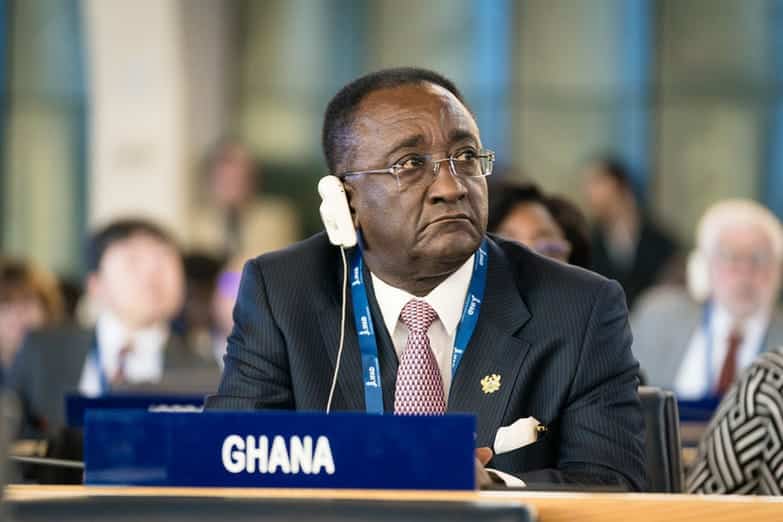

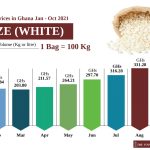
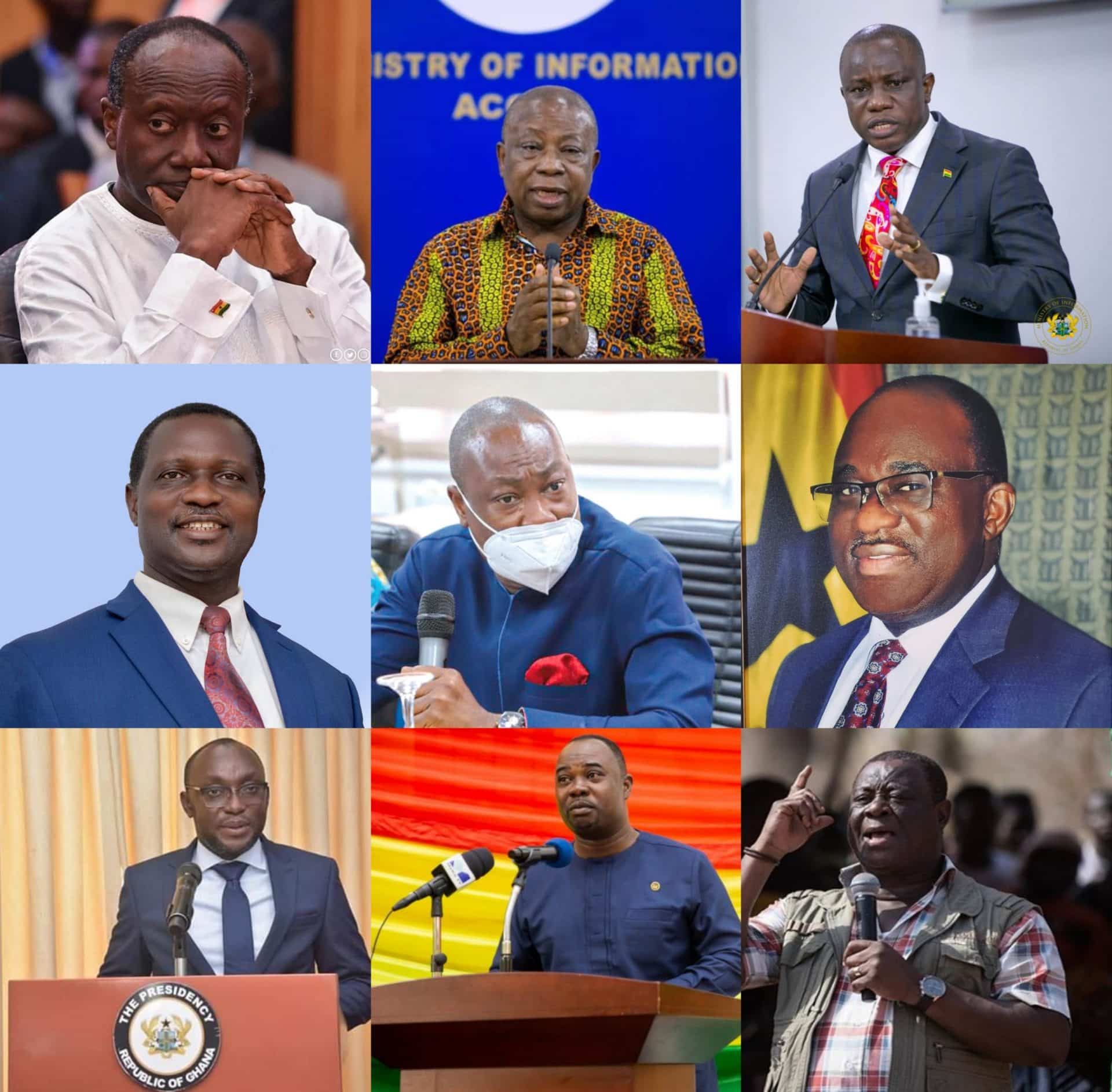
 Nearly 60% of the applications by The Fourth Estate were refused access to information