The Electricity Company of Ghana (ECG) has proposed a 148% increase in electricity tariffs. According to the ECG, the increment is to cover 2020 to 2022, a period that has not witnessed any increase in electricity charges.
The ECG has made this proposal to the Public Utilities Regulatory Commission (PURC) in a report, adding that there should be 7.6% yearly average adjustments between the periods of 2023 to 2026.
“This high increase in 2022 is largely attributable to the cost of investment projects; the gap that has developed over the years between the actual cost recovery tariff and the PURC approved tariffs,” the ECG justified its proposal.
The proposal has occasioned media and political discourse on electricity tariffs and how much they have increased over the years.
In this report, Fact-Check Ghana presents the key facts on how electricity tariffs have changed since 2010.
Since 2010, the PURC has conducted 29 tariff reviews. This has resulted in 11 tariff increments and two tariff decrements. The remaining reviews did not bring about any change in tariffs.
In November 2009 and early 2010 (January-February, 2010), the utility service providers (ECG, VRA, GRIDCo, and Ghana Water Company Limited) submitted proposals to the Commission for upward reviews in tariffs. The PURC, after a review, announced, on May 31, 2010, an average increase of 89% in electricity. This was followed by a 36% increase in water tariffs. The increment took effect on June 1, 2010.
In mid-February 2011, the PURC announced a reduction in electricity tariffs following a review using the Automatic Tariff Adjustment Formula (AAF). The downward review in tariffs, according to the PURC, was a result of the reduction in the cost of production.
“Consumers within the 0-50 units bracket will still pay 9.5 pesewas per kilowatts hour, 51-150 and 151-300 will now pay 15.95 pesewas, down from 17 pesewas while those in the 301-600 bracket will pay 20.7 pesewas down from 21 pesewas,” the Ghana News Agency reported the PURC’s decrement in tariffs. Electricity charges for lifeline consumers were reduced from GHs 1.50 to GHs 1.00.
The decrease in tariffs came into effect in March (2011) but was shortly countered with an increase six months later. In August 2011, the PURC announced a 7% increase in electricity tariffs. This came into effect in September. The PURC increased the electricity tariffs again in December by 3%.
There were three reviews of electricity tariffs in 2012. But none resulted in either an increase or decrease in tariffs. This was an election year. A single review in the following year resulted in an increase.
In 2013, the PURC announced a 78.9% increment in electricity tariffs, which was to take effect in October 2013. This resulted in a nationwide demonstration and agitations by the Trade Union Congress (TUC). The protests led to a reduction of the increment to 58.19% in November 2013.
Following four reviews in 2014, the tariffs were increased three times. Specifically, they were increased by 9.73%, 12.09%, and 6.53% in January, April, and October respectively.
In 2015, the PURC further increased the tariffs by a total of 90.93% after four reviews – two brought no change in the charges. In April, electricity tariffs went up by 31.73% and by 59.2% in December.
From 2016 to 2018, the PURC conducted eight reviews of electricity tariffs. The reviews led to a decrease in tariffs in March 2018. The PURC reduced electricity tariffs for households by 17.5% while reducing it at different rates for non-household consumers and special traffic load consumers.
In 2019, the PURC conducted two reviews of the electricity tariffs. Both reviews brought about an increase. In July 2019, the government increased the tariffs by 11.7%. This was followed by another increment of 5.94% in October of the same year.
The government of Ghana subsidized electricity tariffs by half as part of the COVID-19 relief packages in 2020
The Commission conducted three reviews in 2020, but none led to an increment. The government of Ghana subsidized electricity tariffs by half as part of the COVID-19 relief packages in 2020.
However, that did not constitute a PURC-reviewed decrement as government bore the cost. According to media reports, the ECG, in a document to the PURC, says the government is yet to fully settle the cost.
In 2021, there was no change in electricity tariffs in Ghana. Below is a timeline presentation of changes in electricity tariffs in Ghana since 2010.
Increase and decrease in electricity tariffs since 2010
The Media Foundation for West Africa (MFWA) is calling for entries for the 6th edition of the West Africa Media Excellence Conference and Awards (WAMECA).
WAMECA 2022 will be held from October 20 – 22 in Accra, Ghana, and will focus on the theme: Media and Women Empowerment in Africa.
The first two days of the event will be dedicated to discussing various topics under the theme while the last day will be for the annual awards, which honours the best journalistic works in West Africa.
Participants in this year’s event will explore the role of the media and journalism in addressing the challenges women face in African societies including difficulties related to access to education, finance, health, and technologies; abuses such as domestic violence and child marriages; inequalities in visibility, voice, and participation; among others.
The Awards are opened to journalists from print, electronic and online media in Anglophone, Francophone, and Lusophone countries in West Africa. An applicant must be West African, working with and for a media organisation(s) based in the sub-region.
An entry for the Awards must have been published or broadcasted between the period January 1 to December 31, 2021.
WAMECA 2022 will honour outstanding works of journalism in West Africa in the following categories:
Telecoms and ICTs Reporting
Oil and Gas Reporting
Business and SMEs Reporting
Anti-Corruption Reporting
Health Reporting
Environmental Reporting
Investigative Reporting
Human rights Reporting
Migration Reporting
In line with the theme for WAMECA this year, a new category, Women Empowerment Reporting, has been introduced. The category seeks to recognise and honour journalists in West Africa who had produced analytical and high-quality reports aimed at promoting women and gender equality, amplifying women voices and highlighting women who are breaking the gendered stereotypes in the region.
The deadline for the submission of the entries is on June 30, 2022, at 17.00 GMT. Finalists for WAMECA 2022 Awards will be announced on October 1, 2022.
Interested applicants should upload published works via the entry form on the website: www.mfwa.org/wameca. The entry should be an original work published through a media outlet in West Africa and must show the date of publication/broadcast and the medium in which the work was published. Applicants may submit entries to a maximum of two categories. For each category, a maximum of two entries is permitted.
Winners of the various categories will be announced at the West Africa Media Excellence Awards on October22, at Swiss Spirit Alisa Hotel, Accra where the awards ceremony will be held. The Conference will feature sessions on topical journalism issues and also provide opportunities for networking among journalists, editors, and experts from West Africa.
Below are the important dates:
Opening of Entries – May 3, 2022
Deadline for submission of entries: June 30, 2022
Assessment of entries and selection of finalists: August 1-30, 2022
The 2020 vice-presidential candidate of the opposition National Democratic Congress (NDC), Prof. Naana Jane Opoku-Agyemang, has said her party did not cancel the teacher trainee allowance.
The professor, who was the education minister in the previous administration, made the claim when she addressed members of the Tertiary Education Institutions Network (TEIN), the student wing of the NDC, at the Kumasi Wesley College, on Sunday, April 24, 2022.
“I need to emphasize that we never scrapped the allowance, we never took anybody’s money from them. All those who were receiving their allowances received them till they ended,” Prof. Opoku-Agyemang said.
She added the students who granted media interviews and said they couldn’t pay their fees because there was no allowance were misinforming the public.
“I was saddened by that, that young people could do that because nobody took their money from them. We gave the loan that was about twice what they were getting as allowance because we felt they needed loans,” Prof. Opoku-Agyemang bemoaned.
Her statement has been widely published by many media houses and has also courted social media debates.
Fact-Check Ghana verified the claim and presents the details below.
To verify the claim of whether the teacher trainee allowance was scrapped, Fact-Check Ghana followed a timeline of the government’s key decisions and public reactions to the allowance beginning from 2014.
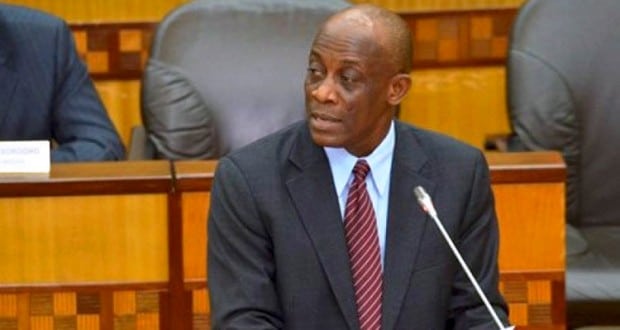
In 2014, the then NDC government announced it was taking measures to ensure effective management of the education delivery. This included a review of the payment of teacher trainee allowance. Seth Terkper, the then finance minister, confirmed the review in the 2014 budget, which was presented in parliament on November 19, 2013.
Seth Tekper announced the government’s decision to review payment of teacher trainee allowance in parliament in 2014 ||Source: myjoyonline.com
“In 2014, the Ministry will take pragmatic steps towards improving quality and enhancing efficiency of the management of education service delivery. Specific measures to be undertaken include cleaning of payroll and rationalization of recruitment; teacher deployment from urban areas to deprived areas; review of payment of teacher trainee allowances; enforcement of policy on zero tolerance for teacher absenteeism and; rationalization of all school fees,” Seth Terkper said.
About three months later, on February 25, 2014, President John Mahama, while delivering the State of the Nation Address (SONA), explained that the review of the payment of the teacher trainee allowance was a transfer of trainees onto the Student Loan Trust. According to the former president, the payment of the allowance was restricting the government from the training of the teachers.
“Mr. Speaker, the availability of teachers has been a major challenge. Because of constraints of paying teacher trainee allowances, Government previously imposed quotas on admissions into colleges of education. Annual admission to these colleges was therefore restricted.
“With the recent decision to transfer teacher trainees onto the Students Loan Trust, it has made it possible to increase the number of trainees in the colleges of education from the previous 9000 to 15000. This would improve the supply of teachers and open up the opportunity to many young people who want to take up teaching as a profession,” President Mahama said.
Seth Terkper, in the 2015 budget statement, reiterated that the replacement of the allowance with student loans had, indeed, resulted in the increase of intake of students at the teacher training colleges.
However, the decision did not sit well with some stakeholders at the teacher trainee colleges. The Teacher Trainee Association (TTAG) embarked on a series of protests against the decision.
“Some of us agitated against the cancellation of the allowance,” Prince Yaw Malba, the SRC President of Bagabaga College of Education told Fact-Check Ghana
The member of parliament of North Tongu, Samuel Okudzeto Ablakwa, who was the deputy minister of education at the time, defended the government’s decision against the TTAG’s protests
“Last year, only 9000 students were admitted; this year more than 15,400 students have been admitted so the irony is that they would not even have been admitted to be agitating,” he stated.
Okudzeto Ablakwa, who was then deputy education minister, defended the government’s decision against stakeholder protests
He, however, promised to continue engagements with the principals of the various colleges to explain the government’s intentions to the students.
“We are still appealing to them to look at the best interest of teacher training in Ghana,” Okudzeto Ablakwa said.
NPP promised restoring, Mahama stood his ground, NDC later made U-turn
Ahead of the 2016 elections, the then opposition New Patriotic Party (NPP) promised to restore the payment of the teacher trainee allowances. The promise was contained in the party’s manifesto.
“Restore in full, teacher trainee allowances,” the manifesto itemized the promise among others on page 32 under the education section.
The NPP’s decision to restore the allowance received applause and support from the campuses of the training colleges.
But President Mahama stood his ground. He intimated his position on the matter when spoke at a forum at the University of Cape Coast in September 2016.
“For purposes of partisan politics, you have your political opponent come and say ‘when we come back, we will restore trainee allowances to colleges of education’. For me, it is better to lose the election on principle than to win it on falsehood,” the former president said.
Four years later, ahead of the 2020 elections, the National Youth Organiser of the NDC, George Opare Addo, was reported to have apologized for the cancellation of the teacher trainee allowance. He admitted on radio in August 2020 that the decision by former President John Dramani Mahama was unpopular.
“Everybody has the right to change his mind, so there’s nothing wrong if former President Mahama believes the decision was unpopular. If he comes he will restore it because it was an unpopular decision and we apologise,” the National Youth Organiser of the NDC expressed remorse.
True to his words, the NDC promised to restore the teacher trainee allowance in its 2020 manifesto.
From the above, it is inaccurate for the Prof. Jane Naana Opoku Agyemang to say that the NDC never scrapped the teacher trainee allowance
Did those on allowance continue to receive them?
The claim by the former vice-presidential candidate of the NDC that the teacher trainee allowance was never canceled is false, however, she is right when she said “All those who were receiving their allowances received them till they ended.”
This was confirmed by some teachers who were trainees at the time the government scrapped the allowance.
“I started the college in [the] 2012/2013 academic year. We were the last batch to receive the allowance. Those who came after our year group [2013/2014], did not receive allowance,” Aliwu Alhassan, a former student of Assin Fosu College of Education, explained to Fact-Check Ghana.
He added that, “we [2012/2013 batch] continued to take the trainee allowance till 2016 when we left the school. Those who came after us never took the allowance till they also left.”
Prince Malba Yaw of the Bagabaga College of Education also affirmed the same point.
“When we were admitted in 2012/2013, we were given allowance. From then onwards, our subsequent juniors admitted after us were not given an allowance. We received our allowance till we wrote our last paper in June 2016,” he explained.
Thus, Prof Jane Naana Opoku Agyemang’s claim that those who were receiving allowance during the erstwhile NDC government continued to receive them till they finished school is accurate. But that doesn’t mean that the teacher trainee allowance was not scrapped. The students who were admitted to the Colleges of Education from the 2013/2014 academic year and afterward did not receive teacher trainee allowance until it was restored by the NPP government.
Barely two years after the last elections, tensions have already started brewing in Ghana’s political space about which party will win the next elections and with which candidate.
President Akufo-Addo’s constitutional two-term limit will elapse on January 7, 2025, making him ineligible to run in the December 2024 election. His party, the incumbent New Patriotic Party (NPP), is hoping to hold on to power beyond President Nana Addo Dankwa Akufo-Addo’s tenure. But that will be determined by the party’s choice of a flagbearer and by maintaining unity.
Vice President Dr Mahamudu Bawumia and Trade Minister Alan Kyerematen are widely considered frontrunners in the race to succeed Akufo-Addo as flagbearer of the NPP.
A former finance minister of the main opposition National Democratic Congress (NDC, Dr. Kwabena Duffour, has recently announced his intention to run for the flagbearer of the party. A former mayor of Kumasi, Kojo Bonsu, has also said he’s lacing his boots for the race. He’s emphasised that his intention to contest must not be misconstrued as hatred against former President John Mahama, whom many consider has already crossed the finishing line for the presidential candidacy race of the NDC.
The jostling for flagbearer positions and the parties’ chances of winning the next election have set the tone for the political discourse and its attendant tensions. The latest addition to this is the Economist Intelligence Unit (EIU) in a report titled “Five Year Forecast: Ghana”.
The report, which was released on April 13, 2022, provides insight into the EIU’s forecasts on some issues and sectors of development in Ghana such as the economy, political stability, elections, and international relations. The forecasts follow baseline studies and observations conducted by the EIU.
The report has provoked heated media and political discourse. Many media outlets and political actors are reporting conflicting accounts from the same 22-page report by the EIU.
GhanaWeb reported that NDC would lose the election should Mahama represent them
For instance, the GhanaWeb in its banner story reported that “NDC cannot win elections with Mahama – EIU”. This was further supported by the statement by the NPP on the report which stated in part that the “EIU implies that former President Mahama’s record of leadership is so poor that if he becomes the candidate, the NDC’s predicted win goes up in smoke”. There were also social media claims.
NDC will lose massively if they present John Dramani Mahama as the Presidential candidate coming 2024- EIB
Myjoyonline.com’s earlier report on the EIU forecast had indicated that the NDC could win the election but not with John Mahama as the presidential candidate. It later changed the headline to suggest that a fresh candidate for the NDC would better their chances and not necessarily NDC losing the elections with Mahama.
Fact-Check Ghana has examined exactly what the EIU five forecast reported, specifically on who is likely to win the next presidential elections.
Who did the EIU forecast say will win the 2024 elections and under what conditions?
In the period of forecast, five years, the EIU expects Ghana’s political stability to endure despite a “highly acrimonious party-political landscape”. In their expectation, the fierce rivalry between the two major parties, NPP and NDC, will continue to the next election. But this rivalry, according to the EIU, will lead to a change in political power.
“We expect a transfer of power to the NDC in the 2024 elections, driven by anti-incumbency factors and public dissatisfaction with the current government,” the report said.
The EIU forecasts that the drivers for the change of power will be citizens’ displeasure with low development, high unemployment, and corruption.
“Our baseline forecast is that ongoing public dissatisfaction with the slow pace of improvements in governance—such as infrastructure development, job creation and easing of corruption—will trigger anti-incumbency factors and push the electorate to seek a change. The NDC therefore stands a reasonable chance of winning the 2024 elections,” the EIU report stated.
Despite overall political stability prevailing, the new government, the EIU predicts, will inherit similar challenges its predecessor faced. The current challenges of the incumbent government, the EIU emphasizes, are public discontent, which stems from “factors such as rising prices (stoked further by the Russia-Ukraine war), unfavourable public-sector working conditions, limited economic opportunities for young people—exacerbated in part by the socioeconomic fallout from the coronavirus—and perceptions of corruption.”
The EIU says these challenges “will continue to fuel sporadic unrest, which will be mostly non-violent and concentrated in urban centres, in 2022-26”.
However, regardless of which party comes into power, there will be continuity in policies in the medium term, the report said. These policies would focus on food security, industrialisation, and economic diversification.
Did EIU say NDC cannot win the elections with John Mahama?
Contrary to many social media posts and news media reports that the EIU said the “NDC cannot win elections with Mahama” the EIU report did not state that the NDC will lose the elections with John Mahama as the candidate. The London-based analysts did not also say Mahama is a spent force.
The report rather says the NDC will improve their chances should they present a new candidate, even though it reckons John Mahama is considering coming back for the presidential race.
“The former president, John Mahama, is reportedly considering running again, but we expect the opposition NDC to try to revitalise its prospects with a fresh candidate,” the report said on page 6.
The mention of John Mahama’s name on page 6 is the only time the report mentioned the former president’s name. The statement quoted above does not in any way suggest that the EIU implied John Mahama had a poor leadership record. This makes NPP’s statement that “EIU implies that former President Mahama’s record of leadership is so poor that if he becomes the candidate, the NDC’s predicted win goes up in smoke” false.
On Thursday, April 7, Vice President Dr Mahamudu Bawmia delivered the much-anticipated lecture on Ghana’s economy.
One of the claims the Veep made at the lecture was that the government had provided free WiFi for students at the Senior High School as part of the government’s digitization agenda.
“For the first time in our history, Government has provided Free WiFi to over 700 senior high schools, 42 colleges of education and 13 public universities,” Dr Bawumia said.
Dr Bawumia delivered the much-anticipated lecture on Ghana’s economy on April 7, 2022
That was not the first time the Veep made this claim. The Vice President has since 2020 repeated the claim about the NPP government providing free WiFi for some educational institutions.
On September 30, 2020, ahead of the general elections, Dr Bawumia said at least 80% of all SHSs in Ghana had been provided with free WiFi. He made the claim in an interview on Accra-based Asempa FM.
“We promised to provide free Wi-fi to our secondary schools and, thankfully, the Education Minister, Dr Matthew Opoku Prempeh, and the Communications Minister, Ursula Owusu-Ekuful, have worked very hard on this. I really salute them for this. At least 80% of all our Senior High Schools have now been connected to free Wi-fi. That is the data we have,” the Veep said.
About a year later, on November 2021, Dr Bawumia said 710 SHSs had benefited from the free WiFi project. He made the claim at the 60th anniversary speech and prize-giving day of Navrongo Senior High School (Navasco).
This year, before the April-7 economic lecture, Dr Bawumia had already referenced the free WiFi project in his public engagements. He repeated the claim at the launch of an integrated online learning (e-learning) programme, which, according to the government, is to deliver courses for the youth and professionals covering artisanal, entrepreneurship, and technical and vocational education and training (TVET).
Government’s promise to provide free WiFi
The initiative to provide schools with Wi-Fi was at the heart of the governing New Patriotic Party (NPP) educational policy that brought them into power in 2016. The promise was captured in page 32 of 2016 manifesto of the NPP.
“Collaboration with the private sector, provide free WiFi coverage for senior secondary and tertiary institutions nationwide dedicated to learning, administration and enhancing the capacity to do research,” the manifesto stated.
In the 2020 manifesto, the party reported that contracts had been awarded for the project to be completed. The 2020 manifesto put the total number of Senior High Schools in Ghana at 722.
“Contract awarded to provide free Wi-Fi connectivity to all 722 SHSs, 46 Colleges of Education (CoEs), 16 Regional Offices, and 260 District Education Offices,” NPP’s 2020 manifesto stated in page 57.
Fact-checking the claims
Using the Right to Information law, Fact-Check Ghana wrote to the Ghana Education Service requesting the number and list of schools that are beneficiaries of the free WiFi project.
According to the GES, as of March 10, 2022, the free WiFi project had been completed in 663 Senior High, Technical and Vocational Schools. The data indicates at the end of 2020, 523 (79%) of the 663 schools had been connected to the WiFi. The remaining beneficiary schools received the government WiFi in 2021.
Thus, Dr Bawumia’s claim, which he has been repeating since 2021, that the free WiFi project has been completed in over 700 schools is therefore inaccurate. The Veep’s claim is inconsistent with data from the GES.
Below is a regional break down of the number of beneficiary schools. The data was presented in the old ten administrative regions.
Region
Number of Schools
Ashanti
100
Brong Ahafo
80
Central
75
Eastern
94
Greater Accra
49
Western
53
Volta
87
Northern
55
Upper East
37
Upper West
33
Total
663
Source: GES
Had 80% of the SHSs been connected to WiFi as of 2020?
Dr Bawumia said, as of September 2020, government had connected 80% of SHSs in Ghana to WiFi. However, according to data from the GES, the claim is inaccurate.
GES indicates that the total number of Senior high/technical vocational schools in Ghana at the end of 2020 was 724; 80% of the number is 579 schools. But the data the GES submitted to Fact-check Ghana indicate that at the end of 2020 it was rather 523 schools that had been connected.
In conclusion, 663 Senior High Schools (SHSs) had benefitted from government’s free WiFi project as of March 10, 2022, according to the GES. This makes Dr Bawumia’s claim, which he has been repeating since 2021, that over 700 SHSs have been connected to the WiFI inaccurate.
Yesterday, Vice President Dr Mahamudu Bawumia addressed an auditorium packed with top government officials, the media, party leaders and the tertiary students wing (TESCON) of the governing New Patriotic Party (NPP).
While his presentation was addressing a Training and Orientation Conference organized by the TESCON in Kasoa in the Central Region, the Veep’s speech was a response to what appears to be a nationwide clamour for his voice on the ongoing economic hardship. Dr Bawumia has over the years touted the government’s strong economic fundamentals.
The Vice President’s two-hour speech, therefore, addressed the economy. It focused mainly on the current macroeconomic indicators of the country and what the government has been doing so far.
Fact-Check Ghana followed the presentation and verified some of the claims. Below are the details.
Claim 1: “Despite these tax reductions, the data shows that revenue collection in nominal cedi terms has increased by 25% annually since 2017.”
Verdict: Completely False
Explanation: In the mid-year budget statement of every year, the Ministry of Finance presents the fiscal performance of Ghana in the previous year. The fiscal performance data include total revenue and grants, total costs, and the fiscal balance. The team compiled the total domestic revenue (without grant) of the country from 2016 to 2020 to ascertain whether there has been an annual 25% increment.
Ghana’s Total Domestic Revenue 2017 – 2020
Year
Amount (GHc)
Year-on-Year Growth (%)
2016
32,537,445,681
–
2017
39,963,042,097
23
2018
46,501,927,375
16.8
2019
52,393,486,520
12.7
2020
53,899,737,919
2.9
Source: Ministry of Finance
From the Table above, it is clear that revenue being collected over years has been increasing. However, it is not accurate that it has been increasing by 25% annually. In fact, since 2017, there has never been a 25% increment in year-on-year growth in domestic revenue.
Claim 2: “In fact, the average rate of growth of GDP from 2017 to 2021. This is the period including COVID when we had 0.4 percent growth in GDP. The average rate of growth of GDP between 2017 to 2021 is 5.3 percent. But this compares with an average rate of growth between 2013 to 2016, when you had no COVID, when you had no Ukraine war, of 3 percent.”
Verdict: False
Explanation: Dr Bawumia’s claim of the GDP growing at an average of 5.3 percent from 2017 to 2021 is accurate. However, the Veep appears to have reduced the average growth rate from 2013 to 2016 by 0.92%.
Below is a World Bank Data on Ghana’s GDP growth from 2013 to 2020. The team sourced the 2021 data from the Ghana Statistical Service (GSS)
Ghana’s GDP growth rate from 2013 – 2021
Year
GDP (%)
Year
GDP (%)
2013
7.313
2017
8.129
2014
2.856
2018
6.2
2015
2.121
2019
6.508
2016
3.373
2020
0.414
–
2021*
5.3
Total
15.663
Total
26.551
Average
3.92
Average
5.31
Source: World Bank & GSS *Average GDP growth by Quarter 3 of 2021
While the 0.92% could be said to be small, it is however a significant growth rate that cannot be disregarded, given that Ghana recorded a lower growth rate, 0.4%, in the whole of 2020.
Claim 3: “The robust growth in GDP has led to a decline in total unemployment. Based on World Bank data, the average unemployment data between 2014 and 2016, stood at 6.29 percent but has declined to an average of 4.37 percent between 2017 and 2020.
Verdict: True, but misleading
Explanation: When cross-checked from the World Bank data, the unemployment rate presented by Dr Bawumia is accurate. However, the Veep appears to be engaging in a cherry-picking exercise, resorting to data that makes the government look good.
According to the 2021 Population and Housing Census, unemployment rate in Ghana is currently 13.44%. The figure is the highest in recent years, having gone up by 6% since 2010. The data was reported in parliament last month, March, by the Employment Minister, Baffour Awuah.
Minister of Employment, Ignatius Baffour Awuah, announced in parliament that unemployment rate is 13.44%
The World Bank data that Dr Bawumia referenced is modeled after the International Labour Organisation’s (ILO) estimates. The 13.44% unemployment rate was compiled by the Ghana Statistical Service, the national statistical office of Ghana, charged to be producing such important pieces of data.
Also, if the Vice President is presenting the state of Ghana’s economy in April 2022, it is misleading to ignore current unemployment figures and focus on what was reported in 2020.
Claim 4: “Reduced electricity tariffs cumulatively by 10.9% compared to a cumulative increase of 264% under the previous government”
Verdict: Completely False
Explanation: This is a claim that the Vice President has made before which Fact-Check Ghana debunked.
According to data from the Public Utility Regulatory Commission (PURC) and media reports, during the tenure of the John Mahama government (2013-2016), electricity tariffs were increased at different rates and at different times.
In 2013, the PURC announced a 78.9% increment in electricity tariffs which was to take effect on October 1, 2013. This resulted in a nationwide demonstration and agitations by the Trade Union Congress (TUC) leading to a reduction of the increment to 58.19% in November 2013.
In 2014, the tariffs were increased at an average rate of 28.35%. Specifically, the tariffs were increased by 9.73%, 12.09% and 6.53% in the first, second and fourth quarters respectively.
In 2015, the PURC further increased the tariffs by 59.2%. Even though there were reports in May 2016 suggesting that there had been an increment in tariffs in the first quarter of 2016, the PURC had, in a press release, indicated that there had not been an adjustment of tariffs in the first quarter of 2016. Below is the breakdown of the increment from 2013-2015.
Year
Percentage Increase
2013
58.19%
2014
28.35
2015
59.2%
Total
145.74%
Source: PURC, Media Reports
Thus, during John Mahama’s tenure, electricity tariffs increment was cumulatively 145.74%. Indeed, an analysis of electricity tariff increment under the Mahama regime by the vice president in 2019 arrived at a cumulative increment of 166%. It is therefore not true that there was a cumulative increase of electricity tariffs by 264% in the erstwhile NDC government.
But has the NPP government indeed reduced tariffs by a cumulative 10.9%?
According to the PURC, in the last ten years (2010-2020), there has only been a reduction in electricity tariffs twice. The first happened in March 2011. And the next was in March 2018, which was under the current government. Under this same government, there have been increments in electricity tariffs twice- in July and October 2019. Below is a screengrab of a table indicating the times the PURC revised electricity tariffs in the last ten years.
Source: PURC, 2020
Year
Review in Electricity Tariff
Increase
Decrease
March 2018
–
17.5%
July 2019
11.7%
–
October 2019
5.94%
–
Total
17.64
17.5%
Source: PURC
In March 2018, the government reduced electricity tariffs for households by 17.5%. About a year later, in July 2019, the government increased the tariffs by 11.7%. This was followed by another increment of 5.94% in October of the same year. Comparing the cumulative increase in electricity tariffs and its decrease, the government has rather increased electricity tariffs by 0.14%.
Claim 5: “I should note that Ghana is the first country in Africa and one of the few in the world to achieve this type of interoperability between bank accounts and mobile wallets.”
Verdict: Completely False
Explanation: This is a claim that the Vice President has made before which Fact-Check Ghana debunked.
The Mobile Money Payment Interoperability is the service that allows direct and seamless transfer of funds from one mobile money wallet to another mobile money wallet across networks. It was developed by Ghana Interbank Payment and Settlement Systems (GhIPSS) with the active collaboration of the telecom industry.
The first phase of the mobile money interoperability system was launched on May 10, 2018 by the Ghana Chamber of Telecommunications, together with the Government of Ghana, the central bank, GhIPSS and commercial banks.
Six months later, on Wednesday, November 28, 2018, the second phase of the project was launched.
However, before Ghana had contemplated this move, Tanzania was already benefiting from the usage of the mobile money interoperability system. The country was the first to launch the system in 2014 followed by Kenya in 2016 and Madagascar in 2017.
Tanzania effectively launched Account to Account interoperability to facilitate payments by mobile networks in September 2014. It followed a two-year engagement among mobile money operators.
Fact-Check Ghana also spoke with some Tanzanian citizens to confirm if, indeed, the type of interoperability between bank accounts and mobile wallets works in the country.
“Yes, it’s very convenient to send money from one’s mobile account to a different mobile account or bank,” Hussein Bin, a photographer and youth activist in Tanzania, said. He added that the “charges for the services differ depending on the bank”.
Asked if the type of interoperability works in Tanzania, Lilian Alex, a programme assistant with the East African Civil Society Organisations Forum (EACSOF), based in Arusha, said “Yes, it does.” She confirmed that she has ever used it.
It is, therefore, not true that Ghana is the first country in Africa to achieve this type of interoperability between bank accounts and mobile wallets.
The finance minister, Ken Ofori Atta, announced the government’s intention to introduce the Electronic Transactions Levy (E-levy) in November last year at the reading of the budget statement for the 2022 financial year.
‘’After considerable deliberation, Government has decided to place a levy on all electronic transactions to widen the tax net and rope in the informal sector. This shall be known as the “Electronic Transaction Levy” or “E-Levy,” Mr Ofori-Atta said.
Ken Ofori-Atta announced the Electronic transactions levy at the reading of the budget statement for 2022
According to the finance minister, electronic transactions, including mobile money, remittances, and bank transfers would be taxed. A portion of the levy, he said, would be used to support entrepreneurship, youth employment, road infrastructure among others.
The announcement of the proposed tax has courted a heated media and public debate, with fierce resistance from some quarters, especially the opposition political parties.
Many financial interest groups have bemoaned the almost lack of consultations prior to the introduction of the levy.
A fisticuff clash between the two sides in parliament on December 20, 2021, symbolised the height of the contestations on the bill at the legislature. While the majority side of parliament is gunning for it, the minority has opposed it with statements, press conferences, and walkouts
The fate of the E-levy, which was meant to come into effect in February 2022 still hangs in balance as parliament has made no progress on its passage. But what appears to be progress, following the public debates and online protests, is the hint that government is considering withdrawing the current bill with 1.75% of the tax rate and replacing it with one with 1.5%.
The government has in the last few weeks started what appears to be nationwide town hall meetings on the E-levy, sensitising the public and hoping to garner support for it.
President Nana Akufo-Addo said in February 2022 that it was necessary to introduce the E-levy to address some fiscal gap challenges created as a result of covid-19. The president’s words are supported by several other government officials such as the majority leader, the deputy majority leader, and other top government officials who have been defending the need for the introduction of the E-levy.
Nana Addo has justified the E-levy saying it is needed to address the country’s fiscal gap challenges
But Ghana is not the only country that is considering taxing electronic transactions. Across Africa, many governments have already introduced some form of E-levy or are considering introducing same.
In this report, Fact-Check Ghana looks at how Ghana’s mobile money (Momo) tax compares with similar taxes introduced in other African countries.
Uganda: Bank transactions not included in tax
In Uganda, there are 27 million registered mobile money users. In May 2018, the government of Uganda proposed a 1% levy on mobile money transactions. Stakeholders in the sector complained that they were not consulted in the policy formulation process. According to a report by Global System for Mobile Communication (GSMA), stakeholder consultation was “rushed”, and many parties including internal technocrats, opposition MPs, mobile money operators, civil society and international organizations were left out of consultations. The Ugandan version of this tax, however, does not include bank transactions. After widespread public outcry and opposition, the government reduced the tax to 0.5% in November 2018.
The tax was introduced in May 2018, by August 2018, overall person-to-person transaction values had dropped by more than 50%, according to the GSMA report. Industry transactions also dropped by 24% that same year. According to the report, many mobile money users had turned their attention to “lower value transactions” such as the use of cash and banks.
The GSMA reports that while mobile money volumes remain optimal, the average transaction values per user have decreased, suggesting that people are limiting the amount of transactions they make using mobile money. At the same time, it observes that larger value tiers, such as industry users have not returned to mobile money, but have remained with the banking system.
Congo: Govt makes U-turn on tax details
In Congo DR, the situation is no different. The tax policy process that resulted in the introduction of a mobile money tax has been described as ‘a chaotic affair’ by the GSMA. The GSMA also reports that local civil society felt the government was only interested in “imposing” policies on citizens instead of consulting. The government introduced a 1% tax in 2019 and was applicable to both mobile money and electronic bank transactions. However, because of the protests that followed the introduction of the policy, the government was forced to review the policy to only cash-out transactions on Mobile-Mobile Payments (MMPs).
By October 2019, mobile money businesses started recording negative results. Mobile money operators observed that people began to withdraw higher values from their accounts, and the number of active mobile money agents started to decline. The government of Congo has since given assurances that it would review the tax.
Cote D’Ivoire: Govt withdraws tax
Similar results have also been observed in Cote D’Ivoire. The government quickly withdrew its 0.5 percent mobile money tax which it introduced in 2018 after widespread public outcry. Many stakeholders including the Federation of Consumers and Stakeholders, deplored lack of consultation prior to the decision.
Alassane Ouattara’s government withdrew the momo tax after widespread public outcry | source: Wikipedia
When the concerns grew, the government came into an agreement with the mobile money service providers to absorb the fees instead of passing them to consumers. As a result of this agreement, the service providers absorbed the tax.
Malawi: Government withdraws tax
The government of Malawi also introduced a 1% tax in 2019 amidst huge public outcry and opposition. The public, key among them being civil society and other consumer groups, argued that tax was going to derail the efforts to promote financial inclusion and discriminate against the poor. In October 2019, the government removed the tax.
Tanzania: Telcos deplore declining revenue after momo introduction
In Tanzania, Telecom companies said they noted ‘an immediate change’ since the government introduced a 0.1 percent levy on mobile money transactions. According to the Telcos, revenues have since been declining drastically because consumers are no more using mobile money services. Describing the situation, the Chief Executive of Vodacom, Hisham Hendi, said “the situation is not good at all”, highlighting the bad situation they are currently facing as a result of the tax.
Benin: Withdraws social media tax, introduces mobile money tax
Benin is currently considering applying its existing digital tax to mobile money amidst wild criticism from the public and other stakeholders. In January 2022, the government of Benin announced that the existing 5% tax on digital services would also apply to mobile money operators, making the country the latest African country to introduce a tax on mobile money services.
The reaction from the public has not been different from the reactions that greeted the introduction of Benin’s social media tax in 2018. That tax was fiercely resisted by the public and later revoked by the government after several days of online protests and agitation. Policy analysts and stakeholders in the sector have criticized the current tax move, calling it “a bad idea” that is “not warranted”.
Cameroun introduced a 0.2% tax on mobile transactions in February 2022, which applies to both withdrawals and deposits. The only exemptions from the tax are bank transfers and electronic transactions carried out to pay tax and customs duties.
As one of the most widely used services in Cameroun among the middle and low-income class, the tax has been criticized as “unfair”. At some time, anti-momo tax hashtag campaigns were trending on Twitter in hopes that the government would reconsider the tax requirements.
The table below shows an outlook of how the E-levy or mobile money has been implemented in other African countries and how the policy has responded to market changes and public pressure.
Country
Originally intended percentage
After public protests
Uganda
1%
– Reduced from 1% to 0.5%
– 50% drop in P2P transactions
– 24% drop in industry transaction
Congo
1%
Replaced with cashouts only
Cote d’Ivoire
0.5%
Withdrawn after public outcry
Malawi
1%
Withdrawn after public outcry
Benin
5% on Momo operators
Implemented under widespread public opposition
Cameroun
0.2%
0.2%
What’s happening in Ghana
The reaction of Ghanaians to the E-levy bill has not been different from how similar tax proposals were received by citizens of other African countries mentioned in this report. Although the government projects a 24% decline in transactions when the levy is finally implemented, preliminary findings published by the bank of Ghana indicate the value of mobile money transactions had dropped by 3.2 billion in December 2021, less than 2 months after the proposal to introduce E-levy. The report further indicates that compared to November, transactions decreased by 3.8 percent.
It is not immediately clear the fate of the E-levy when it is finally implemented in Ghana, but facts from how the levy has performed in other African countries provide valuable lessons for Ghana.
In these countries, widespread complaints and opposition from civil society, opposition political parties, stakeholders, and the general public have modified its implementation, and in some cases, total cancellation.
The Government of Ghana appears bent on passing the bill, but what looks very probable is a reduction in electronic transactions by consumers.
The writer of this report, Redeemer Buatsi, is a fellow of the Next Generation Investigative Journalism Fellowship at the Media Foundation for West Africa (MFWA).
Broadcaster Blessed Godsbrain Smart, popularly known as Captain Smart, has said that Ghana’s first president, Kwame Nkrumah, predicted the Russia-Ukraine conflict.
The controversial TV show host made the claim on the morning show of Accra-based Onua TV on February 25, two days after Russia invaded Ukraine. The date was also a day after the anniversary of the 1966 coup by the National Liberation Council that ousted Kwame Nkrumah’s CPP government.
Captain Smart appeared to be reading verbatim from Kwame Nkrumah’s book “Dark Days in Ghana”
Captain Smart who appeared to be reading verbatim from Kwame Nkrumah’s book Dark Days in Ghana said the first Ghanaian president saw conflict loom years ahead of time.
“What had happened in Ghana was no more than a tactical set-back in the African revolutionary struggle of a type which I had often predicted like Ukraine being attacked by Russia. It’s in this book. Like Ukraine to be attacked by Russia. It’s in this book. I did not write this book. Kwame Nkrumah did,” Captain Smart said.
Still holding the book on live TV and appearing to be reading word-for-word from it, Captain Smart also said:
“I say this to you: Africa rise and defend Eastern Europe for between 2021 and 2023, Russia will attack Ukraine.”
“And we are in 2022. Russia two days ago evaded (sic) Ukraine. We are talking about the man Osagyefo Dr Kwame Nkrumah. Take it or leave it, he’s the founder of this country,” he added, this time addressing his audience on the show.
Captain Smart’s claim follows a wave of misinformation and disinformation emerging on the back of Russia’s invasion of Ukraine, some of which Fact-Check Ghana has already debunked.
The fact-checking team decided to verify the broadcaster’s claim that Kwame Nkrumah predicted the Russia-Ukraine war.
Sovereign State of Ukraine only began to exist in 1991
The Dark Days in Ghana, which Captain Smart read on the show was first published in 1968, two years after the coup that overthrew Nkrumah. In the author’s note, Nkrumah stated that he wrote the book while in an asylum in Guinea to state the facts about the 1966 coup that overthrew his government and to “expose similar setbacks in other progressive independent African states’’.
At the time of writing the book, sovereign Ukraine, as it is today, did not exist. It was an integral part of the Soviet Union or the USSR. It had been part of the USSR since 1922 and was only known as Soviet Ukraine. It only became a sovereign State after it gained its independence in 1991 after the dissolution of the Soviet Union.
Indeed, in 2021, the country celebrated the 30-year anniversary of its declaration of independence from the Soviet Union.
Kwame Nkrumah could therefore not have predicted that Russia would invade Ukraine without having to first predict that the USSR was going to be dissolved. That prediction would have appeared more worthwhile given that the Soviet Union was engaged in the Cold war at the time. The Soviet Union could not have attacked or invaded Soviet Ukraine, which was part of the Union.
Captain Smart added his own words to the book’s text while reading
In fact-checking Captain Smart’s claim, the team got a copy of the Dark Days in Ghana book and compared the words the broadcaster was reading on set with the book’s text.
Screen grab of page 10 of Dark Days in Ghana (1968)
Fact-Check Ghana realized that Captain Smart added his own words to the text in the book. Below is a comparison of the transcript of what Captain Smart said and the original text of the book.
Comparing the texts, it was observed that the broadcaster added his own text “like Ukraine being attacked by Russia” (highlighted in photo above) to cause his audience to believe Nkrumah had written that.
The team further verified another text Captain Smart read on the set which suggested that Nkrumah had called on Africa to support Eastern Europe in the book when Russia invades Ukraine.
“I say this to you: Africa rise and defend Eastern Europe for between 2021 and 2023, Russia will attack Ukraine.”
The text cannot be found anywhere in the book, the team observed. Using text-searching techniques and reading software, Fact-Check Ghana realized that the word and figures “Ukraine”, “2021” and “2023” are not included in the text of the book.
Fact-Check Ghana, therefore, concludes that Captain Smart’s claim that Kwame Nkrumah had predicted the Russian-Ukraine war in his book Dark Days in Ghana is completely false.
Amidst the many videos and pictures emerging online purportedly showing the situation in Ukraine is a video of fighter jets flying in the skies.
The video which is 30 seconds long is being circulated with commentary suggesting they areRussian fighter jetsarriving in Ukraine for the invasion.
Fact-Check Ghana has verified the video and concludes that it is not related to the Russian invasion of Ukraine.
The team took a screengrab of a thumbnail of the video and did a reverse image search. The search revealed that the video first emerged online in May 2020. The video is a rehearsal of Russia’s fighter jets celebrating the 75th anniversary of World War II victory.
The jets were flying over Tushino, near Moscow, on May 4, 2020.
The reverse image search led the team to a video on YouTube published by “GoOn” on May 4, 2020, with the title ”Parade rehearsal 05/04/2020. Air part. Flight of aircraft over Tushino” translated from Russian. The video is 4mins 48 seconds long.
Reviewing the frames of the video, the team found that the video which is making rounds on some social media platforms in Ghana was taken out of the 4mins 48 seconds video.
In conclusion, the video is not related to the ongoing eastern European conflict and must be disregarded.
A video showing a storey building being razed down by missiles is making rounds on social media. The video is being circulated together with many other photos and videos purportedly emerging from the ongoing Russian invasion of Ukraine.
In the video, a tall tower is seen collapsing after it is hit by rockets while people are filming. Fact-Check Ghana has verified the video and concludes that it is not related to the ongoing eastern Europe conflict.
The team did a reverse image search of a thumbnail of the video. Fact-Check Ghana found that the video is from the Israeli-Palestinian conflict. Specifically, the video is the May-11-2021 Israeli Forces air attack on Hanadi tower, a 13-storey building (other outlets report 12 or 14-storey) in Gaza city.
Residents and local people were warned to evacuate before the Hanadi tower missile attack. The Palestinian army was reportedly aware of the impending airstrike. These made it possible for many people, including media houses and journalists, to take positions to film the attack.
That explains why people are seen in the video filming the incident. The video in circulation is one of the many footages onlookers and media houses took of the airstrike.
The video is therefore not related to the ongoing Russian invasion of Ukraine.
Below are other videos from the May-11-2021 Hanadi tower airstrike published by some media houses when it happened.