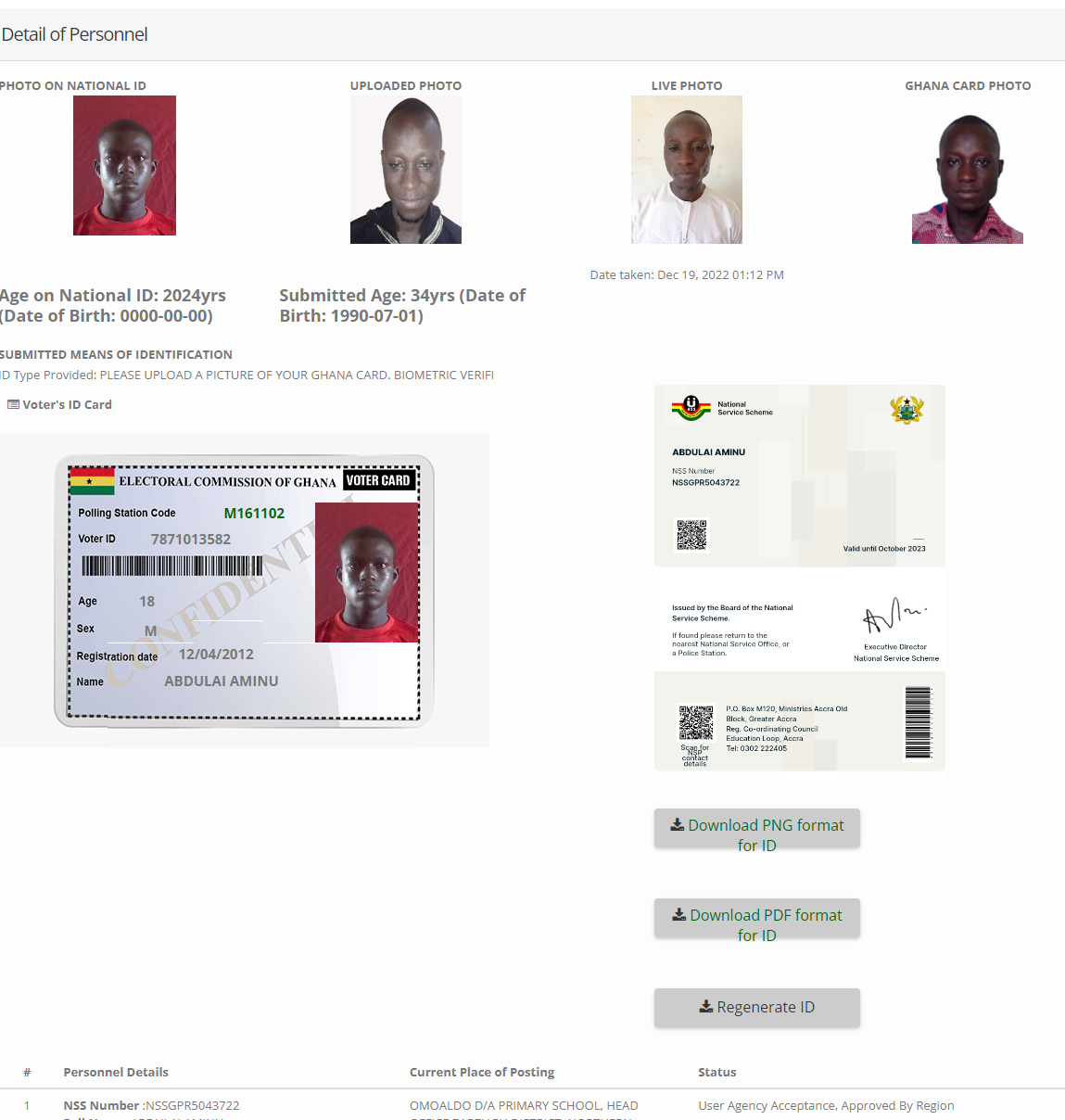
Findings from the technical and forensic audit of the National Service Authority (NSA), seen exclusively by The Fourth Estate, indicate that the former Director-General of the NSA, Osei Assibey Antwi, while at post as D-G, was at the same time posted as a volunteer within the NSA. This was during the 2022/2023 service year, about a year after he took office as the head of the NSA (then NSS).
Mr Assibey Antwi is said to have been designated a volunteer, assigned an EZWICH card with the number 1177042059, and posted to the Greater Accra region after his registration. But auditors say the payroll records indicate he was assigned to the Kumawu Farms, a 200-acre farmland in the Ashanti Region. The Kumawu Farms, described in media reports as a mixed commercial farming project for service personnel, is an initiative Mr Assibey Antwi’s NSA administration is reported to have commenced when they came into office.
According to the report, Mr Assibey Antwi was paid GH¢516,000 every month for 16 months, totalling GH¢8,256,000. At the current national service allowance of GH¢715.57, the amount paid to Mr Assibey every month could have paid the allowance of 721 service personnel.
The findings in the audit report align with a previous statement by the Attorney-General and Minister of Justice, Dr Dominic Ayine, when he provided an update on the investigations by Operation Recover All Loot (ORAL) into financial malfeasance at the National Service Authority on Friday, June 13.
“In the 2022/2023 service year, a total of eight million, two hundred and fifty-six thousand Ghana Cedis (GH¢8,256,000.00) was deposited into EZWICH account number 1177042059, which is registered in the name of suspect Osei Assibey. Investigations showed that he personally received these funds,” Dr Ayine said.
He added that when his house was searched during the investigations, the EZWICH card was found.
Background
In November 2024, The Fourth Estate concluded its months-long investigations into alleged malpractices at the NSA. The investigations revealed the presence of thousands of ghost names in the database of the NSA, which potentially was causing the nation to lose millions of cedis through what is famously known in Ghana as ‘ghost names’.
But before publication of the report, the leadership of the NSA went to court on the blindside of The Fourth Estate to secure an injunction against the publication of the story.
Following the development, the MFWA, which runs The Fourth Estate project, submitted a petition to the Office of the Special Prosecutor. A similar petition was subsequently submitted to the then newly constituted Operation Recover All Loot (ORAL).
On June 13, 2025, the Attorney General and Minister of Justice, Dr Dominic Ayine, announced to the nation that investigations had been conducted and some former executives of the NSA, alongside other persons, were going to be prosecuted for fraudulent practices at the NSA that had cost the nation over GH¢ 548 million. In his presentation to the nation, the Attorney-General extoledThe Fourth Estate for what he described as the foundational work that had aided his investigations.
“The now-famous National Service scandal, which was first uncovered by The Fourth Estate through its investigative journalism, formed a major plank of the oral report. My office is extremely grateful to The Fourth Estate for the excellent foundational work that they did,” Dr Ayine said.
There appears to be a disagreement between the Minister for Youth Development and Empowerment, George Opare Addo, and the Director-General of the National Service Authority (NSA), Felix Gyamfi, about the propriety of the NSA’s CMSP/Metric App.
While the Minister has issued a fresh directive for the immediate termination of the system, which has been embroiled in the ghost names scandal, the Director-General, in response, says the system is suitable for the NSA to continue using it.
According to documents seen by The Fourth Estate, the minister said his directive was in exercise of his oversight responsibility as the supervising Minister of the NSA. The minister also indicated that the directive was given after his consideration of the report of auditors who were commissioned to audit the NSA following the ghost names scandal.
The minister further stated that his decision was in line with the instructions contained in a June 27 presidential directive mandating him to oversee the design and deployment of a new digital platform that ensures transparency and security, and real-time verification.
“You are hereby directed with immediate effect, to cease reliance on and use of the system provided by Inpath Technologies Limited and to commence the processes necessary to terminate any legal or contractual relationship between the NSA and the said provider,” the letter from the Minister dated August 25, 2025, said in part.
The Minister further instructed that a termination notice be issued within 72 hours and that all government property and credentials necessary for the continuation of operations be collected.
“You are hereby directed to constitute within five working days, a Transition and Implementation Steering Committee to supervise the design, implementation and operationalisation of a new platform that should be deployed within the next 15 days of receipt of this letter and report progress to the Ministry,” the Youth Empowerment Minister further directed.
But in what appears to be a determined position to maintain the current CSMP/Metric App provided and controlled by Inpatch Technologies Ltd, the Director-General of the NSA, Felix Gyamfi, responded to the Minister’s letter on August 27, 2025.
In his response, the director-general claimed that the origin of the NSA investigations was a headcount conducted in February after he assumed office. He adds that the current digital platform in question was used and that, in the end, it aided in the detection of irregularities.
He further claimed that since his assumption of office, compliance with the systems processes had saved the nation some GHC460 million this year alone.
Even though the Minister had indicated in his letter that he had considered the report of the auditors before issuing his directives, Mr. Gyamfi in his response, pointed out that the Audit findings concluded that the system was “fit for purpose” and that the financial malfeasance was not as a result of system deficiencies but rather due to circumvention of the system’s controls through “external manual processes.”
The director-general went on to state other findings from the audit that suggested that the system in place was robust to deal with potential fraud. He also catalogued other reasons why it will be challenging to discontinue the use of the current system.
On July 7, 2025, Mr. Gyamfi wrote to the Minister, forwarding and justifying a proposal from Inpath Technologies Ltd to hand over the platform to the NSA. The owners and managers of the platform had valued it at $2 million, claiming that NSA would spend more if it were to have an alternative system with similar functionalities.
Background
The Fourth Estate’s exposé on the NSS Scandal, published earlier this year, revealed the padding of ghost names in the NSA database and manipulation of posting processes, which caused the government to pay millions of cedis to service personnel that only existed on paper. Beyond revealing the existence of ghost names in the NSA database, the publication raised critical questions about value-for-money, data security, and institutional integrity of the CSMP/Metric App.
The findings from The Fourth Estate’s investigations prompted the Office of the Attorney General and Minister of Justice to conduct their own investigations, which revealed that the top-level executives of the NSA and their private sector vendors, in a scheme, had mismanaged over 548 million Ghana cedis through Ghost names. The investigation prompted public demand for probity and accountability. In response, the Office of the President, through the Ministry of Youth and Empowerment, directed an immediate suspension of the CMSP/Metric App to allow for a comprehensive technical and forensic review.
In 2022, the family of the late Benjamin Handle Kwasi Dzata may have been preparing to mark the 10th anniversary of his death. But in the books of the Controller and Accountant General’s Department (CAGD), the government’s payroll master, Mr Dzata was very much alive and drawing his pension from state coffers.
Mr Dzata worked at the head office of the CAGD until his retirement. After his death on October 13, 2012, his monthly pension payments were supposed to have stopped. But a decade after his passing, his name was still on the government payroll, a “ghost” receiving a monthly paycheck.
At this particular count in 2022, there were 58 other ghost names discovered in the books of the head office of the CAGD. One of these ghost names was that of a man who died in 2009 but was still being paid a pension 13 years after his death.
Until 2022, when the Auditor-General’s review of public accounts discovered the waste, the 59 ghost names had sunk almost GH¢400,000 at the head office of the CAGD alone for 13 years. But these infractions did not only occur in the books of the CAGD head office. They were rampant in some of the CAGD’s regional offices as well.
In the records of the Auditor-General (AG), these ‘ghost’ payments are designated as either cash irregularities or payroll irregularities. Between 2017 and 2023, Ghana lost about GH¢1.1 billion to both irregularities — Cash (GH¢1 billion) and Payroll (GH¢42.9 million).
Yet, these are just two of the various irregularities identified in government finances. There are irregularities in how the State pays or collects rent (rent irregularities), anomalies in tax collections (tax irregularities) and how outstanding debts or loans are recovered (loan irregularities). And there are contract and store or procurement discrepancies (contract irregularities and procurement irregularities).
These seven financial irregularities in public institutions, according to the Auditor-General’s special audit reports (2017-2020 and 2021-2023), have contributed to the loss of GH¢43.7 billion in seven years – that is an average of GH¢ 6.2 billion annually.
An insipid story of recoveries
For many, the telltale story of waste and loot captured in the annual AG’s report makes for a grim read. But these reports often leave what appears to be a glimmer of hope at the end of almost every recorded infraction — an order for the concerned public institutions to recover the monies lost. The institutions are advised to pay the recoveries either into the Consolidated Fund, the Auditor General’s recoveries account or a designated Public Fund.
However, the reality is that the Auditor-General’s recommendations are not complied with. And most of the funds are often not returned.
When The Fourth Estate combined the recoveries the AG accounted for in his two special audit reports for the period from 2017 to 2023, it was noted that about 66% of the funds lost to irregularities were not paid back.
For instance, between 2017 and 2020, the Kwame Nkrumah University of Science and Technology (KNUST) under the Ministry of Education recorded contract irregularities amounting to GH¢ 26.7 million. Upon the AG’s instructions and demands, the University could only recover a paltry GH¢ 1.39 million.
This is emblematic of the problem with public institutions cited in the annual AG’s report on public accounts. Most of them fail to retrieve funds lost to what appears to be fraudulent activities, negligence and non-compliance with established financial protocols.
Source: Auditor General’s special audit reports
After the Auditor-General flagged financial irregularities from 2017 to 2023 and ordered the retrieval of funds, the public institutions were only able to recover GH¢ 14.9 billion out of GH¢ 43.7 billion lost. Thus, 66 per cent of the questionable expenditure of state funds has not been recovered – and from all indications, the remaining GH¢ 28.8 billion may be lost for good.
Enforcement gap persists despite Supreme Court’s emphatic ruling
When asked why the majority of the questionable expenses are left unrecovered, the Audit Service said it is not within their purview to compel public institutions to return the money.
“When it comes to the enforcement side of things, it’s outside our mandate,” says Fredrick Lokko, Assistant Director of Audit. “It’s outside the mandate of the Auditor General. So we believe that when you engage those other institutions, they can probably give you more precise reasons why they’ve also not been able to do the needful.”
But Beauty Emefa Narteh, Executive Secretary of the Ghana Anti-Corruption Coalition (GACC), believes the AG has the power to disallow and surcharge, which is not only needed in recovering, but also in stopping or preventing unlawful payments.
“For instance, the Auditor-General can exercise the power by saying I disallow this payment, which means that that person cannot be paid,” she says. “It means it will be unlawful to pay that person. That is also a form of recovery. At the same time, the Auditor-General can also exercise the power of surcharge, which means that they can say you have spent this money unlawfully, so you have to pay for it.”
Mrs Narteh’s statement is consistent with a landmark ruling by Ghana’s Supreme Court in 2017.
In the case Occupy Ghana vrs Attorney-General, the plaintiff argued the Auditor-General must not only issue reports about loot and waste in the public institutions but must also disallow and surcharge institutions and individuals to ensure monies lost are returned. The Court held that the mandate of the Auditor-General is not accomplished by just issuing reports on infractions and irregularities.
“It [is] quite clear that the said constitutional provision on the powers of disallowance and surcharge of the Auditor-General must be enforced,” the Supreme Court ruled.
For Kofi Bentil, a founding member of Occupy Ghana, the civil society group that secured the monumental ruling from the apex court, the problem is with the leadership.
“We have observed that since Domelovo [immediate past Auditor General] was removed from office, that office has become ineffective. In fact, it has even become negative because whoever was put there is even said to clear some people who clearly Domelovo was going to surcharge,” Mr. Bentil told The Fourth Estate.
He emphasised that the AG does not lack any law or facility to ensure enforcement in the recovery of illegal expenditure. He thinks the ongoing constitutional review exercise must re-examine the appointment of the Auditor General and prevent the president from selecting the occupant of the office.
Officials at the National Service Authority (NSA) circumvented mandatory validation processes for payments of allowances to national service personnel, enabling thousands of nonexistent names to be added to the payroll.
This made it easy to use the ghost names to drain the public purse of millions of Ghana cedis in allowances intended for national service personnel.
The Fourth Estate has been investigating allegations of corruption at the NSA for some months and has discovered evidence of fraudulent addition of nonexistent names, otherwise referred to as ghost names, to the list of personnel deployed annually since 2018. The inclusion of tens of thousands of fictitious names each year is done through the generation of fake student index numbers that are clandestinely created for various universities and other tertiary institutions. The index numbers that are used for the ghost names are not only fake, but most of them do not follow the patterns used by the universities and colleges whose names were used in assigning the fake index numbers to the ghost service personnel.
The Fourth Estate’s investigations show that the NSA’s system is designed to ensure rigorous verification of work attendance of service personnel before allowances are paid. This process, known as pre-approval, requires district managers and regional directors to authenticate personnel and confirm their presence at their assigned posts. This is done on monthly basis before payments are made to the personnel.
However, a source familiar with the NSA’s operations disclosed to The Fourth Estate that during the tenure of the immediate-past Director-General, Osei Assibey Antwi, certain high-level accounts operating the authority’s database manipulated the system monthly, allowing ghost personnel to be cleared before regional directors could complete verification procedures.
How the process should work
According to the sources, the NSA is mandated to ensure that only personnel who have actually worked receive allowances each month. The process begins at the workplaces of service personnel (known as user agencies) where their immediate supervisors sign a monthly duty report form confirming attendance. This form is then submitted to the NSA District Office.
“The district manager verifies that the personnel have reported to work and met the required days for payment,” the source explained. “The manager then enters the data into the NSA system, where it is reviewed by the regional internal auditor before reaching the regional director.”
The regional director works on the pre-approval process and forwards the verified list to NSA headquarters in Accra. There, the internal audit team performs additional checks before sending the list to the finance department. Once approved by finance, the list is then forwarded to the Director-General and then to the Ghana Interbank Payment and Settlement Systems (GhIPSS) for final payment.
Breach of protocol
Evidence obtained by The Fourth Estate suggests that this procedure was not followed for all pre-approvals at the regional level, despite management being alerted to the irregularities.
During a virtual management meeting in May 2023, the NSA’s Western Regional Director, Okatakyie Amankwaa Afrifa, who has oversight responsibility of the Western North Region, raised concerns about the number of pre-approvals in the two regions under his supervision, hinting at possible padding of personnel numbers.
“My Western Region account always has 250 personnel already approved when I’m doing my pre-approvals, and for Western North, it’s always 993. I don’t know where that number is coming from. I want to supply you with this information to see how you can address it,” Mr. Afrifa, who is also the New Patriotic Party’s Western Regional Secretary, told the meeting, recordings of which are available to The Fourth Estate.
In response, the then Director-General, Osei Assibey Antwi acknowledged the concerns and promised to look into the matter. However, there is no evidence that any action was ever taken to address Mr. Afrifa’s concerns.
NSA’s Western regional director, Okatakyie Amankwaa Afrifa raised concerns about pre-approvals in the authority’s system for allowance payments| Photo: facebook/oktafrifa
When The Fourth Estate contacted Mr. Afrifa, the Western Regional Director of the NSS, he confirmed the irregularities. “I didn’t understand it. That’s why I raised it in our meetings,” he said. He explained that, under normal circumstances, the pre-approval stage in the system should show zero approvals before the regional director’s verification.
He said, he however, discovered that numbers were already appearing at the pre-approval stage before he completed his checks – meaning some payments had been approved without his verification and input.
“I raised it a number of times and didn’t get a response, so I just kept quiet. I thought it was because it was technical, and people didn’t understand,” he added.
When asked if the issue still persisted, Mr. Afrifa could not provide any confirmation due to inconsistencies in monthly allowance payments.
“What about 2024?” The Fourth Estate asked.
“That was last year, I think there were still some [pre-approved] numbers.”
“And 2023?”
“That was when I raised the issue.”
When The Fourth Estate requested an interview with the directors of the NSA on November 27, 2024, Mr. Assibey Antwi, said he would not be available until December 10, 2024.
Later, The Fourth Estate received a letter from the NSA stating that the institution was unable to grant interviews to The Fourth Estate because it was cooperating with the Office of the Special Prosecutor, which had opened investigations into the scandal following a petition from The Fourth Estate.
The findings from The Fourth Estate investigations raised serious questions about the integrity of the NSA’s payroll system and the potential loss of public funds through ghost names.
At the beginning of every service year, the authority announces to the public, the total number of personnel to be deployed. But behind the scenes, thousands of additional names are added through the creation of fake index numbers of universities and fake PINs for supposed service peronnel who could not take up national service in previous years.
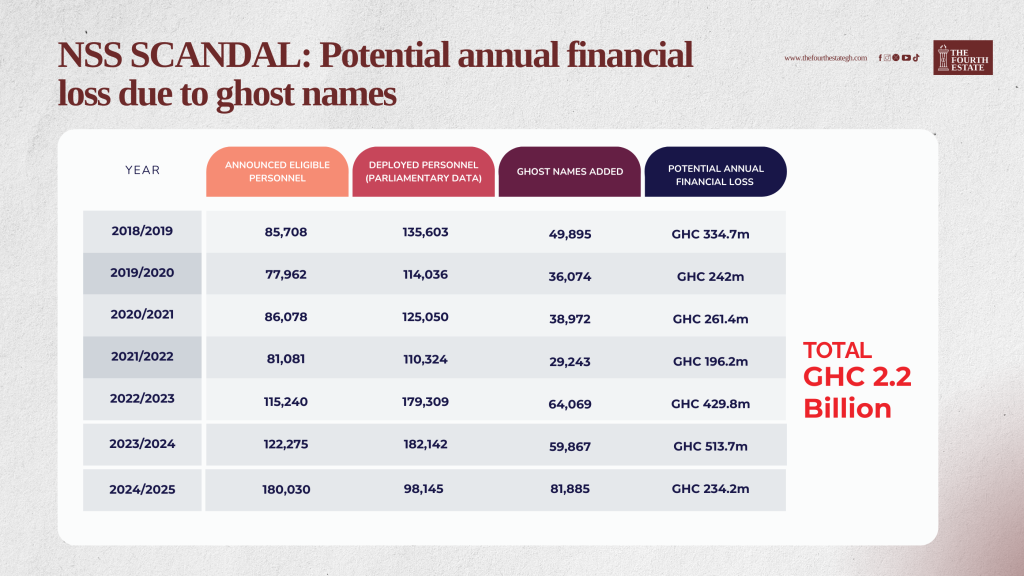
A comparison of figures put out by the NSA to the public for each service year and what was presented to the Parliamentary Select Committee on Education since 2019 reveals a systematic pattern of significantly inflated figures.
These dubious activities are happening at a time when the NSA struggles to pay thousands of genuine service personnel posted across the country on national service.
“It is disgusting that while many of us struggled to barely feed after being sent to marginalized communities in the middle of nowhere, people were riding on our presence to enrich themselves,” a former national service person, who wants to be known as Joel told The Fourth Estate. “I’m really disappointed. The most annoying part is they didn’t pay me two months of my allowance.”
In February 2022 when former Vice President Dr Mahamudu Bawumia visited the National Service Authority (NSA), its management, led by the Director-General, Osei Assibey Antwi, claimed they had implemented a digitalization process that had saved the country GHC 112 million.
Mr Antwi, the 59-year-old former Mayor of Kumasi, said the introduction of an app called ‘Metric app’, which combines facial recognition technology and identity card checks for verification and validation, had blocked the enrolment of some 14,027 potential fraudsters onto the scheme for the 2021-2022 service year.
“We had them (ghost names) on our list as potential service persons, but they ran away and could not register because the system raised red flags and weeded them out,” he boasted.
“This achievement is massive by any stretch because if we replicate this in ten institutions, we are talking of saving the country almost a billion cedis,” the NSA website quoted him as saying. “You can understand why it is so important to link the payroll with the Ghana Card which in your case has chased 14,027 people away.”
Since this development, Dr Bawumia used the case of the National Service Scheme as a classic success story of how digitalisation can prevent ghost names and enhance the fight against corruption.
However, The Fourth Estate’s months-long investigation has exposed a vastly different reality. Rather than preventing fraud, the NSS’s digital system has been co-opted to facilitate one of the country’s most brazen financial scams, where fake identities (some belonging to non-existent individuals and even 90-year-old “graduates”) regularly receive national service stipends.
Ghost names, fake index numbers and inflated personnel data
At the beginning of each service year, the NSS announces the number of personnel to be deployed. However, internal records show that thousands of additional names are added through the creation of fake index numbers and Personal Identification Numbers (PINs) linked to nonexistent students.
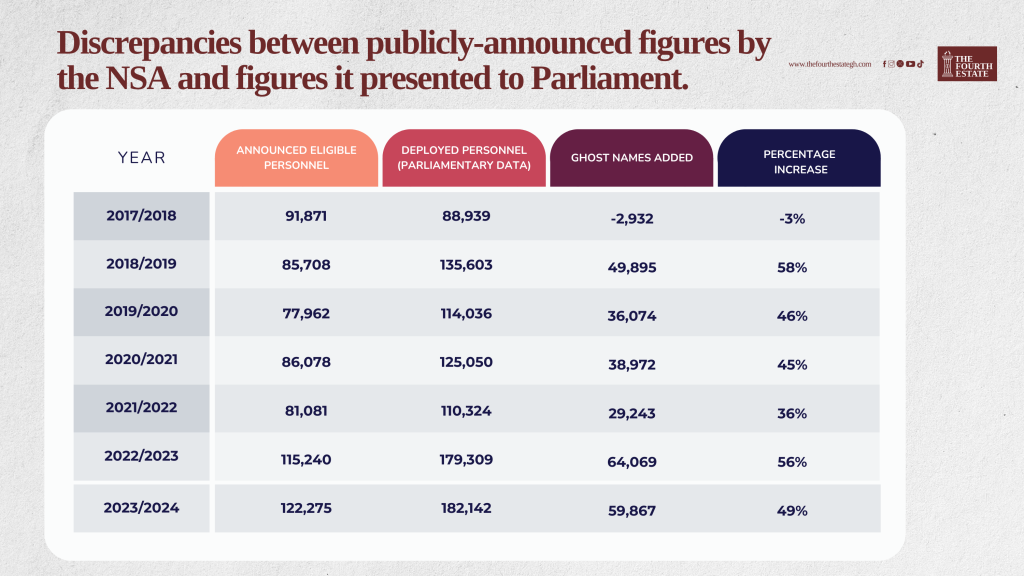
A comparison of NSS figures released to the public and those submitted to Parliament’s Select Committee on Education in June 2024, reveals consistent and significant inflation of personnel numbers.
The figures in the table below show that in the first year of President Nana Akufo-Addo (2017/2018), the authority announced that 91,871 personnel were eligible to be enrolled on the scheme. The data for the same year shows that in the end, 88,939 personnel were deployed, indicating that 2,932 of the eligible personnel did not enroll in the scheme that year.
Experts say this is a normal pattern since it is impossible to have all persons eligible for national service in a particular year undertaking the service.
If we are going through the advertised processes of the NSA for personnel deployment religiously, there shouldn’t be much discrepancy in the data,” Dr Peter Anti, Executive Director of Institute for Education Studies, said. “‘Normally about a range of one to three percent do not take up the positions when they are posted, and there are others who return to do their service. Therefore, it becomes very difficult to have a large discrepancy between the number that’s announced and what’s given to parliament.”
In all the subsequent years after the first year of President Akufo-Addo, the announced figures of eligible service personnel shot up by tens of thousands.
The Fourth Estate’s investigation found thousands of names assigned fake student index numbers supposedly linked to institutions such as Kwame Nkrumah University of Science and Technology (KNUST), University for Development Studies (UDS), University of Education, Winneba (UEW), Tamale Technical University, Valley View University (VVU) and some colleges of education.
For example, born on January 1, 1963, Abubakar Fuseni was listed in the NSS database as a graduate of UDS in the 2022/2023 service year. His index number, 591GHA-725913201-2, was flagged by UDS officials as fake. More shockingly, the 2022/2023 NSS list contained 226 other individuals named “Abubakar Fuseni,” all supposedly from UDS, and all with identical degree qualifications – Bachelor of Arts in Integrated Development Studies. On the NSS posting list for the 2022/2023 service year, 2,338 names with index numbers similar to Abubakar’s and inconsistent with what the University officially issues can be found.
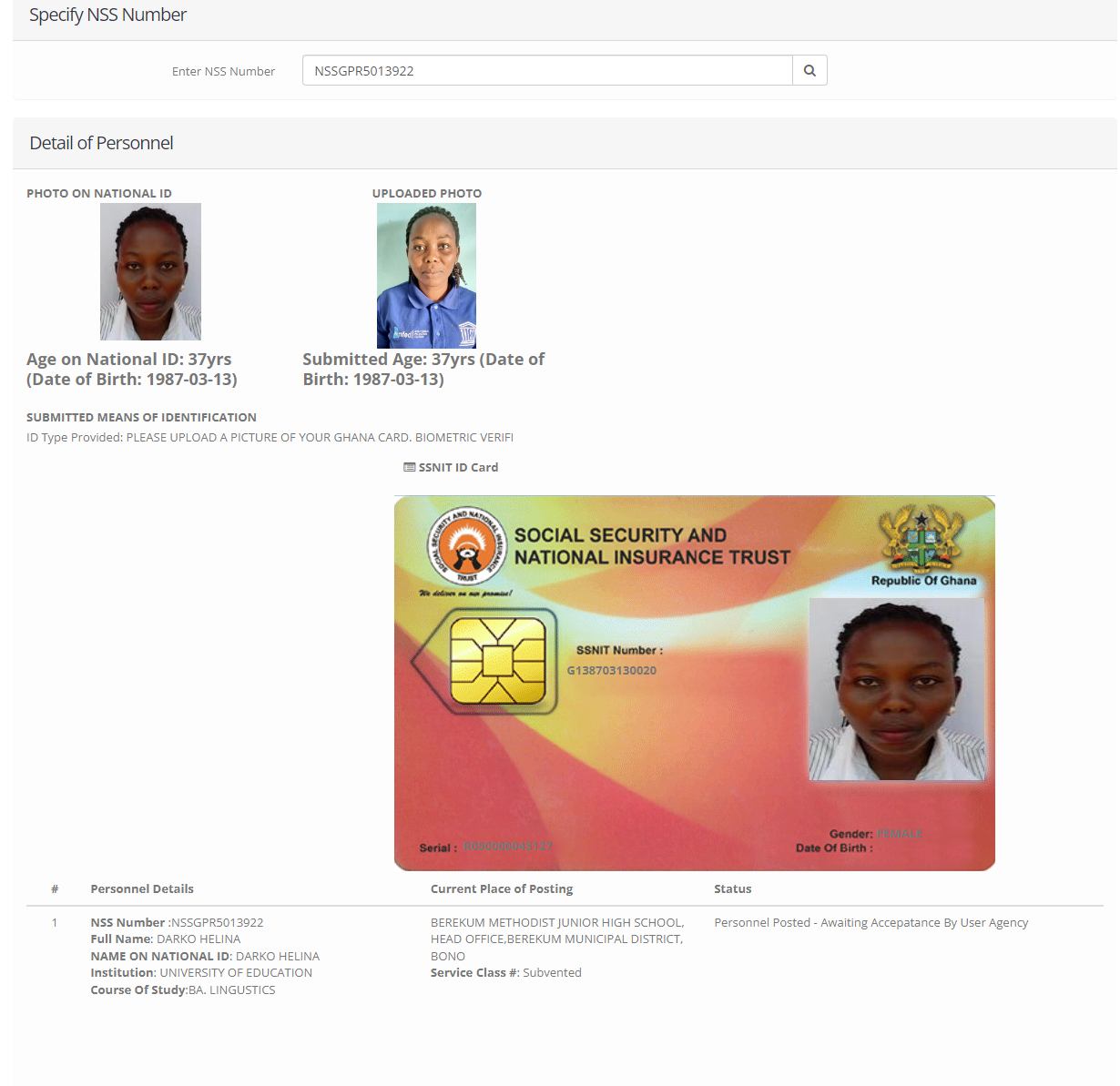
Similarly, in the same 2022/2023 service year, Collins Benneh, supposedly a BA Linguistics graduate from UEW, was assigned an index number VL09T/0002/09T. However, UEW’s Acting Registrar, Wilhelmina Tete-Mensah, confirmed that “this is not a UEW index number. We do not use alphabets in our numbering.”
This pattern of issuing fraudulent index numbers extends across multiple educational institutions – private and public, with fake identities inserted into NSS postings every year over the past eight years.
80-year olds and 90-year olds “serving” asnational service personnel
Among the most bizarre discoveries was the inclusion of individuals well past retirement age in the NSS database. 93-year-old Nimatu Salifu was listed as a UDS graduate, deployed to Kpiyagi D/A Primary School in the Upper West Region in the 2022/2023 service year.
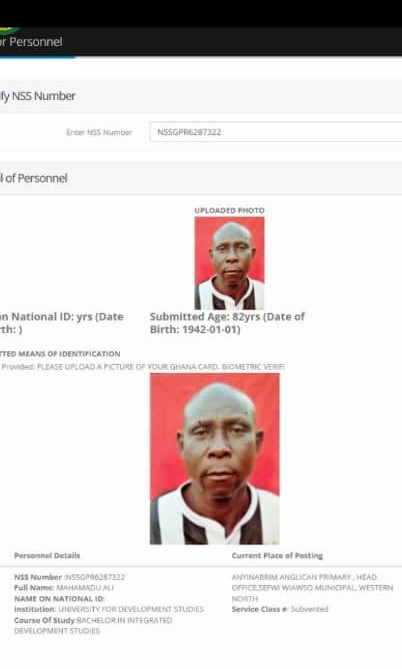
In the same service year, 91-year-old, RuthAbdulai, supposedly a Development Studies graduate from UDS, was posted to Adakura Primary School in the Upper East Region. There is also an 82-year-old Mahamadu Ali, another UDS graduate, who was posted to Anyinabrim Anglican School in Sefwi Wiawso in the Western North Region.
According to the NSA, 82-year-old Mahamadu ali was as service personnel in sefwi wiawso in the 2022/2023 service year
Fake IDs and manipulated biometric data
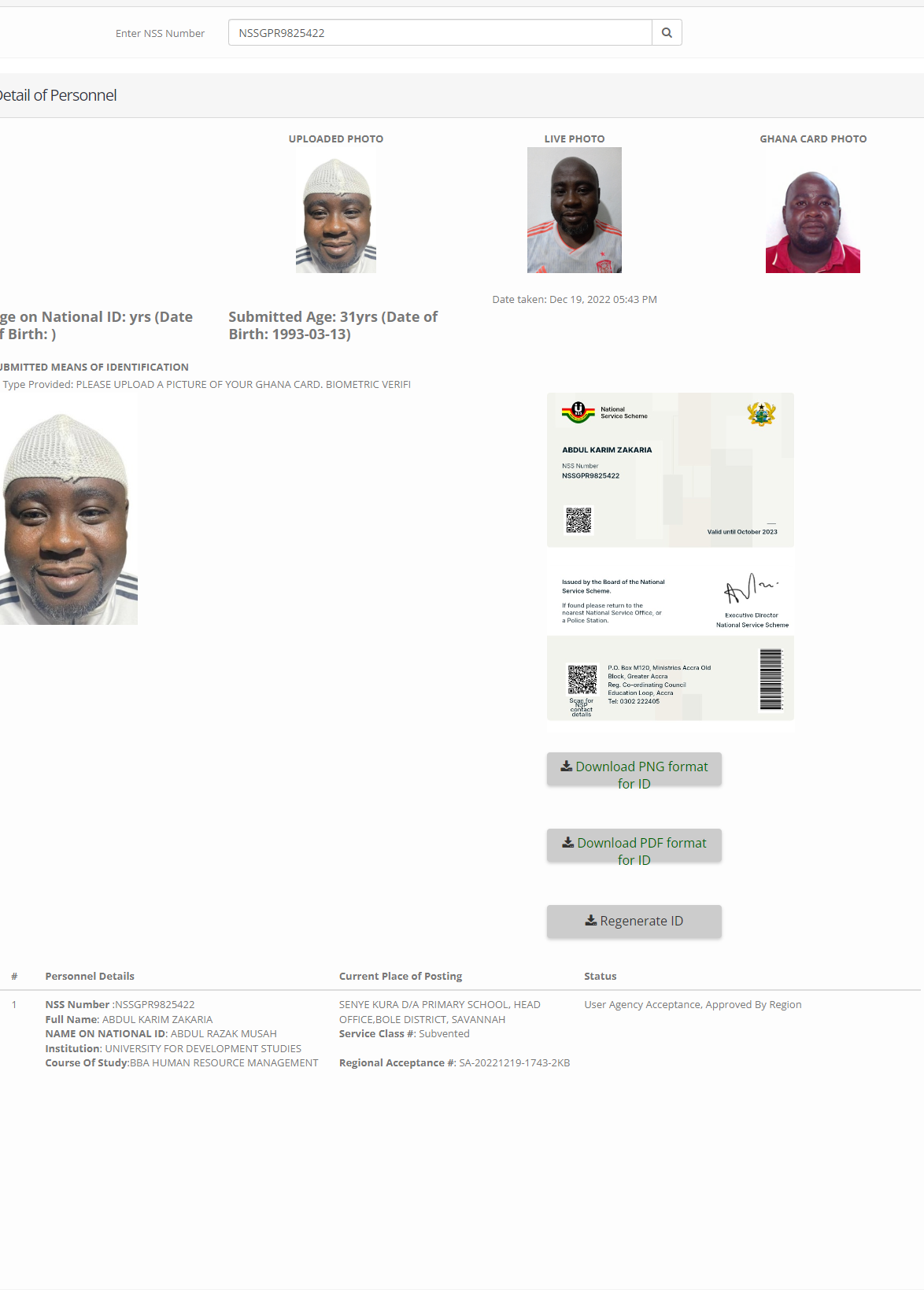
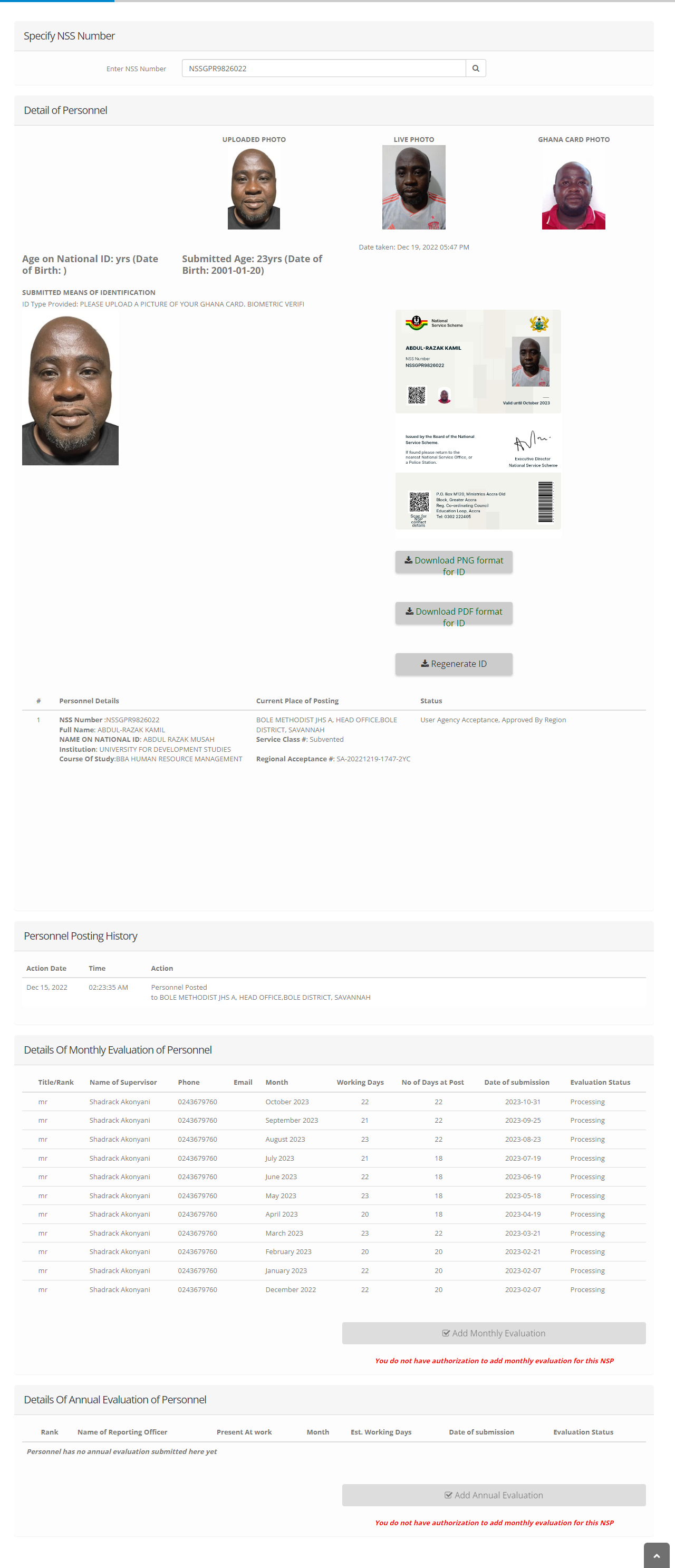
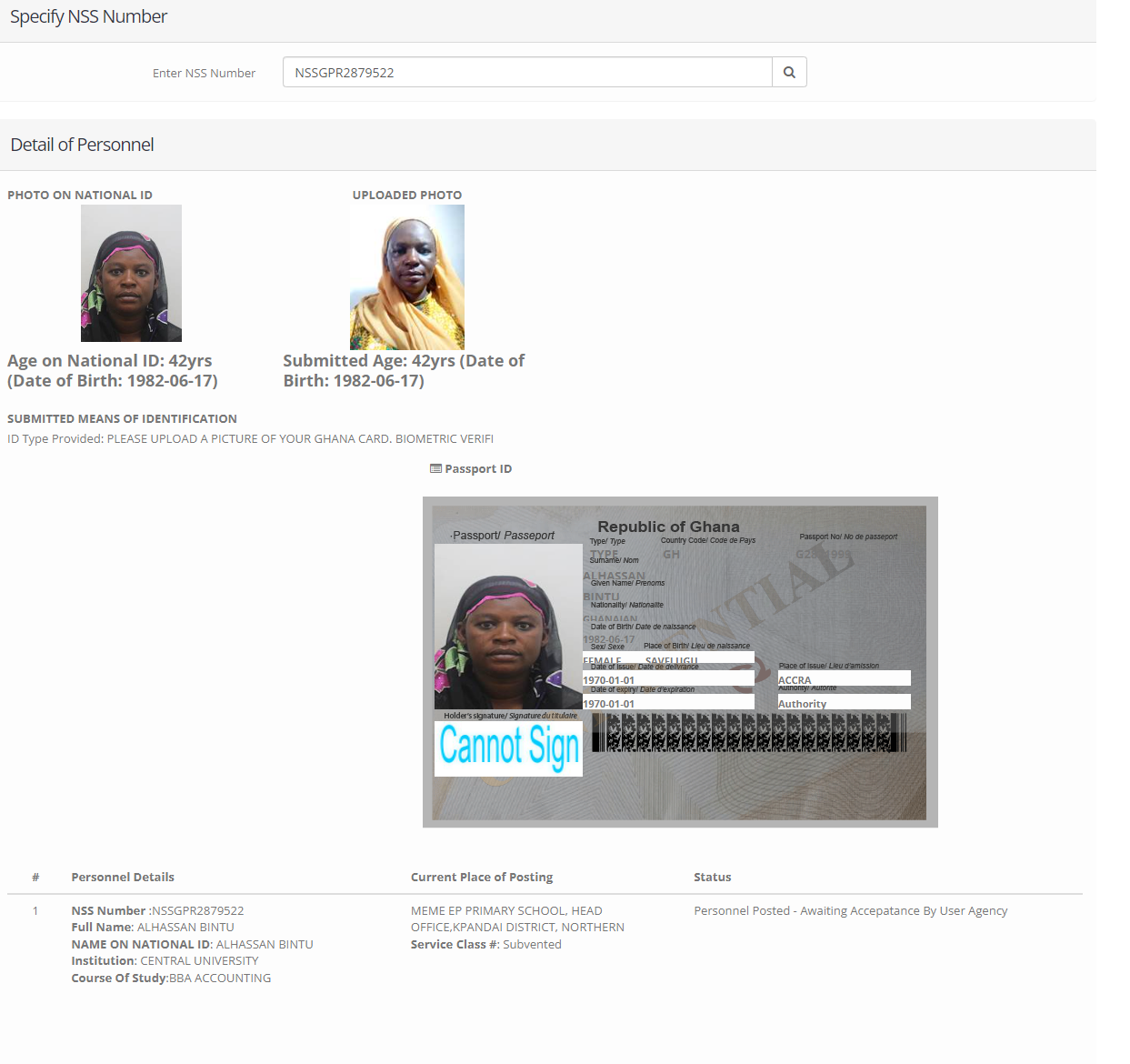
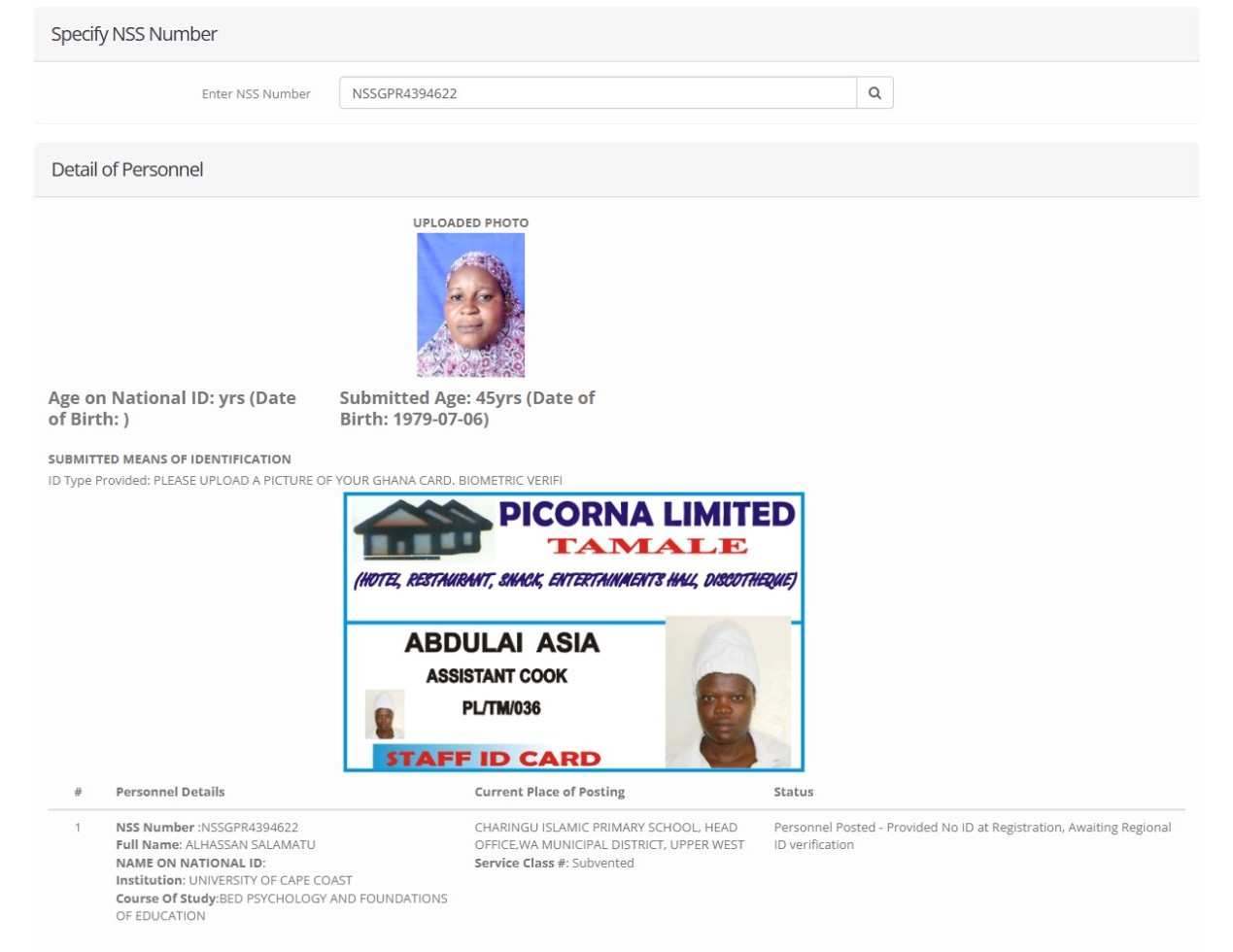
Despite the NSA’s claim of using the Ghana Card for biometric verification, The Fourth Estate found that multiple forms of identification, including doctored school ID cards, Ghana National Fire Service ID cards, provisional voter ID cards, and even private company ID cards, were used to register fake personnel.
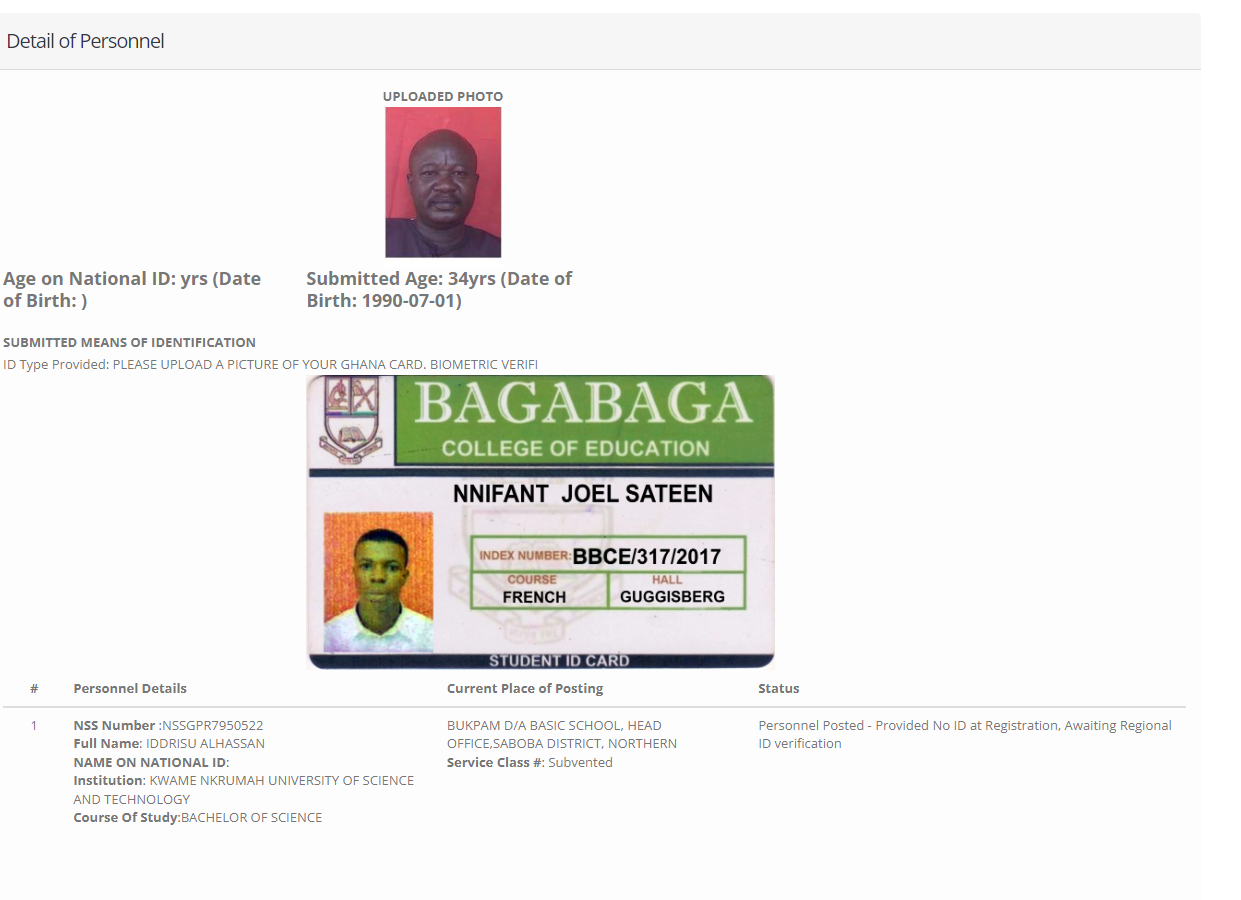
For example, a supposed student ID card from Bagabaga College of Education in Tamale, bearing the name Nnifant Joel Sateen was used to register at least two different people. First, it was used to register Iddrisu Fatima, 34, a purported KNUST graduate. Again, the same ID card was used to register 34-year-old Iddrisu Zakaria supposedly from KNUST who was posted to Sakogu Senior High School in East Mamprusi District in the North East region in the 2022/2023 service year.
Alhassan Salamatu, 44, a supposed UCC graduate, registered using a Ghana National Fire Service ID card bearing the name of Ophilia Akolgo, 41, who joined the Service in 2016.
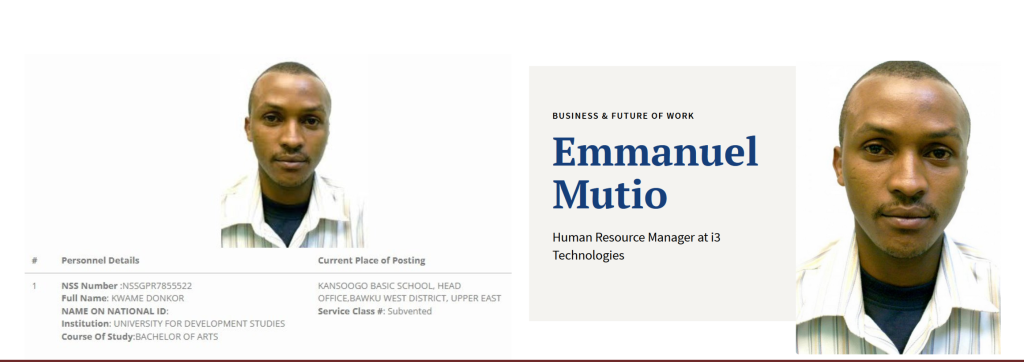
Kwame Donkor, 72, was registered without any ID card. In place of an ID card, a photo was used. When The Fourth Estate run a reverse image search, it was revealed the photo was a certain Emmanuel Mutio, a Human Resource Manager of a private IT company in Kenya.
NSA’s legal attempts to suppress publication
When The Fourth Estate requested an interview with the Directors of the NSA on November 27, 2024, the Director-General, Osei Assibey Antwi, said he would not be available until December 10, 2024. The NSA also said it would need more time to respond to an RTI request for data it had earlier shared with parliament.
Upon learning of The Fourth Estate’s impending publication of its investigations, the NSA took a legal action to block the publication of the report. On December 2, 2024, a day before the scheduled publication, the NSA secured a 10-day injunction to prevent the story from been published. When that injunction expired, they sought another, arguing that publication without their response would cause “irreparable harm.”
However, on December 19, 2024, an Accra High Court struck down the NSA’s injunction request, after The Fourth Estate’s lawyers described the NSA’s legal manouvres as a SLAPP lawsuit (Strategic Litigation Against Public Participation) intended to silence investigative journalism. The court awarded costs of GHS6,000 against the NSA in favor of the Media Foundation for West Africa, which runs The Fourth Estate as a non-profit, public interest and accountability investigative journalism project.
A digital ruse that stole millions
Rather than eliminating ghost names, digitalization at the NSS has been used as a cover for one of the most sophisticated financial scams in Ghana’s public service. The scheme has resulted in financial losses to the country amounting to millions of cedis while allowing fraudulent actors to exploit a system designed to ensure transparency.
With the NSS refusing to release additional data under the Right to Information Act, The Fourth Estate has now filed an appeal with the RTI Commission to force disclosure of further records.
Part two of this story will reveal how the NSS bypassed systems monthly to pre-approve ghosts names who are paid monthly
At about a quarter to 10 a.m. on May 21, 2022, a phone rang in the office of The Fourth Estate.
I have low sexual libido, the caller said to the journalist who answered the call.
This was not the usual call that comes to the office of the accountability journalism outlet. This caller was searching for medicine that could cure sexual dysfunction.
I was hoping your medicine would improve my performance in bed, the voice continued. I heard your advertisement on radio, so I picked up your number and decided to call.
Where are you calling from? The Fourth Estate journalist enquired.
Kintampo, the caller replied.
The caller was one of the numerous unsuspecting herbal medicine users who called the office of The Fourth Estate after Macofa Herbal Mixture was advertised in the media.
Eight media platforms across four regions in Ghana marketed Macofa Herbal Mixture which was presented as a medicine that could cure all menstrual-related problems, impotence in men, infertility, and heightened libido in men and women. The media outlets comprised radio and television stations, as well as newspapers.
But, in truth, Macofa Herbal Mixture did not even exist. The herbal mixture was prepared in the office of The Fourth Estate from a mixture of three popular soft drinks in Ghana – Malt, Coca-Cola, and Fanta. The brand name was coined from the first two letters of the names of the soft drinks.
Without registration or approval from the Food and Drugs Authority (FDA), The Fourth Estate sought advertising spots for the herbal mixture in the media. This was to test widespread concerns that some media outlets put the lives of consumers at risk by validating and advertising unlicensed herbal products and fake traditional medicine practitioners without the required due diligence.
Advertisement on Macofa
The Macofa Herbal Mixture advertisement artwork
The Macofa Herbal Mixture did not have FDA approval for usage. It did not also have approval for its advertisement. But The Fourth Estate sought advertisement spots to test the media’s compliance in terms of strictly ensuring that the FDA’s regulations and guidelines are adhered to.
Reporters of The Fourth Estate reached out on the phone to marketing and advertising officers of some of the top media houses across the country, posing as marketing officers of Krodwoa Enterprise, the producers of Macofa Herbal Mixture. The agreement to advertise the herbal medicine was only based on phone conversations and the transfer of money.
TV3 and Onua TV
After the team called the office of Media General, the parent company of TV3 and Onua TV, a marketing officer reached out.
My name is Xorlali. My boss Nicholas gave me your contact. He says you want to do some business with us, he said.
Xorlali engaged TheFourth Estate’s reporter for days without even asking about FDA’s endorsement of the product. It was all about the money.
TV3’s Squeezeback on Macofa Herbal Mixture
Given the kind of viewership on TV3, you would need a commercial advert and product placement for it to be effective. But since you don’t have them, I would advise you to do LPM and interviews on Captain Smart’s show. You’d need a jingle too. Captain Smart’s show on Onua FM and TV is very hot. The show is on TV, radio, and Facebook Live. Three different platforms,” he advised.
At a fee of GH₵ 100.00, Xorlali also created a squeeze-back for the reporter for TV3’s morning show.
On April 25, 2022, Onua TV advertised the Macofa Herbal Mixture on the station’s morning show, Onua Maakye:
Onua TV Presenter advertising Macofa Herbal Mixture
“… Macofa Herbal Mixture: I give this medicine a standing ovation. It’s very potent. Macofa Herbal Mixture: Listen to the name well so you don’t mix it up at the herbal and pharmaceutical shops. Macofa Herbal Mixture: It’s a very good medicine. For my sake, just take one. Listen to what it does: If you have any sex-related problems, you need Macofa Herbal Mixture. Simple! It’s a potent medicine. It works! Also, if you have become a calendar for people because of your monthly menstrual-related pains and cramps, this is your medicine. Don’t let people use you as a reminder for their monthly salary,” the co-host announced.
On May 10, at exactly 9:22 a.m., a squeeze-back advertisement for Macofa Herbal Mixture was aired on TV3’s morning show programme, New Day.
Angel FM, TV
The Macofa advert being advertised on Angel FM
At the Lapaz-based office of Angel Broadcasting Network (ABN) in Accra, Justice Amankwaah, who gave his designation as the “Commercial Director of ABN, in charge of radio and TV”, offered to help TheFourth Estate’s reporter to advertise the herbal product.
On our morning show one effective tool we use is the LPM, interviews, and TV commercials. I can assure you that that will make you break into the market, Justice said.
However, the reporter declined the offer to appear for an interview and added that the company was not done working on a television commercial.
Justice: An LPM on our morning show, when it is read once, will be 550.
Reporter: 550 Ghana cedis?
Justice: Yes, when it is read once on the morning show because it passes through the radio and TV at the same time. So, when someone is not watching, someone will hear. When someone is not hearing, someone is watching.
Receipt showing payment for an advert on Angel FM
On April 24, 2022, the team paid for LPM for two days on the Angel morning show, Anopa Bofoͻ. The following day, the advertisement started running on the programme.
EIB Network
Excellence In Broadcasting (EIB) Network’s Marketing Officer, Duke Odamtten-Sowah, engaged The Fourth Estate’s reporter. In series of calls with the reporter, Duke’s interest was more about the money than ensuring due diligence. He directed the reporter to make a payment of GHC 1,400.00 for LPMs to a mobile money number with the registered name of Sharon Odamtten-Sowah.
Starr FM receipt for the payment of Macofa Herbal Mixture advertisement on Starr FM
A script and details of the non-existent herbal medicine were sent for the LPM but just before giving the green light, Duke requested FDA approval. The reporter said the FDA approval was not ready yet and, therefore, demanded that the payment be reversed.
The marketing officer said that, at EIB, monies received could not be refunded. After heated arguments with the reporter, Duke had a solution to the problem. He sent the proposed solution via email on April 20 upon the request of the reporter:
I wish to bring to your notice our inability to execute your three-day running LPM which was slated for the Morning Starr Show with Francis
Abban from Monday to Wednesday last week.
As you are aware, this was due to your inability to furnish us with the required copy of the Food and Drugs Authority approval.
I, however, propose that we instead have an exclusive 10 minutes interview in return.
Please let me know when you can be available for this interview so I can confirm [the] time for you.
Thank you,
Duke.
On May 5, 2022, the reporter was hosted in a phone interview on the mid-morning show on Starr FM to advertise the herbal product. For the entire period of the interview, Blessing, the show host, asked only the questions the reporter had submitted to the production team.
Volta Star Radio, Ho, GBC’s regional station issued a wrong receipt for the LPM.
On April 24, in Ho, the advertisement for Macofa Herbal Mixture was aired on the state-owned regional radio station, Volta Star Radio. The marketing manager of the station, George Nunyuie, facilitated the placement of the LPM.
Skyy Power FM
A phone shot showing the mobile money sent to Skyy Power FM in Takoradi in the name of West Serve
In Takoradi, on Skyy Power FM, an advertisement for Macofa Herbal Mixture was aired during the mid-afternoon drive time on April 23, 2022. This was after Gifty, the marketing officer, had engaged with her ‘boss’ following enquiries from the reporter.
The impact of the LPM on Skyy Power was instant. A day after the advertisement, The Fourth Estate received a call from a potential client in Takoradi, who confirmed hearing about the herbal medicine on the radio station.
Oyerepa FM
In Kumasi, Oyerepa Afutuo, a mid-afternoon media programme in the Ashanti Region, marketed Macofa Herbal Mixture. The Oyerepa FM and TV programme, which discusses marital and domestic problems, advertised the herbal medicine for two days. The marketing officer, who gave his name as Richmond, facilitated the herbal product’s advertisement without any enquiry about FDA approvals.
Oyerepa receipt for the payment of Macofa Herbal
Though the reporter submitted a script to the station, the presenter misinformed the audience about the herbal medicine’s indication.
Macofa Herbal Mixture. What this medicine resolves are menstrual problems and candidiasis. There are many ailments hidden in the body. When you start taking Macofa, all of them will vanish, the presenter said.
Daily Graphic
Macofa Herbal Mixture advertised in the Daily Graphic on Thursday, May 12, 2022.
The media’s disregard for FDA’s regulation on herbal medicine was not limited to the broadcasting outlets.
At the Graphic Communications Group Limited, the engagement was brief and straight to the point. The front desk officer, who responded to the reporter’s call, doubled as the advertising officer. The officer, who introduced herself as Rosemond Mann, shared the rates for the advertisement through WhatsApp, and payments were made through mobile money.
Pro Forma Invoice for Macofa Herbal Mixture from Graphic Communications Group
On May 12, 2022, the advertisement was published in Ghana’s biggest and most-read newspaper, the Daily Graphic.
For all the radio and television platforms, the reporters requested Live Presenter Mentions (LPMs) and whenever a media house insisted on FDA approval before advertising the products, the reporters backed down.
LPMs are spontaneous extempore delivery or reading of a written marketing text on a product. Apart from grabbing the attention of the audience midway through a programme, LPMs leverage on the voice and credibility of the show host or journalist, who may have a huge public following. This undoubtedly increases believability and trust in the brand or product. It is also prone to misinformation and the use of unapproved advertising language, a reason the FDA has outlawed it in the marketing of medicinal products.
Porous and ineffective regulatory system
The Traditional Medicine Practice Council (TMPC) is an agency of the Ministry of Health. Established by the Traditional Medicine Act 2000, ACT 575, the Council is mandated to regulate the registration of traditional medicine practitioners and their place of practice. This place could be a company that manufactures herbal medicine or a traditional medicine health facility.
“A person shall not operate or own premises as a practitioner or produce herbal medicine for sale unless that person is registered in accordance with this Act,” Section 9 (1) of ACT 575 says.
On April 20, 2022, two reporters of The Fourth Estate visited the office of the TMPC to assess the Council’s regulation process by attempting to register a traditional medicine practitioner and a herbal medicine manufacturing company.
According to ACT 575, to qualify for registration as a traditional practitioner, an applicant must have had “adequate proficient practice in traditional medicine” and be endorsed by a district chairman of a recognised traditional medicine practitioners association or a district co-ordinating director.
To register a facility, the law requires an applicant to present the block plan of the premises and provisional approval from the district planning authority or relevant authorities on the land housing the premises. An applicant must further present evidence of the ability of proposed practitioners in the practice, proof of registration, and testimonials from a traditional medicine practitioners association he or she belongs to.
On paper, the requirements by the regulatory body are comprehensive enough to deter fake manufacturers and practitioners. In practice, however, the experience is different.
At the TMPC office, TheFourth Estate’s reporters met a lady who was brash and appeared disinterested in their mission to register a practitioner and a facility. After reading the requirements, including a visit by TMPC to inspect the facility, she added that the Council was unable to do the inspection.
She said the registration would be completed in the office after the team had paid the required money. This would be after presenting the address of the facility, business registration, name of a guarantor, and photo identities of the practitioner.
When the team agreed to make the payment, she tore part of a crumpled paper and wrote the list of items and corresponding costs in a way that suggested it was a regular practice done at the office.
The itemised list presented to The Fourth Estate by TMPC
The items included building the capacity of the applicant through training. Though the Council was not going to inspect the facility, the TMPC officer added a GHC 200.00 inspection fee.
Below is the breakdown of the total cost:
Form – GHC 10.00
Endorsement – GHC 20.00
Certificate – GHC 80.00
License – GHC 400.00
Inspection – GHC 200.00
Training – GHC 150.00
Total – GHC 860.00
About a week later, on April 28, TheFourth Estate’s reporters returned to the TMPC office. They gave the name of the herbal medicine manufacturing company to be registered as Krodwoa Enterprise Limited. They presented another name, Maxwell Akroma Duah, as the founder and practitioner who wants to be certified.
The narrative the team presented to the Council was that Mr Duah was a prominent Kumasi-based herbalist who wanted to start packaging his ‘efficacious’ traditional medicine into a product called Macofa Herbal Mixture.
Having paid the registration fees, the reporters provided a non-existing address as the location of Krodwoa Enterprise, a guarantor name, contact numbers, and business documents.
About a month after The Fourth Estate’s visit to the TMPC, the team called to follow up.
Please it is not yet ready. When it is ready, we will call you, the attendant who introduced herself as Exornam said. She wouldn’t say when the registration would be ready but gave the team the green light to start operating.
If it’s a shop, you can start selling once you have the receipt, she said.
A certificate certifying fake Maxwell Duah Akroma as a traditional health practitioner.
Eventually, in November 2022, about seven months after the registration, two new documents were presented to The Fourth Estate: A registration conferring a traditional doctor title on Mr Duah and a certificate validating Krodwoa Enterprise as the certified premises for the manufacturing of herbal medicine.
A certificate of license for the non-existent herbal manufacturing company, Krodwoa Herbal Enterprise.
There was no inspection of the premises of Krodwoa Enterprise or the training for Mr Duah.
Media advertisements on medicinal and herbal products
As more herbal medicine products are being approved, figures from the FDA show a commensurate rise in competition in the market and a scramble for advert placement in the media.
In the first quarter of 2021, the FDA gave approval to 81 medicinal, chemical, and pharmaceutical companies to place advertisements for their products in the media. From June to December 2021, the number of companies rose to 319, which is almost four times the number it approved at the beginning of the year. While some of the companies had as many as 10 products, on average, each company had about five products approved to be advertised.
According to the State of the Ghanaian Media Report, published in April 2023, the traditional media is “heavily dependent on advertisements from pharmaceutical companies, especially herbal medicine.” The study showed that advertisements for herbal medicines dominate the media, contributing 25% of advert revenue for television and 22% for radio.
The study echoes the concerns of many stakeholders in the advertising industry that the media sleeps on its gatekeeping role when it comes to herbal medicine. Stakeholders even blame some media personalities for being purveyors of false information on herbal medicine.
Head of the Communication Studies Department, University of Ghana, Dr Abena Animwaa Yeboah-Banin
“There’s a lot of misinformation going on, there’s a lot of exaggeration going on,” Dr Abena Animwaa Yeboah-Banin, the Head of the Department of Communication Studies, at the University of Ghana, shared her worry about how media houses advertise herbal products on their platforms.
Dr Yeboah-Banin, who led a team of researchers to study consistency in radio advertisements about some selected herbal products with the actual information provided on the packaging of the same products, found many inconsistencies.
“There was an instance where what had been promised on the package of an oil product was that it would add flavour to your food and make it tasty. In the LPM on the radio, the presenter said the product can cure breast cancer,” Dr Yeboah-Banin said.
Executive Director, Advertising Association of Ghana, Francis Dadzie
The Advertising Agency of Ghana (AAG) is part of the advertisement vetting committee of the FDA. AAG’s President, Francis Dadzie, says a product needs FDA approval and approval for its advertisement before it can be marketed in the media.
“But what we are seeing now is that there are a lot of these herbal medicine products that do not have the advert certification of the FDA to be advertised on radio or television but are being advertised,” he said.
In a response to The Fourth Estate for a request for comment, the FDA confirmed Mr Dadzie’s position that a company needs approval on the content for a product and another for its advertisement.
Regarding advertising traditional herbal medicines, the FDA said, “LPMs in any form are not permitted as a form of advertisement.”
The letter, signed by Dr Mrs Akua Amartey, Deputy Chief Executive Officer, Technical Operations Division, referred to the FDA’s Guideline 3.2.5: “LPM in any form is not permitted as a form of advertisement.”
Abuse of traditional medicine practice and herbal medicine intake
Traditional medicine is a vital part of healthcare delivery in Africa. According to the World Health Organisation (WHO), herbal medicine, made up of various plant parts, constitutes 80% of traditional medicine in Africa and it is the main or the only source of healthcare for over 80% of the population. In Ghana, WHO estimates that 80% of patients use herbal medicine.
The preference for herbal products stems from the country’s historical faith in and the cultural relevance of traditional healthcare. Compared with conventional treatment, traditional healthcare is considered more accessible and available, studies say.
“Many Ghanaians prefer our traditional and herbal medicine to the one from the Whiteman because our medicine is indigenous and it is what they know and have since been using,” Nana Kwadwo Obiri, the General Secretary of Ghana Federation of the Traditional Medicine Practitioners (GHAFTRAM), told The Fourth Estate.
Dr Elliot Koranteng Tannor, a consultant Nephrologist and senior lecturer at the Kwame Nkrumah University of Science Technology(KNUST), says herbal medicine plays an important role in healthcare delivery in Ghana.
Consultant Nephrologist and Senior Lecturer, KNUST, Dr Elliot Koranteng Tannor
“If it’s well regulated, most likely, [herbal medicine] has a major role to play,” Dr Tannor said. “You would realise that now there’s integrative medicine. You will go to some hospitals and there’s a herbal doctor and there’s an orthodox. People are allowed to decide on what to choose.”
Data from the FDA shows a steady rise in the number of herbal products approved for the market annually. For instance, in 2020, 655 herbal products were approved by the FDA. In 2021, the number rose to 931.
The common usage among the Ghanaian population is the reason there are many concerns about prevalent abuse in traditional medicine practice and herbal medicine usage.
In his practice as a kidney specialist, Dr Tannor says his average patient’s condition can be traced to herbal medicine abuse.
“It can shut down your kidney acutely,” Dr Tannor explained. “We also know that if you have been taking it for a long period of time, it can affect your kidneys for a long period of time.”
In the absence of adequate oversight, Nana Obiri Yeboah of GHAFTRAM admits that there are abuses in the traditional medicine practice and the danger of a porous regulatory system.
Executive Secretary, GHAFTRAM, Nana Obiri Yeboah
“Some people can even offer acid as medicine for consumers to drink. It is the regulation that is helping us to weed out all these quackeries in the system. Regulation is very important,” he said.
By regulation, Mr Yeboah is referring to the mandate of the TMPC.
Media houses that said No
Not all the media outlets gave in to The Fourth Estate’s requests to advertise the unregistered herbal medicine product on their platform.
At the onset, New Times Corporation’s Ghanaian Times demanded FDA approval before the conversation on advertising Macofa Herbal Mixture would continue.
It was the same experience with Accra-based Peace FM. The sales officer requested FDA approval at the first enquiry by the reporter. Without it, he said it was not possible to place an advertisement.
At The Multimedia Group Limited, a Marketing Officer, Rita Naa, was excited at the prospects of securing a new client and so did not request FDA approval after days of engaging the reporter. She opened an advertising folder for Krodwoa Enterprise for Adom FM. But eventually, she came asking.
A schedule of the Macofa Herbal Mixture LPM on Adom FM until they later refused to advertise if there was no proof of FDA approval for the herbal mixture
The FDA approval is something the company needs, Naa detailed her conversation with her supervisor. My boss won’t agree to it unless we provide an FDA certification, she stressed.
Responses
The Fourth Estate requested an interview or comment from the media houses cited for negligence in this investigation. None of them responded to the request, except the Ghana Broadcasting Corporation who, in a letter, denied ever running an advertisement on Macofa Herbal Mixture on any of its platforms across the country. However, the State Broadcaster clearly failed to conduct a proper internal check as its Volta Star Radio in Ho aired the advertisement with the support of the marketing manager.
Though the TMPC agreed to grant an interview, the regulator never made itself available for their response.
Disclaimer: Macofa Herbal Mixture was never packaged and sold to any member of the public.
About two weeks ago, Vice President Dr Mahamudu Bawumia suggested in a speech that the UK does not have a motor insurance database.
Bawumia made the claim when narrating a story about how UK Police had towed a Lamborghini because they could not ascertain its insurance status, adding that Ghana was ahead of the UK with regards to motor insurance database.
Dr Bawumia made the claim while delivering a speech at the launch of two new high-level information technology programmes at the Accra Business School in Accra on July 14. Below is a transcript of what he said in his speech:
“Just this week, in the UK, someone driving a Lamborgini was stopped and the police officer was not able to tell if this vehicle was insured. So, they had to tow the vehicle. It came in the news. They couldn’t establish whether the vehicle had been insured.
“Now they need to come and implement the Motor Insurance Database, for they could have just used their phone to find out whether the vehicle was insured or not. So, we are ahead of many advanced countries in this area. We are ahead.”
Fact-Check Ghana has verified, the Vice President’s claim and concludes that it is false.
UK has a Motor Insurance Database
The UK has a motor insurance database managed by the Motor Insurers’ Bureau (MIB). On its website, the MIB says the information is available to the police, other enforcement agencies and the vehicle licensing agency.
“The MID is the central record of all insured vehicles in the UK. It is managed by the MIB and is used by the Police and the Driver and Vehicle Licensing Agency (DVLA) to enforce motor insurance laws,” the MIB says.
“MIB shares the information on the database with the information held at the DVLA to identify uninsured vehicles under the Continuous Insurance Enforcement (CIE) scheme. Enforcement agencies and the police also use the MID to tackle uninsured driving. They have the power to remove uninsured vehicles from UK roads,” it adds.
Further checks by Fact-Check Ghana showed that the UK’s Motor Insurers’ Bureau has a platform called askMID where even the general public can verify the validity of the insurance policy of their vehicles from the motor insurance database.
askMID is a platform that allows the general public in the UK to check whether their vehicle is insured or not
Augustine Gyapong, a Ghanaian who has lived in the UK for over a decade, told Fact-Check Ghana his experience about how the police use the motor insurance database.
“The police can stop you and then check the database to see whether you have insurance. They basically call someone in one of the contact centres and ask them to run a check on the database and confirm whether you are insured or not,” he said.
He further added that “sometimes, the police vehicles are equipped with cameras which can automatically scan your number plate and run the checks automatically and if it turns out you are not insured, you will hear the alarm. They will stop you and the law will take its course”.
Thus, contrary to Dr Bawumia’s claim, the UK has a working motor insurance database.
The inaccuracy in Bawumia’s claim about the Lamborgini
On July 11, UK Police towed a Lamborghini Aventador, reportedly worth about £270,000, driving through central Milton Keynes, Buckinghamshire. They suspected it of being uninsured as the driver couldn’t prove its insurance.
Indeed, the car was towed because the police couldn’t verify whether it was insured or not. However, this is not because the UK does not have a motor insurance database as Vice-President Bawumia sought to imply. The car was towed because it didn’t have a number plate for the police to run a check from and since the driver couldn’t prove its insurance, they took it off the road.
The police tweeted about it. The BBC produced a report on the tweet.
Police ? spotted this beautiful Lamborghini Aventador driving in CMK without a front number plate. Enquiries showed the driver could not prove he had insurance. Therefore the vehicle was #seized#S165 and driver reported. PS1136 pic.twitter.com/gzO9ji7sni
In conclusion, the UK has a motor insurance database, contrary to the Veep’s claim. Also, the UK police could not ascertain the insurance validity of the Lamborgini because the car did not have a registration number; and not because the UK does not have a motor insurance database.
News is circulating on social media that Minister of Finance, Ken Ofori-Atta, has said government spent GH¢36 million on designing the agenda 111 logo.
The news emerged hours after the minister responded to the call by parliament to provide a statement on the government’s expenditure on COVID-19.
The design of this logo [ Agenda 111 ] cost the country Ghc 36m. According to the finance minister Ken Ofori-Atta. Criminals in suits pic.twitter.com/M0uTlQWqsM
Fact-check Ghana has verified the claims and concludes they are false.
The team watched the recordings of the entire proceedings of the minister of finance’s presentation. The team also assessed the minister’s 15-page statement to parliament on the COVID-19 expenditure, which he read on the floor.
“Agenda 111” is a moniker for the government’s project which is aimed at building 111 district, regional and mental hospitals across the country. The project was announced in the wake of the pandemic and is therefore captured as part of the government’s expenditure under COVID-19.
In his speech, Ken Ofori-Atta mentioned “Agenda 111” twice. In both instances, the minister indicated how much the government released for the construction of the hospitals. Nowhere in Ken Ofori-Atta’s speech did he mention agenda 111 logo, its designing, or how much was spent on its design. The minister did not also mention GH¢36 million with regard to agenda 111.
Here’s what the finance minister said about the agenda 111 in his presentation:
“Mr. Speaker, in the wake of the pandemic, Government took a bold decision to provide health infrastructure in the districts and regions that did not have a District or Regional Hospital. In all, 111 District, Regional and Mental Hospitals (Agenda 111) were programmed for construction. A total of GH¢600 million was released to begin the construction across the country in 2020.”
He continued: “In the 2021 budget, an amount of GH¢779.05 million was programmed for the continuation of the Agenda 111 projects. Out of this, an amount of GH¢763.92 million has been released”.
In the document on the expenditure submitted to parliament by the ministry, the above-quoted statement of the finance minister is exactly what is captured. The document further captured “Agenda 111” twice in the tables in the appendix. The tables in the appendix do not also indicate that GH¢36 million was used to design the logo.
So where did the claim of GH¢36 million logo design for agenda 111 come from?
After Ken Ofori-Atta’s presentation, Cassiel Ato Forson, MP for Ejumako-Enyan-Esiam constituency and former finance minister, made a number of arguments on the floor. At some point in his argument, Mr Ato Forson referred to the 2021 mid-year budget statement which was presented in July last year where he mentioned that GH¢36 million was used to design the agenda 111.
Below is a transcript of part of what Cassiel Ato Forson said on the floor of parliament regarding the agenda 111.
“You went on in your own document. You said that you paid 36 million for the design of the agenda 111. For who? For what purpose? Design of agenda 111. Mr Speaker, in the same document, page 100 of the mid-year review[2021], he went on to say, again stated here; and that’s why I am saying I commend him for the consistency.
“Mr Speaker, he says here that agenda 111, January to December 2020, provision of health infrastructure agenda 111 600 million cedis. Mr. Speaker my question is, you spent 600 million cedis for agenda 111, a noble idea. But have they used the money?”
From the above, Cassiel Ato Forson, MP for Ejumako-Enyan-Esiam constituency, did not even say it was the design of the logo that cost GH¢36 million but rather the project design.
Therefore, the viral claims that suggest that Ken Ofori-Atta, the finance minister, said GH¢ 36 million was used to design the agenda 111 logo are completely false.
The Ministry of Transport has stated that “there was no procurement nor bidding process for the award of contract” in the controversial Christmas tree and decorations by the Ghana Airports Company Limited (GACL).
This revelation by the ministry contradicts the claim by the board chairman of the GACL, Paul Adom-Otchere, that “two separate suppliers were invited to submit bids. The bids were discussed and discounts obtained.”
The Ministry also said the 2021 “Christmas decorations in question were rented” and not bought as was previously claimed by the GACL board chairman.
The Ministry of Transport’s revelations are contained in a response to a right to information (RTI) request filed to GACL by Redeemer Buatsi in January 2022 and sighted by The Fourth Estate.
Redeemer Buatsi, a fellow of the New Generation Investigative Journalism Fellowship of the Media Foundation for West Africa, asked questions about how the services of the two companies were procured for the controversial Christmas decoration at the Kotoka International Airport.
He filed the request because of what to him were inconsistencies in the response given by Paul Adom-Otchere when the airport Christmas tree saga popped up early this year.
Background
When news emerged that the GACL had bought Christmas trees and decorations at over GHS 128,000, the board chairman of the company responded to the allegations in hours.
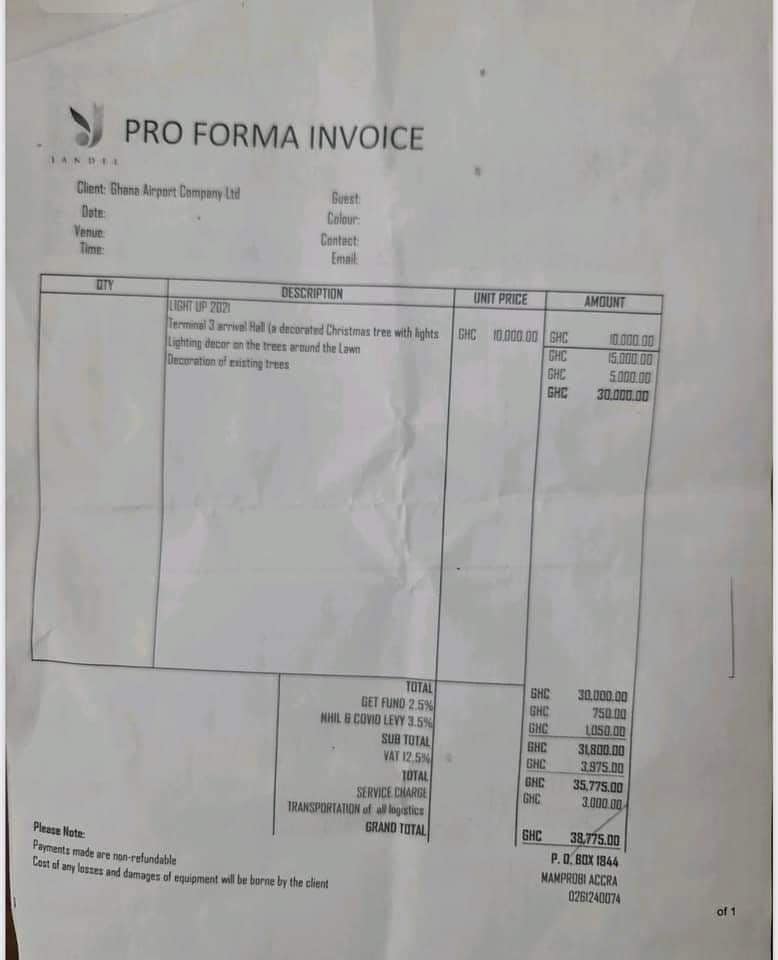
The news of the procurement emerged with leaked proforma invoices from two companies from which the services were procured. The two invoices were addressed to the GACL, with one of them naming the board chairman, Paul Adom-Otchere.
Jandel Limited’s proforma invoice amounted to GHS 38,775
A proforma invoice from Jandel Limited for “Terminal 3 Arrival Hall (a decorated Christmas tree with lights), lighting décor on the trees around the lawn, and decoration of existing trees” amounted to a total of GHS 38,775.
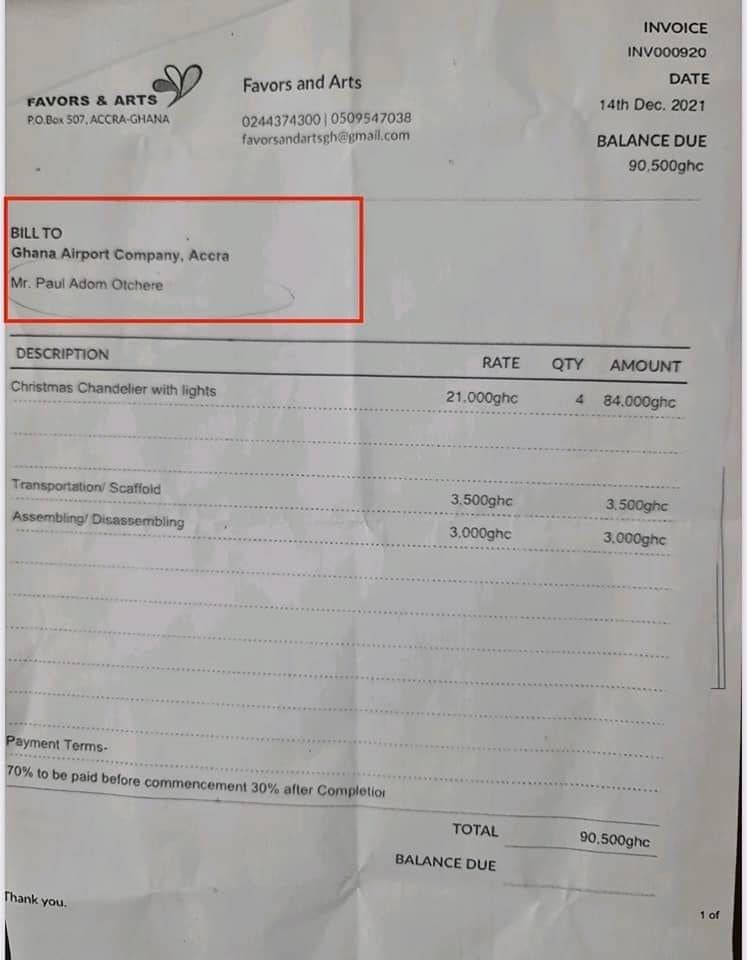
Another proforma invoice from Favors and Arts for the rental of a Christmas chandelier with lights amounted to GHS 90,500.
Proforma invoice from Favors and Arts amounted to GHS 90,500 and was addressed to Mr Paul Adom-Otchere
The proforma invoice from Favors and Arts was addressed to the GACL and “Mr Paul Adom-Otchere”.
Social media commentators questioned the corporate governance structures at the GACL that allowed the board chairman of the state-owned company to be directly involved in the procurement of Christmas decorations.
On January 7, 2022, Paul Adom-Otchere sidestepped the corporate affairs department of the company and issued a statement to clarify the widely circulating information that suggested imprudent use of public funds by the company.
“Dear folks, my attention has been drawn to a social media post (herein attached) grossly misrepresenting facts about Christmas inspirations that were mounted at the Kotoka International Airport,” Paul Adom-Otchere wrote on his Facebook wall.
In what he called “Facts”, Mr Adom-Otchere explained in a bulleted release that the GACL paid GHS 118,000 for the decorations, out of which GHS50,000 was paid by a sponsor.
The statement went on:
“FACT: Two separate suppliers were invited to submit bids. The bids were discussed and discounts obtained. (We are grateful to Jandel Limited and Favors and Arts).
FACT: The beautiful Christmas tree standing at Terminal 3 and 3 others altogether cost GHC 34,000, which was graciously provided by Jandel Limited at a heavy discount. (We thank Jandel Limited).
“FACT: The other inspirations were provided by Favors and Arts for a total cost of GHS 84,000 out of which GHC 50,000 was obtained via sponsorship.”
On January 11, four days after his social media release, Mr Adom-Otchere, who’s also the host of the Good Evening Ghana programme on Metro TV, followed his statement up with an explanation on his TV show.
“We put out a statement that the Christmas tree was bought for 34,000 cedis,” Mr Adom-Otchere emphasised how much the GACL paid for the tree while referring to an invoice on a touch screen monitor in the studio.
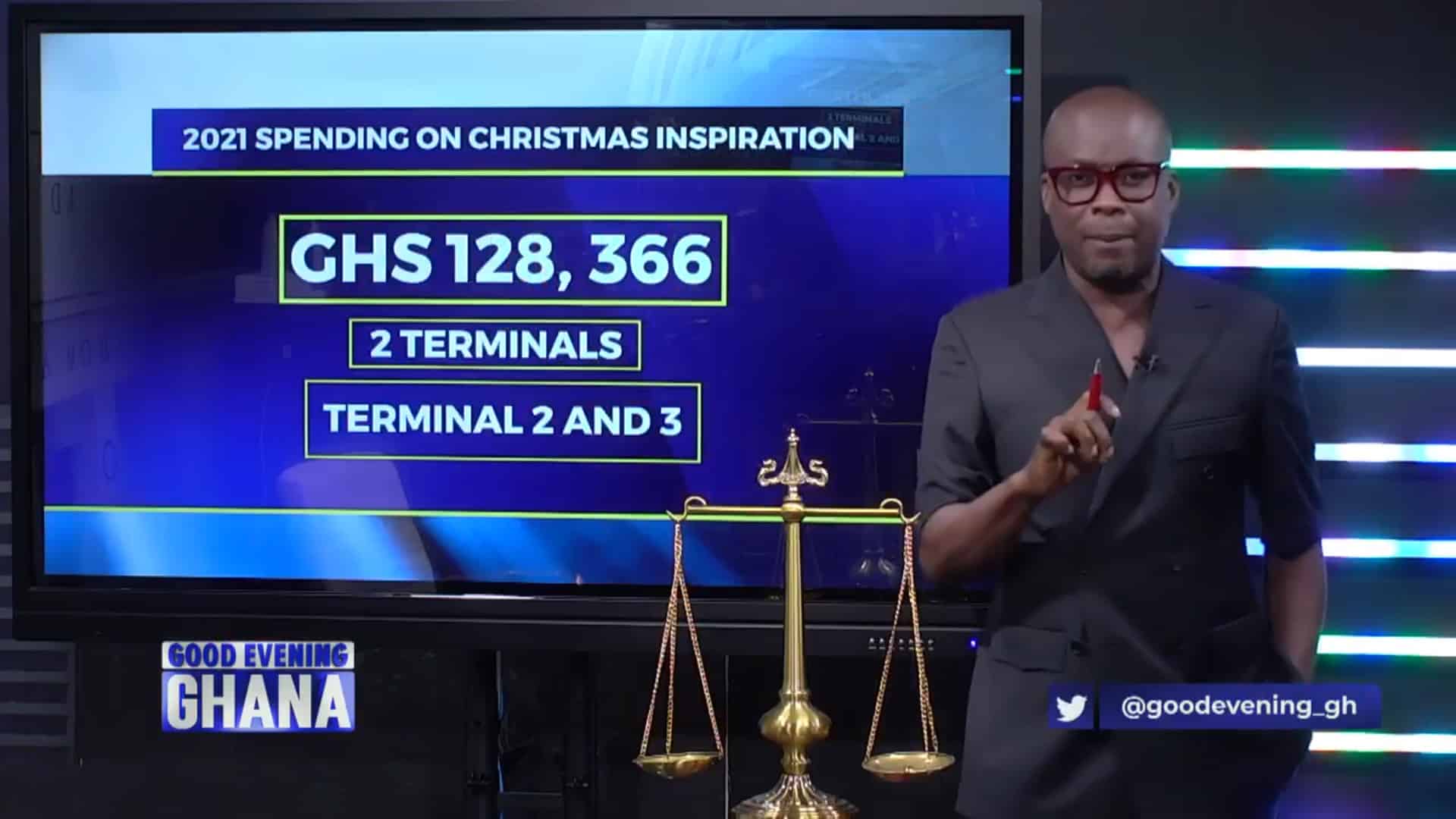
However, what changed in the TV presentation was how much the company paid for the decorations. Instead of the GHS118,000 he earlier stated as the total payment, he revised the figure to GHS 128,366.
On TV, Mr Paul Adom-Otchere revised the figures for the total cost of the decorations
This GHS 128,366 is the closest to the amounts stated on the face value of the two proforma invoices— GHS 129,275 (the sum of 38,775 and GHS 90,500)
The contradictions in the two explanations by Paul Adom-Otchere, coupled with the viral claims, provoked Redeemer to file an RTI request for clarification.
Alleged breach of the procurement law
Some critics of the deal alleged that the GACL had breached the Public Procurement Act in the application of the request for quotation method.
According to Paul Adom-Otchere, the GACL requested quotations from two companies to provide the different services for the Christmas decorations at the airport.
Article 42 of the Public Procurement Act states that a “procurement entity may engage in procurement by requesting quotations in accordance with section 43.”
Section 43 of the Act says, “The procurement entity shall request for quotations from as many suppliers or contractors as practicable, but shall compare quotations from at least three different sources that should not be related in terms of ownership, shareholding or directorship and the principles of conflict of interest shall apply between the procurement entities and their members and different price quotation sources.”
What this means is that the GACL should have requested quotations from at least three service providers for the Christmas tree and another three quotations for the rental of the chandelier.
However, the GACL requested one quotation each for the two services, a practice some critics said fell foul of the procurement law.
The RTI request in January and the response in June
In January, Redeemer Buatsi requested copies of the procurement contract and how much the GACL spent on Christmas trees over the years among other pieces of information.
The GACL refused to respond to the request. Mr Buatsi followed with an internal appeal to the managing director of the company, in accordance with the RTI law.
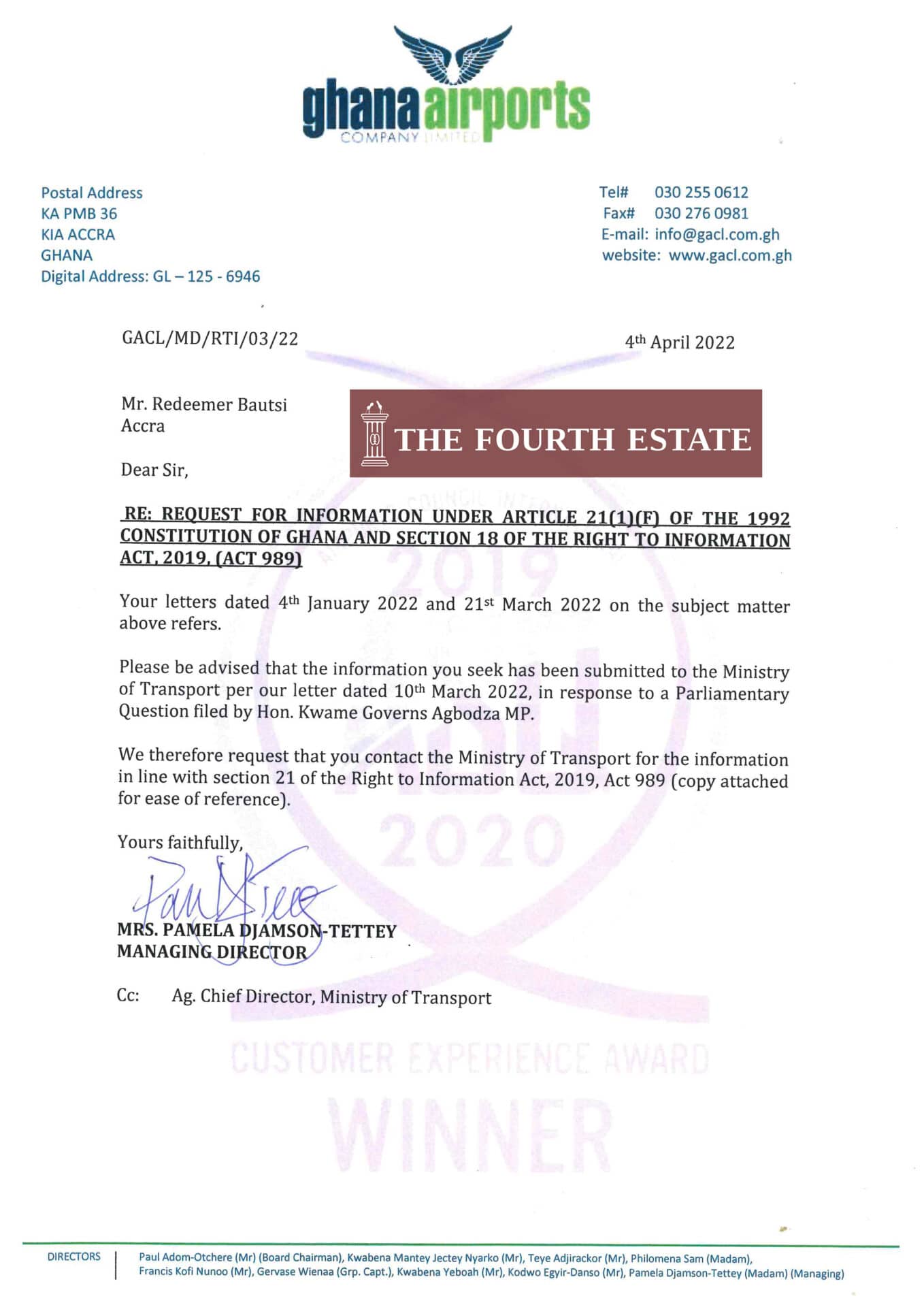
In a response dated April 4, 2022, about three months after the initial request, the GACL, in a letter signed by its managing director, Mrs Pamela Djamson-Tettey, referred the journalist to the Ministry of Transport.
The GACL letter referred the journalist to the Ministry of Transport/Fourth Estate
“Please be advised that the information you seek has been submitted to the Ministry of Transportation per our letter dated 10th March 2022, in response to a parliamentary question filed by Hon. Kwame Governs Agbodza, MP.
“We therefore request that you contact the Ministry of Transport for the information in line with Article 21 of the Right to Information Act, 2019 (Act 989),” the GACL stated in the letter.
Redeemer transferred the request to the Transport Ministry.
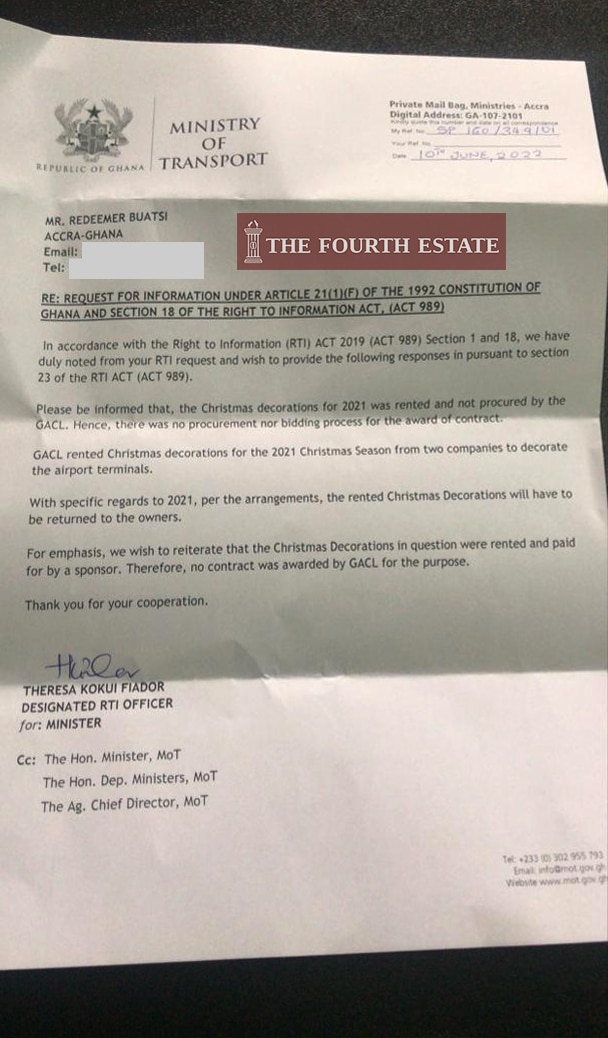
In a letter dated June 10 and signed by Theresah Kokui Fiador, for the Minister, the Transport Ministry denied both the January 7 and January 11 claims of Paul Adom-Otchere, on the procurement of the Christmas decorations.
“Please be informed that the Christmas decorations for 2021 was rented and not procured for by the GACL. Hence there was no procurement nor bidding process for the award of contract,” the Ministry of Transport said.
In the letter, the Ministry said there was no procurement nor bidding process for the award of contract
The Ministry also said even the rented decorations were paid for by a sponsor, implying that the GACL incurred no cost on the 2021 Christmas decorations.
“For emphasis, we wish to reiterate that the Christmas decorations in question were rented and paid for by a sponsor. Therefore, no contract was awarded by GACL for the purpose,” the Ministry said.
Contradictions
While Paul Adom-Otchere in his January 7 release stated that “Two separate suppliers were invited to submit bids and that the “bids were discussed and discounts obtained”, the Transport Ministry said in its letter “there was no procurement nor bidding process for the award of contract”.
Also, while Paul Adom-Otchere stated that GACL “bought” and paid for Christmas tree and inspirations, the Ministry said the decorations were “rented” and not bought.
The Ministry also said the entire cost of renting the decorations was borne by a sponsor whereas Paul Adom-Otchere said the supposed sponsor paid only GHS 50,000 out of GHS 128,366 (39%) of the cost of purchasing the decorations.
In the last few days, it has emerged on social media platforms in Ghana that Zimbabweans are selling their toes for huge sums of dollars. According to the viral claims, people are engaging in the sale of human body parts because of hardship and high cost of living in the country.
The information, which is apparently spreading wide on various social media platforms across Africa also suggests it is the business of a Zimbabwean millionaire. He offers $40,000 or a brand-new car in exchange for the toe, the viral messages claim.
Other news portals that republished the viral claims suggested that the toes were being collected for money rituals by a cult.
Monitoring the messages making rounds on social media without any credible source, Fact-Check Ghana decided to verify.
The team followed news media reports in Zimbabwe, social media posts and as well interviewed some experienced journalists and editors in Zimbabwe about the issue.
Social media rumours and frenzy
According to news reports in Zimbabwe that Fact-Check Ghana has been monitoring, the issue of people trading their toes for cash has been trending in the country.
“Frenzied reports these past few days have emerged on social media, of pictures being shared of people selling their toes,” Bulawayo 24, an online news portal, reported.
The portal also reported that the claims were circulating on WhatsApp, Twitter, and Facebook and suggested people offered their big toe for US$ 40,000, the middle toe for US$ 25,000, and the tiny toe for US$ 10,000.
“Memes and jokes have been spread across social media, with people laughing at pictures of some who have reportedly sold their toes for varying amounts of money,” the news portal added.
Indeed Fact-Check Ghana sighted a number of the posts, photos, and videos of people making jokes and creating fun out of the rumours. Some of the content creators posed as beneficiaries of the toe trade.
While the rumours about the Zimbabweans selling their toes for money have been rife, there has not been news report by any credible media outlet providing evidence of someone who has, indeed, traded their toe for money.
However, a local tabloid, H-Metro, carried the news on the front page of its May 31, 2022 edition titled “Dealer confirms toe trade”. The story which is also published on its online platform quoted one David Kaseke, a trader at Ximex, an abandoned mall in Harare, the Zimbabwean capital.
A local tabloid, H-Metro, carried the news on its front page
In the report, David claimed he was the dealer for the toe traders who were based in Harare. The paper did not provide any further evidence but said it was investigating further.
We haven’t seen the people selling their toes – Zimbabwe journalists
Fact-Check Ghana further enquired from some journalists and editors in Zimbabwe about the veracity of the toe trade. All the journalists who spoke with the team said they were mere rumours without any evidence.
“It’s just one of those social media rumours that nobody has proved [sic] at all. We like those rumours around here,” Ranga Mbery, an online news editor and communications specialist, told Fact-Check Ghana in a chat.
“Nothing. Nobody has interviewed or met anyone with any missing toes. Everyone claims to have “heard”,” Ranga responded when asked if he had seen anyone who had traded their toe for money.
Chamu Murava, a journalist and media liaison officer of the Zimbabwe Anti Corruption Commission, confirmed it had been trending on social media.
“I can’t confirm whether it’s true or false because I have not encountered a real-life story about it,” he said.
“While the country is facing economic challenges, this issue has been circulating but it seems like fake media posts. It’s trending on social media but we have not really seen the people that sold their toes for money,” Veneranda Langa, an awarding-winning journalist working with the NewsDay and the Standard in Zimbabwe, explained to Fact-Check Ghana.
Police promise to investigate
On June 1, 2022, Zimbabwean police said it had begun investigating the matter. Assistant Commissioner Paul Nyath, the police spokesperson, said the police was monitoring the issue.
“Police are conducting investigations and we shall issue a comprehensive report in due course. The public must do things according to the laws of the country, especially when it comes to human body parts,” he said.
“The laws of the country are very clear when it comes to the issue of health and body parts, in terms of movement. The selling of human body parts in the country is illegal, whether people are advertising, soliciting, offering; in terms of the country’s law as espoused by the Criminal Law and Codification and Reform Act, Chapter 9:23, is very clear,” Asst. Commissioner Nyath added.
It’s a hoax – Deputy Minister of Information
Zimbabwe’s Deputy Minister of Information, Publicity and Broadcasting Services, Kindness Paradza, has said the stories are not true, adding that the government has made its own investigations.
Kindness Paradza, Deputy Minister of Information, Publicity and Broadcasting Service, said the claims are not true | credit: mazw.org.zw
“As Government, we made some investigations into this issue and we assessed the status of the matter. There’s nothing like that. It’s an act of social media peddlers who are trying to tarnish our country,” he explained.
“They are tarnishing the image of our citizens, who are working hard to earn a living, assuming they are trading their toes to prosper”.
Supposed dealer of toe trade faces charges in court
Yesterday, June 7, David Kasege, the Ximex trader and supposed dealer of the toe trade who granted interview to H-Metro, was presented to a magistrate court in Harare.
According to media reports, the state alleged in its charge sheet that David Kasege “indicated that he was drunk and joking” when he granted the interview to H-Metro.
The State argued in court that his prank had “materially interfered with the comfort, convenience, peace of the public as he had wantonly and mischievously raised [a] false alarm to the public”.
David has been released on bail of Z$8,000 (US$24.84) and will appear in court on Friday, June 10.
From the above, it’s clear there’s no evidence supporting the viral claim of Zimbabweans trading their toes for cash.