The Traditional Medicine Practice Council (TMPC), a health regulator under the Ministry of Health, has for the second time been caught in an investigation by The Fourth Estate for licensing a quack herbal medicine practitioner.
The health regulator, which is responsible for the registration of traditional medicine practitioners, registered a non-existent herbal company, Krodwoa Herbal Enterprise, and licensed a non-existent herbal practitioner, Maxwell Akroma Duah.
This is contrary to the Traditional Medicine Act 2000, ACT 575 which states that to register a facility, applicants are required to present evidence of the ability of proposed practitioners in the practice, proof of registration, and testimonials from a traditional medicine practitioners association they belong to.
Also, to register a facility, the law requires an applicant to present the block plan of the premises and provisional approval from the district planning authority or relevant authorities on the land housing the premises.
Although Krodwoa Herbal Enterprise was non-existent, the Council licensed it. It also licensed its non-existent herbal practitioner, Mr Duah.
The TMPC official told The Fourth Estate’s undercover reporter that though inspection was required, she could process the licence without visiting and inspecting the herbal enterprise as required by law.
What is more fascinating is that the TMPC in its requirements said a herbal medicine manufacturer can only qualify as a traditional medical doctor after training by the TMPC.
But this was not done.
According to ACT 575, to qualify for registration as a traditional practitioner, an applicant must have had “adequate proficient practice in traditional medicine” and be endorsed by a district chairman of a recognised traditional medicine practitioners association or a district coordinating director.
The official, who handled the process, only tore part of a crumpled paper and wrote the list of items for the registration and corresponding costs in a way that suggested it was a regular practice done at the office.
The items included:
Form- GHC 10.00 Endorsement- GHC 20.00
Certificate- GHC 80.00 Licence- GHC 400.00
Inspection- GHC 200.00 Training-GHC 150.00
Total- GHC 860.00
The Fourth Estate’s undercover reporter presented an address of the facility, business registration, name of a guarantor, and photo identity of the non-existent practitioner, Mr Duah.
Though the Council took money for training and inspection, neither the training nor the inspection took place.
A certificate of license for the non-existent herbal manufacturing company, Krodwoa Herbal Enterprise
After seven months, The Fourth Estate finally received the certificate of registration for the non-existent manufacturing company, Krodwoa Herbal Enterprise and a licence for a fake and non-existent herbal medicine manufacturer, Mr Duah.
This is not the first time the TMPC has licensed a fake practitioner.
In May 2020, the TMPC issued a certificate to a quack practitioner, Jonathan Ohene Nkunim. Mr Nkunim was exposed by The Fourth Estate for sexually assaulting some women who visited his facility for physiotherapy services.
Quack practitioner who was issued a licence by the Traditional Medicine Practice Council
Apart from the certificate, Mr Nkunim also had two other licenses from the TMPC, Ghana’s regulatory body for traditional and alternative medicine.
Jonathan Ohene Nkunim and his facilities had three licenses from the Traditional Medicine Practice Council
The TMPC issued Mr Nkunim these licenses though the police were still investigating his previous licenses which were acquired under dubious circumstances. The TMPC ignored the fact that he had no training to provide the services listed on his call cards, and notice at the premises of his facility. The Fourth Estate brought this to the attention of the TMPC before it issued the licence.
On April 24, 2021, a traditional medicine practitioner wrote to The Fourth Estate to investigate the laxity in the TMPC’s operations. This coincided with The Fourth Estate’s story on the licensed sex predator, Mr Nkunim.
“Our training in KNUST [Kwame Nkrumah University of Science and Technology] and Mampong [Centre for Plant Medicine] takes us six years to be licensed. We are trained in medical school and pharmacy school and then we do attachment and clinical rotations for an additional two years. When you are out, and you see the body responsible for ensuring sanity in the system messing up, it hurts,” the petitioner said.
Meanwhile, the Deputy Minister of Health, Mahama Asei Seini, has said the government will launch an investigation to find staff of the TMPC who licensed a non-existing herbal medicine practitioner, Mr Duah and his manufacturing company, Krodwoa Herbal Enterprise.
Deputy Minister of Health, Mahama Asei Seini
“The government, and by extension, the Ministry of Health, has taken a keen interest in this documentary and will launch an immediate investigation into key revelations of the documentary, to ascertain which of the staff members at the TMPC failed to do due diligence in the licensing of this fake manufacturing company,” Mr Mahama said this on Thursday, September 14, 2023, at a public forum organised by the Media Foundation for West Africa.
On Friday, December 3, 2021, social media in Ghana was flooded with a video of the Energy Minister, Dr Mattew Opoku Prempeh’s appearance on Accra-based Asempa FM’s political show Eko si sen.
In the said video, Dr Prempeh, who is also the Member of Parliament for Manhyia South, questioned the minority side in parliament’s insistence that the 2022 budget should address the tidal waves disaster in Keta.
He threatened to lead a demonstration in Kumasi if the Minister of Finance, Ken Ofori Atta, dared bend to the request of the Minority, particularly when the Rawlings administration had misapplied a loan it contracted for the Keta Sea Defence Project.
The video, which has gone viral has generated a lot of controversy on social media, with a section of the public condemning the former Education as being insensitive to the plight of the people of Keta.
The minister’s misgivings came on the back of the minority’s displeasure with the fact that the 2022 budget presented to Parliament failed to capture mitigation measures for residents of some communities in the Anloga District, Keta and Ketu South municipalities. They had endured a distressful weekend from November 5-7 when tidal waves battered their settlements, rendering thousands homeless.
The Fourth Estate has verified the claims Dr Prempeh made and presents the fact below.
Claim 1:
“During the eight years of NDC [2009-2017], I didn’t see Keta Defence project anywhere.”
Verdict: Completely false.
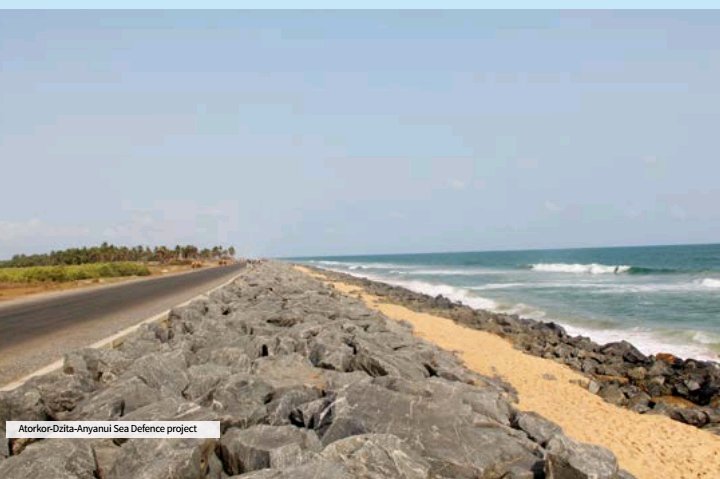
During the Mills-Mahama administration, two sea defence projects were executed in the Volta Region to protect coastal communities against the vagaries of the ocean. One of them was the Atorkor-Dzita-Anyanui Sea Defence Project.
According to parliamentary hansard of March 5, 2013, the then Finance Minister, Seth Terkper, told the House that the second phase of the Atorkor-Dzita-Anyanui Sea Defence Project was five percent away from completion.
“Mr Speaker, under the phase II of the Atorkor-Dzita-Anyanui Emergency Sea Defence Works, the Groyne System being constructed to protect the 1.5 kilometres stretch of the coast is about 95 per cent complete.”
Until the Anloga District wascarved outof the Keta municipality in 2019, Atorkor, Dzita and Anyanui were communities in the Keta municipality.
This is supported by media reports that indicate that the construction of the project started in June 2011 to stop tidal waves from the recurrent destruction in the beneficiary communities.
Amandi Holding, an Israeli construction firm, started construction work in October 2010 and it was expected to be completed by December 2011. It was, however, completed in October 2014.
Credit: Twitter
It is, therefore, not true that during the eight years of the NDC there was no work on a sea defence project in Keta.
Claim 2:
Between 1998 and 2000, NDC went for money for the sea defence at Keta. They used the money for something else. When the NDC was in power, Keta was still experiencing tidal waves. They went for a loan in the name of that project but they didn’t do it. President Kufuor had to contract another loan for it, but they still voted against him.”
Verdict: Misleading
Coastal erosion has been causing extensive damage to Keta and its environs as far back as 1929. Fishing and farming communities crumbled as advancing tidal waves fueled by climate change consumed homes, schools and the most popular colonial legacy on the shores of Keta -Fort Prinzenstein.
By the 1990s, the Rawlings administration decided to tame the sea with a wall.
The first reported loan for the sea defence was carried in the Daily Graphic publication of June 19, 1996. The Rawlings administration had contracted a $42-million facility from the Exim Bank of the USA for the project.
On July 3, 1997, the Daily Graphic reported that feasibility studies on the Keta Sea Defence Wall had been completed and construction was to start in August of that year. The studies undertaken by Great Lakes Dredge and Dock Company, an American construction firm, centred on coastal erosion, flooding of the lagoon and the protection of shores.
Even though the state-owned newspaper had reported that construction work was to start in August that year, the project did not start on that date.
On November 3, 1997, the Daily Graphic reported that all was set with Keta Sea Defence Project with the signing of agreement between the government of Ghana and an American contractor, Great Lakes and Dock Company, which also did the feasibility studies. The exact date for beginning of the construction work was not announced.
Daily Graphic, November 3, 1997
Daily Graphic, May 31, 2000
However, the Daily Graphic again published on July 8, 1999 that construction work was to start in September that year, following the signing of an agreement between the governments of Ghana and the United States of America. As part of the terms, the US government was to extend a concessional credit of $93.8 million through the Export Funding Corporation (EFCO) and the Exim Bank.
The parties agreed on a five-year moratorium on interest payment, but Ghana was obligated to honour the loan over a 10-year period, beginning from September 2004. According to the report, the loan agreement came to fruition through the personal efforts of President J.J Rawlings of Ghana and President Bill Clinton of the USA.
The actual construction work at the site started on June 1, 2000, the Daily Graphic reported on May 31, 2001. By this period, preparatory works—the mobilization of human resources, the assemblage of large consignment of equipment and machinery at the site at Havedzi and Metsrikasa quarry sites—had been completed. According to the May 31, report, Great Lakes and Dock Company had commenced work on September 15, 1999.
From the various reports, the cost had ballooned from $42 million in 1996 to over $90 million because the scope of work had increased with the resettlement of affected communities added to the cost.
Keta Sea Defence Wall during its construction Credit: Great Lakes Dredge and Dock
The National Democratic Congress (NDC) lost the 2000 elections to the New Patriotic Party (NPP) led by J.A Kufuor. In the Kufuor administration’s first budget read on March 9, 2001, and published in the Daily Graphic of March 10, 2001, the then Minister of Finance, Yaw Osafo-Maafo said, “Work on the Keta Sea Defence has progressed.”
President Kufuor visited the project site on January, 6, 2002 during a three-day tour of the Volta Region. Briefing the then President, the Project Manager of the Keta Sea Defence Wall, Torgbui Kporku III, said 40% of the work had been completed and that the project was on schedule with the expected date of completion penciled for February 3, 2004.
He, however, said the greatest challenge the project faced was paying the contractor $ 3million, which was what remained of Ghana’s $12 million contribution as counterpart funding. The cost of the project had now been pegged at $84 million.
Responding to concernsduring a parliamentary debate to approve the financial estimates of the ministry of Works and Housing on March 26, 2001, the Minister of Water and Housing, Kwamena Bartels, explained that the counterpart fund for the Project depreciated by half its value in 2000 due to the depreciation of the cedi but the project was on course.
A World Bank document titled “West African Coastal Area Management Programme,” corroborated the chronology of events. It stated that following feasibility studies which commenced in 1997 as part of efforts to adapt to the severe erosion and to protect the built-up environment in particular, an US$85 million Keta Sea Defence Project (KSDP) was undertaken between 1999 and 2004.
While the Exim Bank of the United States of America funded the project, the Great Lakes Dredge and Dock Company of the United States of America executed the project as the contractor with Baird & Associates, and Messrs Conterra Limited providing design and consultancy services respectively.
Indeed, part of the original funds meant for the project was reportedly mismanaged by Pentrexx Ghana, a local dredging company. The company was awarded the contract in April 1995. Former President J.J. Rawlings cut sod for the commencement of work in November, 1996.
But the then Ranking member of the Work and Housing Committee, Kwamena Bartels, raised red flags on a number ofimproprieties concerning the project.
According to The Independent publication of February 24, 1998, as part of the agreement, “all equipment bought for the project by the Ministry of Works and Housing should be marked ‘Keta Sea Defence Project’, but the bulldozers and articulator tipper trucks have not been so marked.The Independent investigations also reveal that even the Architectural Engineering and Services Limited (AESL), who prepared the payment certificates of Pentrexx Ghana Limited for the demolition works at Keta, allegedly inflated the rates for the work done by the company.
“Masonry blocks and ordinary sand concrete blocks were referred to as ‘bulldozers’ and consequently attracted higher rates than the rates for sand. Further, although 49 partly ruined houses were demolished, Pentrexx Ghana Limited were paid for demolishing 99 houses. As at today the site for the Keta project is situated on the Spintex Road in Accra,” The Independent reported.
In 1998, the government set up a committee to investigate allegations of misappropriation of funds. The committeerecommendedthat Pentrexx Ghana Ltd and Bascom Ltd—two companies at the centre of the scandal—should refund ¢3.76 billion (GHc376,000) to the public purse.
According to the government white paper issued on the committee’s report, although no act of impropriety was found against the then Minister of Works and Housing, Mr Fosu, he ought to take responsibility for the lapses, Ghanaweb reported on February 24, 1998.
From the foregoing, the Minister of Energy, Dr Mattew Opoku Prempeh misled the public when he claimed that loan the Rawlings administration acquired for the project between 1998 and 2000 was misapplied and that it had to take the Kufuor administration to acquire a new loan for the project.