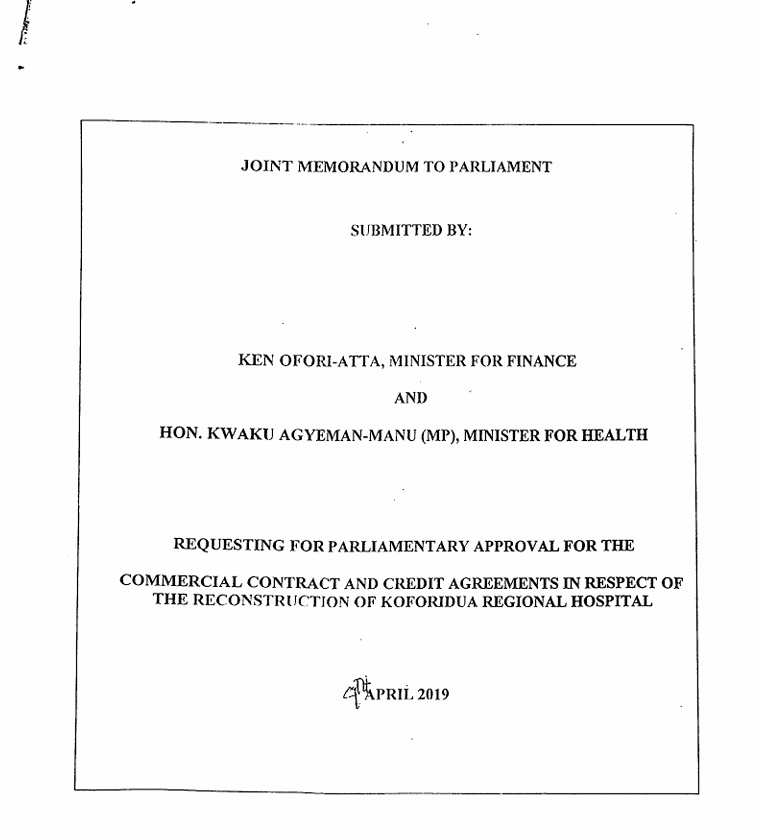
On 9 April 2019, Ghana’s Finance Minister, Ken Ofori-Atta, and Health Minister, Kwaku Agyeman-Manu, signed and submitted a joint memorandum to Parliament for approval.
The request was specific and, on paper, straightforward: approve €70 million in financing to construct a new Eastern Regional Hospital in Koforidua, to save the ageing facility that has served Ghanaians in the region since 1926.
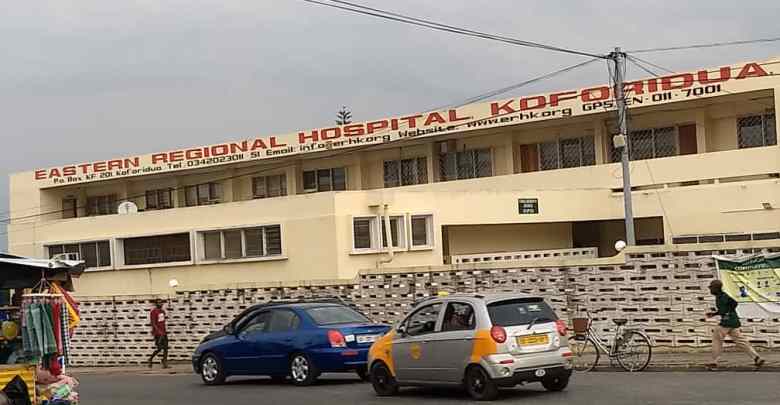
Photo of the current eastern regional hospital in koforidua
The memorandum broke the money down into two credit agreements: a €60.24 million facility backed by UK Export Finance, and a €17.68 million tied commercial facility.
The plan attached to that signature was an ambitious 600-bed hospital. Seven operating theatres. Radiation therapy and oncology, cardiology, nephrology, a dedicated burns unit. Teaching facilities to train medical cadres. Staff accommodation for the personnel who would eventually run the place.
Artistic impression of the Eastern Regional Hospital
It also included sixteen two-bedroom flats, ten three-bedroom flats, eight four-bedroom flats, and twelve one-bedroom ensuite units for staff. There was also construction of roads, drainage, boreholes, and solar backup power.
The memorandum promised completion within three years, from 2019 to 2021, with Tyllium U.K. Ltd. named as lead contractor. Parliament approved it. The loan was, per the memorandum, already on the list of projects cleared for non-concessional borrowing under an IMF programme 2019.
On 22 July 2020, the fanfare arrived. Then President Akufo-Addo travelled to Koforidua to cut the sod for Phase One, 285 of the planned 600 beds, in a ceremony that, by its nature, is designed to mark a beginning rather than guarantee an end.
President Akufo-Addo was precise about the terms he expected the contractor to meet: the project, he said, must “be completed within the thirty-six (36) month period and on budget.” Thirty-six months from a July 2020 groundbreaking put the deadline at July 2023.
That deadline came and went without a hospital.
By December 2023, five months past the promised completion date, the story had turned from delay to abandonment. Contractors Tyllium U.K. Ltd and Ellipse Projects walked off the site entirely, citing unpaid funds. Subcontractors handling electrical work and plastering stopped soon after. Workers were laid off “until work resumes,” a phrase offering no timeline at all. Progress had stalled at roughly 30 percent complete.
Then, in July 2025, President Mahama’s “thank you” tour got to the Eastern Region. At a durbar of chiefs and residents at Jackson Park in Koforidua, another promise was made. President John Mahama told the gathering his government would honour projects begun under the previous administration.
The Omanhene of New Juaben, Daasebre Kwaku Boateng III, whose predecessor had donated the very land the project – Koforidua Regional Hospital sits on, used his welcome remarks to ask the President directly to finish what had been started.
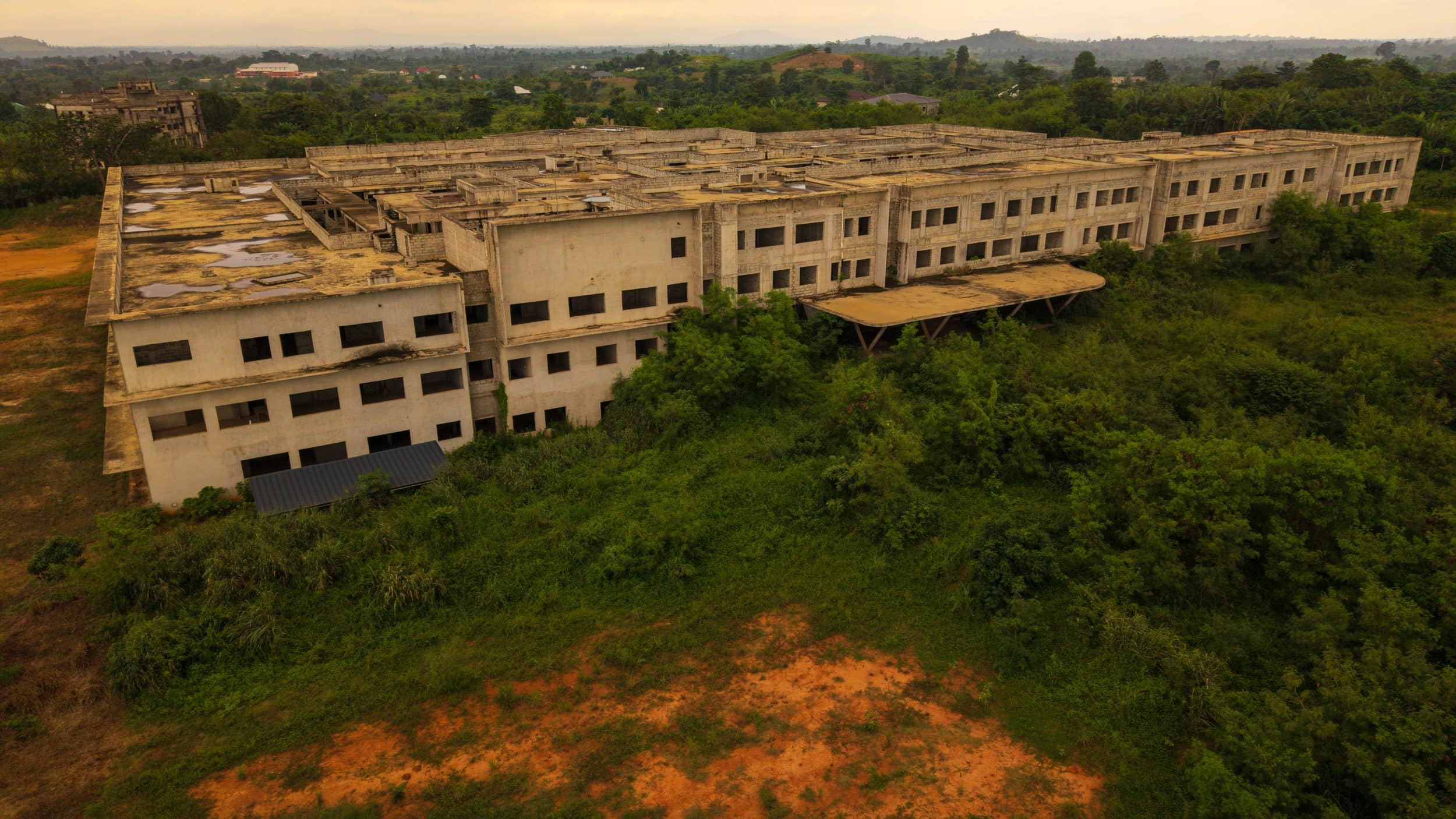
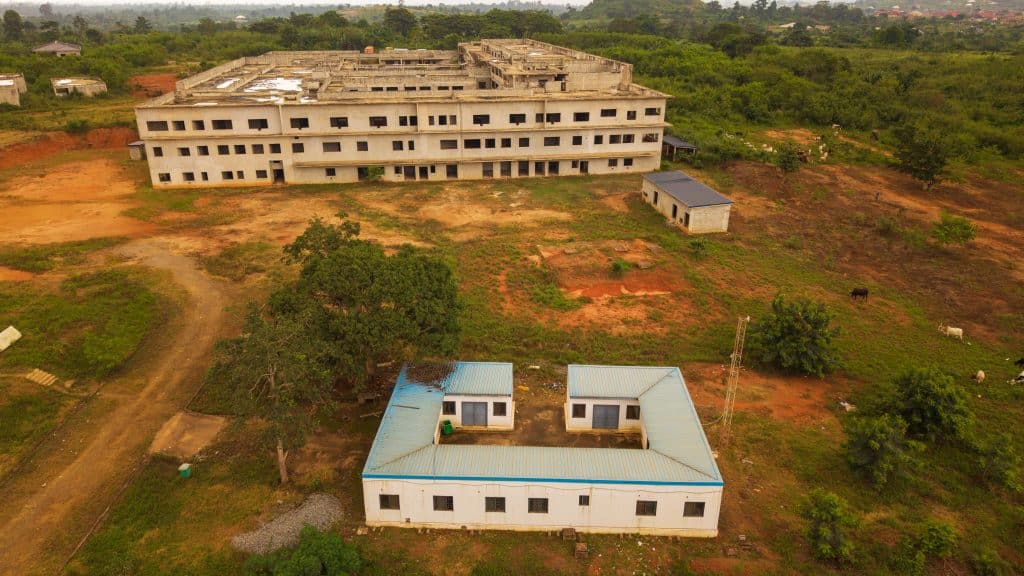
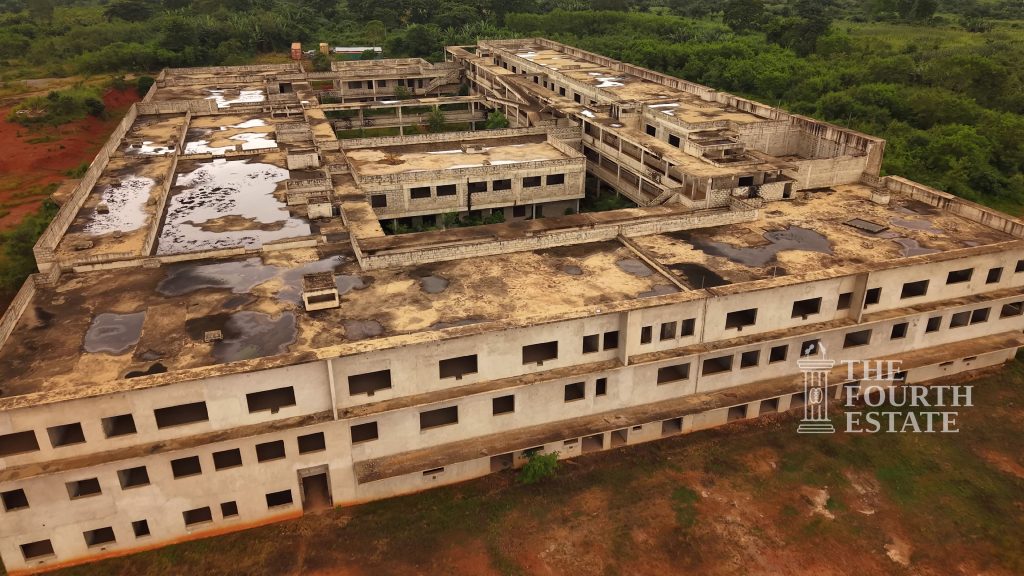
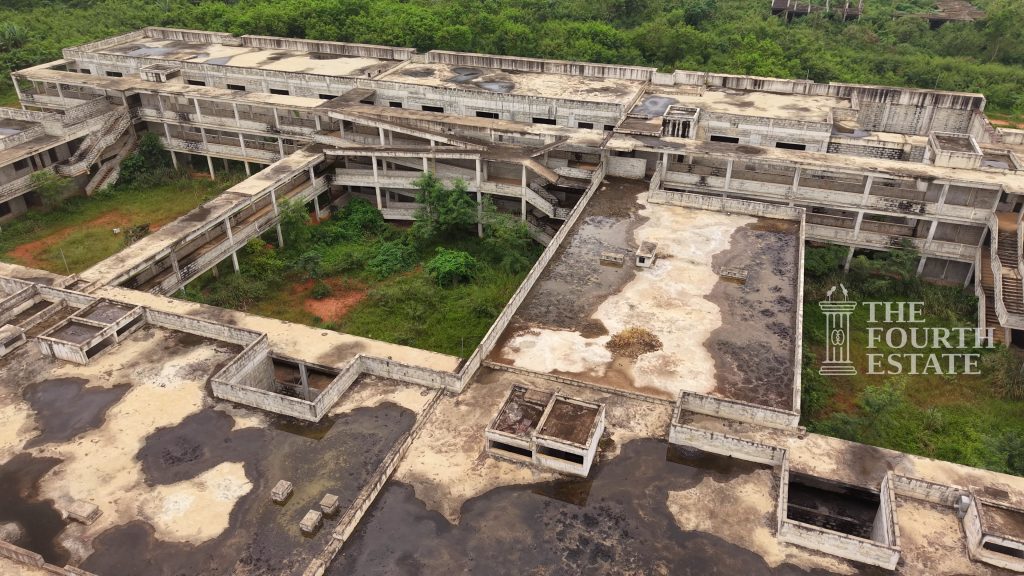
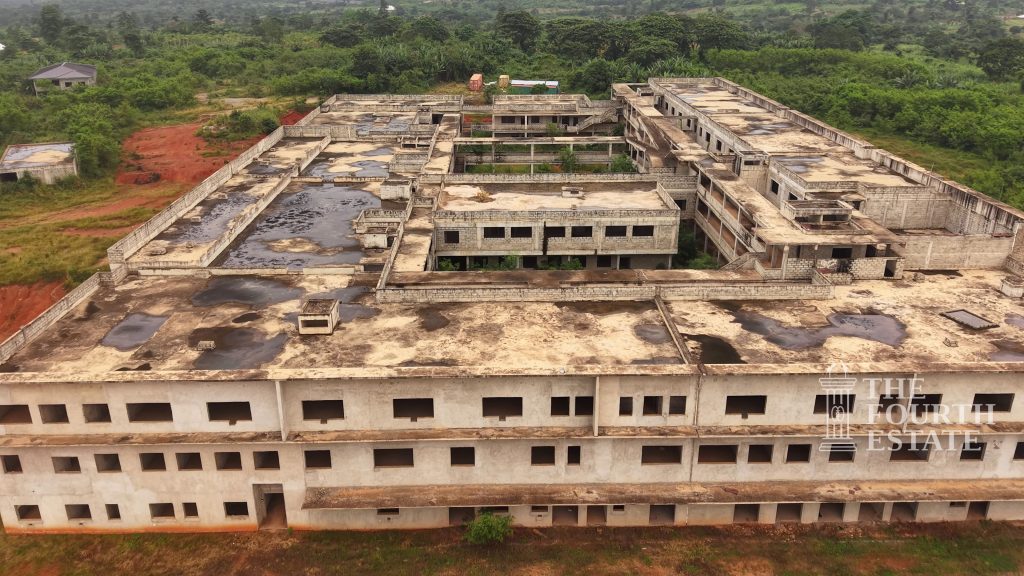
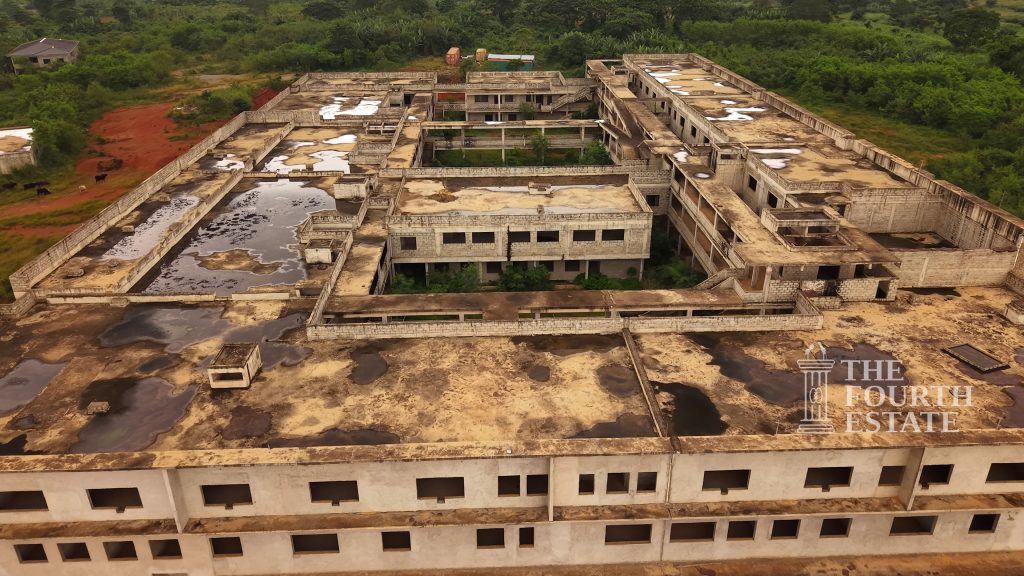
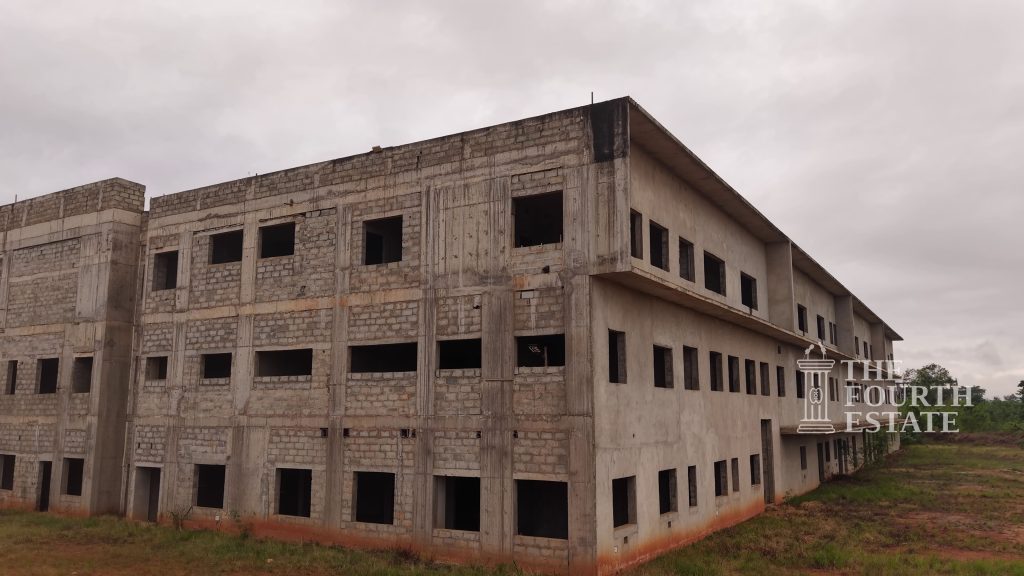
It was a project expected to redefine healthcare delivery in the Eastern Region. Today, those promises stand in contrast to reality. The road leading to the project site still ends at the imposing concrete structure that dominates the surrounding landscape.
When The Fourth Estate visited the project site on July 26, 2026 – a year after John Mahama’s promise, there was no sign of construction activity. No earth-moving equipment.
No masons. No carpenters. No engineers. Instead, weeds had taken over.
default
What was expected to become a busy construction site is now, after the second promise, still being slowly reclaimed by nature.
Thick vegetation stretches across sections of the expansive compound, swallowing pathways and creeping toward the entrances of the unfinished hospital. Some of the weeds have grown almost to the height of the building’s entrances, making access into parts of the facility difficult without first clearing a path.
By the side of the facility, forty-foot shipping containers sit where the contractors left them, some still locked, weeds climbing their flanks. They were meant to be temporary but have become permanent tenants.
Parliament approved a financing package with a 13-year repayment period for a hospital expected to be completed within three years.
Today, nearly five years into that financing period, the towering concrete structure is left to the mercy of nature, unfinished and unusable. However, the loan clock continues to tick, and soon the taxpayers’ money will be used to service this €70 million loan.
The promise that once inspired hope waits, still, to be fulfilled.
Two years after Ghana spent US$145 million to build the Borteyman Sports Complex for the 13th African Games, weeds have overtaken parts of the multi-sport facility — in some places growing taller than the perimeter fence.
A visit by The Fourth Estate to the sprawling complex on Sunday, July 5, 2026, paints a picture that contrasts with the fanfare that accompanied its commissioning ahead of the African Games in March 2024.
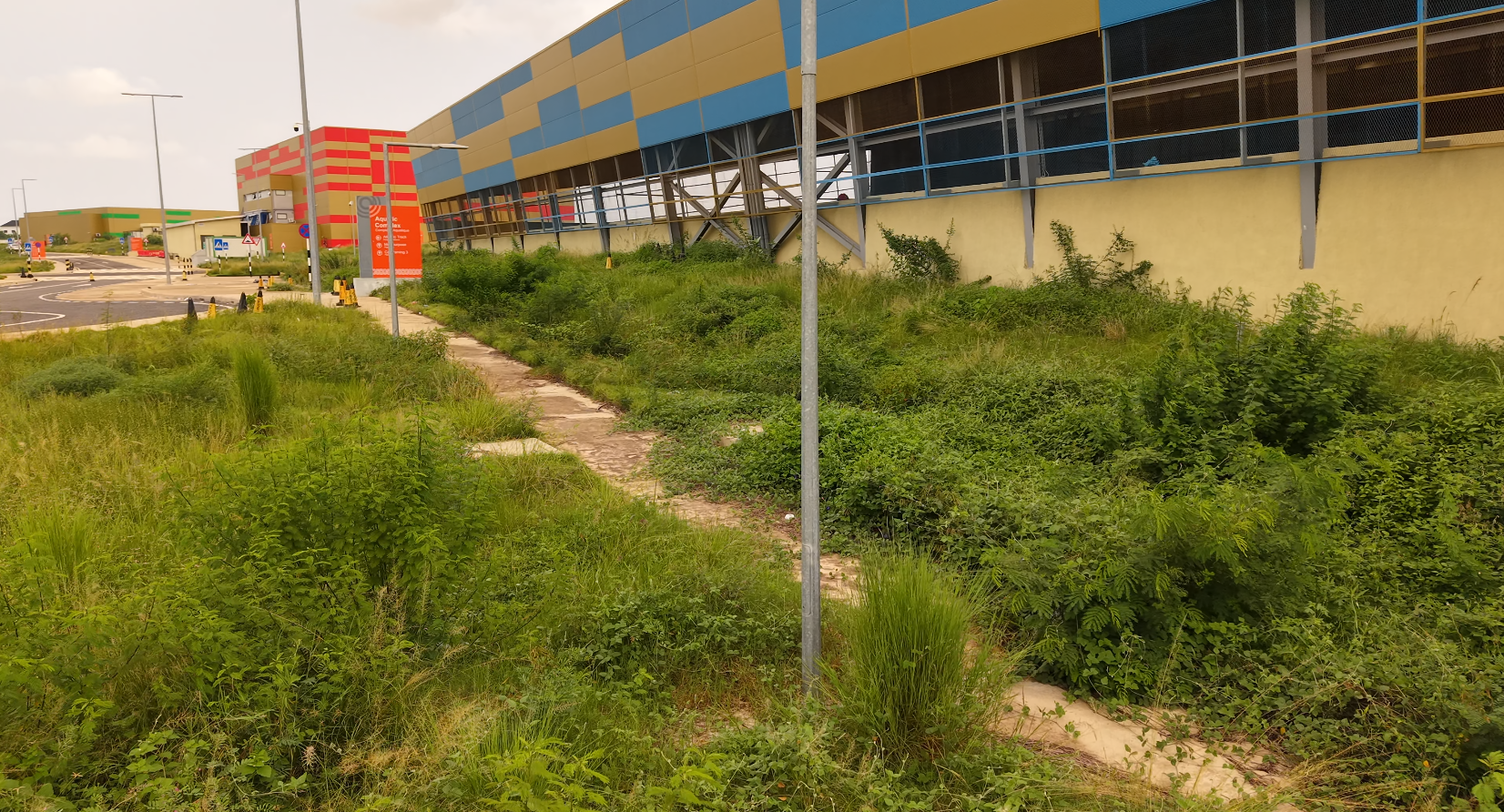
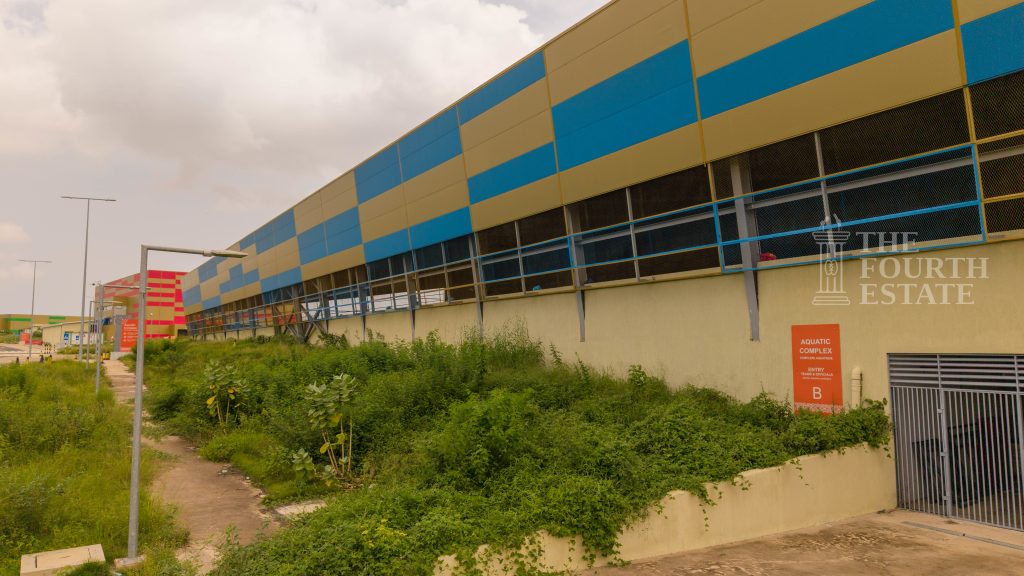
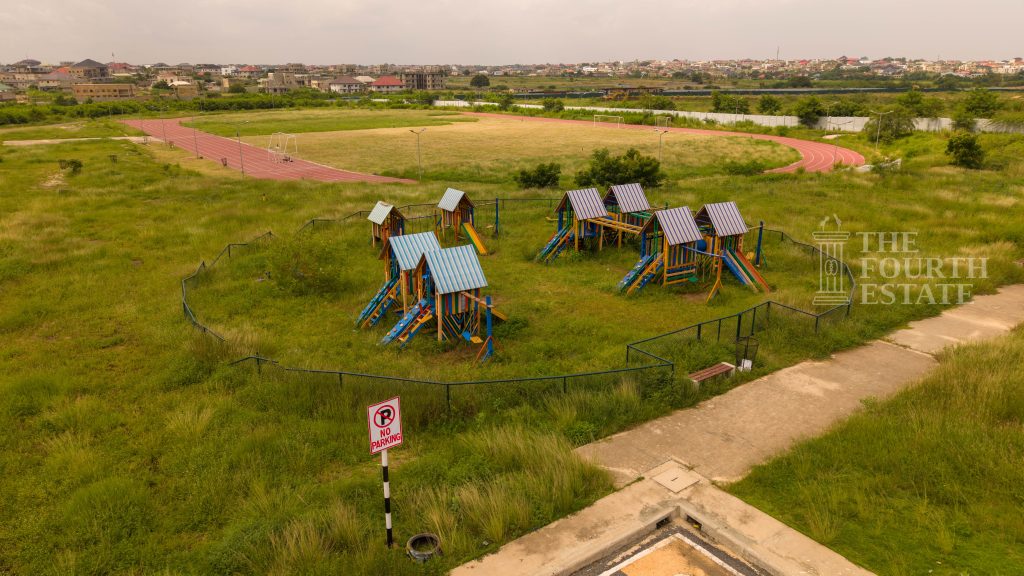
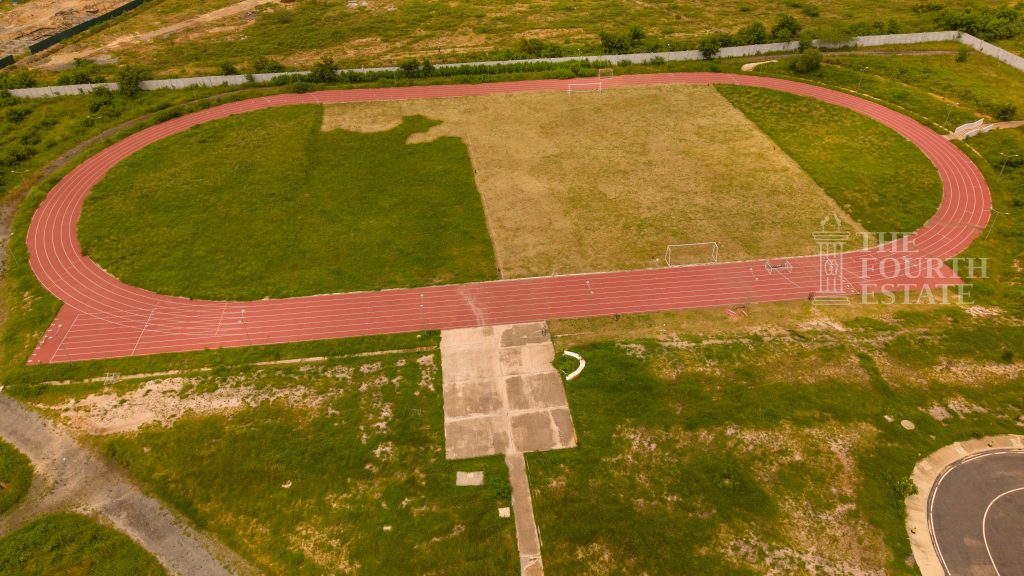
In its dormant period, many of the facilities remain locked, while nature takes over major sporting infrastructure, including a swimming pool complex, athletic tracks, children’s playground, tennis and volleyball courts.
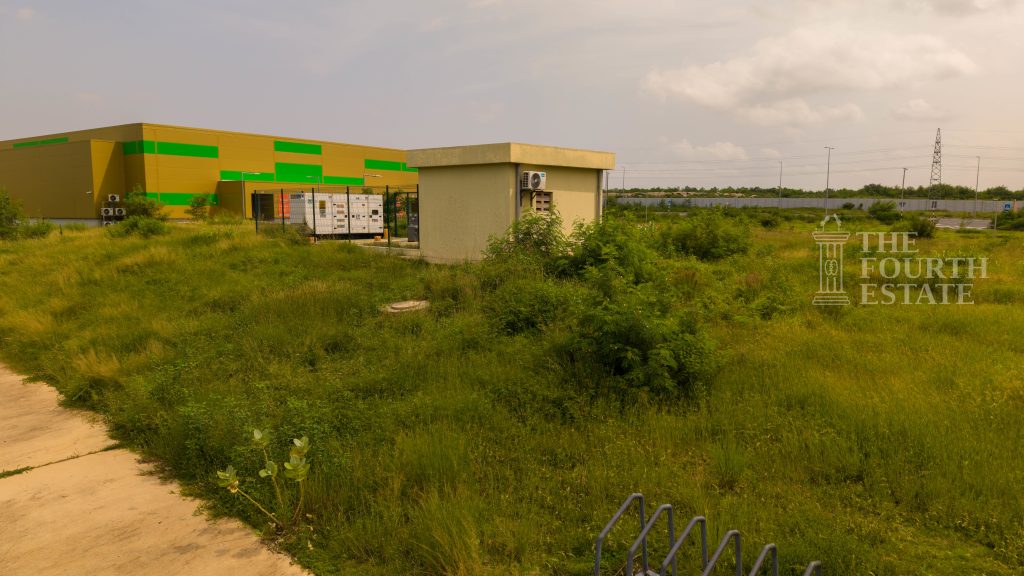
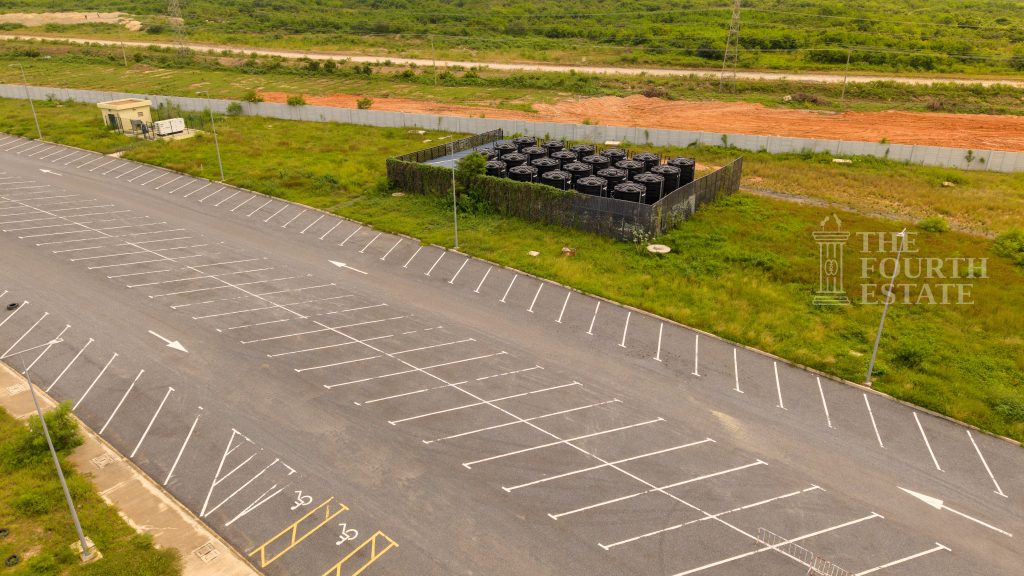
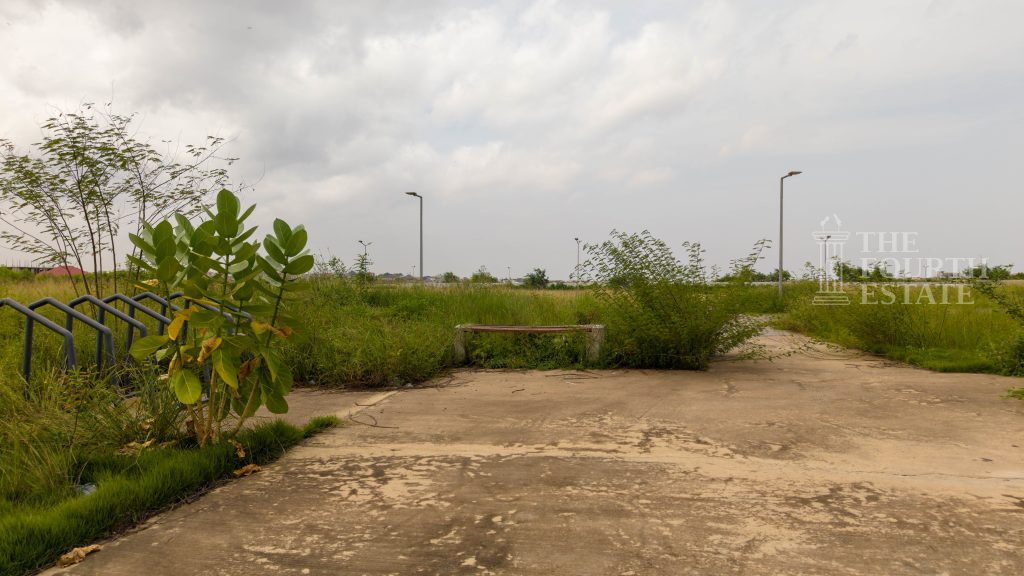
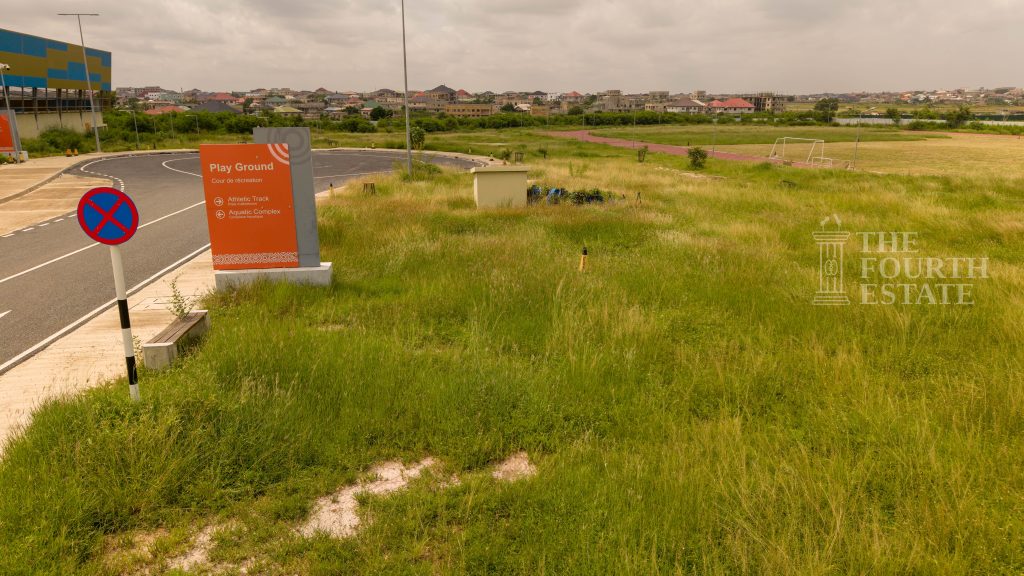
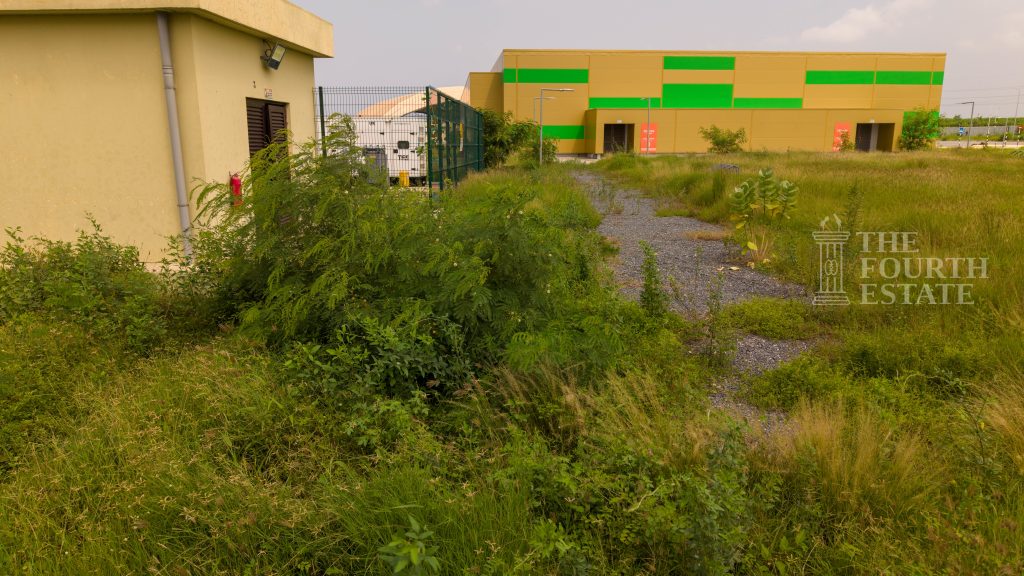
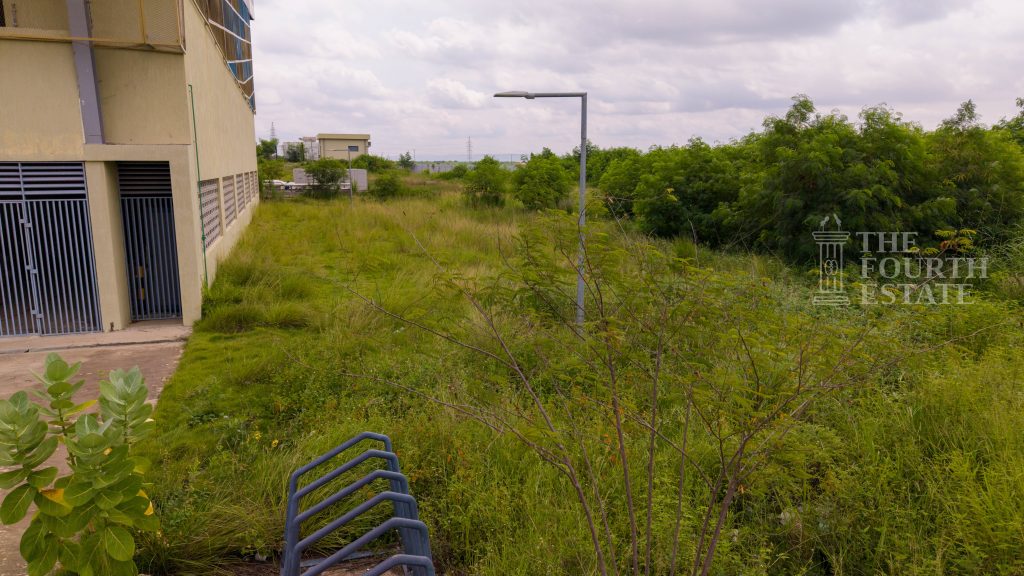
The walkway at the side entrance to the Aquatic Complex (swimming pool) and its walls are overgrown with weeds.From the playground to the utility areas, weeds are taking over the Borteyman Sports Complex, including the generator and water storage zones.
The Borteyman Sports Complex alone consumed US$145.1 million out of US$170 million that the Akufo-Addo administration borrowed from CAL Bank Ghana as part of the funds to finance the 13th African Games. It was constructed by Contracta Construction UK Limited.
The Complex has facilities including an aquatic centre, which houses a 1,000-seat swimming pool, an eight-lane warm-up pool, a 1,000-seat multi-purpose sports hall, and a 500-seat dome. It also has a five-court tennis complex with a collapsible 1,000-seat centre court, access roads, utility infrastructure, parking lots, an administration block, a children’s park, and Information and Communication Technology (ICT) infrastructure.
However, during a visit to the complex, The Fourth Estate observed that the Aquatic Centre, Athletics Track, Tennis Centre, Multi-purpose Dome, and children’s playground were all surrounded by overgrown weeds. The weeds have also invaded the pedestrian walkways and open spaces, with some of the weeds growing taller than the facility’s perimeter wall.
Dense weeds have overgrown the area between the Aquatic Complex and the tennis courtsTall weeds have overgrown the children’s playground at the Borteyman Sports Complex.
There was no sign of any sporting activity in the Complex in spite of the huge public investment that went into it,. The Akufo-Addo administration had planned to turn it into a sports university.
Behind the Aquatic Complex, weeds have grown into towering vegetation, rising almost to the height of nearby electric poles.The athletic tracks remain visible, but weeds are steadily reclaiming the spaces inside and outside the perimeter.
When the project was conceived, the government presented it as infrastructure that would not only host the African Games but also serve generations of Ghanaian athletes by expanding access to world-class sporting facilities.
Two years after the games ended, the Complex instead shows visible signs of neglect, with weeds showing dominance rather than sporting activities.
The maintenance of the facility is the responsibility of the National Sports Authority.
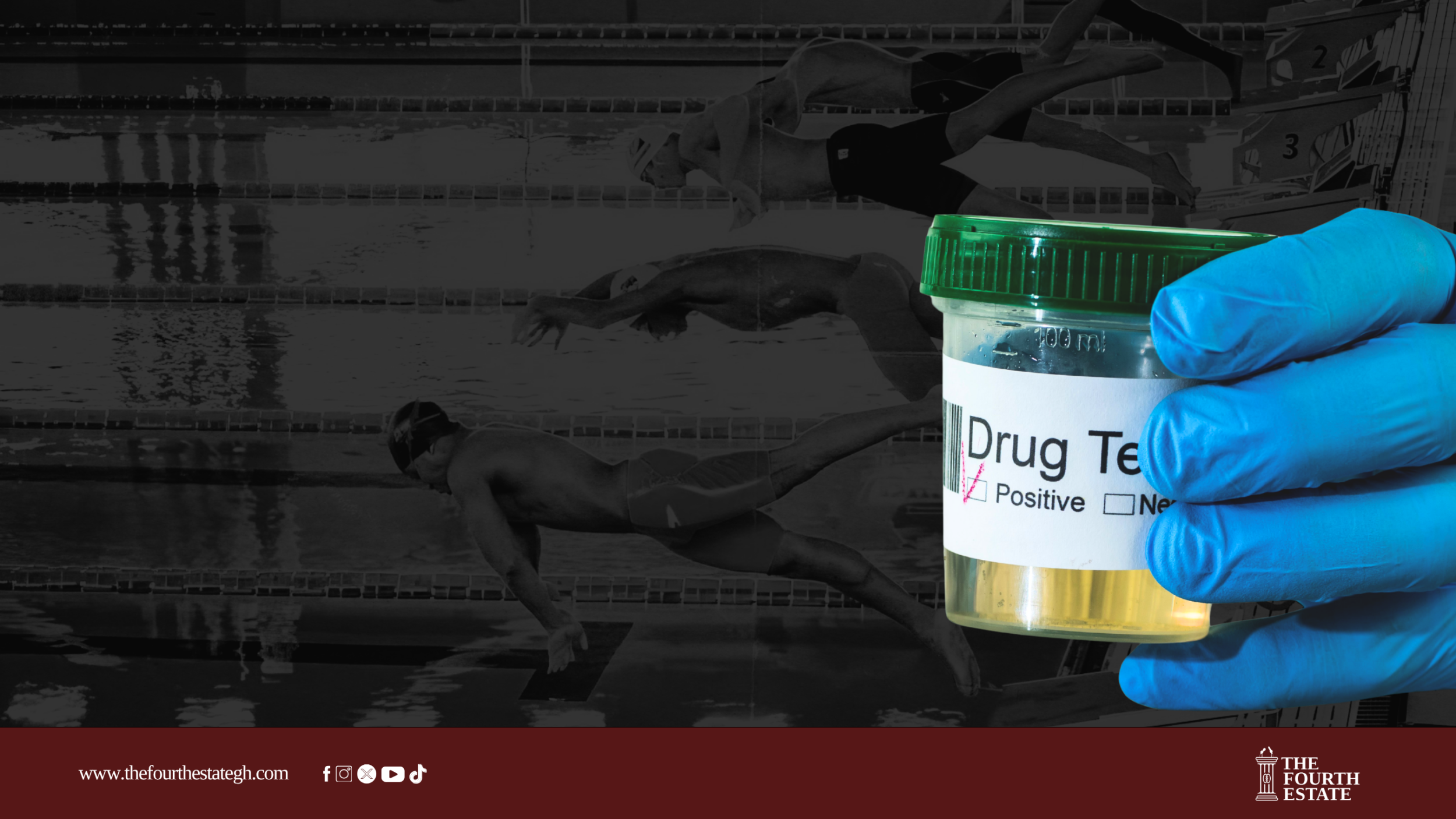
A forensic audit of the 13th African Games held in Ghana in 2024 has revealed that the Ministry of Youth and Sports contracted anti-doping services at prices five times higher than internationally approved fees by accredited laboratories.
On 8th March 2024, just weeks before the 13th African Games opened in Accra, the Ministry of Youth and Sports signed a EUR 739,225.98 (GH¢ 10,349,163.72) contract with a company called Omni Specialty Product Limited, a subsidiary of the Omni Group, owned by Michael Zormelo.
The purpose of Anti-doping tests ahead of international games is to ensure that athletes compete fairly and safely by checking whether they have used banned substances or methods to gain an unfair advantage.
Therefore, Ghana needed to meet its obligations under the World Anti-Doping Agency (WADA) by testing athletes for banned substances.
The price gap
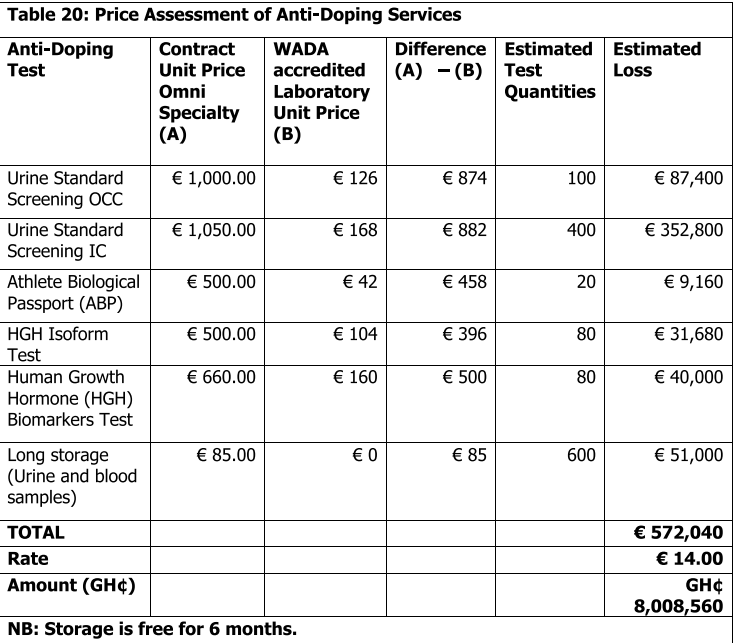
When auditors cross-checked Omni Specialty Product Limited’s unit prices against those of WADA-accredited laboratories at the Center for Preventive Doping Research and the German Sport University Cologne, the numbers were startling. They showed wide disparities.
According to the report, long-term sample storage for 600 urine and blood samples is provided free of charge for the first six months by accredited laboratories. But Omni Specialty Product Limited, which the report said was mandated to engage an accredited WADA laboratory for the tests, charged Ghana €85 per sample, translating to €51,000 for a service that should have cost nothing.
Across all test categories, the audit calculated a total overcharge of EUR 572,040, equivalent to a little over GHS 8,008,560.
A fixed Price for a variable service
According to the Audit report, the entire contract was awarded at a fixed, predetermined lump sum, although the number of tests depended on how many athletes compete, in how many events, across how many days.
The auditors found that the contract did not clearly explain:
Why were 600 long-term storage tests planned or how was that number determined?
How the amount paid would be checked against the actual number of tests carried out.
Proof that the work was actually done, because there were no sample collection records, laboratory confirmations, or documents showing how the samples were handled and tracked.
Missing report
According to the audit report, under the Terms of Reference governing Omni Specialty Product Limited’s engagement, the contractor was required to submit a final report to the Ministry of Youth and Sports and the Local Organising Committee (LOC) within 30 days of the conclusion of the Games. The report was to summarise the activities undertaken, the number and type of tests conducted, outcomes of the testing process, and any recommendations.
The auditors found no documentary evidence that the report was ever submitted, not within the deadline, and not at any time afterward. There is no record on file covering the scope of activities performed, the number and type of tests conducted, or the outcomes of the testing process.
Management Response
When confronted with the overpricing findings, the Ministry of Sports and the Local Organizing Committee said the pricing reflected genuine operational complexity, market conditions, and a scope of work far broader than the auditors acknowledged.
On the question of the missing final report, the actual document that would confirm what tests were conducted and what the results were, the management response was: “The final report is available.”
Following The Fourth Estate’s publication on the latest Auditor-General report on nationwide payroll irregularities, the Audit Service now says the GHS427 million attributed to Mr Frank Oliver Kpodo, a former Director of Procurement at the Ministry of Defence, was a transpositional error.
According to a statement issued by the Service and signed by its Right to Information Officer, Frederick Lokko, the actual figure in Mr Kpodo’s name is GHS 422,920.01.
According to the Audit Service, it made an error in attributing the figure to Mr Kpodo.
“We offer our most sincere and unreserved apologies to Mr. Frank Oliver Kpodo for the distress and unwarranted public scrutiny this error may have caused,” the statement said. “We further extend our apologies to the Government and people of Ghana, and the Controller and Accountant-General for the transpositional error noted above.”
The Audit Service further explained that the figure originally attributed to Mr. Kpodo should rather have been in the name of the Ministry of Education.
“We wish to state that the amount attributed to Mr Kpodo above was due to a transpositional error. The GHC427,995,661.40 relates to the Ministry of Education in respect of 3,476 unaccounted staff during the payroll audit,” the statement said.
Also, the Audit Service produced a corrected table of 34 Ministries and Departments that could not account for over GHS800 million paid to their staff.
In the corrected list, The Fourth Estate has found that the Audit Service made several “transpositional” errors in the original report, which has been submitted to parliament.
Figures attributed to 27 of the 34 Ministries and Departments in the original report have been changed.
Meanwhile, in a separate statement, the Controller and Accountant-General’s Department says it is impossible for any government employee to receive unearned salaries.
Following the development and the corrections made by the Auditor General in its Audit report, which formed the basis of the orginal story by The Fourth Estate, we have taken down the original publication.
For 29 months, a senior civil servant at the Ministry of Defence received over GHS427 million in unearned salaries – an average of more than GHS14 million per month.
Frank Oliver Kpodo was at the time serving as Director of Procurement at the Ministry of Defence.
His unearned salaries featured prominently in a recent report by the Auditor-General on the processes by which government employees were paid from January 2023 to June 2025. The main objective of the audit was to assess the effectiveness of internal mechanisms set up to ensure only legitimate employees are paid their rightful salaries.
The report details a near-broken system leaking money to thousands of civil servants, most of whom had done little to no work over the period.
The Auditor-General reported that more than 6,000 government employees received more than GHS800 million in unearned salaries, but Mr Kpodo alone allegedly received more than half of this amount – that is, GHS427 million.
This exceeds the budget allocation of the Transport Ministry, which is GHS151 million.
Frank Oliver Kpodo’s trail of audit red flag
Mr Kpodo worked previously as head of procurement at the University of Health and Allied Sciences in 2013. Before then, he was at the Ministry of Health, his LinkedIn profile says. In 2018, Mr Kpodo moved to the Ministry of Defence, where his role as Director of Procurement drew considerable scrutiny and consternation at a recent hearing of the Public Accounts Committee of Parliament.
Three weeks ago, officials from the ministry appeared before the committee over a GHS4.8 million contract for six SUVs intended for border surveillance and election monitoring.
Although a Stores Receipt Advice (SRA) had been issued to confirm delivery, checks revealed the vehicles had never been supplied, raising concerns among members of the PAC over falsified documentation on the undelivered vehicles.
They called for Mr Kpodo to be interdicted from his current role at the Ministry of Lands and Natural Resources as the Director of Finance and Administration. They also recommended his prosecution.
In his Payroll Audit Report for 2025, the Auditor-General recommended that the Controller and Accountant-General’s Department should “immediately delete” Mr Kpodo’s name from the payroll, along with those of some 6,000 other individuals who received monies for no work done.
“Principal Spending Officers should discontinue the validation of these individuals and recover the total amount of GH¢801,808,427.04 as unearned salaries paid to them, failing which the Principal Spending Officers and the Validators should pay,” the Auditor-General recommended.
The Principal Spending Officers in Ministries are the Chief Directors
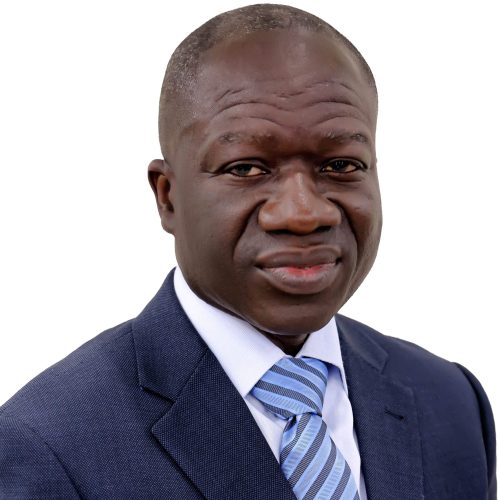
The Fourth Estate’s checks reveal that Dr Evans Agbeme Dzikum was the Chief Director of the Ministry of Defence for the period Mr Kpodo received the over GHS427 million.
Dr Evans Agbeme Dzikum
A financial analyst, Nana Kwaku Amankwah Appiah, told The Fourth Estate that Ghana’s payroll system goes through multiple channels before payments are made.
Due to this, he said he was surprised that Mr Kpodo was able to receive hundreds of millions for over two years without detection.
“For such payments to go on like that, I suspect there might be others benefiting from the amount,” he said. “It might not be only the individual benefiting. I wouldn’t be surprised that there is a chain of people who share this money every month.”
Lack of political will
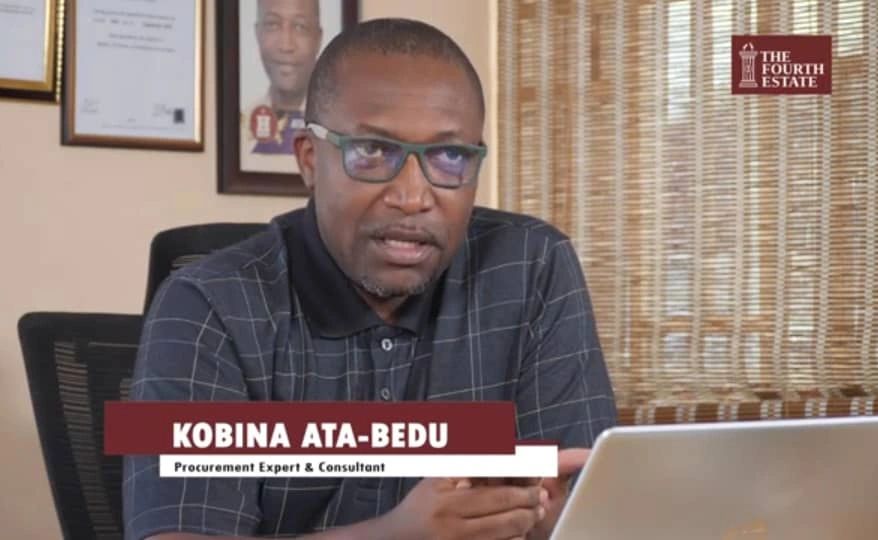
Kobina Ata-Bedu, a procurement expert with nearly three decades of experience, told The Fourth Estate in an interview that Ghana does not lack laws. But the problem is with the lack of political will to prosecute individuals who violate those laws.
“Until we start punishing people and making them pay a dear price, nothing will change,” he said.
He added that the Principal Spending Officer bears the ultimate responsibility for any procurement and payroll infraction.
Nana Kwaku Appiah emphasized that any internal auditor caught engaging in payroll fraud must be “declared a criminal. The professional needs to be reported. He must be handed over to the criminal prosecution institutions.”
Gatekeepers are culpable
A Development Economist at the Institute for Statistical, Social and Economic Research (ISSER), Professor Peter Quartey, also told The Fourth Estate that payroll fraud has been a decades-old systemic problem in Ghana.
“The gatekeepers are culpable. We need to stop this. If we don’t pursue these issues, if we don’t enforce [the laws], and we let people get away with it, then the figures will continue to increase, the scandals will continue to be perpetrated every now and then,” he said.
Prof Quartey
Prof Quartey said that, from his assessment, the situation is more prevalent in Ghana than in other countries.
“What software are other countries using that we can adopt to minimise this kind of fraud?” he asked.
“Because usually, it’s an orchestrated system. Maybe [Mr Kpodo is] the lead, but there may be other people who assist him in doing what he’s doing.”
Prof Quartey added that he is surprised Mr Kpodo is still holding an office at the Ministry of Lands and Natural Resources even after what ensued at the Public Accounts Committee.
“I remember hearing that he should be interdicted. So, if he’s still at post, that for me is a big problem,” he said. “We are a developing country. There are so many areas where money is needed to develop our country.
Many are dying because we couldn’t buy hospital beds. We couldn’t find medicine. We have no doctors around. We should not allow just a few people to distribute the coffers while the rest of the citizens struggle to survive.”
Denial
When The Fourth Estate contacted Mr Kpodo, he described the audit findings as “worrying and surprising,” adding that he could not “imagine how that can happen”.
He said his salaries were processed through the Controller and Accountant-General’s Department with pay slips that can be independently verified.
He insisted he was unaware of any irregularities and could not explain how such payments could have occurred. He added that the validation of salaries at the Ministry of Defence is handled by the Human Resource unit and the Chief Director’s office.
He also told The Fourth Estate that no one had reached out to him from the Audit Service.
The Auditor General has indicted the Ministry of Education (MoE) for implementing the Akufo-Addo government’s free wifi project for Senior High Schools (SHSs) without a clear implementation plan.
This, according to the Auditor General’s report for 2024, resulted in the payment of more than GHC430 million to the project contractor, even though no services were rendered for long periods.
The problems plaguing the free Wi-Fi project were first revealed by The Fourth Estate in 2024, with whistleblower evidence pointing to procurement breaches, poor service delivery, and what appeared to be an orchestrated scheme to defraud the state. That investigative report, based on one year of project records, indicated that GHC54 million had been paid to the contractor, BusyInternet, for little to no work.
But the latest report by the Auditor General reveals that, after four years, the free Wi-Fi project cost the Ghanaian taxpayer almost half a billion cedis, with little to show for that expenditure. The best the nation got out of the project can only be described as intermittent internet supply to a few schools, frustrating teachers, students, and school administrators.
In his latest report, the Auditor General expressed disappointment in the failure of the project to deliver what it had promised, even though a lot of money had been spent on it.
“Providing internet services to schools, colleges, and educational offices is a laudable initiative that involves high ICT investment costs,” the Auditor General says in his report. “Hence, the absence of a clear implementation plan or formal policy and procedure to optimize the delivery of the intended benefits undermines the value for money in the investment being made.”
The free Wi-Fi project was initially budgeted to cost GHC84.4 million. This amount was meant to be used to install modems in 717 Senior High Schools, 16 GES Regional offices, 260 GES District offices, and 46 colleges of Education, as well as the delivery of broadband services at a monthly cost of GHC6.37 million.
Even though the modems were largely installed, the broadband service delivery was patchy at best, with most schools reporting no internet connectivity. Yet, Busy Internet and its parent company, Lifted Logistics, kept invoicing the government, and the Education Ministry kept paying despite complaints from school heads and project coordinators.
“The Ministry of Education had made a total payment of GHC430,516,872.11 to Busy Internet Ghana Ltd and Lifted Logistics Ghana Ltd for the period between 3rd February 2020 and 24th October 2023,” the Auditor General’s report for 2024 says.
Below is the breakdown of monies paid by the Ministry of Education.
Perhaps what might outrage every Ghanaian taxpayer is how the Ministry of Education completely surrendered control of the whole free Wi-Fi project to the vendor.
The contract required a deployment of three major monitoring systems, namely a network monitoring system to track uptimes and outages, real-time data dashboards, and a professional ticketing and complaint handling platform
The contract also mandates that the vendor give the officials of the Education Ministry access to these systems. This access would allow the officials to see whether the Ministry was getting value for money. But somehow, this crucial requirement was simply ignored, and the Ministry appears never to have complained about it.
According to the Audit report, the MoE relied on the vendor’s own reports to approve payments. And when problems arose, which were constant, the officials of the Ministry of Education solely relied on the vendor, Busy Internet Ghana Ltd’s own technicians for updates.
As such, there was no independent oversight, no way to verify claims, and no mechanism to hold the vendor accountable for poor performance, the audit revealed.
Surprisingly, the Ministry’s ICT staff weren’t trained on how to use most of the monitoring systems they were paying for. They had access to just one dashboard while other critical monitoring tools remained inaccessible to the Ministry’s ICT staff.
Connected on paper, disconnected in reality
Three years into the contract, no user satisfaction survey had been conducted to determine whether beneficiary institutions were satisfied with the service. Yet, in 2023, the Ministry of Education increased monthly payments from GHC6.37 million to GHC11.55 million without any justification.
When the Auditor-General later sampled 224 of the 1,017 beneficiary institutions in a user satisfaction survey, the results revealed widespread dissatisfaction
The Auditor General’s results from the survey revealed that 97% of users reported poor internet speed and latency. All of the users sampled ( 100%) said the bandwidth was inadequate for their needs and had abandoned the service. 75% said technical problems remained unresolved for months, and none of those sampled (i.e. 0%) reported receiving regular maintenance
Busy Internet’s contract breaches
In the last five months of 2023, Busy Internet shortchanged Ghanaian taxpayers by billing schools like Achimota SHS, Aburi Girls, Daboase SHS, and Tarkwa SHS for 30 days of internet service the schools never received.
This represented a pattern of systematic overcharging that affected over four hundred schools across Ghana.
However, the contract between Busy Internet and the Ministry of Education was explicit – a detailed Service Level Agreement (SLA) spelled out expectations for service quality, communication, and billing. Yet, both sides failed to uphold them.
According to the contract, the vendor was to ensure 99% service availability to each school or education office. Any unplanned outages or service degradation were to be resolved within four hours of a reported fault. If service was disrupted for more than four hours in a day, the vendor would lose payment for that full day, and if service was unavailable for more than half the month, the vendor would receive no payment at all for that month.
These safeguards should have protected taxpayers from exactly what happened. Instead, Busy Internet billed and the Ministry paid as if services were running smoothly, even when most beneficiary institutions were offline.
The audit report further revealed that the committee responsible for validating vendor claims should have rejected at least GHC14.5 million in charges because Busy Internet billed for internet service at locations where there was no service.
Below is a summary of the invoices submitted by the vendor for August and September 2023, and the active days the audit team checked on the vendor’s monitoring systems.
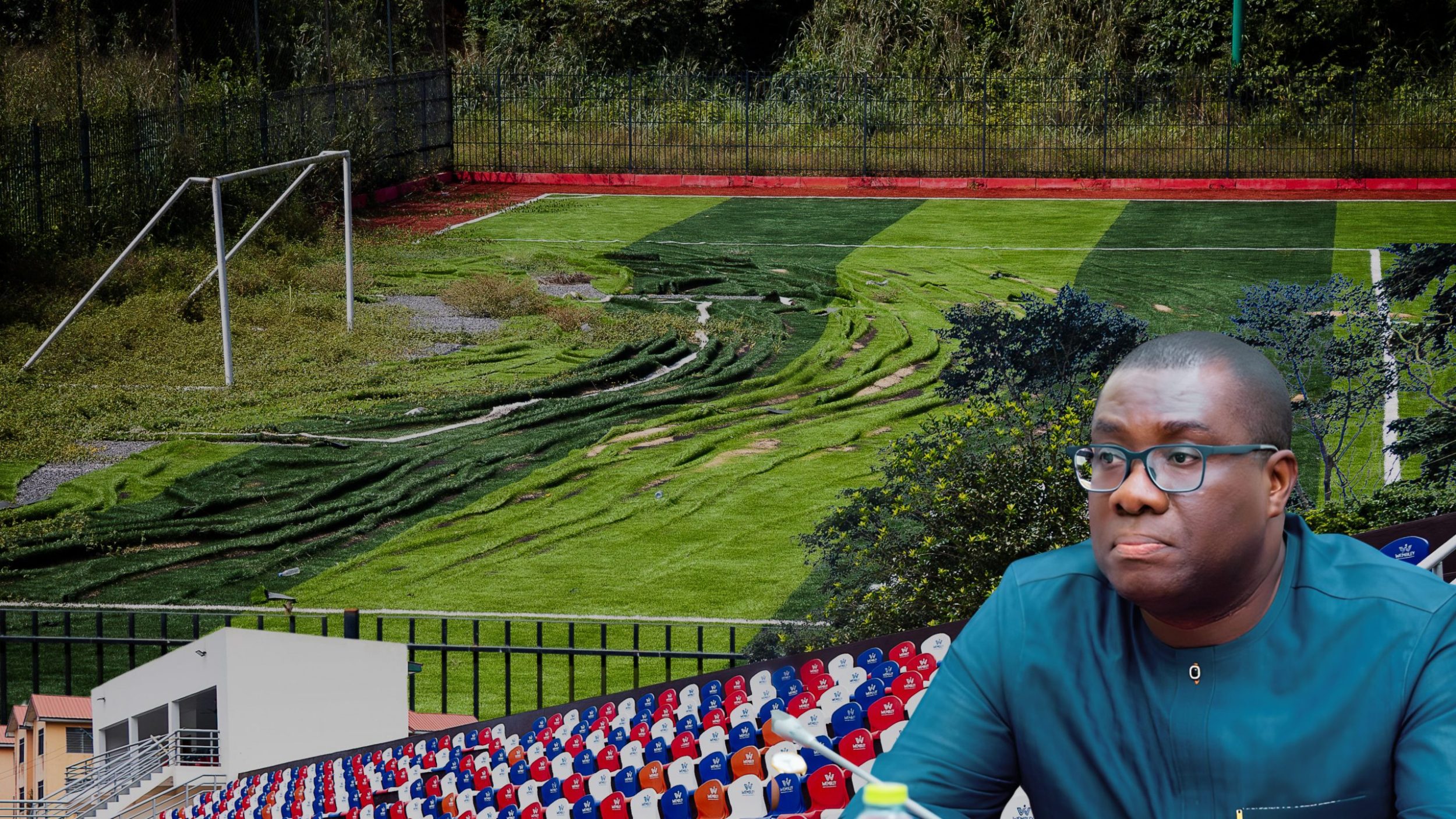
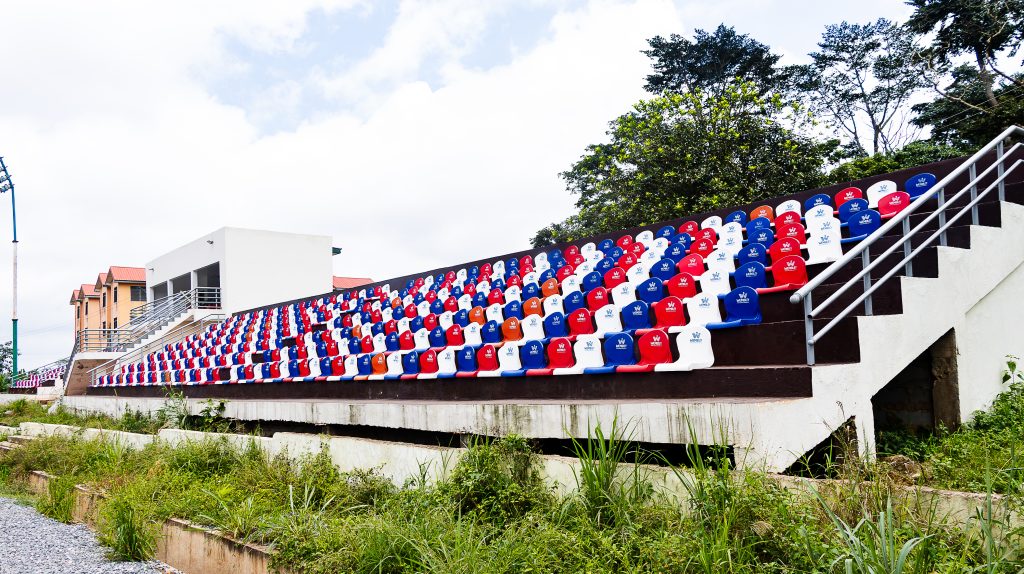
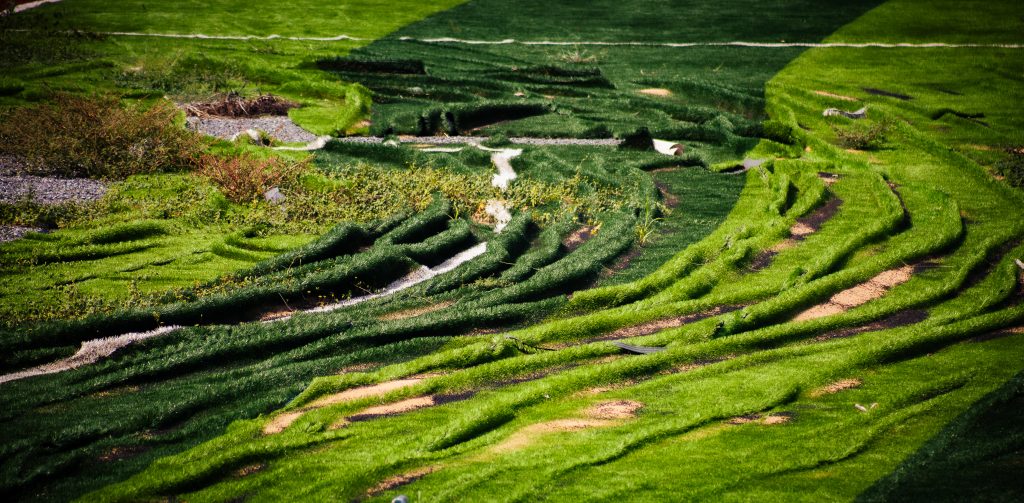
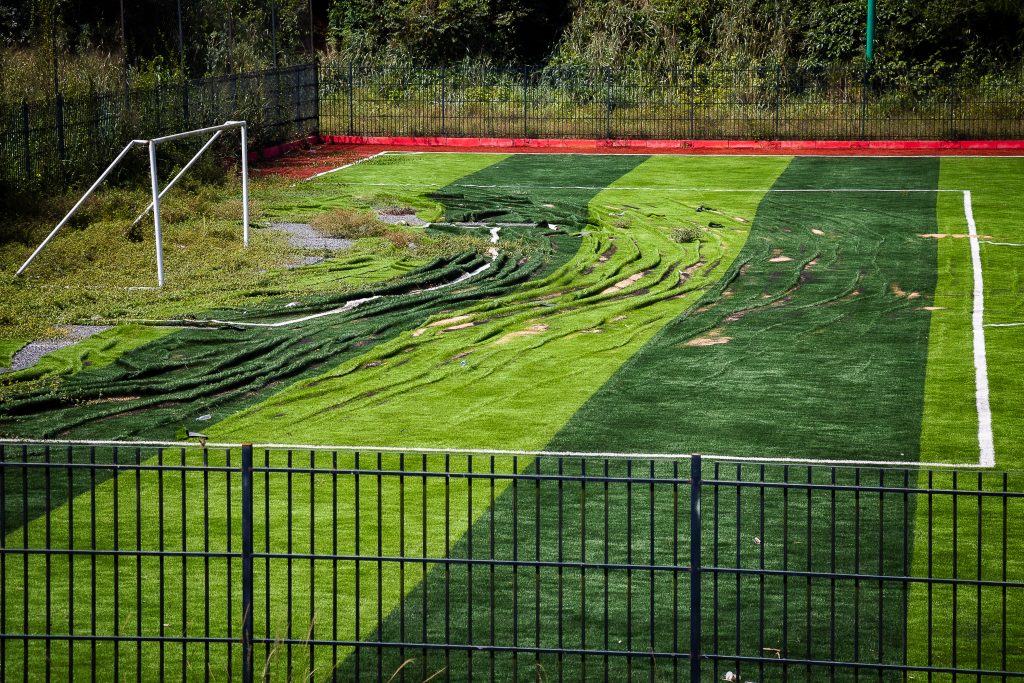
An artificial grass pitch, otherwise known as AstroTurf, and a sports arena in Akuapim Akropong, funded for by the National Lottery Authority’s Good Causes Foundation at GHC 2 million, now lies in ruins — just a year after construction.
Without a single game ever having been played on it, part of the turf has been ripped into pieces, exposing the gravel under it.
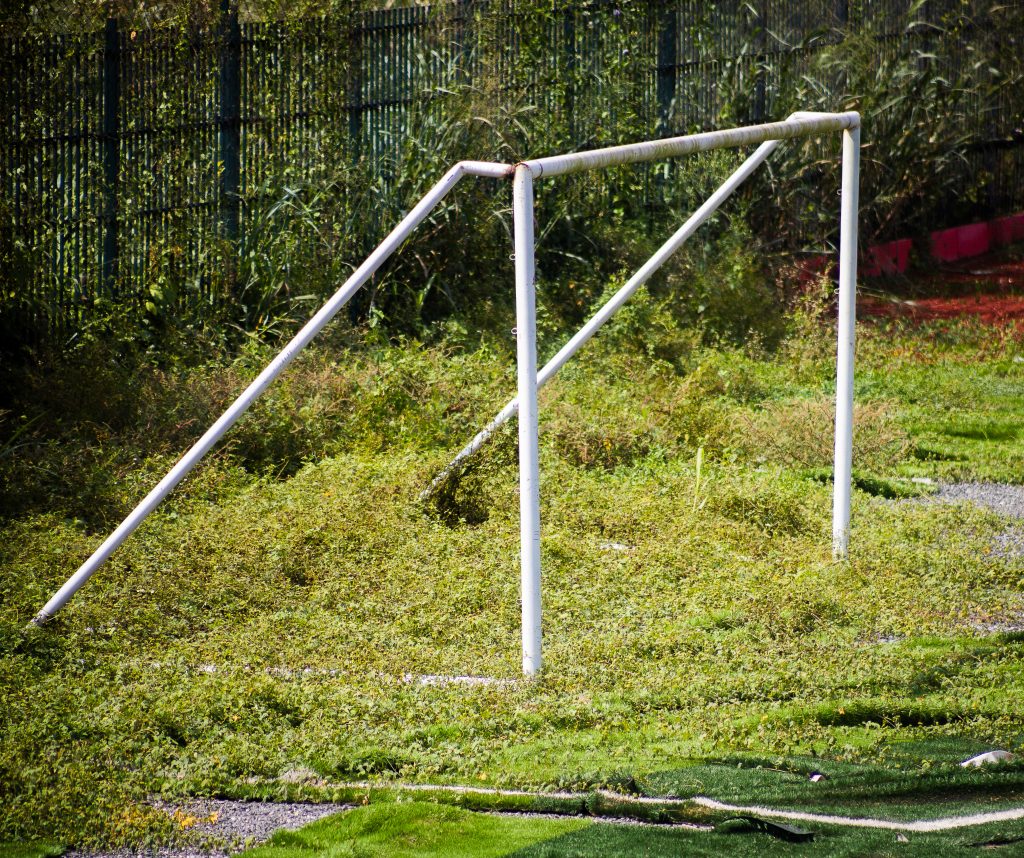
Weeds have colonised sections of the turf, including the goal posts, while creeping plants climb over the goalposts and fences of the 578-seater capacity sports facility.
A side view of the 578-seater spectator stand at the abandoned AstroTurf in Akropong.
Residents say the pitch, located in a low-lying area of the Akuapem hills, was severely damaged after a downpour.
The Ademi Astroturf in Akropong with sections of the carpet ripped and gravel exposed.
The damage occurred before the contractor, Wembley Sports Construction Company, could hand the facility over to the community.
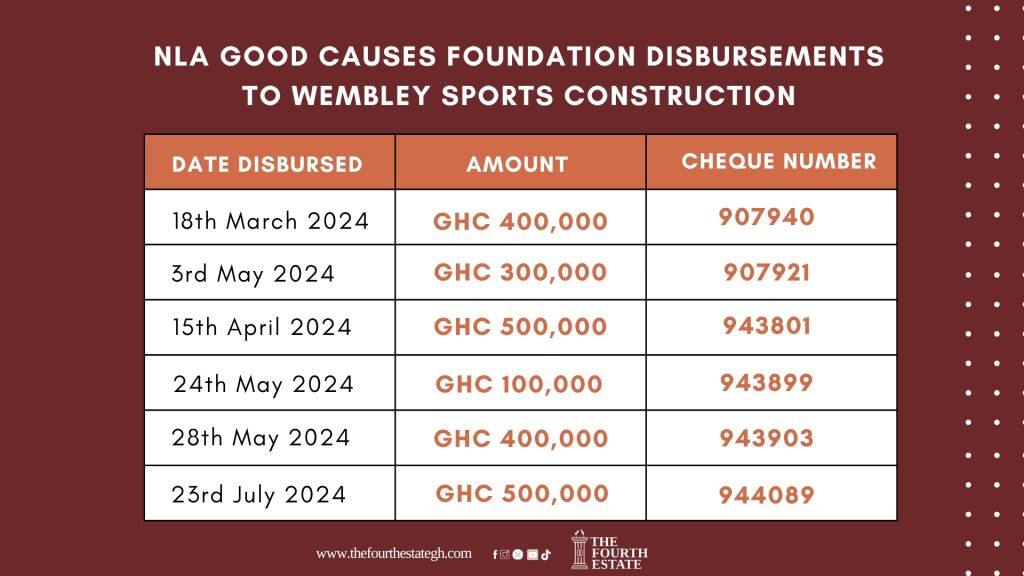
The Fourth Estate found that funds were advanced to the contractor in tranches from the Good Causes Foundation.
Residents who asked not to be named for fear of retribution told The Fourth Estate that the project, now on what was then known as Ademi Park, was doomed from the start.
“No matter how many times they fix this astroturf, it won’t last,” said one resident. “This land is waterlogged. If the contractor had asked us, we would have told him that what we need here is natural grass.”
Weeds have colonised sections of the turf, including the goal posts.
“The park was where we did all our school games when I was in primary,” said a 29-year-old unemployed graduate. “Now, because the contractor refused to consult us, he has destroyed the land by building only a soccer pitch. Even the drainage he built makes it impossible to create athletic tracks.”
Contractor shifts blame
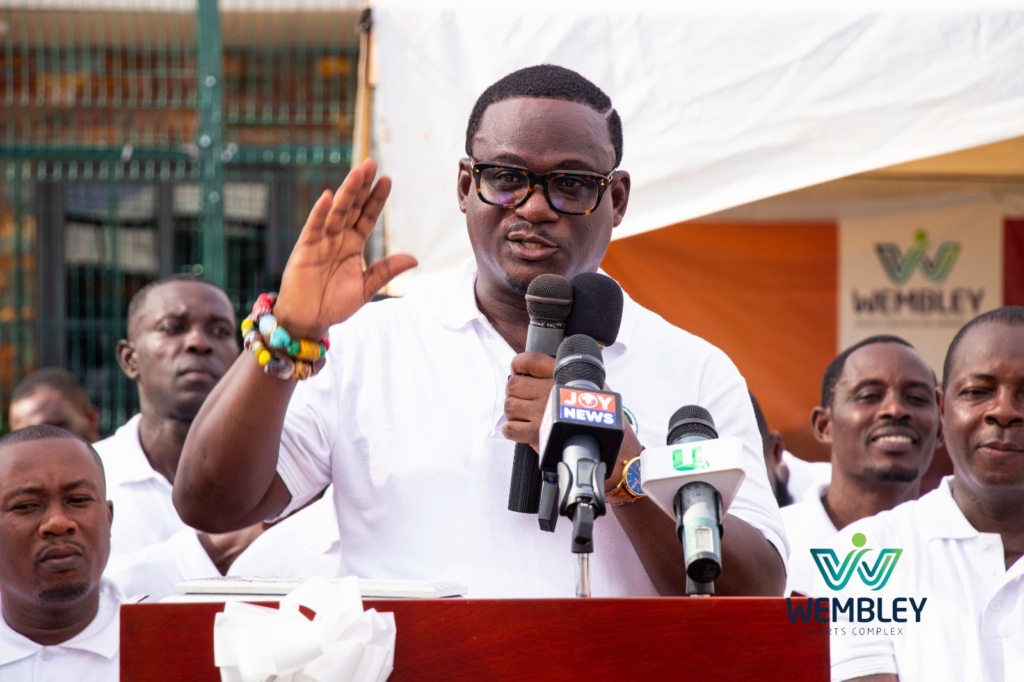
When The Fourth Estate contacted Robert Coleman, the CEO of Wembley Sports Construction Company, he denied abandoning the project, placing responsibility on Sammi Awuku, former NLA Director General, now the MP for the area.
Robert Coleman, the CEO of Wembley Sports Construction Company
“I am a contractor. Speak to the MP,’ he said. “It’s the MP who commissioned me to do it.”
According to Mr. Coleman, the drainage system constructed for the pitch is unable to handle the volume of water during heavy rains, leaving the field flooded.
“[A different contractor] did the drain, but it cannot accommodate the water, so it has been gushing onto the pitch. I have requested that they fix the drainage, then I will go and do the finishing touches because the drainage system was not part of my contract,” he explained
He added that the work was completed on his side and that he had written to Mr. Awuku “several times” to give him a date for commissioning.
The contractor also added that once a solution is found for the drain, he will return to the site and repair all damages.
Residents told The Fourth Estate that the astroturf has not only deteriorated but also deprived the town of access to its only sports venue.
A wide shot shows portions of the Akuapem Akropong astroturf deteriorating.
According to them, the field hosted inter-school tournaments and community games before the MP decided to convert it into an astroturf, which is primarily used for football. With the turf now in poor condition, residents say they have been denied their main playground, compelling them to always seek permission from Okuapeman Senior High School to use its facilities.
They say that most of the time, their requests are denied to prevent disruption to teaching and learning.
“It’s very difficult for residents of Akropong to even organize games now,” said a pupil teacher in the town.
The residents are demanding the removal of the artificial carpet and the restoration of natural grass, which, according to them, is the only surface suited to the waterlogged land.
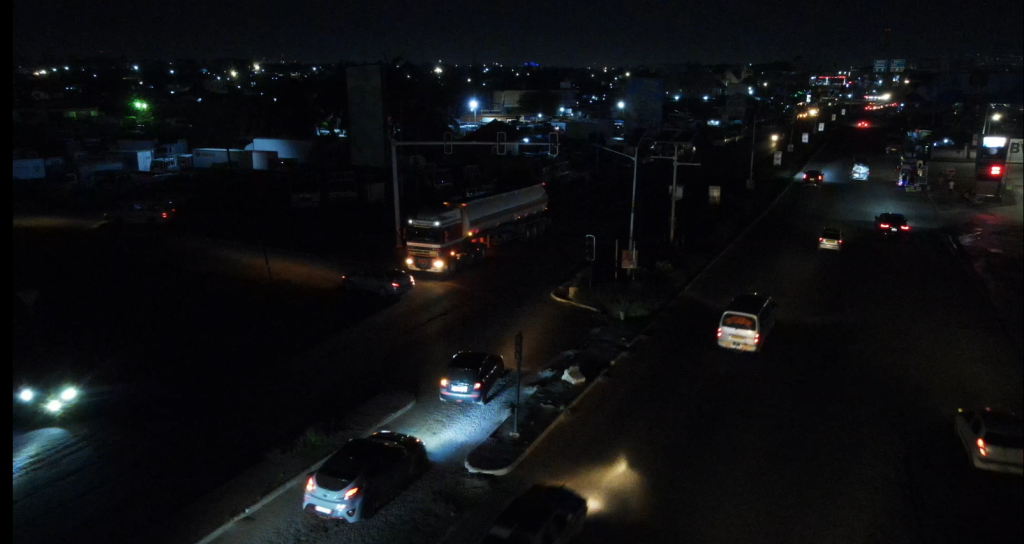
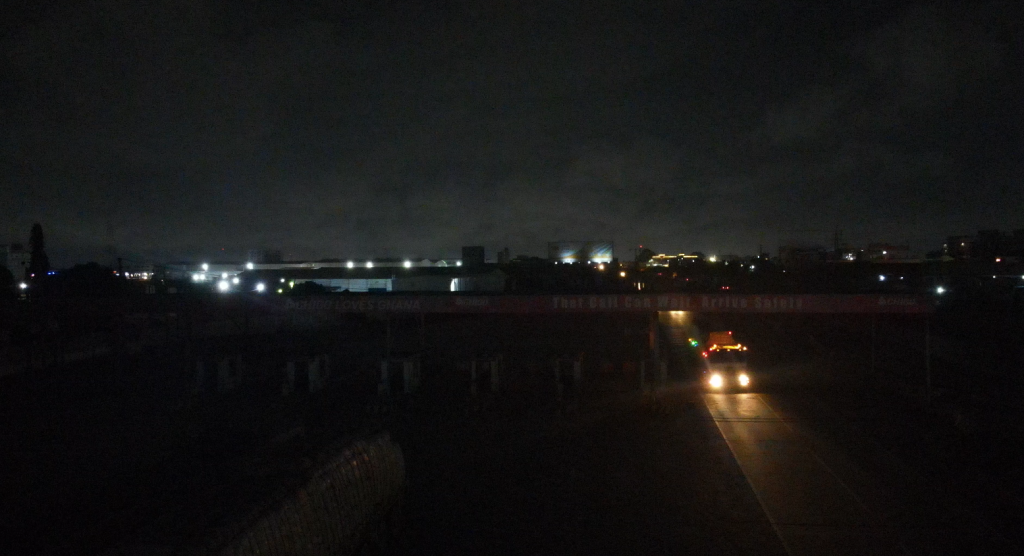
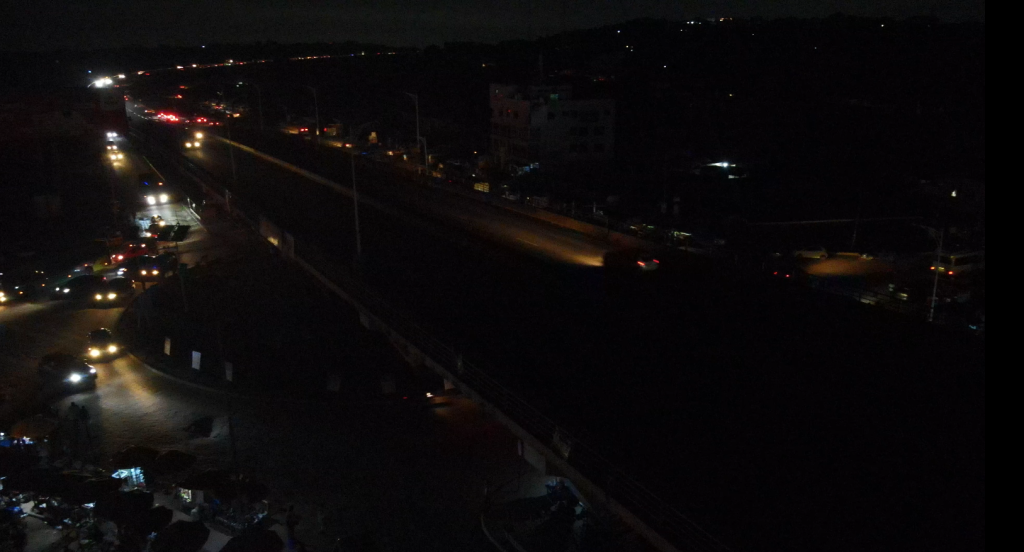
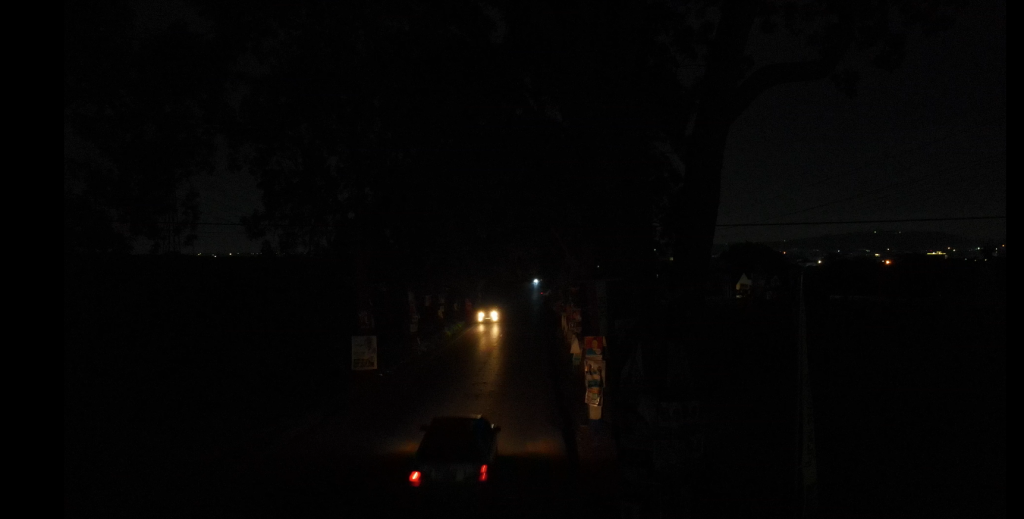
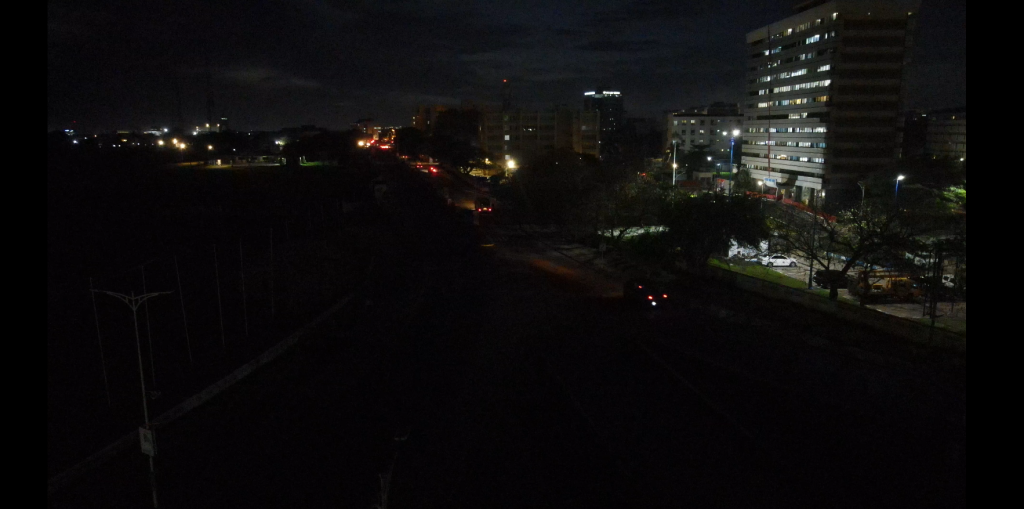
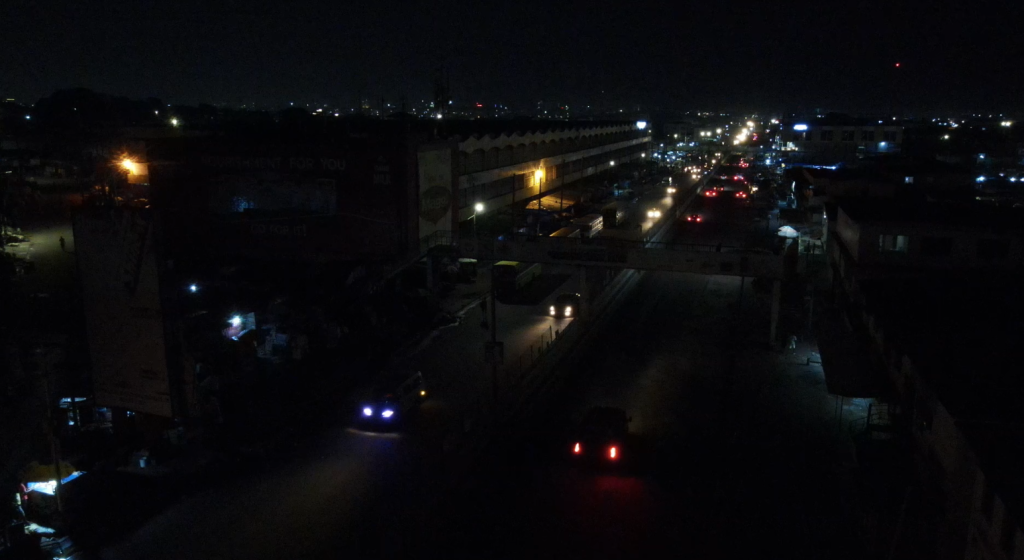
Between 2020 and 2021, the Millennium Development Authority (MiDA) spent $15.8 million on a Streetlighting Replacement Project that was supposed to illuminate the roads, highways and streets of the national capital, Accra.
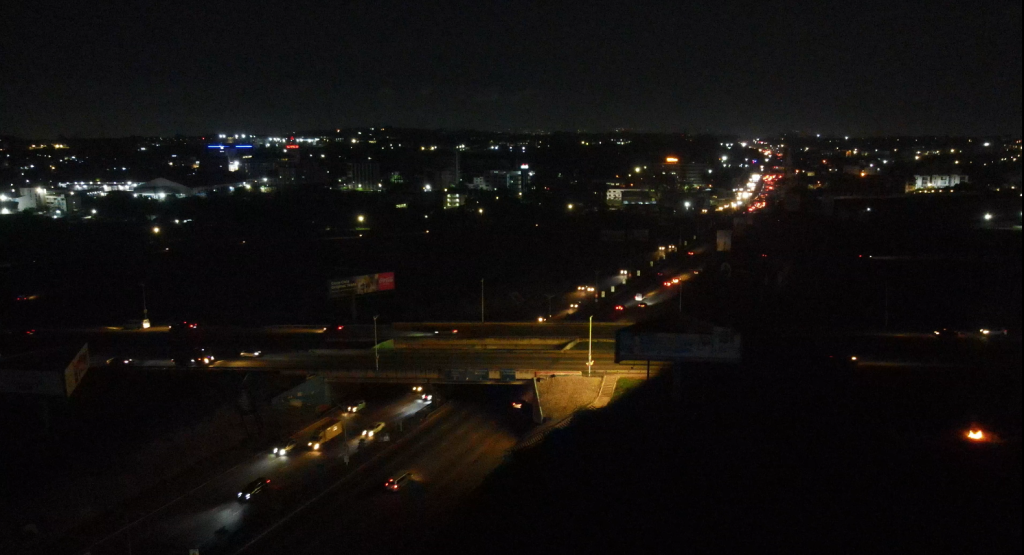
Despite the expenditure of millions of US dollars, most of the streets, roads and highways in the national capital remain dark at night, endangering the lives of motorists and pedestrians. In response to a Right to Information request by The Fourth Estate, MiDA said the project was to cover a total of 523.46 kilometres spanning 20 metropolitan, municipal and district assemblies (MMDAs) in the Greater Accra region.
MiDA’s response indicated that “The Project involved the replacement of High Pressure Sodium and Mercury lamps with highly efficient LED on selected Streets in Accra, thereby reducing energy consumption on the Electricity Company of Ghana’s (ECG) network and also improving illumination on the selected Streets.” It added that “in all,14,969 luminaires were installed”.
Tetteh Quarshie Roundabout
In addition, in 2022, the Ministry of Energy took a little over GHS3.3 million from Ghana’s oil revenue to pay Prefos Limited, an electrical company, for the provision of streetlighting infrastructure (the light poles, electrical cables and light fixtures) on the Accra-Tema Motorway, according to the 2022 Public Interest and Accountability Committee annual report. Yet, anyone who drives on the motorway at night will testify to the darkness that pervades Ghana’s most popular highways because of the absence of streetlights. For three nights, from October 27 to 29, 2023 and 2024, The Fourth Estate visited several major roads and streets in 13 MMDAs in which MiDA implemented its Streetlighting Replacement Project.
Achimota-Amasaman Road
The Fourth Estate team drove on the George Walker Bush Highway, the Tetteh Quarshie Interchange, the Liberation Road, the Accra-Tema Motorway, and the Black Star Square among many others. The team found that although there were street light poles on most of these streets, most of them delivered no lighting.
MiDA and the Ministry of Roads and Highways did not respond to questions The Fourth Estate sent them about the Streetlighting Replacement Project.
The Fourth Estate spoke to several motorists and residents in Accra, who confirmed that the lack of functioning streetlights on many roads in the city endangered their lives and those of pedestrians.
Accra-Tema Toll booth – Motorway
Edward Kyei-Baffour, a driver with an online ride hailing platform, often works at night. He tells The Fourth Estate that because of poor visibility, drivers often knock down pedestrians at night.
“When you reach a location where streetlights don’t work and the pedestrian is not wearing a reflective cloth, you will accidentally knock them down,” he says. He believes that poor visibility is a major cause of frequent knockdowns at night.
“Recently, at Akweteyman, a colleague driver knocked down two ladies around 9pm,” he said. “They were on the N1 Highway. Because of lack of visibility, and the fact that the stretch is also dark, and the clothes of the ladies were not reflective, mistakenly, he knocked them down.”
Ofankor-Barrier-Nsawam Road
Kyei-Baffour says the dimly lit roads force most drivers to always turn on their headlights. But because some cars have stronger headlights than others, they blind other drivers on the road, causing havoc.
Michael Kwaku Agamah, another driver with an online ride hailing platform, told The Fourth Estate that he took the advice of a mechanic who told him to buy a stronger headlight to improve his visibility while driving at night. “My headlight is 100 watts. Before, it was 70 watts,” he says. “Somebody who does not have 100 watts but has 70 watts will crash in potholes and will burst his tyre.”
Mr Agamah lamented that when drivers get caught up in traffic in areas where there are no streetlights, they are often attacked by armed robbers.
That was the fate of Sophia Odoley Sagoe. On July 29, 2024, she was accosted by two men while walking home from work on the Teshie Link Road. She says the men left her stranded after they forcibly took her phone and bag.
“The place was very quiet and dark. If there was light on that stretch, I don’t think they could have done what they did,” she says.
In an interview with The Fourth Estate, the Director-General of the National Road Safety Authority, David Osafo Adonteng, said street lighting should be a basic necessity for motorists and residents in Accra. “Night crashes happen to be very significant in our road crashes,” he says. “If you go on the N1, between Tetteh Quarshie and Lapaz, people are driving into disabled vehicles because they are unable to see ahead of them.”
According to the Accra Metropolitan Assembly’s Road Safety Reports (2019 to 2022), the pattern of crashes in the city shows that more people are killed following crashes that occur between 6pm and 10pm.
Atomic-Haatso Road – Infront of Kwabenya Police Station
“This pattern can partially be explained by poor visibility and high vehicular speeds at that time of day,” the 2022 report noted.
Poor leadership is to blame
According to Mr Adonten, the cause of the perennial challenges with streetlighting in Accra stems from a lack of leadership by the Ministry of Energy. He said the ministry has some responsibility in providing and maintaining streetlights. He said a recent stakeholder engagement organised by the NRSA showed that the “Ministry of Energy appears not to be on top of the situation.”
He also pointed out that the institutions responsible for ensuring the city is well-illuminated are not collaborating.
“They are not coordinating and so responsibility has become very difficult as to who is responsible exactly within the space where we are to provide streetlights,” Mr Adonteng says.
The Fourth Estate wrote to the Ministry of Energy for comment. Although the ministry responded that it would respond in “due time,” it is yet to do so – more than six weeks after our request.
According to LI 1961, the MMDAs are to collaborate with the ECG to ensure the provision of streetlights. But a 2011 draft policy on streetlighting by the Ministry of Energy underscores that the MMDAs “lack the financial and technical resources to provide and maintain the service”.
MiDA’s Streetlighting Project was to fill this gap and ensure that the streets and roads in the capital are illuminated at night. But the lack of maintenance appears to be the major reason why many parts of the city remain dark.
Black Star Square – 28 February road
“As to who maintains [streetlights, it has] become a big question for all of us,” Mr Adonten told The Fourth Estate. “For example, if you go on the Accra-Tema Motorway, you would find the installation done but within a few years, then some are broken, some of the lights are not working and some cables have been stolen. And so, it renders the entire stretch of the motorway so dark.”
When The Fourth Estate drove on the Accra-Tema Motorway on Monday, October 28, 2024, there was not a single functioning streetlight on the stretch. And the people crossing the highway were nearly invisible.
The Managing Director of Prefos Limited, the company the Ministry of Energy paid over three million cedis to for the provision of streetlight infrastructure on the Accra-Tema Motorway, declined to respond to questions by The Fourth Estate.
“We are not obliged to do any interview with any media house,” the Prefos MD, Wendy Agyeman said. “We work with the ministry. If you need any information, you can go to the ministry.”
Decentralise streetlight administration
Mr Adonten says the best way forward is for the government to resource the MMDAs to provide and maintain streetlights in the country.
“It will help the communities. If the capacity is not there, it’s a matter of us building their capacities,” he said.
The Estate Officer of the Adenta Municipal Assembly, Raymond Aboagye, affirmed that the assemblies lack the resources and expertise to adequately provide and maintain streetlights. He said the assembly struggles to maintain streetlights mounted on metallic poles. Unlike the wooden poles that the assembly’s electrician can climb, he said they lack the equipment to repair those on metallic poles.
“They use cranes to repair them, and the assembly doesn’t have a crane,” he said. “So, we have to get a crane from a private company like Prefos. We have a lot of [the metalic poles] in this area. And it’s expensive to repair them.”
Although he admitted that the assemblies should visit the communities often to ascertain the state of the streetlights, he said this is nearly impossible as he is the only person at the assembly in charge of maintaining streetlights.
“Adenta is a very big community and I’m the Estate Officer, just one person. I would not be able to identify all the areas that is dark,” he said.
Mr Aboagye claimed he collaborates well with the assembly members to keep the streetlights on. But the Assemblyman for the Ogbojo Electoral Area, Elvis Ofosu Mensah said there is a big challenge with the maintenance of streetlights.
Main Kaneshie Road
“I can take you to my electoral area where streetlights are still hanging there. They don’t need to be changed; they just need to be maintained,” Mr Mensah says. “But where do you get the funds to maintain them?”
The Director of Safety Campaign Ghana, Damoah Emmanuel Nyarkoh, told The Fourth Estate that budget constraints and a lack of routine maintenance have resulted in the vast stretches of poorly lit streets and highways in Accra.
“Theft of cables and light fixtures have significantly affected the functionality of streetlights,” he said. “Poorly lit areas are breeding grounds for criminal activities, including thefts and assaults. Residents and commuters feel unsafe, which affects their overall well-being and restricts nighttime mobility.”
Mr Damoah emphasised the need for year-round maintenance, engaging local communities to report non-functioning streetlights and the installation of surveillance cameras to deter vandalism and theft of streetlight infrastructure. He recommended that there should be stricter penalties for individuals who steal streetlight infrastructure.
Mr Adonteng of the NRSA said it’s disappointing that Ghana is struggling to maintain streetlights six decades after independence.
“More than 60 years after independence, we are unable to light our cities,” he says. “I think it is not the best and we should make a conscious effort to get there.”
In a powerful display of determination, thousands of Ghanaian youth flooded the streets of Accra for three days, their voices rising in a collective cry to save their nation’s dying rivers and forests. The protest, which began on October 3, 2024, was not just a demonstration – it was a desperate plea for survival.
As dawn broke on the first day, young protesters gathered at Okponglo, Legon. Their faces set with resolve, they clutched placards that told the story of a nation on the brink of environmental catastrophe. “Say no to galamsey,” one placard said. Another, more touching, asked: “When did asking for clean water become a crime?”
The march to Independence Square was a clarion call to the government to protect the nation’s increasingly polluted water bodies. Prince Agyei, a 24-year-old environmental science student who traveled over 300 kilometers from Tarkwa to Accra, declared, his voice trembling with emotion, “Our rivers are dying, and with them, our future. If we don’t act now, what will be left for us?”
As the protesters moved through the city, their chants echoed off buildings: “Destroy galamsey, not our future!” The irony was not lost on many that while thousands of youth marched peacefully to save Ghana’s water bodies, state institutions continued issuing mining licenses to political apparatchiks unabated.
One placard highlighted this bitter truth: “1000 policemen at protest. 0 Policemen at galamsey sites.” The message was clear – the power of the state seemed more focused on containing the protest than addressing the issue being protested against.
An environmental expert who joined the protest explained, her voice cracking with frustration, “Every day we delay more poison seeps into our water. This isn’t just about the environment – it’s about our very existence.”
The final day saw the protest swell to its largest numbers. Celebrity figures joined the ranks and held hands, forming a human chain of solidarity, depicting a profound message captured in one of the placards: “The effect of galamsey is beyond partisan politics.”
As the sun set, the crowd gathered for a final, emotional vigil. On a giant digital screen, video documentaries showing the deteriorating state of some water bodies in Ghana were aired for all to see.
Click through to see more photos from the 3 day protest.
The atmosphere was thick with sorrow, hope, and resolute determination. A 19-year-old protester, his eyes glistening with unshed tears, spoke for many: “We are not just fighting for clean water. We are fighting for our lives, our future, our very soul as a nation.”
The protest may have ended, but its spirit lives on in trending hashtags: #FreeTheCitizens, #StopGalamseyNow. These digital echoes of the physical protest serve as a reminder that the fight is far from over.
As the government ponders its response, one placard’s message resonates more than ever: “The power of the people is more powerful than the people in power.”
The youth of Ghana have spoken. The question now is: Will those in power listen before it’s too late?
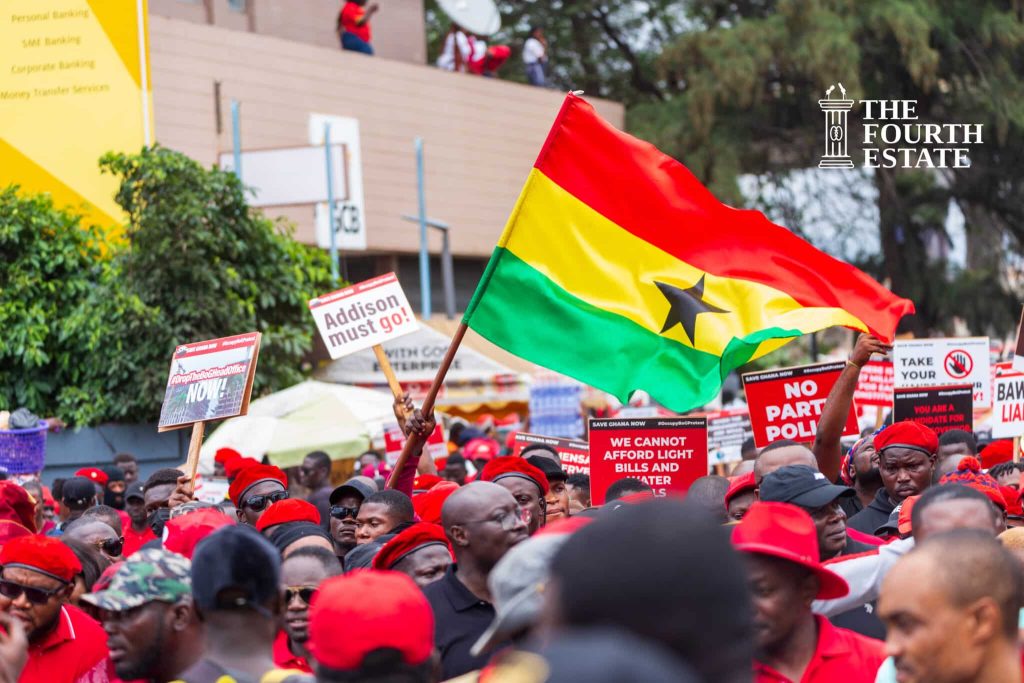
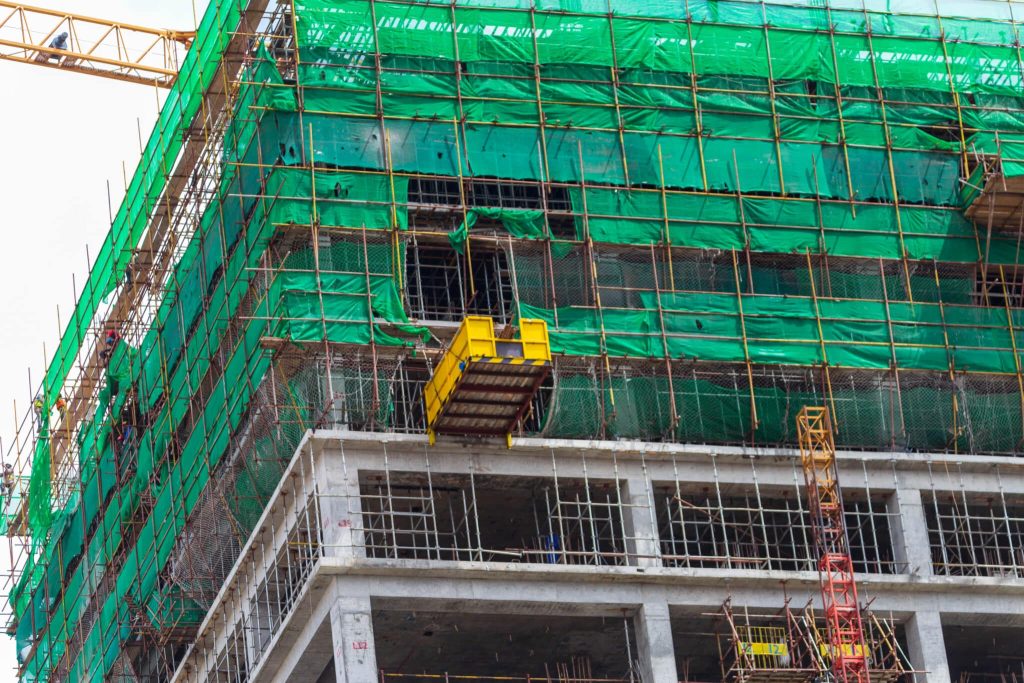
Accra’s bustling streets have once again witnessed a mammoth protest led by the Minority Group in Parliament. This time, the reason for the demonstration was to demand the resignation of the Governor of the Bank of Ghana (BoG), Dr Ernest Addison, and his two deputies for superintending over an unprecedented loss of GHS 60 billion in the year 2022 and an allocation of US$250 million for its new headquarters under construction.
The US$250 million Bank of Ghana office under construction
What is more surprising is that this allocation for the new headquarters took place in 2020, when the nation was brought to its knees by the COVID-19 pandemic.
The protesters deemed the new headquarters as a misplaced priority for a nation in an economic crisis, partly occasioned by the BoG’s decision to extend support to the government far more than the five percent as required by law.
The BoG supported the government, which many have seen as being wasteful, through the printing of more money allegedly without parliamentary approval.
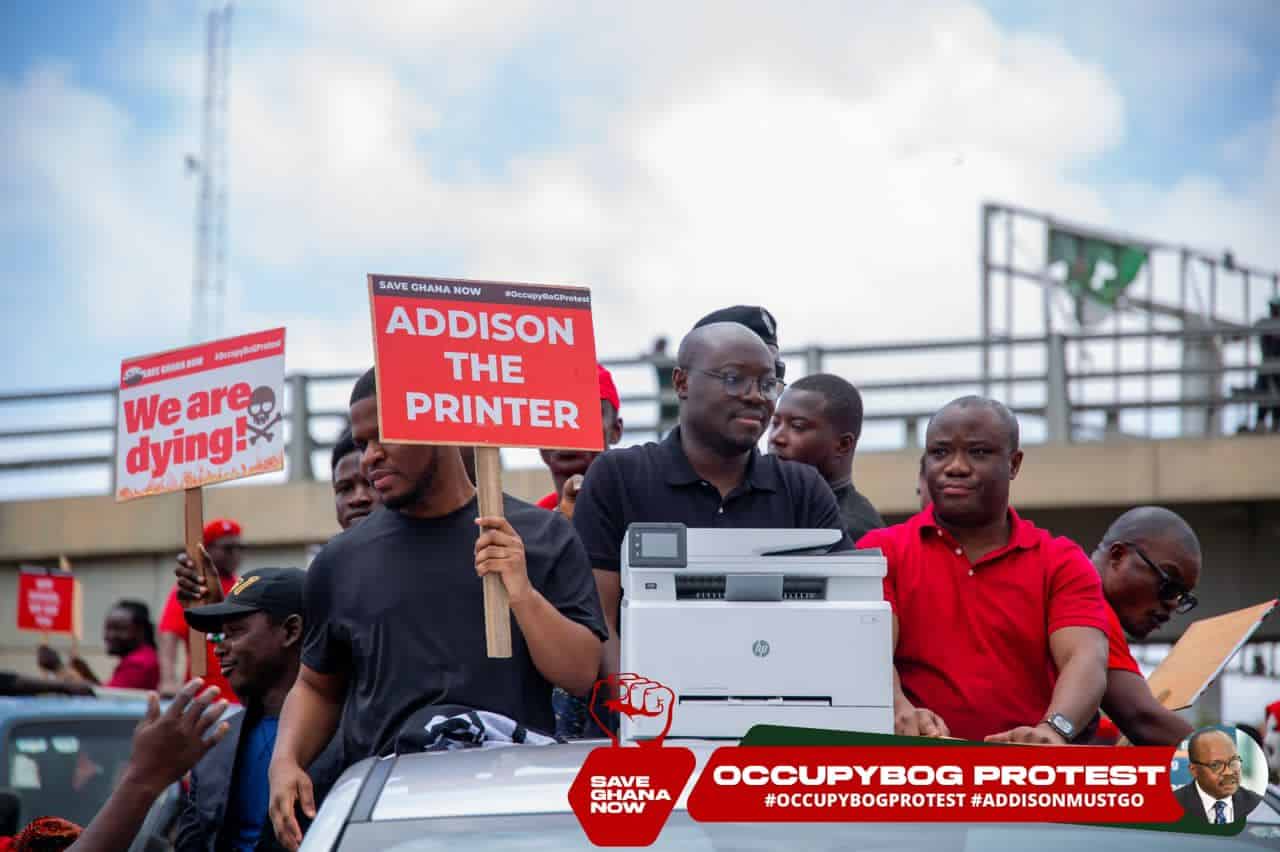
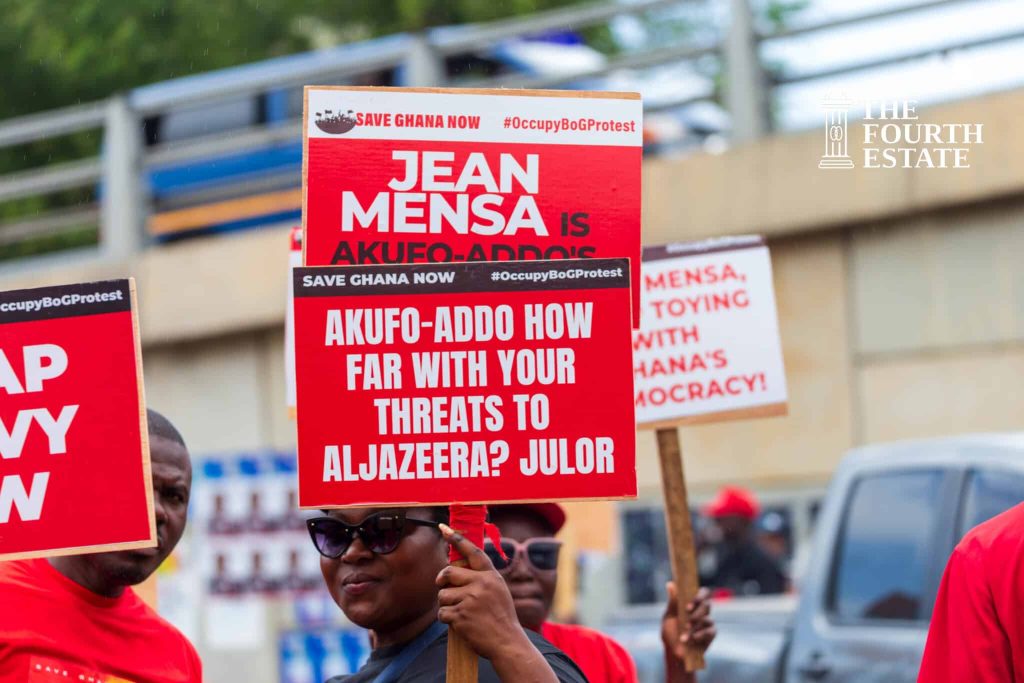
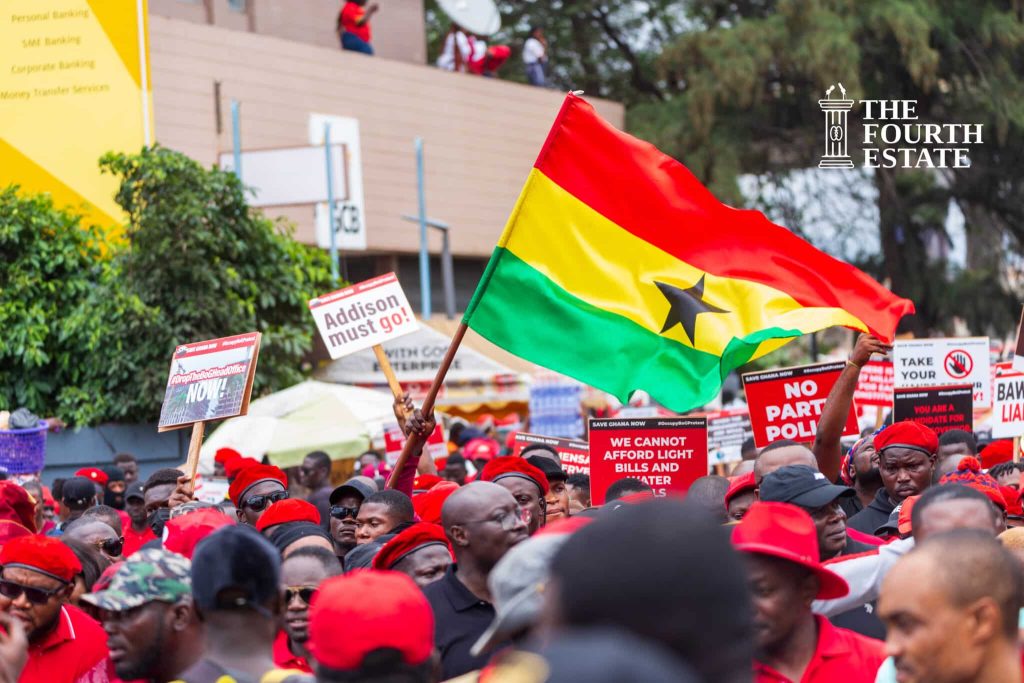
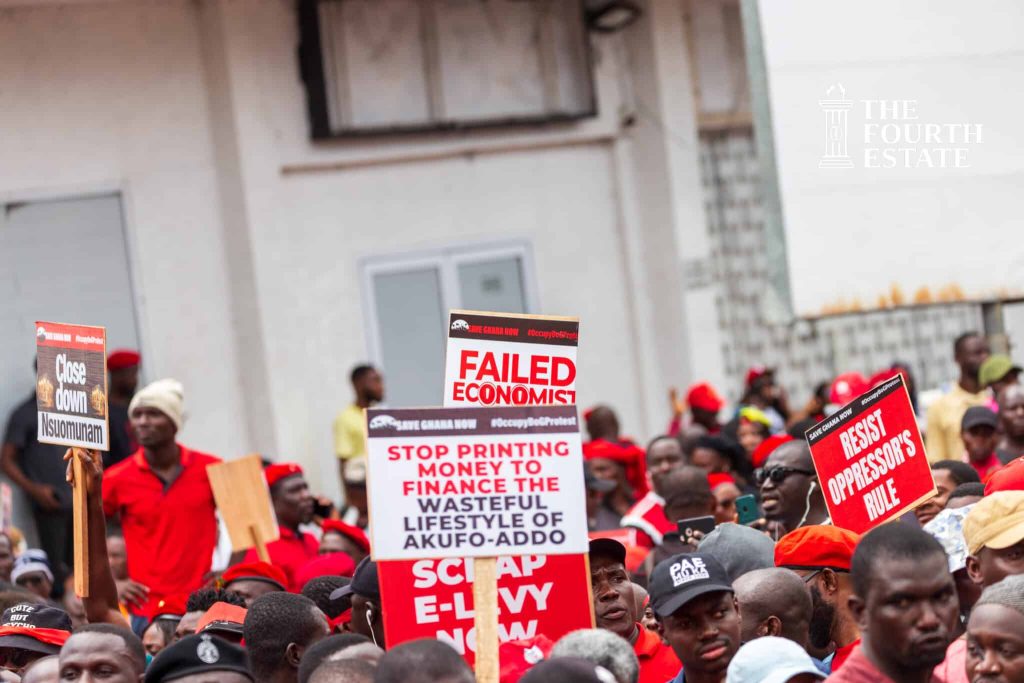
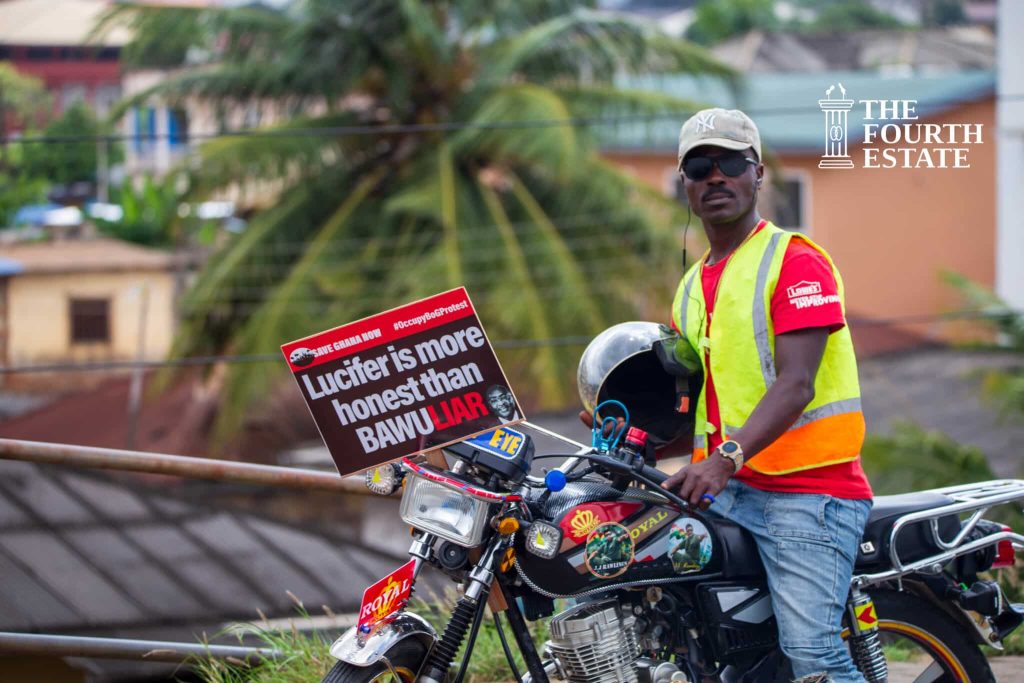
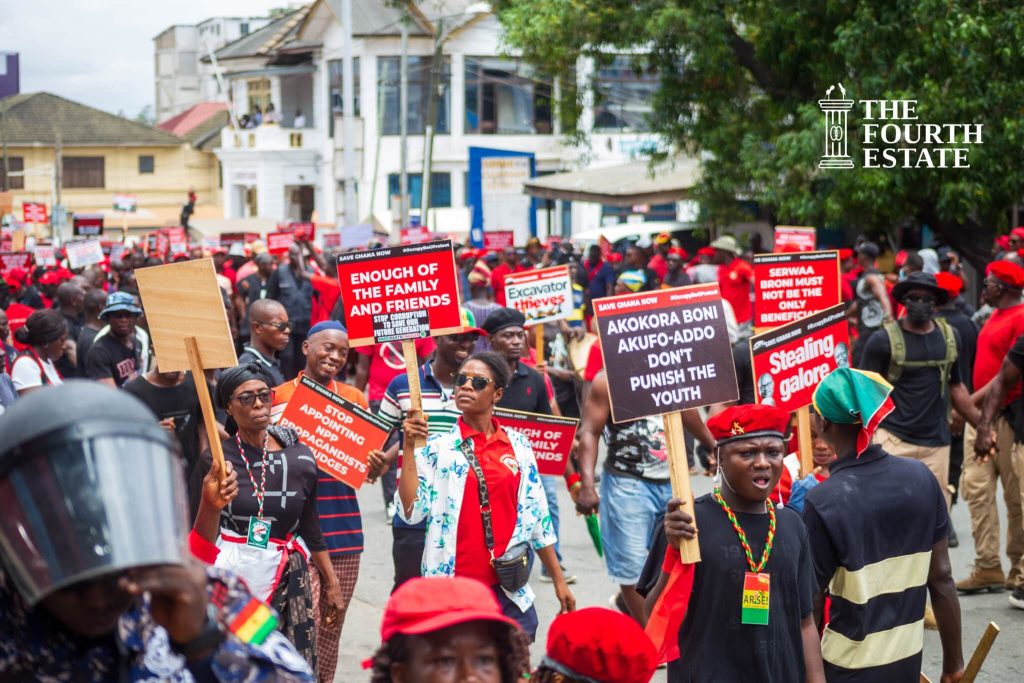
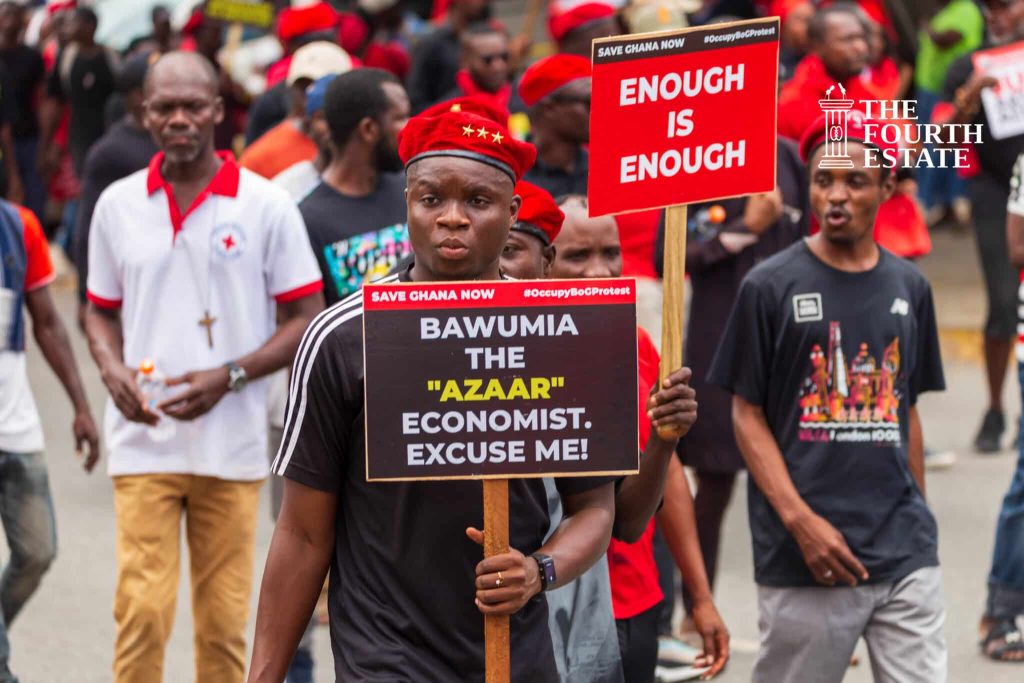
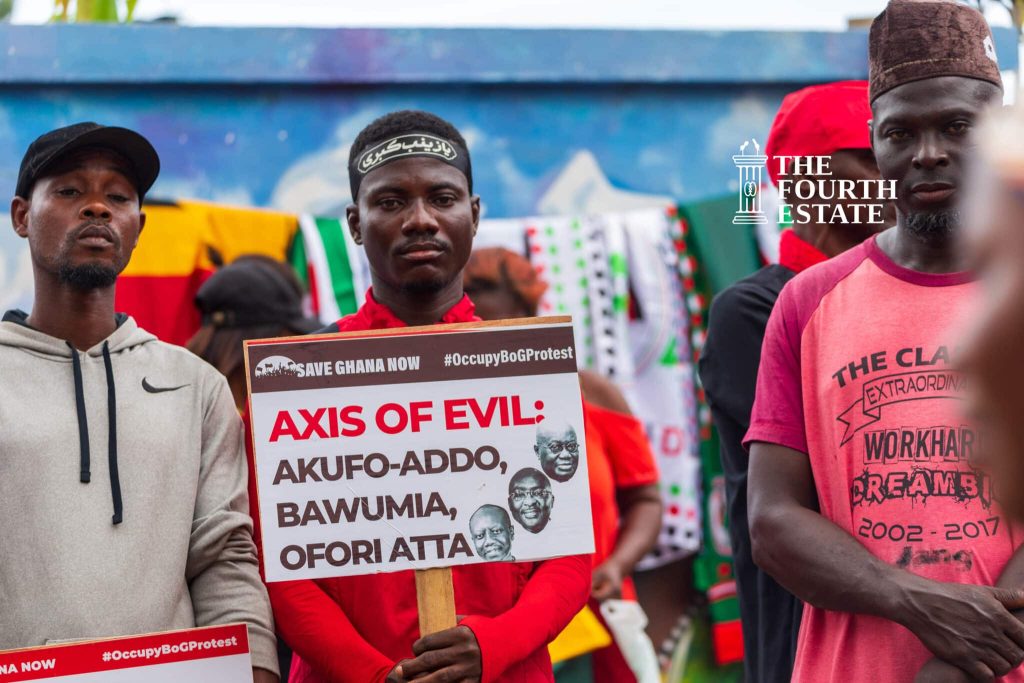
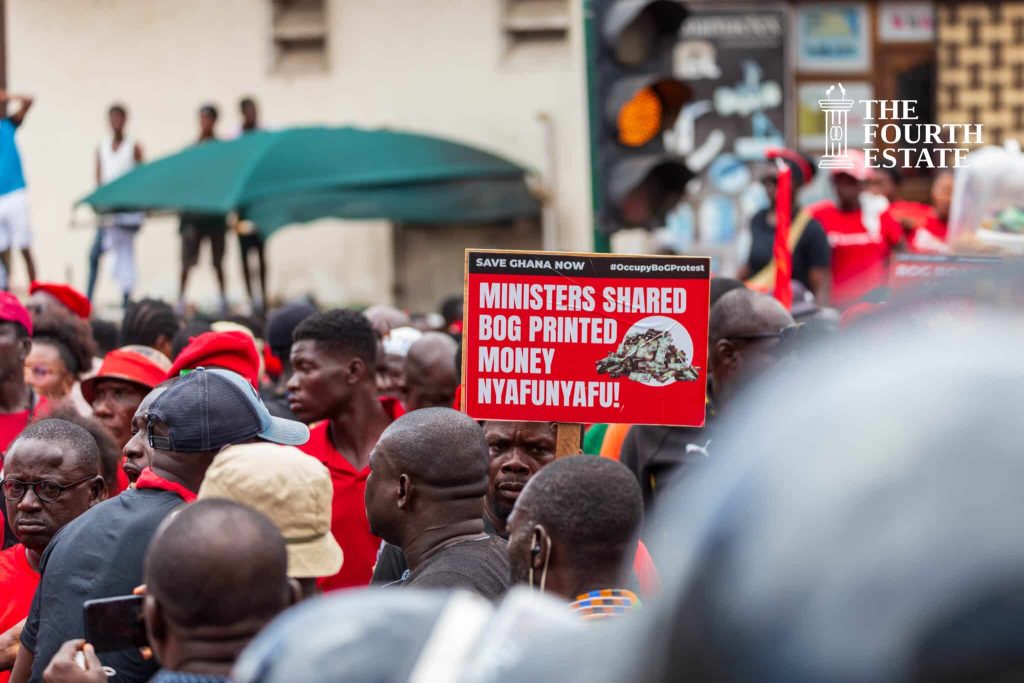
The #OccupyBOG protest on Tuesday, October 3, 2023, witnessed a display of emotions with placards bearing poignant messages, and voices raised in unison, demanding accountability from the Central Bank.
The Minority Leader, Dr Casiel Ato Forson, sandwiched by NDC Communication Officer, Sammy Gaymfi (left with a placard) and Felix Ofosu Kwakye (right) with a printer which symbolises that which was supposedly used for the printing of money
The Minority Leader, Dr Cassiel Ato Forson’s words struck a chord with the crowd as he accused Governor Addison of jeopardising Ghana’s economic stability.
“You printed money to finance the government’s champagne lifestyle! Step aside, Governor,” Dr Forson demanded.
‘’Addison must Go!’’, ”Create jobs for the Youth, not your children,’’ ’’Kill inflation not voters’’ and “Stop printing money to finance the wasteful lifestyle of Akufo-Addo’’ were some of the inscriptions on the placards captured through the lens of The Fourth Estate PhotoJournalist Clement Edward Kumsah.
BoG Governor, deputies snub protesters
After the nine-hour-long protest, the leaders of the demonstration got agitated and felt ‘disrespected’ when the Governor of the Central Bank and his two deputies did not show up to receive the petition from the protesters.
North Tongu Member of Parliament, Samuel Okudzeto Ablakwa, said the failure of the BoG Governor, Dr Addison, to receive the petition from the #OccupyBOG protesters was an affront to Parliament.
Kwame Asare Boateng, the Director of Security at the BoG, showed up to receive the petition with the excuse that the Governor and his deputies were in a meeting with officials of the International Monetary Fund (IMF).
“We were informed that you were coming to present a petition to the Governor but the three governors are currently meeting the IMF and there is nobody there,” he told leaders of the protest.
“So, the Governor has asked that I meet you and take the petition,” he added.
The Minority Leader, Dr Forson, who felt “disrespected” by the gesture, said, “Unfortunately, he (Governor) has decided to disrespect us and the two deputies have also decided to disrespect us.”
“We will come back,” he said.
And “until we see him, we are not stopping. This is just the beginning,” Dr Forson warned.