It was about 2:45pm when Yahsmen Kamal Kokroko was born at the Amoah Hospital at Ablekuma in Accra.
“The baby was not crying. She was silent,” her mother, Salamatu Adams, recalled the events of October 21, 2021.
Midwives and parents often anticipate a baby’s first cry in the labour ward because it signals a newborn’s ability to breathe on its own. But, about four hours after her birth, Yahsmen did not cry.
It was the most devastating period for the first-time mother, Salamatu Adams, and her husband, Kamal-deen Kokroko.
Salamatu watched frightfully as the midwife wrapped Yahsmen in a cot sheet screaming “Jesus, Jesus”.
It was about 2:45pm when Yahsmen Kamal Kokroko was born at the Amoah Hospital at Ablekuma in Accra.
“The baby was not crying. She was silent,” her mother, Salamatu Adams, recalled the events of October 21, 2021.
Midwives and parents often anticipate a baby’s first cry in the labour ward because it signals a newborn’s ability to breathe on its own. But, about four hours after her birth, Yahsmen did not cry.
It was the most devastating period for the first-time mother, Salamatu Adams, and her husband, Kamal-deen Kokroko.
Salamatu watched frightfully as the midwife wrapped Yahsmen in a cot sheet screaming “Jesus, Jesus”.
“[The midwife] asked the other staff [in the labour room] to heat water for her. She then pulled out a hot water bottle from a drawer,” Salamatu says.
When the hot water came, Salamatu said the midwife poured it into the hot water bottle, which she then wrapped around the newborn Yahsmen.
With the baby warming up in the cot sheet, the midwife turned to stitch up Salamatu, whose cervix was cut to open her up for the delivery of the baby with a birth weight of 3.5kg.
As she stitched Salamatu’s cervix, Deborah allegedly forgot about the baby tucked in the cot sheet with the hot water bottle.
The compound of Amoah Memorial Hospital
“By the time she realised that the bottle was around the baby, Yahsmen’s skin had burnt,” Salamatu said, recounting her moment of horror. “When I saw it, I screamed.”
The baby’s skin had turned pinkish. What shook Salamatu to the core was when the midwife said Yahsmen was about to die.
“She then peeled the [baby’s scalded] skin and said ‘as for this, if you use Vaseline on it, it’ll heal’ [and then] she applied the Vaseline on the wound,” Salamatu said.
At this point, the midwife bent the baby, forcing her knees to touch her forehead, Salamatu recalled.
The baby let out a shriek, much to the relief of the little crowd in the labour ward. She had taken her first breath of life but all indications were that her first years of life were going to be filled with pain, distress and a lot of hospital visits.
A test of fortitude
Yahsmen is the couple’s first child, born after barely a year of marriage. They were expectant and had gone through so much trouble and anxiety in preparation for the baby.
Salamatu first visited Amoah Memorial Hospital on October 7, 2021, to continue her antenatal care. That was when she first met the midwife, Debora Yeboah.
On her third visit, a scan indicated she was due on October 22, 2021.
Salamatu Adams, the mother of the burnt baby
On Wednesday, October 20, 2021, Salamatu went for antenatal care again. Deborah examined the expectant mother and told her that her baby bump was not as pronounced as expected though she could deliver any time soon.
When she returned home, she and her husband washed and cooked. But in the night, Salamatu started experiencing labour pangs. So, her husband rushed her to the hospital that night.
Twelve hours later, she delivered. It was supposed to be a joyous occasion. But it rather became the beginning of a trauma that has ruined the couple’s happiness.
Five-hour surgery
After following the midwife’s advice to use Vaseline, a petroleum jelly used to treat some skin conditions, Salamatu and her husband saw no improvement in the baby’s condition. That was when they decided to seek a second opinion.
Parents of the burnt baby
They went to the Ga South Municipal Hospital, on October 27, 2021.
A quick examination of the little girl showed the wound was infected and the doctors recommended surgery. Yahsmen was just six days old – too young to go under the surgeon’s knife.
Medical records from the Ga South Hospital show that the baby suffered 13% burns at Amoah Hospital, where she was born.
“They said the best way was to wait for a while to enable the dead tissue which made the hard skin wear off before they could operate on her,” Salamatu said.
Eventually, on November 4, 2021, baby Yahsmen was taken to the theatre. The procedure lasted five hours.
Four days later, little Yahsmen was discharged from the hospital, and for six weeks, the family shuttled between their Ablekuma home and the Ga South Municipal Hospital at Mallam, also in Accra, for the dressing of the baby’s wound.
The surgery cost the family GHS4,000, which they could only pay with a loan they secured. This is in addition to all the expenses on transportation and medical consumables for dressing the wound.
At just about three years old now, Yahsmen’s burns have left her scarred for life. Her parents, devastated and traumatised by the experience of watching their joy fade into despair, can’t shake off the sense of regret over their choice of Amoah Hospital for the delivery of their first child.
“I have not yet started feeling the love for my baby because I am feeling the pain,” Yahsmen’s father, Kamal-deen told The Fourth Estate in their Ablekuma home. “It has caused me so much pain that when I go to bed, I can’t sleep.”
His wife shared her own pain of seeing her baby suffer.
“I couldn’t take it when they had to inject her hands every day. The hospital staff kept asking how this little baby got burnt? What did I do to her? Even the paediatrician threatened to get me arrested for burning my baby,” Salamatu said.
Saved not burnt – Midwife’s account
In the midst of it all, the couple are having to grapple with the hospital’s refusal to accept responsibility for Yahsmen’s suffering. Even the midwife who applied the hot water bottle to her delicate skin as a baby, insists she did nothing wrong and that Kamal-deen and Salamatu should be grateful that she pulled their child from the brink of death.
Midwife Debora Yeboah has been accused of allegedly burning the baby.
When The Fourth Estatecontacted Debora Yeboah, the midwife, she claimed she was not an employee of the Amoah Hospital but rather came around to help. She claimed she lost the chance of getting a job with the hospital because of the allegations that she was responsible for little Yahsmen’s injuries.
The Fourth Estate had more questions.
“You said you did everything to resuscitate the child, what did you do?”
“Mouth-to-mouth, chest compression,” she said.
“You said you put something behind the child, or?”
“Even with that, she didn’t respond,” she said, and went into another room in search of the hot water bottle but indicated that the hospital’s lawyer had come for it.
“It is like a foam, it’s not something that will burn a child,” she insisted.
“But can hot water be poured inside?”
“Even when we heated the water, it wasn’t hot. Before it went near the baby, I even touched the man’s [Yahsmen’s father’s] body with it and asked him if it was hot. He said no.”
The hospital also has a different account of what happened in the ward where Yahsmen was born.
“Our client (Amoah Hospital) further states that, under no circumstance did the midwife fill a can with hot water and wrapped in a towel at the bare back of the newly born baby,” lawyers for the hospital said in a suit filed by the parents of Yahsmen.
Alien practice
The President of the Midwives Association of Ghana, Mary Ofosu, told The Fourth Estate that the use of the hot water bottle in a labour ward is an alien practice.
“It’s not part of the protocol,” she said. “I’ve never heard of its use like that. Hot water bottle? You can´t use anything hot on a baby’s delicate skin.”
Mrs Ofosu, who has spent a decade and a half in different labour wards, said a hot water bottle was forbidden as a pain soother on even pregnant women.
She said if a newborn baby does not cry within the “Golden Minute”, their first 60 seconds outside of the womb, there are various tried and tested procedures to help them draw breath. They do not include the use of hot water bottles.
Mrs Ofosu said resuscitation could be artificially initiated using a procedure known as bag and mask. Here, the baby is positioned on a firm surface to clear the airway, a sized mask is then attached to the baby’s nose and mouth, and gentle puffs of air is squeezed from the attached bag. The baby’s heart rate, oxygen levels, and overall condition are closely monitored throughout to ensure a heartbeat.
A midwife’s other options in resuscitation include sucking the baby’s mouth and nose or cleaning the baby to stimulate him/her. Chest compressions may also be used.
Did the baby die?
Yahsmen Kamal Kokroko, the burnt baby
Midwife, Deborah Yeboah, employed none of these techniques but insisted that but for her Yahsmen wouldn’t be alive today.
“When the child arrived, she was dead,” she claimed. “You can ask the man [Yahsmen’s father].”
“When the child was born, she was dead? How?”
“It happens,” she interrupted.
“You can place a dead baby in bed for five hours?”
“She was gone.”
“But how do you keep a dead child for—-?”
“I’ve been delivering babies for 40 years now. I have a lot of experience,” she insisted.
“You said the baby was dead when she was born. What was the colour of her skin?”
“The baby was gone. Unfortunately, those with me didn’t take a picture of her.”
“You said the baby was dead. What showed she was dead?”
“She was lifeless. Her mouth was wide open.”
“But if a baby is born and it dies, what do you do?”
“A doctor comes to assess it.”
“So, for those five hours, the doctor didn’t come?”
“It wasn’t five hours. A doctor came from Ridge to give her a vaccine.”
“So, the baby was there from 2pm till the doctor came at 6pm?”
“She cried at 5pm.”
“Did the doctor see the wound?”
“The doctor doesn’t work here. He came from the Ridge Hospital.”
“How long did the water bottle stay behind [the baby]?”
“I had wrapped her. The father was sitting by her. I didn’t check the time. She was behind me in the cot sheet.”
“How long did it take?”
“It wasn’t that long.”
“When I was suturing [restitching the mother], I was watching the baby. We were praying. A pastor’s wife was around and she was praying with us. I told all of them to pray to see what God can do [for the baby].”
A legal tussle begins
In their quest for justice and some recompense, Salamatu and her husband, Kamal-deen wrote a letter to Amoah Hospital demanding GHS500,000 for negligence on the part of its staff. They intended to use the money to defray the cost of Yahsmen’s treatment.
The hospital, through its lawyers, responded that Yahsmen was born with her umbilical cord around her neck, leading to asphyxia (or suffocation) which nearly killed her.
“Our client denies that under no circumstance did the midwife fill a can with hot water and wrapped in a towel at the bare back of the newly born baby,” the letter from Amoah Hospital’s lawyers said. They also claim that Yahsmen’s condition was a result of the asphyxia she had suffered.
“Post-delivery examination of the baby showed that she had a blister at the right flank area about one centimetre by two centimetres.”
The hospital has also rejected the couple’s demand for compensation, insisting like the midwife that they saved Yahsmen’s life.
Dissatisfied with the hospital’s response to their demand letter, Salamatu and Kamal-deen instructed their lawyers to take the matter to court.
In a suit filed on March 18, 2022, they demanded two million cedis from the Amoah Hospital for Yahsmen’s injuries —”Plaintiffs say that the damages they suffered by them was as a result of the negligence of the Defendant which negligence arose from the breach of the duty of care owed to the Plaintiffs by the Defendant and its agents/staff, the writ stated.
Kamal-deen told The Fourth Estate he wanted to use the case to help save others from the ordeal his family has suffered.
“I told myself that if I don’t get justice for my child, some other person could fall victim,” he says. “It’s an experience that I would not want even my worst enemy to go through.”
The people of Tamale, Yendi and Damongo are still without water four years after President Nana Akufo-Addo cut sods for water projects in these towns in the lead-up to the 2020 elections.
Getting water, one of the necessities of life, in these areas is as difficult as mining for some of the world’s precious minerals.
“The situation became critical and we travelled to the next village which is about four kilometres away for water,” Aisha Danlaadi, a mother of four who trades in provisions, told The Fourth Estate.
Aisha said there were days her children went to school late or did not go because they had to spend a lot of time and energy looking for water.
If anyone had told them in 2020 that four years down the line, they’d be so desperate for water to have to dig deep into the earth for it, the people of Changnaayili would have laughed it off: 2020 was a year of hope, optimism and a lot of promises.”
The little water they do get after long walks is hardly ever wholesome. It’s dirty and muddy, so they must use homegrown methods to purify it. Another Tamale resident, Hamza Mohammed, told The Fourth Estate that he uses potassium alum to purify the water he gets from a nearby village.
Residents of Changnaayili were forced to dig a big hole in the earth about the size of a football pitch and about 10 metres deep until they hit the waterbed
The quest for water forced Aisha and other residents of Changnaayili, a community near Tamale to take matters into their own hands. They dug a big hole in the earth, about the size of a football pitch, and about 10 metres deep until they hit the waterbed. It was a lot of work for which every member of the community had to chip in. As the men dug with axes and hoes, the women carried the sand away. And now, thanks to their community spirit, they have some water – still dirty, and muddy. But it’s water. It’s better than nothing. It’s not quite what they need but given the circumstances, it’s what they bathe and cook with and even drink.
If anyone had told them in 2020 that four years down the line, they’d be so desperate for water to have to dig deep into the earth for it, the people of Changnaayili would have laughed it off.
Year 2020 was full of optimism and a lot of promises. The elections were a few months away when President Akufo-Addo came to town and commissioned a project for the construction of a water treatment plant to serve the people of Tamale and surrounding areas, including Changnaayili. Now hope has turned into despair and the people of Changnaayili are in no mood for any more promises. All they want is clean water in their community. And they are not alone.
Changnaayili is just one of many communities in northern Ghana that are demanding the fulfilment of promises made to supply them with potable water in the lead-up to the elections in 2020 – promises made by none other than the president of Ghana himself.
These communities experience a short rainy season and a long and dry season. Their main water sources are streams, rivers, shallow ponds, hand-dug wells and boreholes which dry up in the dry season. Promising to address the perennial water crisis, President Akufo-Addo went on a sod-cutting spree in the north, raising the people’s hopes as he sought a second term in office in 2020. In just two days, and to great fanfare, he cut sods to mark the start of the construction of water treatment plants in Tamale, Damongo and Yendi.
“This will be, by far, the biggest water project in the five northern regions, and the second biggest in the history of our country,” he announced during the sod-cutting ceremony on July 29, 2020, in Tamale.
The $223 million Tamale water project was billed to produce 29.7 million gallons per day, tripling the current water supply to the growing population in Tamale, Ghana’s third fastest-growing city.
Four years later, the project is yet to produce a single drop of water.
The Yendi Water Supply Project was supposed to be financed with a $30 million facility from the India Exim Bank. It was meant to provide the Yendi municipality and its environs with 15,000 cubic meters of water daily to meet the water demands until 2040.
“When I told you that ‘great days lie ahead of Dagbon’, this is what I meant, as this project signals the beginning of infrastructural development for Yendi. And, as you know by now, when Akufo-Addo makes a promise, he keeps it,” President Akufo-Addo told the Overlord of Dagbon, Ya-Na Mahama Abukari II, at the sod-cutting ceremony.
The President’s next stop on the sod-cutting spree was at Damongo. Here the water project was estimated to cost $49 million.
“I indicated that one of the reasons for the creation of the new regions was to accelerate the process of development to all parts of the country. So, you can understand my excitement at the commencement of the Damongo Water Supply Project, because the pledge of extending development to all parts of Ghana is unfolding,” President Akufo-Addo said to a cheering crowd.
The construction of the water supply system, the president explained, was aimed at meeting the water demands of residents of Damongo and its surrounding communities until 2040, in line with government’s policy. It was going to serve 68,000 people, with an expected average water demand of 8,800 cubic metres per day.
The spokesperson to the chief of Damongo, Alhaji Abu Mahama Salange, says since 2020, the government’s intent to provide water for Damongo has been promises upon promises
Alhaji Abu Mahama Salange, Spokesperson of Chief of Damongo, Alhaji Abu Mahama Salange, who speaks for the chief of Damongo, says President Akufo-Addo promised in 2020 that the project would be completed within a year. Four years on, the project is yet to take off.
“After the sod cutting, we expected the construction to kickstart but every day it is promises upon promises and the contractor did not come around,” Alhaji Salange says.
“After the elections [in 2020] we started complaining. We were told that the contractor had arrived and would start the project soon until early this year [2024] when the MD (Managing Director) of the Ghana Water Company, Dr Clifford came around with his team and briefed the overlord of Gonja that there appeared to be no money for the promised water project,” he added.
At Yendi, the most common source of safe drinking water is the hand pump borehole, but seasonal changes in the water table have affected access to potable water.
The situation has become worse due to climate change challenges such as long droughts, high temperatures, erratic rainfall patterns and floods which lower groundwater levels and contaminate existing water sources, thus, posing a threat to access to quality and sustainable water, according to climate experts. This undermines Ghana’s drive to meet the Sustainable Development Goal 6 of the United Nations which aims to achieve universal and equitable access to safe and affordable drinking water for all by the year 2030 – six years from now.
Alhaji Abdul-Raman Mohammed, Secretary to the Overlord of Dagbon, says multiple follow-ups and reminders to ensure President Akufo-Addo and his government fulfil their promise have not yielded any result. And Yendi continues to thirst.
FULL VIDEO
While the projects commissioned by President Akufo-Addo are yet to start, Vice President Dr Mahamudu Bawumia cut sod for a World Bank-funded Gulf of Guinea Northern Regions Social Cohesion initiative at Yendi. The event, which took place in October 2023, was to provide critical social infrastructure like water to communities like Yendi in the Northern region and Oti region.
The Vice President announced that the projects would include the provision of water, the construction of school buildings, health facilities, markets, dams and other critical physical infrastructure.
Our checks reveal that Yendi, for instance, is yet to see any water project being constructed.
Ghana Water MD says debt restructuring affected projects
Managing director of the Ghana Water Company, Dr Clifford Braimah, said banks refused to give loans for the project due to debt restructuring
Managing director of the Ghana Water Company (GWCL), Dr Clifford Braimah, claims the Ministry of Finance’s announcement of a debt restructuring programme in 2022 caused the banks not to release funding for the water projects in Tamale, Damongo and Yendi.
“No bank will spend a penny if they are not sure of getting their money. So, they held on. And so, Tamale, Damongo, and Yendi could not come on,” Dr Braimah told The Fourth Estate.
The Municipal Chief Executive of West Gonja, Karim Musah Kusubari, repeated Dr Braimah’s point on funding. “Maybe financial problems or maybe they are still doing documentation and I can’t best tell or explain,” he added.
Now, according to the GWCL’s MD, Ghana is still chasing funding for the projects from the banks in 2022. Why then did President Akufo-Addo announce that the government had secured funding for all the water projects during the sod-cutting ceremonies in 2020?
Tamale, Yendi and Damongo projects at various stages of completion – Finance Minister
Despite our confirmation that these projects did not take off, the Finance Minister said they were at various stages of completion
Though The Fourth Estate has confirmed that the proposed water projects in Tamale, Yendi and Damongo were yet to start four years on, the Finance Minister gave a false account to Parliament in July 2024.
During the presentation of the 2024 mid-year budget review to parliament on July 23, 2024, the Minister for Finance, Dr Mohammed Amin Adam, said that the non-existent Tamale, Yendi and Damongo water projects were at various stages of completion.
“The following are at various stages of completion: Wenchi Water Supply Project; Sekondi-Takoradi Water Supply Project; Keta Water Supply Project; Yendi Water Supply Project; Tamale Water Supply Project; Damongo Water Supply Project; Sunyani Water Supply Project; and Techiman Water Supply Project,” he said.
This came as a surprise to many and got them asking why leaders are not being honest and truthful to Ghanaians.
An ongoing water project being financed by the Ghana Water Company Limited for residents of Damongo
In the meantime, Dr Braimah says the GWCL is constructing some boreholes for the Yendi Community as a temporary measure. He also said the company is constructing a treatment plant at Broto, a village in West Gonja, where an abandoned borehole could be made wholesome for use.
Communities like Changnaayili, however, will continue to wait as the GWCL MD said his outfit does not provide water to far-flung remote communities.
At least 750 senior high schools and Ghana Education Service offices have been without internet connectivity since March 2024. Internet infrastructure, such as modems, was installed in the schools and offices as part of the government’s Wi-Fi for Schools project.
Following the publication of our findings, several sources have revealed that more than 750 schools have not had internet connectivity for much of this year. This means more than three-quarters of schools and offices nationwide are without internet, even though the government has paid for connectivity. Sources say this is due to the failure of, Lifted Logistics, the company executing the GHS84 million contract, to pay its service providers.
The Wi-Fi contract was awarded to Busy Internet on a sole-source basis and later transferred to Lifted Logistics. An official of the Education Ministry told The Fourth Estate that the contract was sole-sourced because telecom giants like MTN, were wary of delays in government payments. But shortly after winning the contract, Busy Internet sub-contracted MTN, AirtelTigo, and Yahclick, a satellite service provider, to connect the over 1000 schools and offices as part of the contract. Yahclick deployed connections to more than 600 schools and offices while AirtelTigo connected about 180.
Sources say the failure of Busy Internet (and now, Lifted Logistics) to pay Yahclick, AirtelTigo, and other service providers for the past nine months is the cause of the prolonged internet outages the schools and offices have been experiencing.
The Ministry of Education in a statement released on June 3, 2024, stated that it was considering terminating aspects of the contracts in schools that are having connectivity challenges.
The Fourth Estate’s investigations revealed connectivity in some of the schools initially. They however started losing connectivity one after another not long thereafter. Most schools lamented that complaints to Busy Internet/Lifted Logistics’s customer service unit were not addressed, leaving them frustrated and angry. The schools include Labone SHS and Accra Academy, which now uses private internet paid for by its old students association.
Even though the Ministry of Education’s records submitted to parliament said they paid GHC56 million to Lifted Logistics in 2023 for services it supposedly rendered, a leaked report by the Economic and Organised Crime Office suggests that between December 30, 2019, and December 19, 2022, the ministry paid GHC63.7 million to the company.
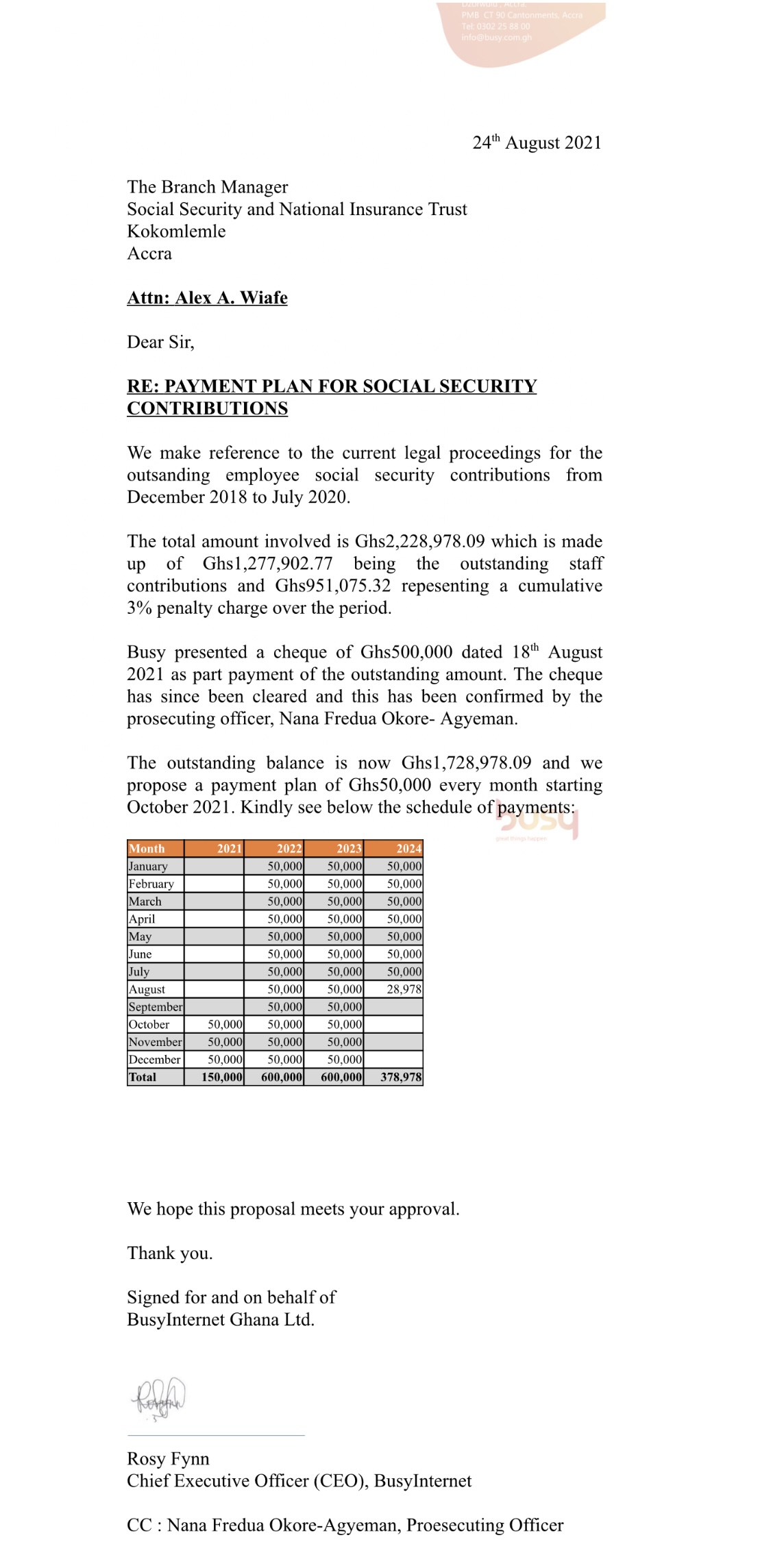
A court document available to The Fourth Estate showed that SSNIT sued Busy Internet in 2021 for the company’s failure to pay GHS1,277,902.77 of its workers’ contributions between December 2018 and 2021. SSNIT also wanted the company to pay GHS951,075.32 in penalties for the failure to pay SSNIT as of July 2020, eight months after it won the contract.
In 2018, Busy Internet was a company in dire straits. As an internet service provider, it competed against industry giants but achieved little success. Revenue had dipped, and liabilities were increasing along with staff discontent.
To cap it all, the company owed millions of cedis in unpaid taxes and social security contributions. At this point, when it seemed that the company was ripe for shutdown, it was announced to staff that Busy Internet had been acquired by a company called Lifted Logistics. A few weeks later, staff were even more amazed and delighted with another announcement that Busy Internet had won a major government contract to supply Wi-Fi services to secondary schools and offices of the Ghana Education Service throughout the country.
It was a contract Busy Internet was not eligible to even think about bidding for. With its huge tax liabilities and hefty arrears in unpaid social security contributions, the company could not have had tax and Social Security and National Insurance Trust (SSNIT) clearance certificates, which are mandatory requirements for any company bidding for a government contract. Despite these clear ineligibility, Busy Internet was not only able to secure a multi-million government contract; it was awarded the contract on a sole-sourcing arrangement.
“What I know for sure is that during that time we did not have a SSNIT clearance certificate neither did we have a GRA tax clearance certificate,” a former staff of Busy Internet, who has intimate knowledge of the contract but asked not to be named, told The Fourth Estate.
Following SSNIT’s legal proceedings against Busy Internet, the company drew a payment plan to clear all outstanding arrears from December 2018
Apart from those statutory requirements the company failed to meet, Busy Internet was not registered with the PPA as a supplier, contrary to the PPA’s procurement rules, according to searches conducted on the Public Procurement Authority’s (PPA) website.
The five-year contract was also awarded to Busy Internet without parliamentary approval as required by Ghana’s Public Financial Management Act.
“It was good news,” says a former employee of Busy Internet who wishes to remain anonymous for fear of victimisation. “At the end, we were all of this conviction that the MOE [Wi-Fi] contract was going to end the woes of Busy Internet. We were sinking as a company and salaries were not being paid.”
Horpe Omotayo-Ojo, CEO, Aguila Holdings, parent company of Busy Internet and Lifted Logistics
The Chief Executive of Aguila Holdings, which acquired Busy Internet, Horpe Omotayo-Ojo, in announcing the contract award to staff, also promised that their jobs were safe and every effort was going to be made to pay off Busy Internet’s debts and put it on the path to profitability. But that was not to be. Workers’ hopes were dashed and many laid off as the company started installing internet connectivity devices in senior high schools across the country.
Busy Internet was considered way more suitable beyond industry leaders, MTN, which had just been licensed to provide 4G internet services and Surfline Ghana Limited, another 4G internet service provider.
When The Fourth Estate asked why the government did not consider any of these companies for the contract, the Free Senior High School Coordinator, William Darkwa, said the big players were not interested in the project because they were wary of delays in receiving payments from the government.
But just after winning the contract, Busy Internet contracted MTN Ghana and AirtelTigo to provide the services it had contracted with the government to provide for secondary schools and education offices across the country.
Initially, the Wi-Fi system worked and the internet was available in some schools. Within a short period, however, the schools started losing connectivity one after another. The Fourth Estate visited 50 schools in 2023 to check if they were still connected to the internet. Out of the 50 schools, 48 of them had been without internet connection for several months. Most of them lamented that complaints to Busy Internet’s customer service unit had not been addressed, leaving them frustrated and angry. Our bid to further investigate why the schools had been disconnected raised more questions than answers, mostly about how an unqualified company was listed as a sole-source candidate for a government contract of such magnitude.
In the initial contract between Busy Internet and the Ministry of Education, the project cost was pegged at GHS84.4 million. The Education Ministry was also obliged to pay a monthly recurrent cost of GHS6.4 million for internet connectivity to the schools and educational offices.
The Wi-Fi for schools projects fulfilled a 2016 manifesto promise by the governing New Patriotic Party to collaborate “with the private sector [to] provide free Wi-Fi coverage for senior secondary and tertiary institutions nationwide, dedicated to learning, administration and enhancing the capacity to do research.”
The contract with Busy Internet resulted in the connection of over 1,000 institutions to the Internet as of February 2024.
PPA approves Contract to unlicensed company, doubling of monthly charge
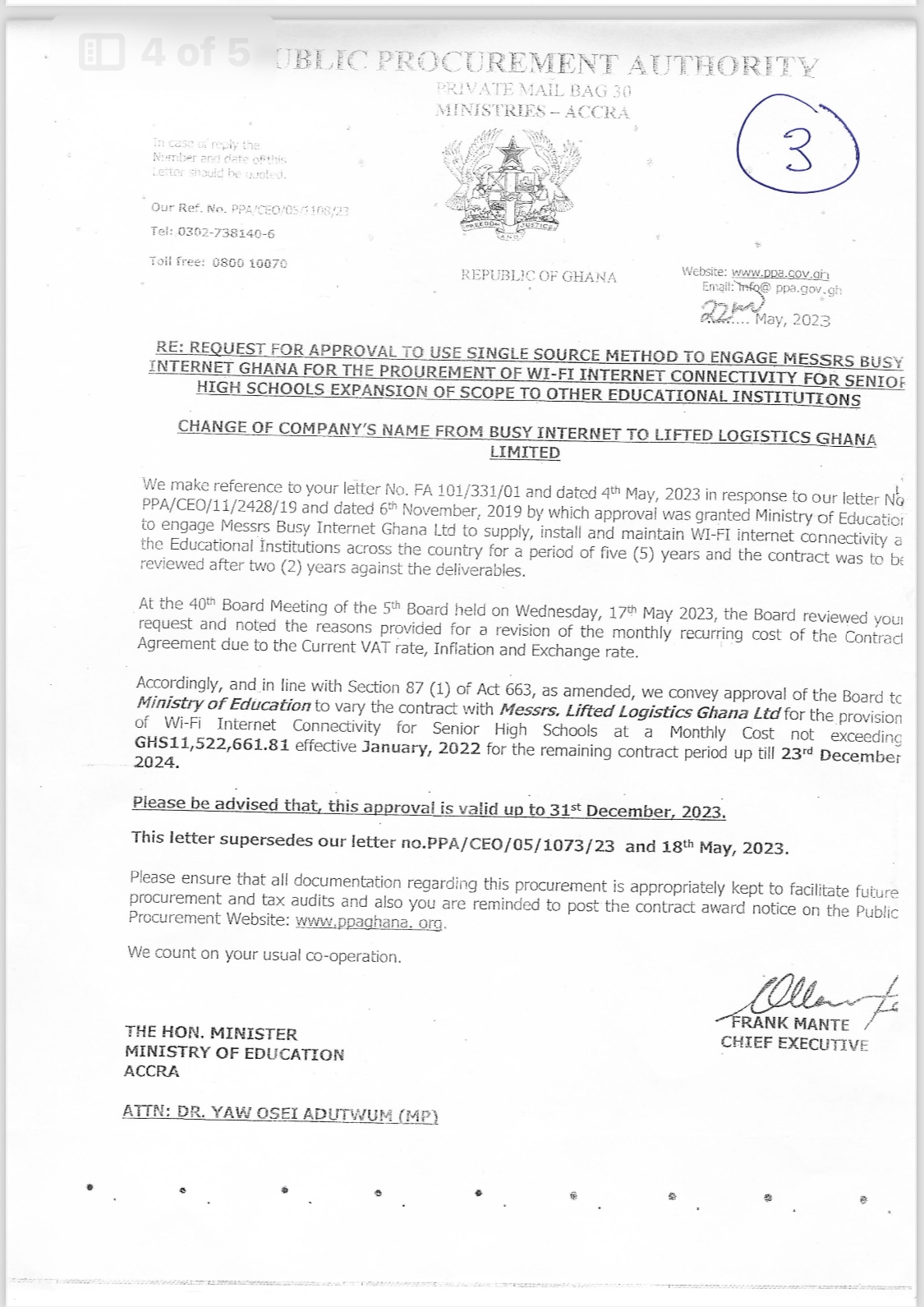
This new approval from the PPA pegs the monthly recurring cost of the contract at GHS11.5 million from an initial GHS 6.3 million
Further investigations revealed that the PPA in a letter dated 22nd May 2023 to the Ministry of Education, approved a request for a “change of company’s name from Busy Internet to Lifted Logistics Ghana.” At that time, however, Lifted Logistics was not even a licensed internet service provider, raising questions about how and why the PPA agreed to substitute the name “Busy Internet” in its records for “Lifted Logistics”, which only obtained a conditional ISP license in February 2024 – 10 months after the PPA approved the request for a change in the contractor’s name.
All these seemed like it was Busy Internet, now under the management of Aguila Holdings which had changed its name. But what was happening was that a new contractor (or company), without an ISP license, was taking over the project.
Though the Ministry of Education’s records submitted to parliament said they paid GHC56 million to Lifted Logistics in 2023, a leaked report by the Economic and Organised Crime Office suggests that between December 30, 2019, and December 19, 2022, the ministry paid GHC63.7 million to the company.
From its website, Lifted Logistics offers solutions for “project management, cybersecurity, banking and finance technology, and other technological solutions.” The company’s owner, Horpe Omotolayo-Ojo, a Nigerian, also owns a chain of businesses in Ghana.
When former employees raised concerns about Mr Omotolayo-Ojo’s attempt to transfer Busy Internet’s license to a different entity, the NCA responded in March 2023 that Busy Internet’s license “has not been transferred, [nor] reassigned.”
Mr Sarpong also said that sub-contracting an internet connectivity project to a company that was not even a registered internet service provider with the NCA makes the whole arrangement even more questionable
Procurement Consultant, Collins Agyemang Sarpong, says it may not be out of place to sub-contract part of a contract to another entity. But what is uncommon is that an entity like Busy Internet cannot give a contract it has won from the Ministry of Education to another company as appears to have happened with Lifted Logistics, until May 2023 when the PPA approved for Lifted Logistics to replace Busy Internet in the contract with the Ministry of Education.
Mr Sarpong also said that sub-contracting an internet connectivity project to a company that was not even a registered internet service provider with the NCA when the contract was purportedly transferred makes the whole arrangement even more questionable.
“If it is a joint venture and there is a new entity borne out of this joint venture, you need to have the mandatory requirements,” Mr Sarpong said. “There is a clause that if you are subcontracting any portion of this contract, you need to inform the principal so that due diligence is done on the subcontractor to check if everything of theirs is good.”
In the same letter approving the name (or contractor) change, the PPA approved an increase in the monthly recurring service charge from GHC6.5 million to GHS11.5million, almost doubling what the government was supposed to be paying for a service that was hardly ever being delivered.
The Fourth Estate contacted the PPA to find out why it approved a multi-million contract for an unqualified company and also approved a doubling of the monthly recurring costs, but we got no response from the authority.
It was 11:00 am on July 6, 2023, at one of Ghana’s prestigious senior high schools, Accra Academy. Students had gathered in the Information and Communications Technology (ICT) lab, tapping their fingers impatiently on keyboards with exasperating sighs. In contrast, others muttered under their breaths in frustration, desperately trying to connect to the internet. With time slipping away and their assignment deadline fast approaching, disappointment was etched on their faces as the blank screens on their computer monitors flashed with the inscription, “No internet access.”
Accra Academy Senior High School (SHS) was one of over 700 schools connected to the internet as part of the government’s Wi-Fi for Schools programme. For a while, jumping on the information superhighway was a breeze for both students and tutors. But within a year, the internet was no longer available. The school was disconnected.
“The internet stopped working when we were in Form 2,” says a final-year student. “We no longer use it at the ICT lab.”
The headmaster, Emmanuel Ofie Fiemawhle, explains that the government-supplied internet only worked for a year but was always unstable. Complaints have been filed. He claims that the company responsible for the network has failed to respond positively or meaningfully.
The Old Students Association has since intervened to keep Accra Academy’s vital administrative functions connected to the Internet. Currently, it is only the school’s administration, accounts office and data room that are connected, said the headmaster. The ICT lab and the libraries, where students usually go for research, are without an internet connection.
Although Labone SHS has the IT infrastructure installed by the government, the internet has never worked. The school relies on Telecel Ghana’s internet service. The government has, however, been paying for internet for the school. Drone Shot by: Clement Edward Kumsah/The Fourth Estate
The situation is no better at Labone SHS, also in Accra. Although the school has the IT infrastructure installed by the government, the internet has never worked. A member of the management of the school, who spoke on condition of anonymity, said they currently rely on Telecel Ghana’s internet service. However, this service is only accessible in the school’s administrative block, which houses the headmaster and other management staff.
At the Bolgatanga SHS (Big Boss), an E-learning centre sits in the heart of the school. The centre was put up to facilitate teaching and virtual learning among students while assisting teachers to undertake academic research and prepare their lessons. But a year after it was opened, Wi-Fi internet connectivity stopped working.
This has not only affected the E-learning centre and the purpose it was supposed to serve. It has also affected the preparation of lesson notes by teachers. Since the Wi-Fi stopped working, staff have had to use their mobile data to conduct online research.
Authorities say several complaints to the Ghana Education Service and the Ministry of Education have yielded no results. Despite this challenge, Bolgatanga Senior High qualified for two national championships – the National Science and Maths Quiz in 2023 and the Energy Commission’s Senior High Schools Renewable Energy Challenge in 2022. However, the unavailability of internet connectivity affected preparations as the students could not hold virtual lessons and conduct research work online, forcing the school to opt out of both competitions.
“This is frustrating and demoralizing,” a student, who did not want to be named, said of the situation.
The free Wi-Fi for schools’ programme was in fulfilment of a 2016 manifesto promise by the governing New Patriotic Party to collaborate “with the private sector [to] provide free Wi-Fi coverage for senior secondary and tertiary institutions nationwide, dedicated to learning, administration and enhancing the capacity to do research.”
According to the project contractor, the policy resulted in the connection of over 1,000 institutions to the Internet as of February 2024. Apart from the SHSs, 16 regional education offices, 46 colleges of education and 260 district education offices were also expected to be connected within a year.
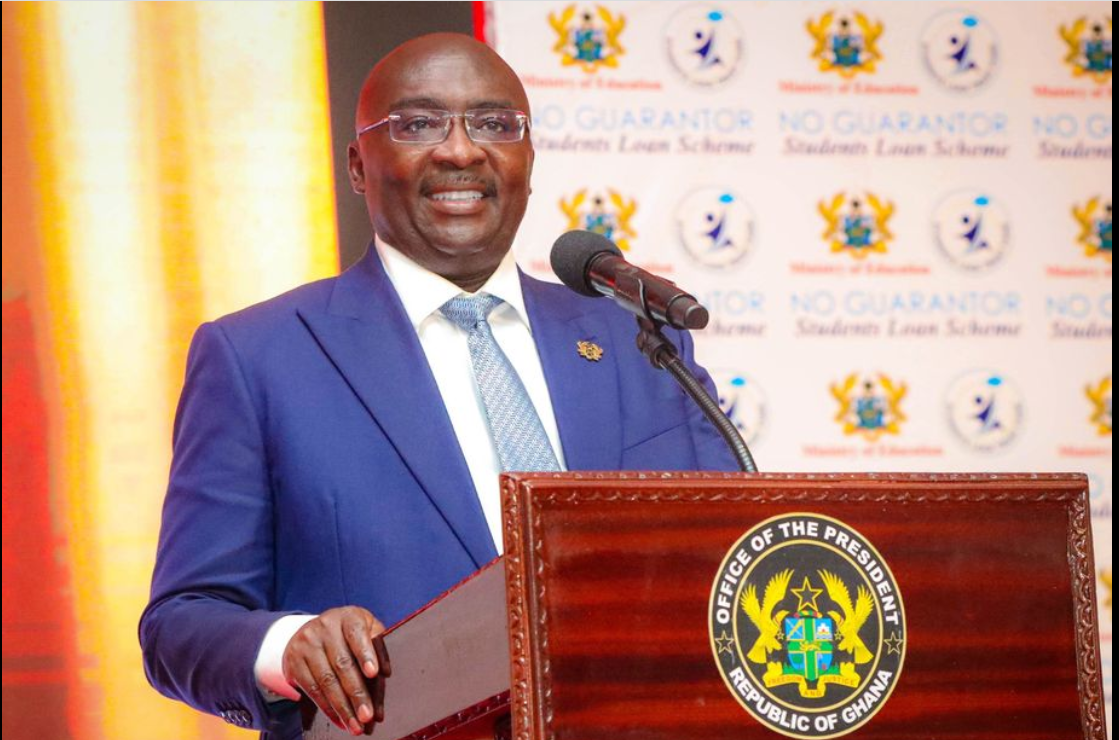
Vice President, Dr Mahamudu Bawumia, who launched the initiative in February 2020 said it will be “a [leveler] of academic opportunities
Vice President, Dr Mahamudu Bawumia, who launched the initiative in February 2020, said it was part of a broader programme to bridge the technology gap in the country and improve learning through internet use.
“There is much knowledge on the internet and we have to allow senior high schools to access that knowledge. We promised free Wi-Fi and we are going to deliver,” Dr Bawumia said at a town hall meeting in Kumasi in 2020.
The project, Dr Bawumia said, will be “a [leveler] of academic opportunities” and provide “an equal opportunity window to the world of [the] Internet of Things.”
Almost four years after the launch of the programme, the lofty promises are yet to be fulfilled and a number of schools are without internet connection in Ghana. Yet, GHS56 million has been paid to Busy Internet, an internet service provider, which appears to have since folded up, and its contract is now assigned to a company called Lifted Logistics, which only secured a conditional internet service provider (ISP) license in February 2024.
When the contract was awarded for the provision of internet services to schools in December 2019, the intent was to have school administration blocks, libraries and the ICT labs connected. However, 48 of the 50 schools Evans Aziamor-Mensah of The Fourth Estate visited between June and July 2023 had no internet connectivity.
Service provider’s unresponsiveness angers school IT co-ordinators
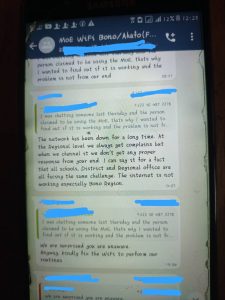
To ensure effective communication on the internet connection, Busy Internet (now Lifted Logistics) created a dedicated line for the schools to lodge complaints about disruptions. It also created a WhatsApp platform for school IT coordinators across the country. In the Bono and Ahafo regions, though the coordinators reported the challenges they were facing with the Wi-Fi connectivity, Busy Internet failed to act.
“The network has been down for a long time. At the regional level, we always get complaints but when we channel it, we don’t get any proper response from your end. I can say for a fact that all schools, districts and regional offices are facing the same challenge. The internet is not working especially Bono Region,” one of the co-ordinators wrote on the WhatsApp platform in May 2023.
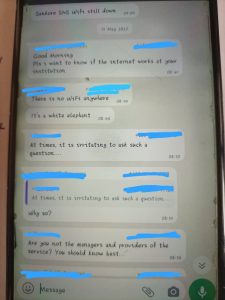
At another time on May 15, 2023, when one of the Busy Internet supervisors asked for an update in the WhatsApp group, it drew the anger of the IT coordinators.
“There’s no Wi-Fi anywhere. It’s a white elephant,” one of the coordinators responded.
“At times, it is irritating to ask such a question,” another coordinator wrote.
“Why?” the Busy supervisor asked.
“Are you not the managers and providers of the service? You should know best,” the IT coordinator responded.
Busy Internet, Education Ministry’s responses
Mr Agyapong-Bempa’s excuse that they could not provide the information on whether a school’s internet was functional or not until August 2023 because Busy Internet suspended its operations for those years is not accurate
Business Lead of Lifted Logistics, Dickinson Agyapong Bempa, told The Fourth Estate that the company did not present any bill to the government of Ghana for the months it did not provide service to certain schools. But this claim is false.
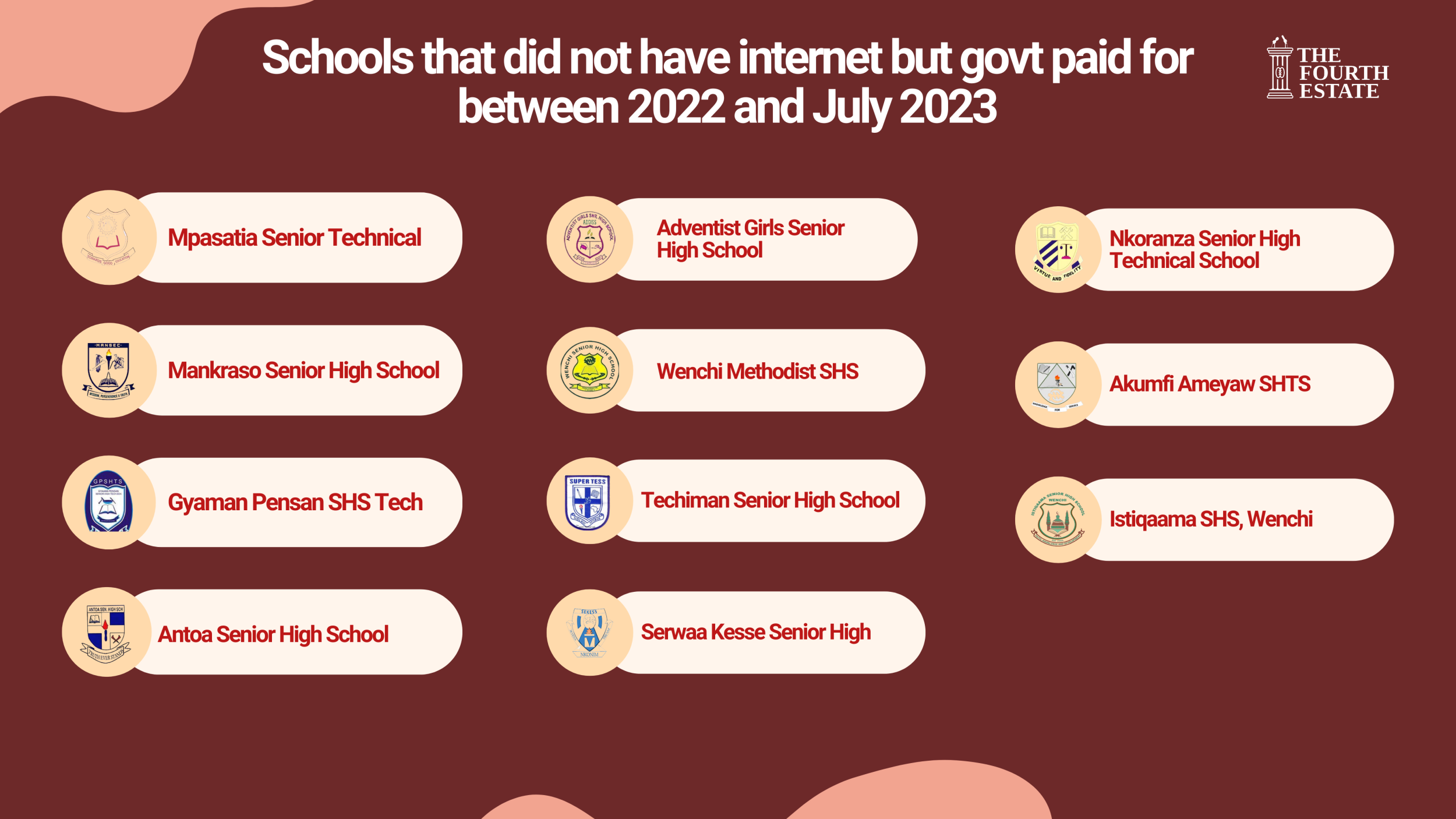
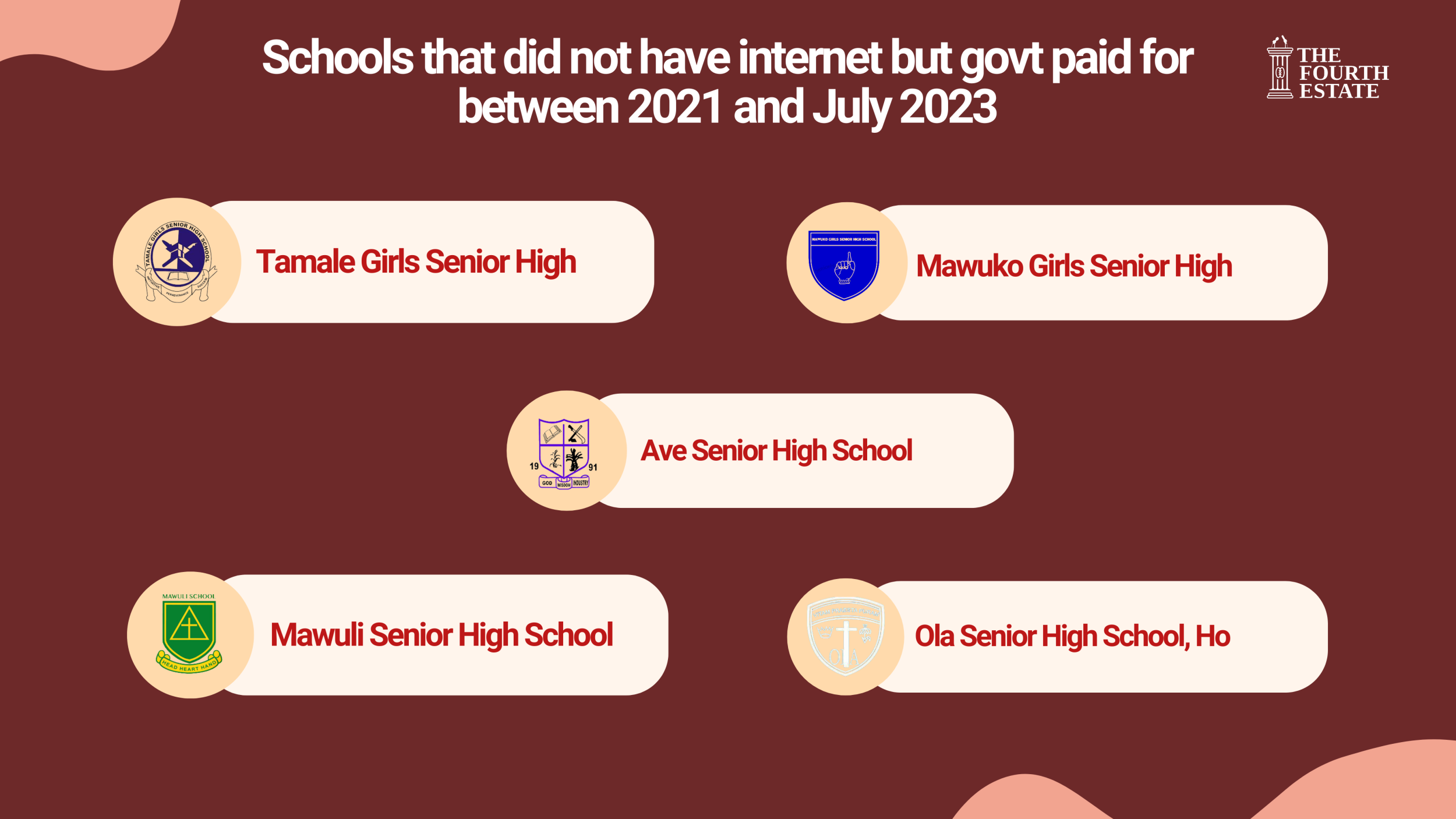
Accra Academy, Labone Senior High School, and Bolgatanga Girls have been without internet under the Busy Internet project for periods of up to 24 months. However, they featured prominently on a list of schools whose internet services Lifted Logistics invoiced and received payments for.
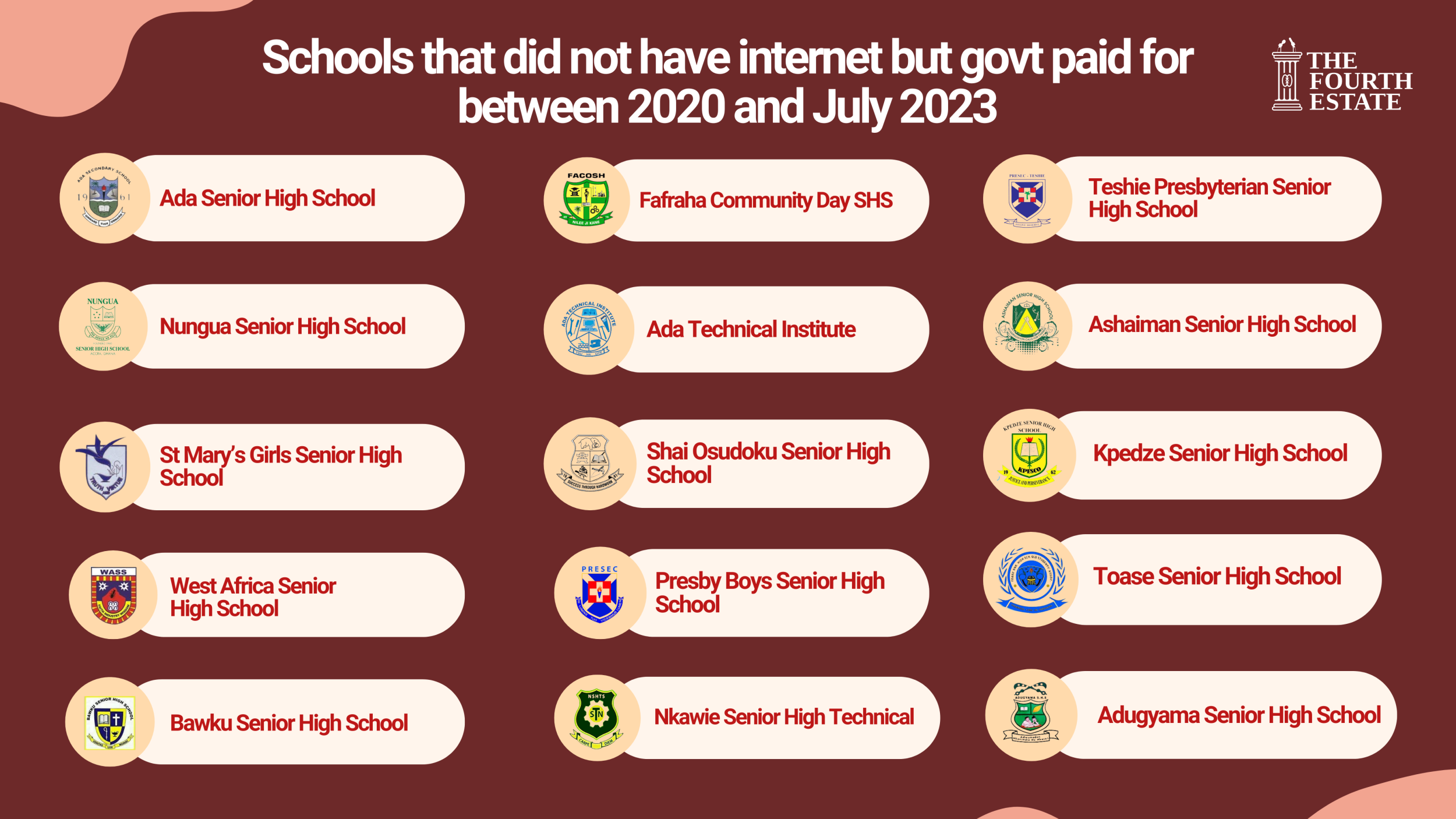
The company also received payments for St Mary’s SHS, Korle Gonno, Fafraha Community Day SHS, Ada Technical, Nungua SHS, Presby SHS, Teshie Presbyterian SHS, Ashaiman SHS, Kpedze SHS, Toase SHS, Bawku and Adugyama SHSs between 2020 and 2023 but all of these schools had no internet access for those years.
A policy advocacy organisation, Africa Education Watch, has also conducted research and found that 107 schools out of 150 visited across the country were not enjoying any benefits under the free Wi-Fi for schools project.
Demand for value-for-money audit
Divine Kpe, senior programmes manager at Africa Education Watch says if teachers and students cannot access the internet on campus then there’s no value for money
Divine Kpe, a senior programmes manager at Eduwatch, says Ghana seems to be paying for a service that is not being rendered and called for an investigation into the project.
“… if we have invested about GHS 84 million for installation,” he says “and we have to pay GHS6.3 million for the next five years and yet the students and the teachers cannot access the service then there’s no value for money.” Mr Kpe says there is a need for the Auditor-General to look into that.
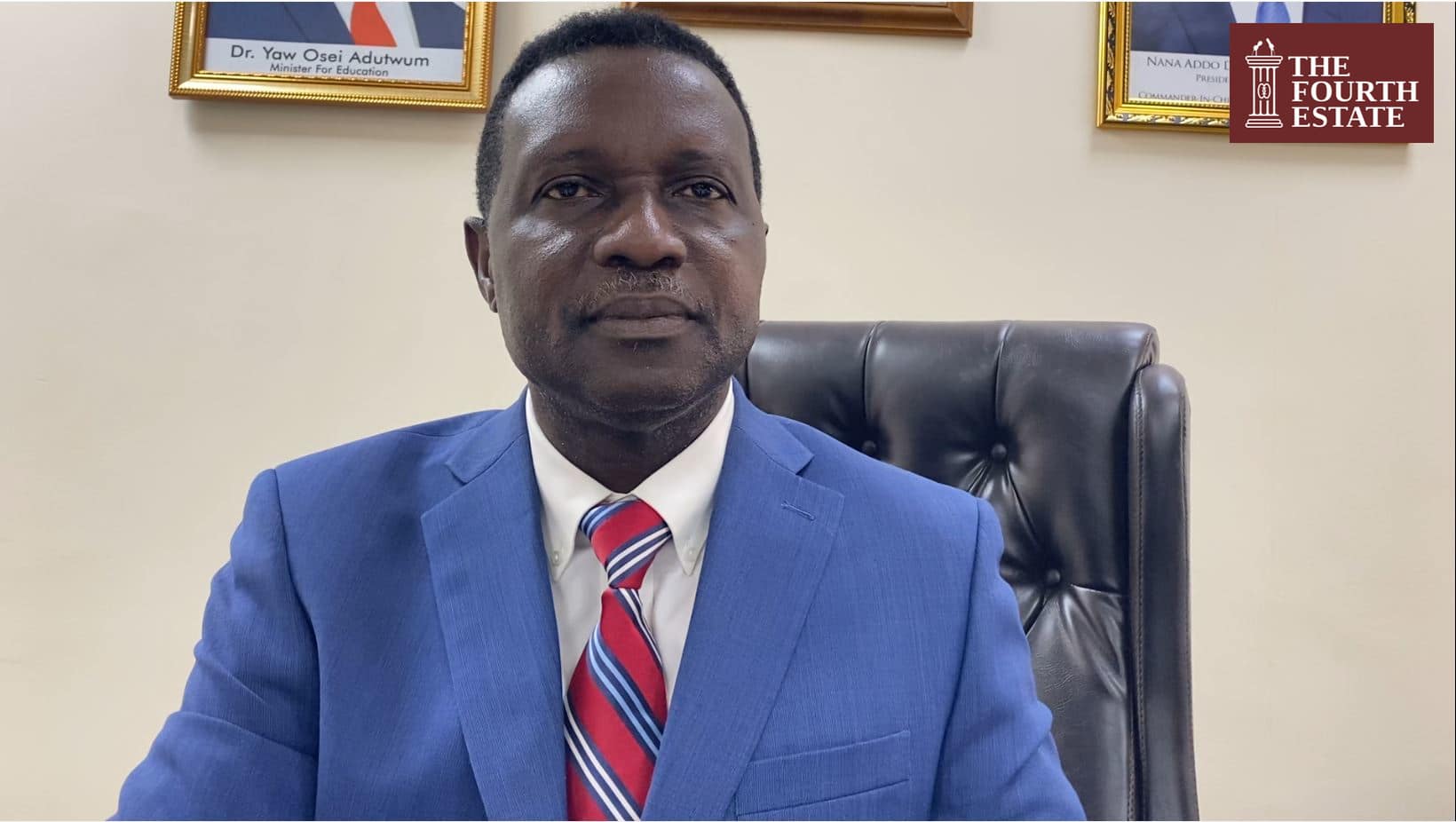
The Minister of Education, Dr Yaw Osei Adutwum, has refused to provide information on how much the government has paid Busy Internet since January 2020
The Fourth Estate wrote to the Minister of Education for responses to these revelations. The Minister directed that we speak to the Executive Director for the Centre for National Distance Learning and Open Schooling, Nana Gyamfi Adwabour, who revealed that a monitoring system was set up to review the contract with Busy Internet in September 2023, almost three years into the implementation of the project.
Nana Gyamfi Adwabour also admitted that apart from the manual verification by a committee, there was no real-time monitoring system in place for the project until September 2023. Such a monitoring system was to be installed as part of Busy Internet’s obligations under the contract.
One of the legal wires that binds the government and Busy Internet in the contract was that, if Busy Internet failed to deliver its service to a school for 15 days, the company would not be paid. This legal wire was tripped not just for 15 days in some schools. As The Fourth Estate has learned, some schools did not have internet for as long as two years.
President of the Conference of Heads of Assisted Secondary Schools (CHASS) who is also the headmaster of Opoku Ware Senior High School in Kumasi, Rev Fr Stephen Owusu Sekyere, said the internet outages have been affecting teaching and learning in schools.
“At times, it goes off for about 2-3 weeks, other times, a month and then it’s restored but as we speak, my school has been off for over a month now and it’s not helping us at all,” he told The Fourth Estate on May 4, this year.
He continued: “We can’t use the service to improve teaching and learning in our schools.”
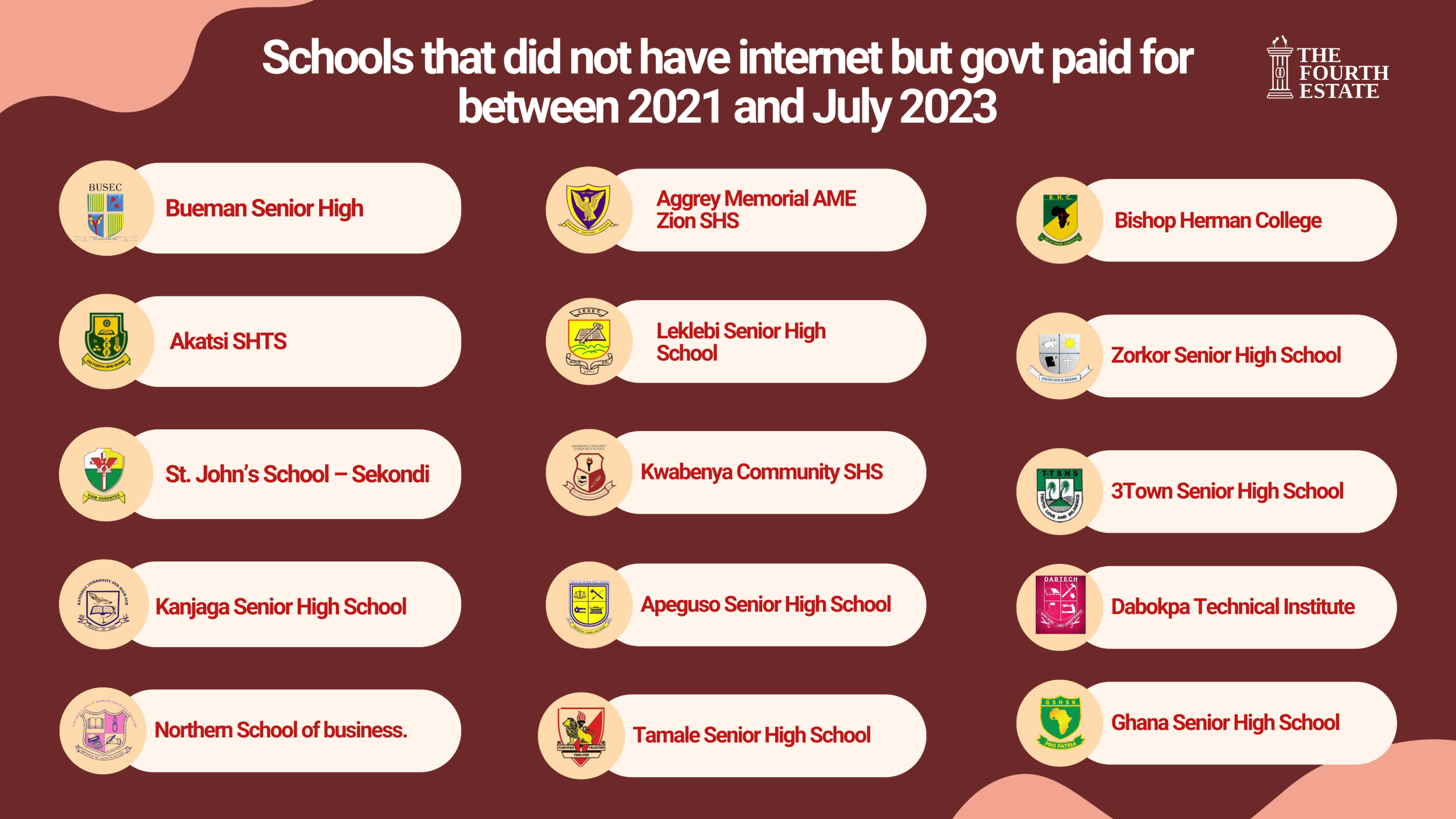
The Ministry of Education paid for these schools even though they did not have internet with the periodThe Ministry of Education paid for these schools even though they did not have internet with the periodThe Ministry of Education paid for these schools even though they did not have internet with the periodThe Ministry of Education paid for these schools even though they did not have internet with the period
When The Fourth Estate sent a list of 53 schools without internet spanning 2020 to July 2023 to Lifted Logistics, the company failed to provide any information on that, stating “Busy Internet, which was in charge of this implementation at the time, has since suspended operations.”
Mr Agyapong-Bempa, however, said, “We have from August 2023 provided a monitoring system, which we gave you a briefing at our last meeting.”
Mr Agyapong-Bempa’s excuse that they could not provide the information on whether a school’s internet was functional or not until August 2023 because Busy Internet suspended its operations for those years is not accurate. This is because Lifted Logistics bought Busy Internet in 2018, a year before the contract was awarded and all payments for work done were made to Lifted Logistics.
If some schools did not have internet for more than 15 days as stipulated in the contract, why did the government of Ghana continue to pay the company for services in these schools? The Fourth Estate asked Nana Gyamfi Adwabour of the Centre for National Distance Learning and Open Schooling.
“I think this is a clear case for us to review again those two monitoring mechanisms to protect the public purse,” was his response.
Despite multiple requests for information, since July 2023, the Ministry of Education has refused to provide a monthly breakdown of what it has paid Busy Internet since January 2020.
Nana Gyamfi Adwabour also failed to provide information on how much the government has paid Busy Internet
Nana Gyamfi Adwabour also promised to provide the data after the interview on May 6, 2024, but failed to do so.
The Business lead of Lifted Logistics, Mr Bempa denied knowledge of how much his agency has so far received from the contract from the government.
But so far what we know is that the company received GHC56 million for work it supposedly did for nine months for which it cannot show any tangible results because most schools don’t have the services they were supposed to provide. The payment was for January to September 2023, according to Parliamentary records. This period includes the months The Fourth Estate visited and observed that the internet was not working in 48 out of 50 schools.
Part 2 of this story chronicles how the Public Procurement Authority failed to do due diligence by approving a single-sourced contract for Busy Internet even though the company did not qualify to win a contract in Ghana.
Audit firm, KPMG, has confirmed The Fourth Estate’s finding that Strategic Mobilisation Limited (SML) cannot take credit for revenue increases in the downstream petroleum sector.
KPMG’s audit revealed that while there was incremental revenue growth from 2015 to 2023, except for a decline in 2017, this growth cannot be attributed solely to the services provided by SML.
“One significant contributor to this growth was the increase in taxes over the years, i.e., from two taxes in 2015 to five taxes in 2023. Another significant contributor to this growth is the increase in tax rates in 2016, 2019, and 2021,” the audit report noted.
The decline in 2017, according to KPMG, was due to a decrease in the tax rate, which coincided with a revenue reduction from 2016 to 2017.
The KPMG report also said there had been a steady rise in volumes before SML’s revenue assurance contract with the GRA, with a temporary dip in mid-2020 due to the COVID-19 pandemic. The audit firm’s GRA, National Petroleum Authority (NPA), and SML data analysis showed that average monthly volumes were around 400 million litres in 2019 and early 2020, before a notable drop during the April 2020 lockdown. KMPG noted that volumes rebounded and consistently exceeded 400 million litres after the lockdown.
Additionally, the audit found that the flow meters at various depots used to calculate volumes were faulty. The meters installed by SML on their pipes contained water, leading to inaccurate data that could not be relied upon for tax purposes.
“SML’s flowmeter readings serve as an alternate source for GRA to determine quantities of liftings, distinct from the volumes recorded by NPA and GRA in the ERDMS and ICUMS, respectively. SML has installed flowmeters at 24 out of 26 depots as of 21 February 2024,” the audit report said.
However, “as of December 31, 2023, SML had flowmeter readings for 16 out of 24 depots, representing 76% of total petroleum products lifted. There were no meter readings available for eight depots as of 31 December 2023, due to the delay in operationalizing SML’s flowmeters at these depots. In addition, SML does not monitor liftings for Residual Fuel Oil (RFO),” the KPMG report stated.
The GRA initially supported SML’s claims of helping boost national revenue, citing a 33% improvement in the downstream petroleum sector over the past two years. The GRA’s statement highlighted an increase in reported volumes from 350 million litres per month in 2018 and 2019 to 450 million litres per month in 2020 and 2021, attributing this rise to the introduction of ICUMS and SML systems.
SML also disagreed with an earlier report issued by the president crediting the company for helping save 2.4 billion in revenue which would otherwise have been lost. The company insisted that it had saved the country GHS12.9 billion in revenue from nine billion litres of petroleum products from May 1, 2020, to December 31, 2023.
But civil society organizations such as Imani Africa and the Africa Centre for Energy Policy found discrepancies in the company’s claims after analyzing data from the Ministry of Finance and the NPA. Their analysis indicated modest growth in refined petroleum product consumption, with a 5% increase reported by the GRA and a 7% increase by the NPA in the year SML commenced operations, followed by aligned growth rates of 11% and 10% respectively in the subsequent year.
When The Fourth Estate confronted the Managing Director of SML Ghana, Christian Sottie, he said he didn’t know about the GHS3 billion cedi revenue claim, which had been widely publicized in the Daily Graphic and on the company’s website.
President Nana Akufo-Addo appointed KPMG to audit the contracts between the GRA and SML following the release of investigative reports by The Fourth Estate, which raised questions about the necessity and propriety of the contracts. The audit report indicated that the agreements were entered without parliamentary approval, as the law requires. The President has since requested a renegotiation of some aspects of the contracts.
The Fourth Estate’s investigative report has revealed that Strategic Mobilization Limited (SML) Ghana won a sole-sourced contract for revenue assurance in the downstream petroleum sector despite no experience in revenue assurance. The Fourth Estate also found that the company had no evidence to back its claim that it had saved the nation from potential revenue losses amounting to GHS3 billion.
The Managing Director of SML, Christian Tetteh Sottie, claimed he did not know about the GHS3 billion figure when The Fourth Estate confronted him with evidence. He said the media, including the state-owned Daily Graphic, had taken a presentation SML made to the Ghana Revenue Authority( GRA) board out of context and reported the wrong information. The same information, however, was published on the company’s website.
The investigations also detailed the circumstances surrounding signing an expanded consolidated contract worth nearly USD100 million a year for revenue assurance in the upstream petroleum and gold mining sectors.
The investigations showed that when the GRA signed the agreement with SML Ghana in 2019, Mr Sottie was the Technical Advisor to the Commissioner-General of the GRA.
Mr Sottie left his job as the Technical Advisor to the GRA Commissioner-General the same year to manage SML Ghana in 2020 when the company started implementing its contract with the GRA.
The GRA has been the only customer of SML Ghana since its establishment.
Meanwhile, state agencies tasked to regulate the activities in the petroleum and mining sectors have denied knowledge of the contract which the Minister of Finance, Ken Ofori-Atta, ordered the GRA to sign with SML Ghana.
The Minerals Commission, the sole regulator of the mining industry in Ghana, in response to a Right to Information (RTI) request by The Fourth Estatesaid it did not play any role in the award of the revenue assurance contract between SML and the GRA.
The Petroleum Commission, in response to The Fourth Estate’s enquiries also denied any knowledge of a contract with SML to monitor petroleum revenue in the upstream sector.
The Ministry of Finance, which directed the GRA to sign the contract, has said it does not have any information on revenue losses in the mining, petroleum downstream, and upstream sectors.
Following the publication of the story in December 2023, Ghana’s president, Nana Akufo-Addo, suspended the contract and caused an investigation into the matter. In April 2024, the international audit firm, KPMG, which was contracted for the investigation affirmed The Fourth Estate’s findings and recommended the possible cancellation of the contract.
The GRA has cancelled the transaction audit and the external verification parts of the contract, saving the country US$500 million while negotiating the cost of the contract for the downstream petroleum audit. Meanwhile, the contract for the Upstream petroleum sector worth US$100 million every year has been suspended indefinitely.
‘Revenue assurance’ company, Strategic Mobilisation Limited (SML) Ghana, has said its claim of tackling under declaration, diversion, and dilution in the downstream petroleum sector was only for purposes of advertisement.
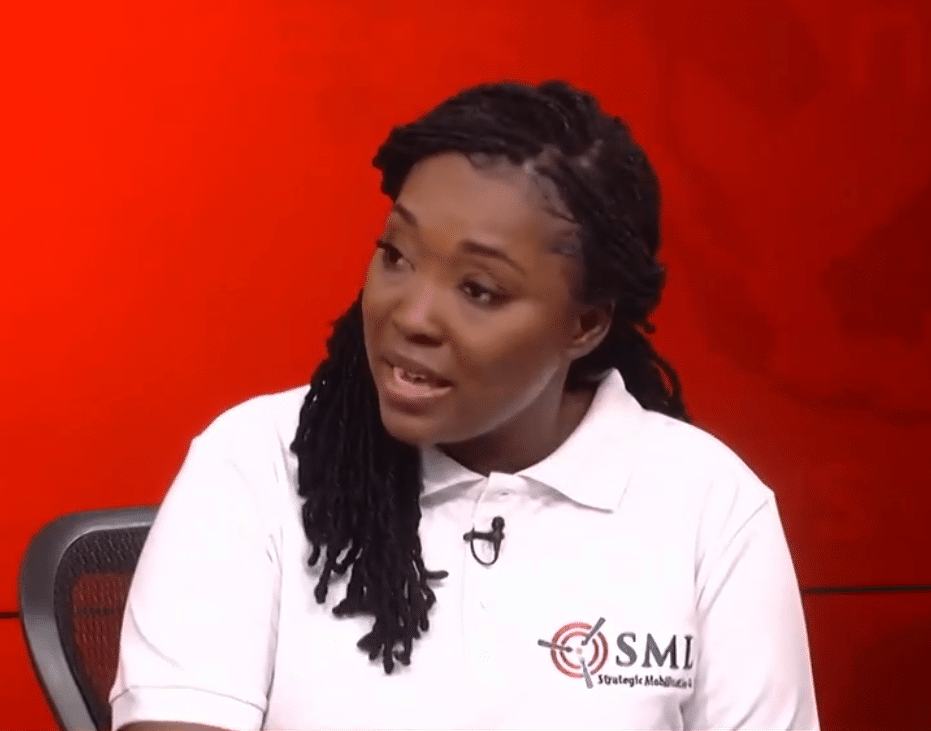
The Director of Support Services at SML Ghana, Yaa Serwaa Sarpong, said on Joy FM’s news analysis programme, Newsfile, that those services it had listed on its website were not part of the services it was performing for the Ghana Revenue Authority (GRA).
“A website is a place that companies advertise what they can do,” she said. “They tell potential clients this is what we do. It is not a scope of work of the contract.”
When the host, Samson Lardi-Anyenini, asked if they were speaking in “general terms,” Ms. Sarpong responded “yes”.
Ms. Sarpong’s comments follow a statement from the presidency on KPMG’s audit of the GRA-SML contract. The statement, released on April 24, 2024, confirmed several anomalies in the revenue assurance contracts that the GRA had signed with SML as revealed by The Fourth Estate in December 2023.
As part of an investigation into the circumstances surrounding the contracts between GRA and SML, the team from The Fourth Estate pointed out false claims the company had made on its website that “SML Digitalisation of downstream petroleum product measurement has stem (sic) the tide of under-reporting, diversion and dilution of fuel products and general non-compliance in the petroleum industry sector.”
SML later deleted the false claims on its website after its managing director, Christian Tetteh Sottie, was interviewed by The Fourth Estate on its contracts with the GRA. In that interview, he confirmed that the company was not involved in the prevention of diversion.
Two years before the interview in 2023, Mr Sottie had told the Ghanaian media that SML had raked in GHS1 billion in revenue that would otherwise have been lost to the state due to leakages.
“Prior to the introduction of SML, leakages were as a result of the diversion of petroleum products for re-export back to the domestic market and also the under-declaration of the volumes lifted for the domestic market,” he said.
Interestingly, the statement from the presidency on the back of the KPMG audit indicated that there might be underreporting, under-declaration and potential revenue leakages.
Meanwhile, President Nana Akufo-Addo has ordered a renegotiation of the downstream petroleum audit contract SML has with the GRA.
Until the suspension of the contract, SML was paid based on the volume of petroleum products recorded every month and it has so far been paid over GHS1 billion under the contract, according to KPMG audit findings.
The president has directed that payments to SML under the various contracts with GRA must be changed “from a variable to a fixed structure.”
He has also tasked the GRA and the Ministry of Finance to consider terminating the contract for transaction audit and external price verification services, which according to KPMG, have only been partially fulfilled by SML and are “redundant” since GRA’s ICUMS [Integrated Customs Management System] is already providing that service.
The Media Foundation for West Africa (MFWA) has filed a Right to Information (RTI) request to the presidency demanding the full report of KPMG’s audit into the revenue assurance contract between Strategic Mobilisation Ghana Limited (SML) and the Ghana Revenue Authority (GRA).
The MFWA’s request follows a statement released by the Director of Communications at the Presidency, Eugene Arhin, on April 24, 2024, on the president’s decision on the KPMG enquiry.
The RTI request, signed by the Executive Director of the MFWA, Sulemana Braimah, stated that: “This request is made by my rights as outlined in Article 21(1)(f) of the 1992 Constitution of Ghana and Section 18 of the Right to Information Act, 2019 (Act 989).”
The request is specifically for “a copy of the full KPMG Audit Report on the revenue assurance contract between the Ghana Revenue Authority (GRA) and Strategic Mobilisation Limited (SML) as commissioned by His Excellency the President and which report formed the basis of the recent directives by the President on the said contract.”
President Nana Akufo-Addo had directed KPMG to audit the GRA/SML deal in January 2024, following The Fourth Estate’s exposé on the questionable revenue assurance contract.
As contained in a statement released by the office of the President, the KPMG audit report revealed that despite disapproval from the Public Procurement Authority (PPA), the GRA went ahead to sign a contract with SML.
“On three occasions, the GRA sought approval from PPA to use the single source procurement method to engage SML to provide transaction audit services. PPA did not grant approval,” the presidency said in a statement on April 24, 2024, almost four months after The Fourth Estate’s exposé.
According to section 33 of the Public Financial Management Act 2016, Act 921, multiyear contracts such as SML’s “must have ministerial and parliamentary approval.” Despite this legal requirement, the statement from the office of the President stated that the GRA did not receive parliamentary approval for any of the contracts signed in 2018, 2019 and 2023 nor did it have any approval from its Board for the contracts, contrary to the GRA act.
“I am quite confident that the Office of the President respects the laws of our country and will, therefore, not hesitate in complying with the RTI law by releasing the full KPMG audit report as requested, within the stipulated 14-day period,” Mr Braimah said.
President Akufo-Addo has instructed the GRA and the Ministry of Finance to renegotiate the downstream revenue assurance contract with SML.