Two leading Civil Society Organisations (CSOs) in the Natural resource sector, the Africa Centre for Energy Policy (ACEP) and IMANI Africa, have found inconsistencies in the Ghana Revenue Authority’s (GRA) claims that the work of SML Ghana since 2019 has led to a significant increase in the volume of petroleum products.
The two CSOs said GRA’s refusal to acknowledge that growth rates prior to the engagement of SML were higher is “disingenuous.”
“We also consider as disingenuous the refusal to acknowledge that growth rates in consumption in the periods before SML’s intervention outstripped the growth rate being attributed to SML,” they said in a joint statement on Thursday, January,4,2024.
The GRA had stated that its revenue assurance contract with SML would rake in over $100 million annually, citing a 33% improvement in the downstream petroleum sector over the past two years.
“The work of SML over the period has led to the significant increase in the figures reported in the downstream petroleum sector, from an average of 350 million litres per month in 2018 and 2019, to 450 million litres per month from 2020/2021. This represents over a thirty- three per cent (33%) increase in volume reporting and an average of an extra 100 million litres per month at a levy rate of GHS1.44p. The extra revenue variance gained for the two (2) years will exceed GHS3 billion. This performance is attributable mainly to the introduction of ICUMS and SML systems,” the GRA said on December 20,2023, in reaction to The Fourth Estate’s investigation.
The CSOs said this however is contrary to data available on the Ministry of Finance’s website for Statutory reporting under the Energy Sector Recovery Act (ESLA) and data on the NPA’s website.
“In the year SML commenced operations (2019/2020), GRA’s data indicates a 5% growth in refined petroleum product consumption relative to the previous year (19.38 million litres). In the same period, the NPA reports a 7% growth (24.71 million litres) in product consumption. In the subsequent year (2020/2021), both GRA and NPA data align, indicating an 11% and 10% growth in product consumption, respectively,” the statement by the CSOs indicated.
Year
Volumes (NPA) (Million litres)
Volumes (GRA ) (Million litres)
Annual
Monthly
monthly differential
Annual
Monthly
monthly differential
2018/19
4,507.03
375.59
4,366.80
363.9
2019/20
4,803.65
400.3
24.71 (7%)
4,599.38
383.28
19.38 (5%)
2020/21
5,262.43
438.54
38.24 (10%)
5,088.55
424.05
40.77 (11%)
2021/22
4,975.12
414.59
-23.95 (-5%)
4,740.32
395.03
-29.02 (-7%)
They also added, “The actual growth between 2018/2019 and 2020/2021 was about 62.95 million from NPA data and 60.15 million from the GRA Data. In the 2021/2022 year, the total consumption of refined products in the country declined by 5% and 7% according to NPA and GRA respectively.”
The duo also said that SML inflated its data to validate its contract with the GRA which “bore no correlation with the data employed for revenue accounting.”
“In 2021, SML issued a press release claiming significant savings in the revenue outlay of the state. A meticulous examination of the data purportedly relied upon by SML, however, reveals notable inaccuracies. We conducted a comprehensive comparison of the month-on-month volumes published by SML for three key products (AGO, Petrol, and LPG) with the data presented by GRA to the Ministry of Finance during the same period.”
These inaccuracies, according to them, render the SML dataset unsuitable for tax purposes, a statement affirmed by Customs officers of the GRA who were interviewed during The Fourth Estate’s investigation.
“This discrepancy raises pertinent questions about the substantial payments made to SML, especially considering that their data does not contribute to the informed decision-making process in revenue collection. Despite this, SML has received gross payments between GH₵700 million and GH₵750 million thus far.”
The GRA’s Samuel Arthur admits that SML’s metres are not used for revenue calculation when he was asked during the investigation which metres the GRA uses for revenue purposes.
“It has been the Waybill figures which is the volume that is being dispensed from the metres. That is the gantry metres,” he said.
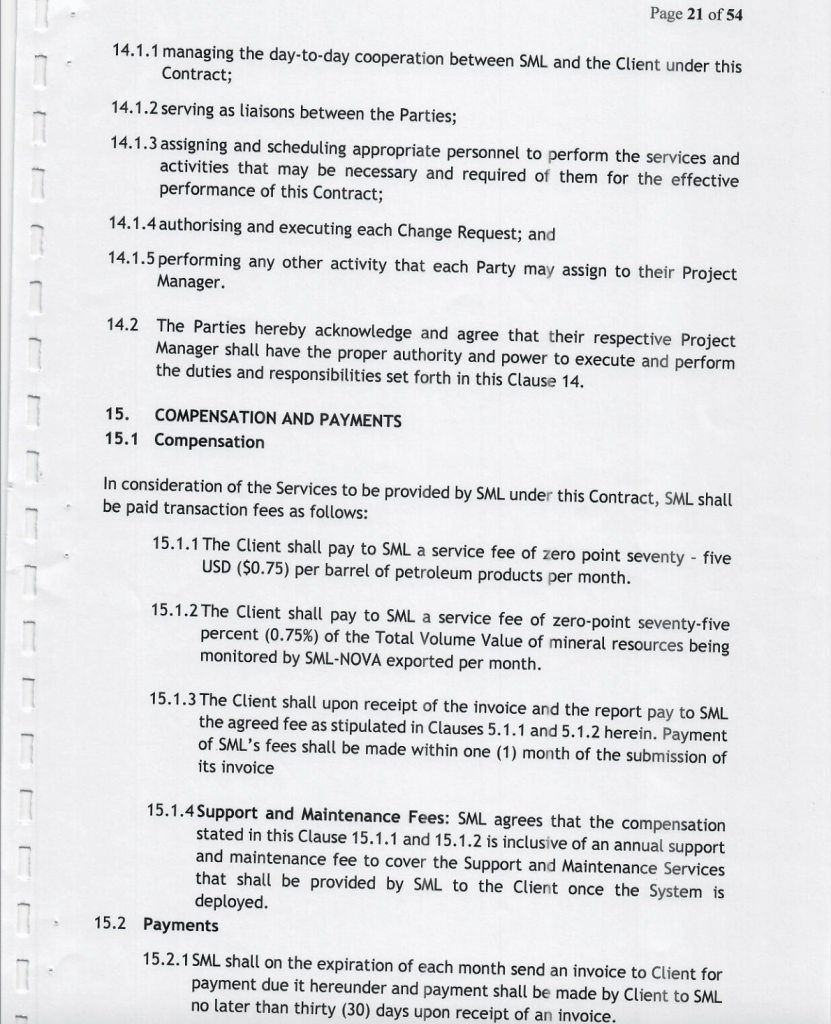
The CSOs have described SMLs’ share of royalty of $0.75 per barrel of petroleum as an “encumbrance of petroleum revenue, a practice abhorred by the Petroleum Revenue Management Act (PRMA).”
“The entire operation of SML is irrelevant, the action constitutes a calculated attempt to dissipate the State’s resources,” the ACEP and IMANI statement said.
They are, therefore, calling on the government to examine all revenue assurance contracts to ensure value for money.
“The SML situation presents an opportunity to: Holistically examine the many revenue assurance gigs that are siphoning revenue from the state across many sectors, particularly the telecoms sector, the ports, at GRA head office etc., to free up revenue for development.”
The Fourth Estate investigations also showed that SML had made false claims that it was checking under-reporting, diversion and dilution in the country’s downstream petroleum sector. When The Fourth Estate team pointed the false claims to the company, the Managing Director, Christian Tetteh Sottie, admitted the company was not into those services.
“Oh no, we are not involved in diversion. We are only at the depots. If the thing [petroleum product] is lifted, we don’t know if [it is diverted],” Mr. Sottie said.
The president also directed tax audit firm, KPMG, to conduct a two-week investigation into the matter.
Strategic Mobilisation Ghana Limited (SML), the company that signed the shady revenue assurance contract with the Ghana Revenue Authority (GRA) and the Ministry of Finance has said it is confident that the appointment of tax auditing firm, KPMG, to audit its activities will confirm it’s integrity and the value of the service it renders.
SML also said the audit will help clear all doubts surrounding its operations.
“We remain resolute in upholding the highest business standards and welcome the scrutiny that this audit would bring. We are confident that the findings will confirm the integrity of the collaboration with GRA and the Ministry of Finance and provide ample evidence of the value we provide citizens,” SML said in a press statement.
The organisation also says making the findings from the investigations public would ensure “transparency and accountability.”
“SML awaits the result of the audit, as it will help establish a clear and accurate picture of our operations. We hope that the report’s findings will be made public, allowing for transparency and accountability,” the statement released on January 3, 2024, stated.
The Fourth Estate investigations also showed that SML had made false claims that it was checking under-reporting, diversion and dilution in the country’s downstream petroleum sector. When The Fourth Estate team pointed the false claims to the company, the Managing Director, Christian Tetteh Sottie, admitted the company was not into those services.
“Oh no, we are not involved in diversion. We are only at the depots. If the thing [petroleum product] is lifted, we don’t know if [it is diverted],” Mr. Sottie said.
President Akufo-Addo “also directed the Ministry of Finance and the Ghana Revenue Authority to suspend the performance contract pending the submission of the audit report, including any payments presently envisaged under its terms.”
Meanwhile, two leading activists in the natural resource sector have opposed the selection of a tax audit firm, KPMG, to investigate the questionable revenue assurance contract the Ministry of Finance and the Ghana Revenue Authority (GRA) have signed with Strategic Mobilisation Ghana Limited (SML).
Bright Simons of IMANI Africa and Benjamin Boakye of the Africa Centre for Energy Policy (ACEP) say KPMG, which also provides services to the GRA might be caught in a conflict of interest situation and may not have the right powers to conduct a thorough audit.
For Bright Simons, the vice president of IMANI, the firm should reject the president’s request to save its reputation.
“KPMG’s practice oversight bosses should prudently preserve the firm’s reputation and drop this assignment. This issue is a hot political potato right now. The nature of the allegations requires an in-depth look by state bodies with the right powers and independence. KPMG has neither,” Mr. Simons stated on X(formerly Twitter).
The Executive Director of the African Centre for Energy Policy, Ben Boakye, also cast doubts on KPMG’s ability to do independent work.
“KPMG has its integrity at stake if it accepts this job. It is a client of GRA and its investigation against the leaders of one of its large portfolios is exceedingly suspicious. Simply unethical,” Mr Boakye stated.
In a related development, former Auditor-General, Daniel Domelevo, has said that the Office of the Special Prosecutor should have been made to investigate the shady SML contract.
Mr Domelevo says the office was established to look into such matters.
“The issue has been reported already to the OSP, so he sits with the case,” he said in an interview on Joy FM. “I don’t know why we will not allow the OSP to do the audit instead of engaging KPMG to do what state institutions are mandated to do.”
Two leading activists in the natural resource sector have opposed the selection of a tax audit firm, KPMG, to investigate the questionable revenue assurance contract the Ministry of Finance and the Ghana Revenue Authority (GRA) have signed with Strategic Mobilisation Ghana Limited (SML).
Bright Simons of IMANI Africa and Benjamin Boakye of the Africa Centre for Energy Policy (ACEP) say KPMG, which also provides services to the GRA might be caught in a conflict of interest situation and may not have the right powers to conduct a thorough audit.
For Bright Simons, vice president of IMANI, the firm should reject the president’s request to save its reputation.
“KPMG’s practice oversight bosses should prudently preserve the firm’s reputation and drop this assignment. This issue is a hot political potato right now. The nature of the allegations requires an in-depth look by state bodies with the right powers and independence. KPMG has neither,” Mr. Simons stated on X(formerly Twitter).
The Executive Director of the African Centre for Energy Policy, Ben Boakye, also cast doubts on KPMG’s ability to do an independent work.
“KPMG has its integrity at stake if it accepts this job. It is a client of GRA and its investigation against the leaders of one of its large portfolios is exceedingly suspicious. Simply unethical,” Mr Boakye stated.
Meanwhile, the minority leader in Ghana’s Parliament, Dr. Cassiel Ato Forson, has criticised the appointment of KPMG to audit the contract. He had earlier said the deal in its “current shape is not valid.”
“The whitewashing attempt by the president in the name of an audit will not dissuade Parliament from looking into this matter to stop the siphoning of state resources into the private pockets of government officials and their crony business partners” the minority leader said.
The Fourth Estate investigations also showed that SML had made false claims that it was checking under-reporting, diversion and dilution in the country’s downstream petroleum sector. When The Fourth Estate team pointed the false claims to the company, the Managing Director, Christian Tetteh Sottie, admitted the company was not into those services.
“Oh no, we are not involved in diversion. We are only at the depots. If the thing [petroleum product] is lifted, we don’t know if [it is diverted],” Mr. Sottie said.
KPMG’s history in public sector audits
KPMG has not always been all successful with public sector consulting work around the world. The company’s failure is largely attributed to pressures of the political economy, systemic conflicts of interest, and the relaxation of standards to meet unrealistic project goals and timelines, according to Bright Simons.
Aside from consulting for the GRA, the firm is the only advisor to the government on its pandemic relief package for small businesses and the recruitment of technical and other staff to boost delivery capacity to the GRA, according to information available to The Fourth Estate. It also manages the ESLA tax vehicle on behalf of the government of Ghana.
According to Bright Simons, KPMG is a technical advisor to the GRA in some of the very areas; audit, accounting, assurance/compliance and consulting that it is being asked to investigate. This makes KPMG a competitor to SML, he says.
In South Africa, KPMG was accused of whitewashing the Gupta cabal. The company was fined and its top management resigned, according to Accountancy Age, a UK-based accounting news portal.
Outside the shores of Africa, media reports said KPMG had to step down over conflict of interest issues in the UK’s politically sensitive ” Tower inquiry. Again, Euronews reported in June 2023 that the UK’s Financial Reporting Council fined the auditing firm £21 million for failing to uphold accounting standards which led to the collapse of two financial institutions.
“The number, range, and seriousness of the deficiencies in the audits of Carillion during the period leading up to its failure was exceptional and undermined that credibility and the public trust in audit,” said Elizabeth Barrett, executive counsel for the Financial Reporting Council, said in a statement.
The firm, according to Scottishfinancialnews.com also suspended its work with the UK government for a period. In Australia, Former KPMG partner, Brendan Lyon, told the country’s Legislative Council inquiry that a report he authored for the New South Wales government (NSW) was more about ensuring a valuable client got what it paid for: a pre-determined answer. The investigation by the Sydney Morning Heralds in 2021 revealed how the “NSW Treasury pressured accounting giant KPMG to delete or amend aspects of a report commissioned by Transport for NSW that found the plan could end up costing the state’s coffers more than it saved.”
In a related development, former Auditor-General, Daniel Domelevo, has said that the Office of the Special Prosecutor should have been made to investigative the shady SML contract.
Mr Domelevo says the office was established to look into such matters.
“… the issue has been reported already to the OSP, so he sits with the case,”case,” he said in an interview on Joy FM. “I don’t know why we will not allow the OSP to do the audit instead of engaging KPMG to do what state institutions are mandated to do.”
“I have also heard that parliament has requested or authorised the finance committee to do this audit. I think that as much as we are worried about corruption, we must also be worried about the waste of public resources.”
“We have institutions given this mandate to protect the public purse. We should use them instead of engaging KPMG.”
Yesterday, the President of Ghana announced that he has engaged the local affiliate of KPMG, one of the “Big Four” global professional services firms, to conduct a two-week investigation into the “SML affair”.
SML is the name of a hitherto unknown entity created in 2017 by timber merchant, Evans Adusei, and a relative just before it entered into discussions with various state agencies to offer “revenue assurance” services.
A mysterious new entrant
The company popped into Ghana’s public consciousness following a documentary and a series of investigations by MFWA-backed investigative outfit, The Fourth Estate. Away from the limelight, activist think tank ACEP has been probing the SML affair as part of an elaborate review of “revenue assurance” programs in Ghana for more than a year. Alongside broader public financial management (PFM) work in the natural resources sector by another Ghanaian activist think tank, IMANI, ACEP’s careful unpacking of the situation has uncovered multiple redundancies and duplications of efforts costing the Ghanaian taxpayer tens of millions of dollars for little value in return.
The thrust of the SML arrangements is summarised below.
SML has been given a series of contracts to block illegal tax evasion and tax avoidance schemes in Ghana since 2019. Beginning with a contract to support the Ghana Revenue Authority (GRA) to detect invoice fraud, SML’s tentacles soon spread to the downstream petroleum sector, where it is supposed to assist GRA fight under-declaration of fuel volumes and, by extension, taxes collected by the fuel marketers from consumers on behalf of the government.
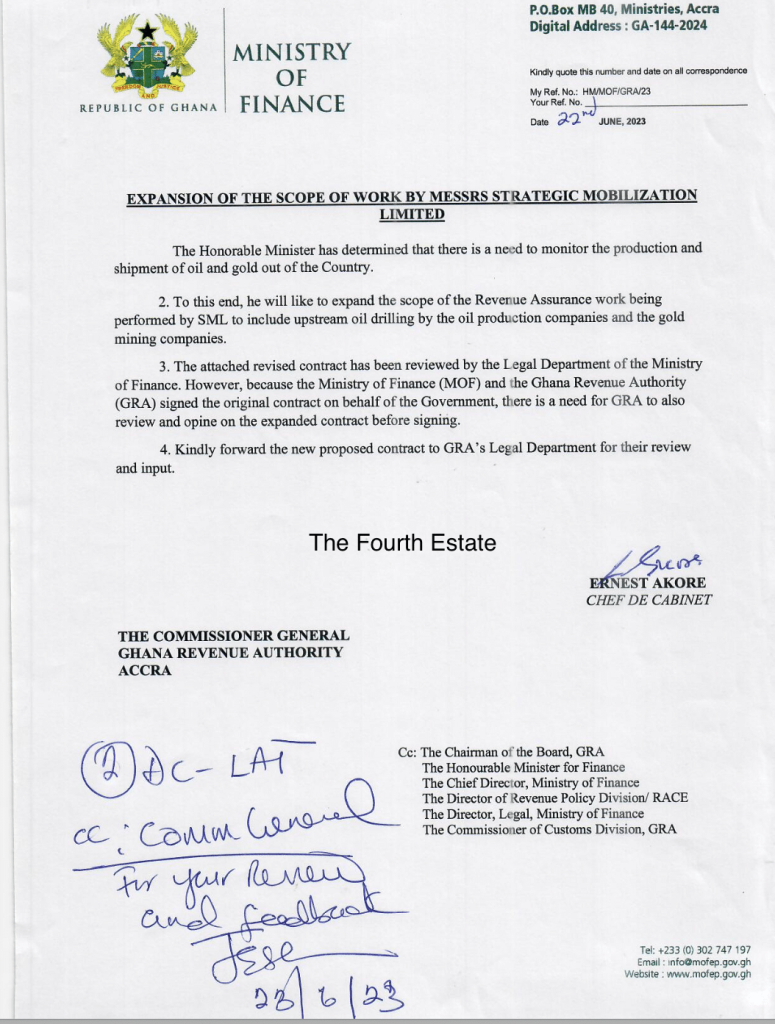
In June 2023, the Finance Ministry wrote to the GRA to advise an expansion of the scope of these contracts to cover minerals exported by Ghana, from which roughly 70% of export revenues are derived.
None of these contracts were competitively awarded. No serious due diligence was conducted on the capacity of SML to deliver any serious value, which is not surprising considering its total lack of track record in this area until it secured the contract. SML’s beneficial owner and principal, the timber merchant mentioned earlier, had no prior Information Technology (IT) business experience either, even though IT is a central plank of the SML value proposition.
The downstream petroleum regulator, the National Petroleum Authority (NPA), has signed multiple contracts with companies such as Nationwide Technologies (an agent/affiliate of Texas-based Authentix Inc) and Rock Africa, a company led by former e-waste consultant, Francis Gavor, all of which are meant to fight fraud, adulteration, and under-declaration etc. GRA could very well have engaged the NPA to institute a data-exchange regime.
SML was, at the time investigations commenced, earning 21 million Ghana Cedis (GHS) a month (or ~3.5 million 2020 dollars) from a pricing regime which granted the company 5 Ghana Pesewas (5 GHP) for each liter of product covered.
In the expanded contract scope, SML will henceforth earn 0.75% of the total “volume value” of all mineral resources exported out of Ghana. It will also earn $0.75 for each barrel of “petroleum products” sent overseas from Ghana’s oilfields.
Why the SML deal is a scandal
There are many things wrong with the SML affair. The procurement abuses are obvious: how did the government learn about the magical revenue assurance mojo of this timber merchant and his new entity to warrant such massive trust? Why did the ever pliant Public Procurement Authority, long discredited after its previous boss was found engaging in his own procurement shenanigans, accept the eligibility of this deal for sole-sourcing?
The pricing is atrocious: SML gets a share of Ghana’s most prized revenue streams for fighting fraud with no clear parameters for measuring the progress of that fight.
And the underlying logic of the arrangement, especially in the context of multiple state agencies spending precious public resources to pursue the same objectives, is hopeless.
The government’s defence
The government has mounted a spirited defence of the contract.
The heart of the GRA’s defence rests on a purported improvement seen in revenue numbers since SML volume monitoring began. We quote the GRA statement verbatim below.
The work of SML over the period has led to a significant increase in the figures reported in the downstream petroleum sector, from an average of 350 million litres per month in 2018 and 2019, to 450 million litres per month from 2020/2021. This represents over a thirty- three percent (33%) increase in volume reporting and an average of an extra 100 million litres per month at a levy rate of GH¢1.44p. The extra revenue variance gained for the two (2) years will exceed GH¢3billion. This performance is attributable mainly to the introduction of ICUMS and SML systems.
There is, unfortunately, no grounding to this strange analysis.
The SML defence “falls flat”
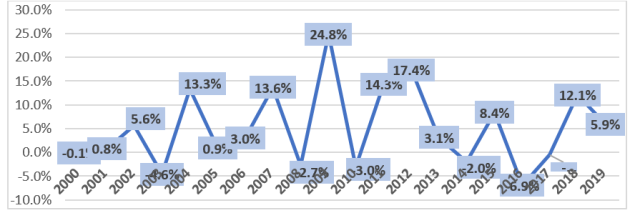
For the argument to be sustainable, proof has to be shown that SML’s interventions have led to an uptick in volumes recorded over and above the historical trend of increases over time. What the data instead show is a correlation between volume increases/decreases and exogenous economic factors.
Take, for instance, the fact that more residual fuel oil (RFO) was consumed in Ghana in 1999 than in 2022. The demand for this fuel was historically boosted beyond its traditional importance in the marine industry due to its use in legacy equipment in the industrial sector. As other petroleum products supplanted RFO, however, volumes dropped significantly. Following a very similar trajectory, the volume of kerosine consumed in Ghana in 2022 was 30 times less than that consumed in 1999, obviously, in part, because of the rise of LPG. Indicative of the challenges in Ghana’s fishing sector, premix fuel consumption has halved over the last ten years. Aviation fuel consumption in 2012, seven years before the SML contract was signed, was nearly 10% higher than in 2020, the first year after the SML monitoring regime went into effect. It is not hard to understand why: COVID.
Clearly, there are broad, and exogenous, factors impacting fuel demand, consumption, and, thus, volumes than can be easily, and mistakenly, subsumed under the ambit of regulatory monitoring and whatever magic SML claims to be performing in the sector.
Focusing only on gas oil (“diesel”) and gasoline (“petrol” or “premier motor spirit”), the main fuels consumed in the downstream sector, elicits the same trend: consumption rises steadily, punctuated mainly by factors exogenous (external) to the fuel industry and its regulation.
For example, petrol consumption was steady for much of the decade between 1999 and 2009 until the completion of HIPC, the discovery and commencement of oil production, and the completion of the 2015 – 2019 IMF program, combined to trigger an economic mini-boom. The surge in consumption continued until dumsor (Ghana’s perennial power crises) peaked in 2015, leading to a major cratering of volumes. The mini-boom created by the end of dumsor, the completion of the IMF program, and the return to the Eurobond market with a vengeance, accounts for the last spurt of growth that just ended in 2022.
The SML value-addition scam
Only basic arithmetic is required to establish the groundlessness of the “volume increase” proof adduced by the government in support of the SML intervention.
As evidence that the SML contract has had no effect on things, we can compare the volume increases since the SML monitoring regime went into effect with previous growth phases. Between 2008 and 2015, for instance, volumes increased by more than 112%, on the back of a compounded annual growth rate of nearly 11.5%. The post-SML situation, on the other hand, saw volumes increase by 18.5% between 2019 and 2022, on the back of a mere 4.34% annual growth rate (the reader should see this in the slope of different segments of the above curve). In simple terms, volumes have increased by far less in the post-SML era than it did during previous eras.
SML may deserve to be surcharged not compensated
The obvious question that arises from the data is whether the fall in volumes that has been experienced between 2021 and 2023 should be attributed to the incompetence of SML. If not, why?
Petrol and diesel volumes dropped 7% and 8%, respectively, between 2021 and 2022 due to a combination of economic slowdown and fuel price hikes. In fact, diesel volumes were lower in 2022 than in 2020, the year COVID-19 shut down parts of the economy. The data for 2023, so far, shows that petrol and diesel volumes will be lower than in 2021.
Should these statistical facts be taken to mean that the SML monitoring regime is losing the country money? Should a surcharge be applied based on an extended application of the same logic of “performance attribution” in the government’s defence of the contract?
The billion-dollar scope-extension
Considering the above analysis of SML’s current work in the downstream sector, it naturally follows that the extension of the contract to cover 70% of Ghana’s exports derived from the minerals and petroleum sectors will lead to similar misattribution of value, and will amount, therefore, to a total rip-off of the country.
First, there is no historical trajectory baseline computed in the contract that would enable the determination of “additional volumes” attributed to SML’s work. Moreover, there is no mechanism to determine how to exonerate/absolve SML if volumes fall and when or how to surcharge them for real underperformance in any given year. The so-called “value for money audits” mentioned in the contract are not defined, and, given the general feel of the contract, may well be undefinable.
From the analysis conducted by IMANI and ACEP, depending on certain developments in the minerals and petroleum sector, SML’s cumulative earnings from the contract could exceed $1 billion over the horizon anticipated by the contract. These developments include the activation of new oil fields; prospects of refined petroleum exports (for example, if Sentuo fully comes onstream); continued surge in gold production; effective local refining of minerals such as bauxite and lithium, thereby increasing their value in light of the contract’s construal of “volume value”; and the discovery of new minerals or commercialisation of currently unexploited deposits.
As has been amply demonstrated, such earnings, in the current framing of the engagement, would be attributable to SML regardless of which exogenous forces (such as local value addition, economic cycles, new discoveries, global commodity prices, global commodity demand etc.) are truly driving the increase in export or consumption volumes. Clearly, the entire arrangement is illogical and cannot be sustained by any rational justification.
SML’s Solution Architecture
SML has protested The Fourth Estate’s coverage and pushed back against the analysis of IMANI and ACEP. It contends that its upfront investments in cutting-edge technologies and skilled staff entitles it to hundreds of millions of dollars of Ghana’s money.
The scope of the planned investments can be summarised by reference to section 15 of the amended and restated contract signed in 2023.
The software, sensors, networks and skillsets being promised by SML are valued in cursory fashion at ~$75 million in two tables found in the appendices of the contract.
The government did not perform any valuation of these assets prior to executing the agreement. Given that SML retains the full intellectual property of all these systems, they are meant to be applied to the assignment on a mere subscription basis during the term of the contract. Presumably, then, the contract could have been drafted on the basis of the value of such subscriptions to the procuring entity. It is completely perplexing how the leasing of agent-operated software suddenly translated into a design to share revenues accruing from the country’s fuel consumption and mineral exports.
Besides the total lack of auditability of the financial numbers involved, the technical specifications of the software and instruments being offered in this billion-dollar agreement are also vague to the point of uselessness. Below, we reproduced the entire schema for the reader’s own appreciation.
Solid minerals monitoring suite architecture. Copyright: SML
First, as any analyst with any experience whatsoever in any technical field would agree, these “specifications” are meaningless. Even basic diagram legends, notations, and references, are missing. The NITA enterprise reference architecture used in Ghana, and other elementary rulesets for IT design in the public sector, were all breezily dismissed for hurriedly cobbled together patchworks that convey no information about how the fancy blockchain technology SML says it will deploy to prevent the mining and petroleum companies from cheating Ghana will actually succeed where all other state agencies have failed.
In order not to bore the reader, this author will not delve further into the technological aspects of the proposed solution, as can be discerned from the diagrams. Suffice it to say that the proposed RFID-blockchain approach in the way it has been laid out betray a woeful misunderstanding of how each of the interacting domains – blockchain, RFID, Xray, gold assaying, gold bar moulding, mineral weighing etc all work. In a proper investigation, the sheer incongruity of the architecture and its porous logic shall be exposed.
Which brings us to the President’s decision to engage KPMG to investigate the SML affair.
Enter KPMG
Ordinarily, any referral of a raging controversy of this nature to technical experts ought to generate some relief. Yet, in this case, the President’s intervention sends mixed signals and can be rather counterproductive. Below, we list some reservations activists have raised.
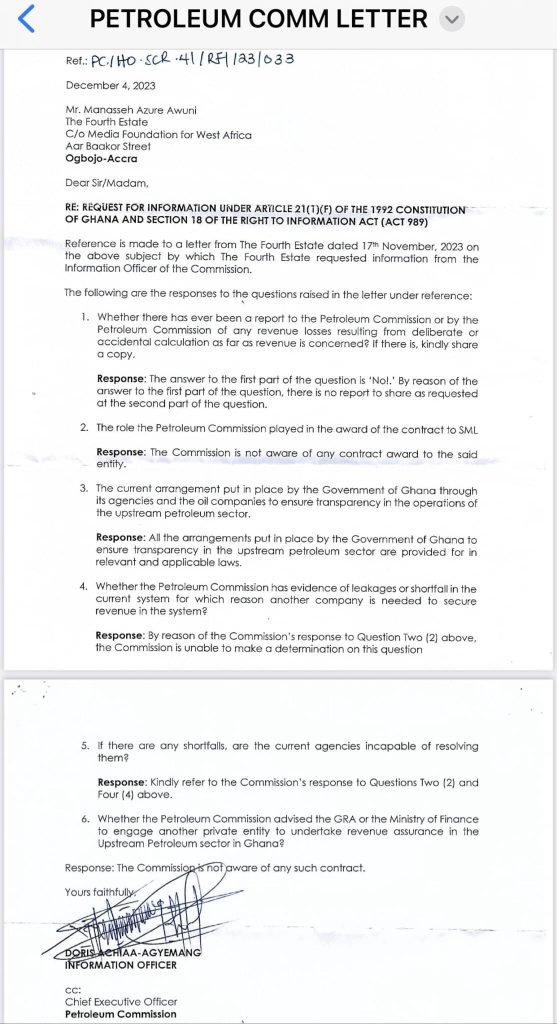
The President’s action came after the matter had been referred to Ghana’s statutorily independent Office of Special Prosecutor, which has acknowledged receipt.
The President’s action attempts to pre-empt a parliamentary enquiry into the matter, and has been described as unwelcome by the Parliamentary Opposition.
The terms of reference issued to KPMG does not cover critical areas like the underlying procurement process and the essential logicality of the actual solution architecture.
There are broader issues of concern as well.
As everyone knows, KPMG, like the other Big Four professional services firms, is heavily exposed to public sector work in Ghana. It is the advisor to the government on its pandemic relief small business stimulus package. It is advising the GRA, which is at the center of the SML storm, on recruitment of technical and other staff to boost delivery capacity. It manages the ESLA tax vehicle on behalf of the government.
More to the point, it regularly pursues “revenue assurance” jobs from various government agencies, including the GRA. In some ways, therefore, it is a technical advisor to the GRA in some of the very areas it is being asked to investigate. It is also a competitor to SML in respect of some of the very areas it is being asked to investigate it on. Literally all practice lines at KPMG are implicated in this assignment: audit, accounting, assurance/compliance and consulting. With only 12 partners spread across these practice lines as at last count, the idea of interlocking Chinese walls are simply impractical in an assignment of this nature.
In recent years, the complexities of confidentiality, conflict of interest, and political economy dynamics have made the involvement of Big Four firms in politically high-risk assignments fraught with reputational pitfalls. In Ghana, we saw the recent incident where GRA appeared to have built on initial work by KPMG to justify the hiring of a ghostly revenue assurance firm, Safari Tech, to trap telecom giant, MTN, a company that KPMG regularly serves (such as it did in MTN’s 2017 capital market transaction). That issue degenerated into a contentious mess involving the Ministries of Finance, the GRA, and the Ministry of Communications, leading eventually to what amounts to a political, rather than a technical, settlement.
In other jurisdictions with superior oversight and institutional maturity, such risks have exploded into serious blowouts. In the UK’s politically sensitive Grenfell Tower inquiry, KPMG had to step down over conflict of interest issues. In fact, protracted issues of a similar nature compelled KPMG to suspend further government work for a period in the UK, and to even sell some its business units in order to sustain public trust. In Australia, multiple confidentiality and conflict of interest abuses linked to public sector work has engulfed all Big Four firms, including KPMG.
Closer to Ghana, South Africa provides the most intense example of why Big Four firms should avoid becoming embroiled in politically high risk assignments. KPMG was manipulated into whitewashing the Gupta cabal and assisting a faction within the Zuma regime fire a Minister they felt was obstructing the state capture goals of the cabal. KPMG was abused by commentators as facilitating plunder, and later lost lucrative client business.
This author cannot presume to lecture KPMG’s risk leaders on which public sector assignments to accept. The firm’s own global reckoning with politically sensitive work, however, counsels extreme caution. The SML assignment, judging by its terms of reference, and the timeframe of only two weeks, presents many slippery slopes for KPMG.
The firm’s In-Flight Review (IFR) framework, which requires partner-level interfacing at multiple rungs of an assignment, and different tiers of internal and external quality assurance, should preclude a rushed and cursory surface-skating over the many delicate issues raised in this essay in a mere two-week period.
Where these controls in KPMG’s public sector consulting work have failed around the world, the driving factor has invariably been the fraught pressures of political economy, systemic conflicts of interest, and the relaxation of standards to meet unrealistic project goals and timelines.
There may well be a narrow role for KPMG in assisting statutory and/or constitutionally independent authorities, such as the OSP, Parliament, and the CHRAJ in conducting tightly narrow and highly technical studies on hyper-specific aspects of the SML affair, in ways that do not put KPMG in the position of “clearing” or indicting a client or competitor. That determination has to be made by the authority concerned, and in the pursuit of forensic goals that only such authorities, and not a private entity like KPMG, truly have the lawful powers to pursue. We respectfully ask KPMG and the President of Ghana to support truly independent state agencies to delve into this affair without undue assumption of primacy or procedural interference.
A country that has just repudiated its debts and is in the middle of an IMF bailout program needs to demonstrate the highest levels of fiscal prudence. Unfortunately, this SML development and the handling of its aftermath threatens to further dent Ghana’s PFM credentials. It behooves on the government of the day to pull back from the brink whilst there is still time to salvage some scraps of PFM credibility.
The New Generation Medical Centre has compensated two victims of its medical negligence, after an 18-month investigation by The Fourth Estate revealed the death of at least two children and the maiming of others.
The Fourth Estate’s sources say two of the victims, who asked to be known only as Kate and Bernice during the investigations, received GHC50,000 each from the hospital following their ordeal at the hands of a quack midwife, Francisca Quaye. The two had threatened legal action against the South Odorkor-based health facility.
But before the threat developed into a full-blown legal battle, the hospital opted for settlement.
Kate’s baby died at the New Generation Medical Centre but was told that the baby had been taken to the Neonatal Care Unit at the Korle-Bu Teaching Hospital. Bernice had a crude episiotomy performed by none other than a quack midwife, Francisca Quaye, alias Matron Gaga. About a week after the medical procedure, her vagina emitted an unpleasant odour, which led her mother to discover that a pad had been left inside her.
An episiotomy is a cut (incision) through the area between the vaginal opening and the anus. This procedure is done to make the vaginal opening larger for childbirth.
Both Bernice and Kate said they are psychologically scarred by their experiences at the hospital.
Prior to the compensation payout to Kate and Bernice, the New Generation Medical Centre paid a fine of GHC80,000 for employing the services of the quack midwife, Francisca Quaye, who had been in the service of the health facility for almost 30 years. A second hospital which employed Ms Quaye after she was sacked from New Generation Medical Centre was fined GHC25,000.
The Health Facilities Regulatory Agency (HeFRA) said the number of deaths, cases of injury, and other incidents, the use of an unqualified staff to provide service in a licensed facility for nearly 30 years informed the decision to impose the heaviest fine ever in the agency’s history on the two facilities.
HeFRA’s Registrar, Dr Philip Bannor, said the fine imposed on the New Generation Medical Centre was the highest penalty ever slapped on a facility for flouting HeFRA’s regulations. He explained that management of the two facilities looked on while the quack midwife practised, without any checks, with preventable deaths recorded at the New Generation Medical Centre.
HeFRA’s position affirmed Dr Ralph Obeng Owusu Snr, the Chief Executive Officer of the New Generation Medical Centre’s confession to The Fourth Estate that he could have handled the situation better.
“It was probably a little bit of naivety on my part…But the thing with her was she was a little boisterous when it came to things of that nature,” Dr Obeng told The Fourth Estate. “…Partly, I’ll take the blame because she had been under my tutelage for quite a while.”
The Fourth Estate’s investigations revealed that at least two babies died within 11 months due to the negligence of Ms Quaye.
The New Generation Medical Centre, however, concealed the two deaths recorded at the facility, as it told the Greater Accra Regional Health Directorate that it did not record a single death, be it a mother or a child from 2016 to 2021.
Thequack midwife, who is currently on the run, had practised for more than 30 years.
The President of the Midwives Association of Ghana, Mary Ofosu, condemned Ms Quaye’s unconventional and incompetent actions, including inducing pregnant women and asking them to go home, while she worked at the New Generation Medical Centre. She said the practice was inconsistent with midwifery practice.
“A midwife cannot do induction on her own,” she said. “There must be a medical officer or specialist around. You should also have a theatre around because induction can fail. So, when you induce and it fails, we need to take the client to the theatre. So, before you do induction, you need to get all those things around.”
The Fourth Estate’s investigations revealed that Ms Quaye had never been to any nursing or midwifery training school.
To be recognised as a midwife in Ghana, one has to attend an accredited nursing/midwifery training institution and pass a licensing exam conducted by the Nursing and Midwifery Council (N&MC), renewable annually. Any exemption to this rule may only be granted by the board of the N&MC.
Ms Quaye had neither a license nor an exemption. She was a janitor at the now-defunct Susan Clinic, where she met Dr Obeng, who did little to stop her from working in his labour ward.
Unannounced inspections by HeFRA
Until The Fourth Estate’s exposé, HeFRA was required to announce schedules for its visits to health facilities for inspections.
However, Agyeman Badu, HeFRA’s Director of Compliance and Enforcement, told The Fourth Estate that the two healthcare facilities had lost that privilege as the agency’s inspectors would now visit the facilities for six months until it was satisfied with their level of compliance.
Similarly, he said HeFRA had decided to pay unannounced visits to all registered healthcare facilities nationwide as part of measures to curtail the ingenious ways some facilities hid their unscrupulous activities.
He observed that the gaping loopholes in HeFRA’s monitoring system had been reviewed and that mechanisms for monitoring health facilities in the country had been enhanced.
“Relative to this particular story, [The Fourth Estate’s Quack Midwife Series], we have decided that it shouldn’t always be the case that we are prompted.
“So, we have stepped up our monitoring activities across the regions such that even facilities that have been licensed also fall in line, to make sure that the conditions for which they are licensed are not varied, which will affect patients’ safety,” he said.
The public relations department of the Strategic Mobilisation Ghana Limited (SML) issued a media statement on December 19, 2023, claiming that the producers of “The GH₵3 Billion Cedis Lie” investigative documentary did not understand the operations of the petroleum downstream sector. The company accused The Fourth Estate of inaccuracies in the documentary.
Here are The Fourth Estate’s responses to the claims in the GRA and SML’s statements.
CLAIM 1: Again, it’s NOT TRUE that SML takes $100 million annually from its contract. The Upstream operations of the company has not yet begun, and no revenue has been realized. No monies have been paid to SML; the $100 million per year payment to SML that has been alleged is purely a figment of the author’s imagination and not factual.
Amount of money due SML per the new contract in the Upstream petroleum and mining sector
The new contract also showed that SML will receive 0.75% of the total volume of gold produced in Ghana. Ghana produced 3.5 million ounces of gold in 2022. Using the 2022 figures, the company’s share of the gold export at a global price of US$ 1,800 per ounce will amount to US$50 million from the gold sector alone. During the contract, if gold production increases, the company will make more.
The downstream petroleum contract currently fetches SML Ghana up to GH₵24 million a month, and about $20 million a year. As told in our story, if this amount is added to the new contract, SML Ghana will be making more than US$100 million every year.
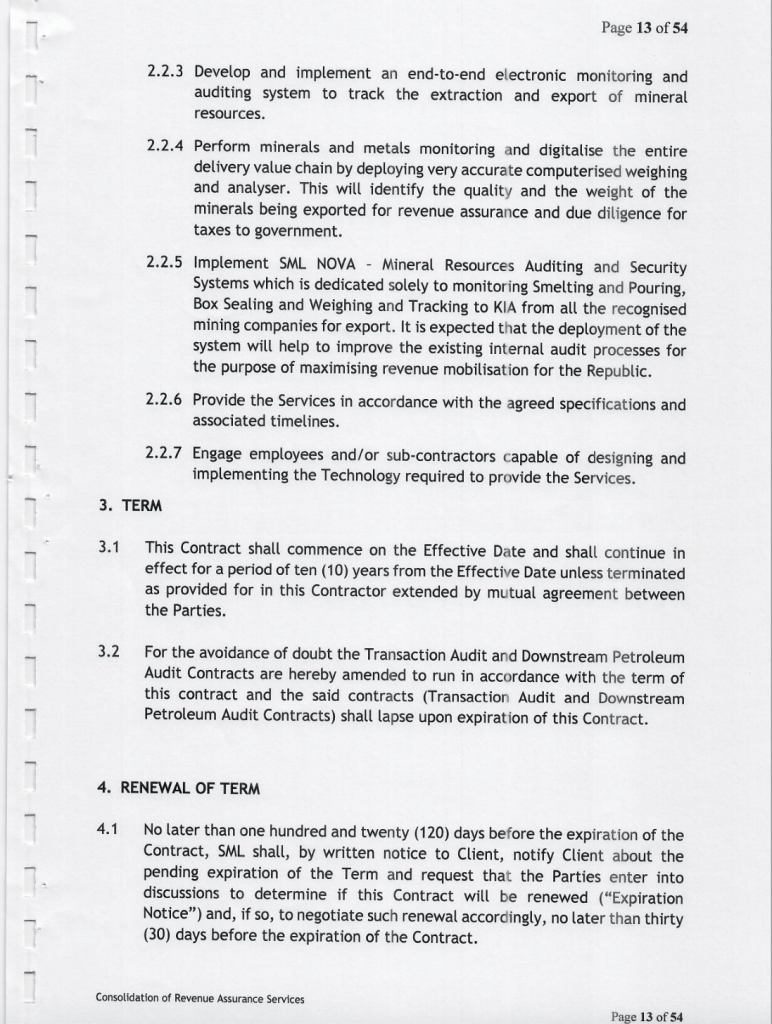
SML also challenged the duration of the contract. We mentioned 10 years in our story, but the company and GRA suggest that the contract is for 5 years, subject to another 5 year-renewal. Our report on the term of the contract was taken from a contract document that said 10 years. If the parties at a point changed the duration, we are ready to concede, but it doesn’t take away the substance of the matter that a company that adds no value to the sector, makes false claims about its services and deletes them when confronted with evidence, has no business making more than $100 million dollars every year for the next five years. All the sectors the company is to operate already has state and private sector agencies monitoring and assuring revenue for the government of Ghana.
CLAIM 2: Again, we challenge him to produce any evidence of wrongdoing in this contract arrangement.
Response: SML is an offshoot of a timber Company, Evans Timbers Ltd. And prior to its contract in 2019 for revenue assurance, it had no experience in revenue assurance. In fact, since its establishment, the Ghana Revenue Authority has been SML’s only client. Ghana’s Public Procurement Act 2003 (ACT 663) provides conditions under which a company could be handpicked for a contract and SML does not appear to meet the requirements. This is the reason we petitioned the Office of the Special Prosecutor (OSP) to investigate possible breaches of the procurement law. We also petitioned the OSP to investigate the parties for possible corruption because we did not get any evidence that the contract is providing any value for money to the state. The content of the documentary shows that SML was not needed in the first place. The National Petroleum Authority and other private companies were already tackling the problems identified in the sector.
CLAIM 3: The downstream petroleum sector’s reported figures have significantly increased because of SML over the time; from an average of 350 million liters per month in 2018 and 2019, to 450 million liters per month as of June 2020. This indicates a rise of more than thirty-three percent (33%) in volume reporting, and an average of an extra 100 million litres per month which translates into revenue.
Response: Data from the National Petroleum Authority shows that petroleum consumption figures in Ghana have been growing from year to year. Consumption grows as more people buy vehicles and the economy grows. It has nothing to do with SML’s work. SML does not check under-reporting, diversion or dilution. The company admitted this and deleted the claim of providing these services from its website after we confronted them. So it cannot take credit for revenue growth when it does not resolve any of the issues that were responsible for revenue losses.
Also, the Ghana Revenue Authority gave us figures for revenue growth in the petroleum sector for a 10-year period. The data shows that the revenue has been growing from 2012 to 2022. SML only came in the middle of 2020 and the data does not support the claim of the growth attributed to SML. Here are the petroleum sector revenue figures from 2012 to 2022.
GRA’s downstream Petroleum from 2012-2022
Petroleum revenue trends from 2012-2022 showed an increase in the figures every year
Source: Ghana Revenue Authority
As shown in the data above, revenue has been on the increase since 2012 before SML’s engagement by the Ministry of Finance and GRA for revenue assurance services.
The steepest was recorded in 2015 when the GRA recorded a 270% increment in revenue against the 2014 figure.
From 2012-2019, the GRA recorded 382 per cent increase in revenue figures.
This gives an average of 47.75 percent growth rate for the 8 years before SML’s engagement.
Since 2020 when SML started its operations, the revenue increased by 41 percent, an average yearly growth rate of 13.6 percent.
“It is not only the volume increase that gives us an increase in revenue. Sometimes, within the period, there are changes in [tax] rates. The tax is on specifics. It’s on volumes so as the rate changes, … as the volume increases, the revenue will naturally grow,” Napoleon Simons of the Policy and Programs Unit of the GRA told The Fourth Estate.
SML claimed it was engaged to check the under-reporting, dilution, and diversion of petroleum products. When asked to mention an instance that the company detected any of these, the company’s MD, said there was never an instance since it began operations in 2020.
CLAIM 4: A careful scrutiny of the work of NPA in terms of taking account and reporting the transactions using ERDMS within the downstream petroleum sector would show that it was not adequate and suited in giving revenue assurance to GRA. The NPA system was designed for its operations and was not suited for providing revenue assurance for tax purposes.
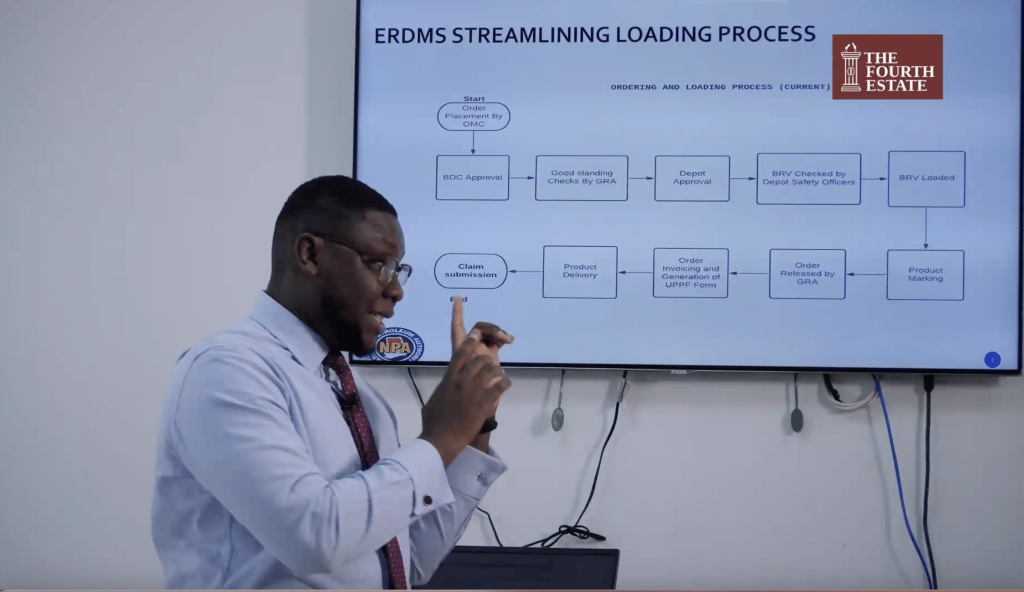
Response: Any action to purchase Petroleum products at the depots starts and ends on the Enterprise Relational Database System (ERDMS). The GRA, the sole organisation tasked with the responsibility to collect taxes told The Fourth Estate that once the volumes are accurately tracked on the ERDMS, the GRA gets its taxes right.
“Once we are able to track whatever is happening on the ERDMS to ICUMS [Integrated Customs Management System], by and large, you would have tracked all your volumes. And once you are able to track your volumes, you are likely to get your taxes right,” said Samson Anim, the head of GRA’s downstream petroleum sector.”
SML Ghana has explained to The Fourth Estate that its ultrasound metres are not intrusive, so they are less accurate than the existing metres at the pumps.
Hamdan Abubakari, the Head of Engineering at SML Ghana told The Fourth Estate that contact metres at the loading gantries of the depots, which are calibrated and certified by the Ghana Standards Authority every six months, take more accurate readings than the SML metres, which are non-contact metres installed outside the pipes.
“The contact metres are always the best,” Mr. Abubakari of SML, emphasised why the SML metres are not as accurate as the ones at the loading gantries.”
He said those metres are more accurate because they get the actual amount of fuel that flows through the pipelines and are loaded. The SML metres, he said, are external and use sound technology to take measurements.
The recording from metres at the loading gantries, according to the GRA, is captured on ERDMS, an electronic platform for transacting business in the entire supply chain process within the petroleum chain industry. This platform has the NPA, GRA, bulk distribution companies (BDCs) and (OMCs) on board to ensure transparency, facilitation, and tracking of transactions.
CLAIM 5: SML installed ultrasonic flow meters to check the volumes of petroleum products loaded at the gantries from the depots to reconcile in real time with the volumes recorded in ICUMS. This system additionally assures Customs that no loading activities occur in the depot in their absence. The installed metering system is designed to detect and record the movement of petroleum products at the depots.
Response: At the depot where petroleum products are lifted, there are Customs officials who are the only persons to lock and unlock the depot. No activities occur on the blind side of the GRA officers stationed at the depots. It is completely false, therefore, to suggest that without SML loading could happen in the absence of GRA officials. The ERDMS provides a platform through which the GRA can disable companies that owe taxes from loading petroleum products. Without the ERDMS, no company can lift products from the country’s depots. They can, however, lift without SML.
Besides, officers from the GRA’s Customs Division are physically present at all the depots. Without them validating the waybills and electronic orders, no truck can load petroleum products. Even the keys of the depot tanks are kept by GRA officials. Without them, nobody can open and operate the tanks.
A Senior Revenue Officer (SRO) of the GRA at the Tema Oil Refinery(TOR) Collection, Naomi Chartey, told The Fourth Estate that it is impossible to steal fuel products due to measures that had been put in place by the NPA and the GRA.
“The product is owned by the BDC [Bulk Distribution Companies], so the BDC must be in the known. Customs must be in the known, and for most of the depots, access to the depots is controlled by us. We have national security at the depots. We have NPA reps at the depots. So, by the time you are done [compromising all the players to dupe the system], you will realise that exercise is not even lucrative. Even when there are no systems, it is virtually impossible and we haven’t had such a case ever since,” Ms Chartey said.
CLAIM 6: SML’s work is designed to culminate in the checking of the products in the tank using an automatic tank gauging system. This aims at replacing the current system of Custom Officers climbing the tank using a dipstick to measure fuel volumes. By utilizing this, the GRA can calculate the overall quantity of petroleum products in depots nationwide to gauge revenue, provide Customs with data for reconciliation, and facilitate the tracking of oil movements during inter-depot and inter-tank transfers. Moreover, it aids in identifying leaks and notification of overfills.
Response: Our story showed that there are metres at the various depots to determine the quantity of fuel products in a tank. The NPA is also implementing a similar project across the country and was about to extend it to the depots. That was why the NPA said the attempt by SML to install an automatic tank gauging system is “potentially duplicitous.” The NPA is able to track liftings at the depots to the filling stations and is able to tell the amount of fuel in every tank of each filling station across Ghana. Connecting the depot tanks to the existing once, according to the NPA would have provided end-to-end tracking. Officials of the authority were, therefore, surprised that SML was brought in to also undertake tank gauging.
CLAIM 7: The GRA claims that the upstream and gold contracts “If there is no value addition, SML will not be paid.”
Response: This is false. The contract gives SML 0.75% of total gold production. It will also get $0.75 dollars per barrel. What value will SML add to our gold production or oil production? They are just to monitor.
In a control room in Tema in the Greater Accra Region, officials of Strategic Mobilisation Ghana Limited (SML) tried to convince The Fourth Estate of its wild claims that it had helped to save Ghana billions of cedis that would have been lost in the downstream petroleum sector but for its intervention.
The company also tried to justify why it receives up to GH₵24 million monthly payments from the government of Ghana in a questionable contract it signed with the Ministry of Finance and the Ghana Revenue Authority (GRA).
A year-long investigation by Evans Aziamor-Mensah, Adwoa Adobea-Owusu and Manasseh Azure Awuni of The Fourth Estate, however, revealed that the company, with the help of a section of Ghana’s media, had made false and unsubstantiated claims of its operations that have served as the basis for the payment it received. It appears the Ministry of Finance and the GRA were aware the claims were false, for some officials of the GRA said they had confronted the company about its claims of savings and volumes on two separate occasions.
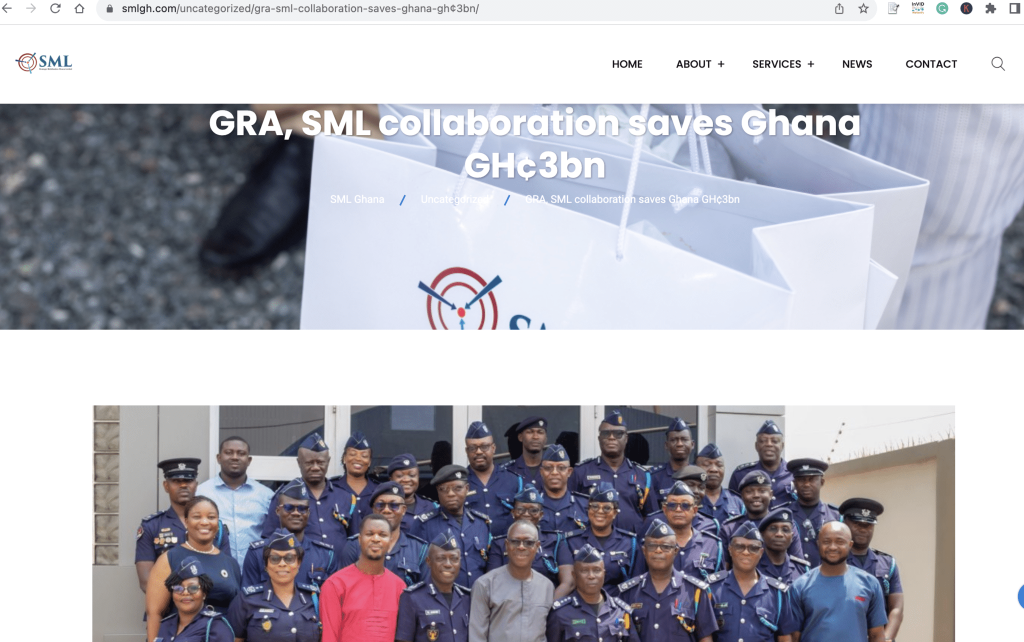
(Left)A picture of the false claim that SML made and (right) a picture of the disappeared claim on its website.
A few hours after the reporters confronted the management of SML with the findings of the investigation and asked for a response, the major services it claimed to render to the government disappeared from the company’s website.
The investigation also uncovered that at a time players in the downstream petroleum sector were questioning the relevance of SML’s involvement, the Minister of Finance, Ken Ofori Atta, initiated a more outrageous deal that would entitle the company to over $100 million every year for the next 10 years.
In the first of this series, we focus on a 2019 contract the Government of Ghana signed with SML. The contract was signed at a time when superior and comprehensive measures had already been introduced by the government in 2018 to curtail losses in the downstream petroleum sector.
SML admits false claim of services it renders to the GRA
SML Ghana started what it calls “revenue assurance” services to the GRA in the downstream petroleum sector in June 2020. The downstream sector is responsible for the refining, distribution, and retail of oil and gas products. The Managing Director of the company, Christian Tetteh Sottie, said SML was an offshoot of a timber company he would not name.
Online records, however, link SML to Evans Timbers Limited. The CEO of SML, Evans Adusei, is also the CEO of Evans Timbers GH, a company that won a defamation case against The Informer newspaper in 2014. In that case, Justice Uuter Paul Dery, who was later dismissed by the Judicial Service of Ghana for bribery and corruption, ruled that the newspaper could not substantiate its claim that Evans Timbers GH used its political connections with Chief of Staff Kojo Mpiani to undertake dubious transactions.
SML registration details at the Office of the Registrar of Companies
Information The Fourth Estate obtained from the Office of the Registrar of Companies shows that Evans Adusei is the sole shareholder of SML. Also, Evans Adusei and his daughter, Esther Adusei, are the directors of the company. SML’s principal activities are “general trading and services, import and export of general goods and audit service activities.”
The Managing Director of SML, Christian Tetteh Sottie, was Ghana’s Controller and Accountant-General from 2005-2009 and is currently a board member of the Internal Audit Agency. He was once an Assistant Commissioner at the GRA.
In 2019, when the GRA entered into an agreement with SML Ghana, Mr. Sottie was the Technical Advisor to the Commissioner General of the GRA. Mr. Sottie left his job as the Technical Advisor to the GRA Commissioner General in the same year to manage SML Ghana in 2020 when the company started implementing its contract with the GRA.
The GRA has been the only customer of SML Ghana since its establishment, according to Mr. Sottie. This means at the time the company was handpicked for the contract through the single source procurement method, it had no prior experience in the services it claimed to have expertise.
A procurement expert and consultant, Kobina Ata-Bedu, says the contract raises questions about a possible breach of Ghana’s procurement laws. He questions the basis for which a company that had no prior experience in the services being procured was single sourced for the contract.
To justify its contract and why it has been paid hundreds of millions of cedis by the government of Ghana, SML falsely claimed that it was rendering a wide range of services that had stopped malfeasance in the downstream petroleum sector.
On its website, SML stated: “The SML Digitalisation of downstream petroleum product measurement has stem(sic) the tide of under-reporting, diversion and dilution of fuel products and general non-compliance in the petroleum industry sector.”
As part of this investigation, The Fourth Estate team spent months interrogating the systems put in place by the Government of Ghana through its sector agencies and third-party contractors to curtail the anomalies SML Ghana claimed to be tackling. The team had rare access to the National Command Centre of the National Petroleum Authority (NPA), where we interviewed officials of the NPA and private sector service providers.
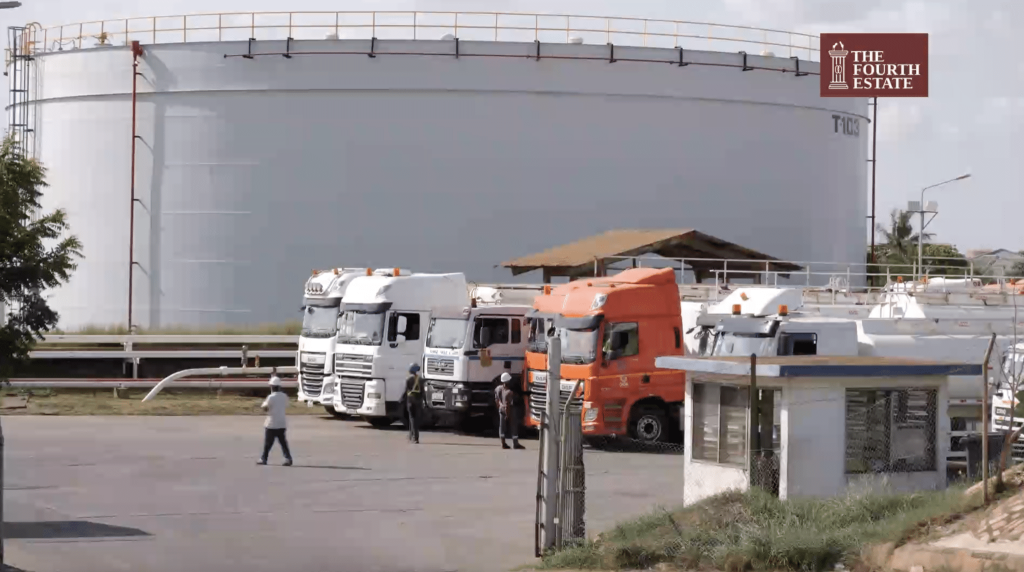
Third-party companies working with the NPA were responsible for checking dilution, diversion, under-declaration and other anomalies in the sector. The Customs Division of the GRA also has officials at the depots and various entry points to ensure that all petroleum products that enter the country are properly accounted for. They do this with independent monitors who police the processes for the owners of petroleum products at various points of the product chain.
The Fourth Estate team also toured some fuel depots in the country and interviewed depot operators as well as oil marketing companies and officials of the GRA. The evidence gathered showed that SML’s claim that it was checking diversion, dilution and under-declaration was completely false.
Our investigation revealed that the introduction of the Enterprise Relational Database Management System (ERDMS) in 2018 had curtailed the continuous operations of oil marketing companies that owed the government in taxes and margins and did not pay within the stipulated time. This was confirmed by the GRA and NPA.
The NPA and GRA said the ERDMS had curtailed under-reporting and other anomalies in the downstream petroleum sector.
A company called Rock Africa was also engaged by the NPA to electronically monitor the tankers that load petroleum products at the depots. The electronic seals send signals to the NPA Command Centre if a truck discharges products outside the fuel station it is supposed to discharge.
This, according to the NPA, curtails the diversion of tax-free petroleum products that are declared as exports to landlocked West African countries but sold in Ghana.
Another company, Nationwide Technologies Limited, had been engaged to undertake fuel marking, which tackles the problem of dilution and the smuggling of petroleum products into the country.
Our investigation showed that the problems that occasioned revenue leakages in the sector were being tackled by different companies to the satisfaction of state authorities, but SML was not one of them. SML, regulatory authorities, and independent operators in the sector could not establish any of the problems SML was solving.
Mr. Sottie also admitted to The Fourth Estate that SML was not into checking underreporting or anomalies in the downstream sector.
“We don’t go into that,” he said when we asked whether SML had “ever detected or identified any issues of under declaration.”
Despite evidence to the contrary, SML made false claims on its website about resolving the problems “under-reporting, diversion and dilution of fuel products and general non-compliance in the petroleum industry sector.”
Officials of the Petroleum Division of the GRA expressed shock when The Fourth Estate team mentioned the listed services SML claimed to provide. SML was contracted to render the services to the GRA.
The GRA officials, led by the Head of Petroleum, Meshack Kwame Danso, were present when we visited SML to confront the company with our findings. Before we started our interview, the GRA officials said SML needed to clear the air on the stated service before we began our interview.
The Company’s Managing Director, Christian Sottie, said SML did not state anywhere that the company was providing services that checked under-declaration, dilution, and diversion of petroleum products. When we pointed out the claims to the management of SML from the company’s website, Mr. Sottie said the information was put on the website in error.
“Oh no, we are not involved in diversion. We are only at the depots. If the thing [petroleum product] is lifted, we don’t know if [it is diverted],” Mr. Sottie said.
He added: “It is GRA, Customs, that will determine where it goes, and they will follow up. We are not capable. We don’t have men outside.”
A few hours after our meeting, the claim of providing services that checked dilution, diversion and under-declaration disappeared from the website of SML.
Executive Director for Africa Centre for Energy Policy, Benjamin Boakye
The Executive Director of the Africa Centre for Energy Policy, Benjamin Boakye, told The Fourth Estate that players in the industry were surprised when the government awarded a contract to SML. He said solutions to most problems in the sector had already been provided and they wondered what SML was coming to do.
Mr. Boakye said the remaining problems in the sector were not at the depots, where SML was stationed to monitor. By problems, Mr Boakye was referring to the non-payment of taxes and margins by OMCs after the sale of products. Even at the depots, the GRA confirmed to The Fourth Estate that it was practically impossible to lose products—and by extension, revenue to the state—even if there were no electronic systems in place.
False Claim of Saving Ghana GH₵3 billion
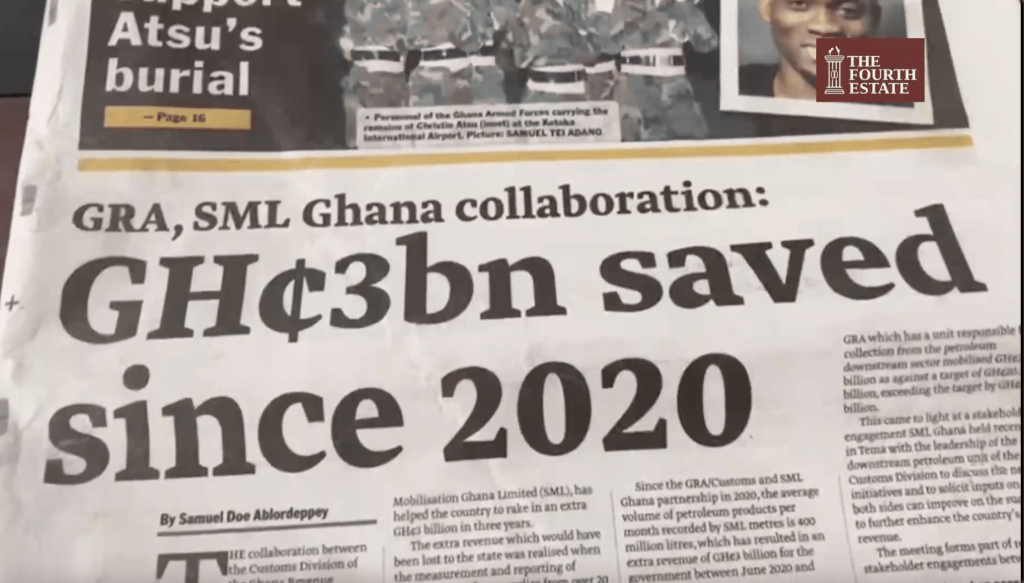
The false claim by SML made it to the headlines and front pages of newspapers, including the state-owned Daily Graphic. When the company was confronted with evidence, it denied ever claiming to save Ghana GH₵3 billion
The Fourth Estate also confronted the Managing Director of SML Ghana with the figures the company churned out as savings Ghana made in the downstream petroleum sector because of its operations.
First was the claim SML made in March 2021 that it had saved Ghana over GH₵1 billion in revenue because of its services.
The company started its operations in 2020. From the revenue figures we obtained from the GRA, the difference in the total revenue from the downstream petroleum sector between 2019 and 2020 was GH₵800 million.
So, if all the incremental revenue in the sector were attributed to the company’s operations, it would still fall short of the GH₵1 billion it claimed to have saved Ghana.
In February 2023, SML Ghana made a more audacious claim that became the banner headline in Ghana’s biggest newspaper, the state-owned Daily Graphic. The story also received wide coverage in major media outlets in Ghana. In its report to the media, the company claimed its operations had helped to save Ghana GH₵3 billion.
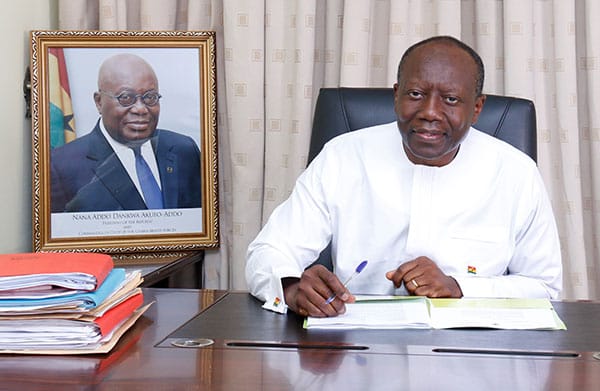
Finance Minister, Ken Ofori-Atta, was the first to claim that the SML contract had resolved the problems that caused “two to three billion cedis losses” in the downstream petroleum sector
The Minister of Finance, Ken Ofori-Atta, was the first to mention billions of losses in the sector, which SML Ghana was going to save. When he commissioned the operations of SML in 2020, Mr. Ofori-Atta claimed that, by engaging SML, the government had eliminated the problems which existed prior to the entry of SML and “it was about two to three billion cedis of losses”.
“We are really excited about this change where we can now determine and get the exact revenues we want,” Ken Ofori-Atta said.
SML Ghana admitted it did not perform the services it listed on its website as curtailing irregularities in the sector and deleted them from its website after we confronted its management.
But even if the company was carrying out those services and all the incremental revenue within the period of its operations was credited to its efforts, the figure would have been GH₵2.4 billion cedis and not the GH₵3 billion it claimed to have saved.
When we put these facts to the managing director, he said he did not know about the GH₵3 billion savings.
“What I want is the agreement from here that the figures are not accurate and that we cannot say that your intervention saved GH₵3 billion,” The Fourth Estate’s Manasseh Azure Awuni insisted that Mr. Sottie should admit the false claim, which was still on the website of the company even while the interview was taking place.
“I have told you that [in terms of the] GH₵3 billion, I am not aware [of it] because when we were told about the publication, we even called the journalist … I think he [journalist] picked it out of context,” Mr. Sotie responded. “I can’t remember the GHS 3 billion. I remember the GHc 1 billion.”
MANASSEH: But the GH₵3 billion was from your outfit?
MR SOTTIE: Yes, you remember when you were talking, I was still speaking about GH₵1 billion. Because, after one year, that was the statement I put out.
MANASSEH: So, who put the GH₵3 billion out?
[The IT Systems Engineer of SML Ghana, Prince Sarpong, interrupts the interview and whispers into Mr. Sottie’s ears].
MR SARPONG: It was a mistake because if you look at other publications, it was just a consultation between GRA and SML. I did the presentation, and I was giving them the expected revenue. Our system can generate expected revenue, so what we did was not even the accurate figure because only GRA can give accurate figures. So, that is a caption by journalists.
MANASSEH: The problem here is that if the journalist made a mistake, it is also on your website this morning even as we speak [in July 2023]. This has been there since February [2023]. So, if a journalist makes a mistake and reports something I did not say, and I put that same thing on my website, then it means an endorsement.
MR SOTTIE: As for me, I don’t know about any website matters.
The Managing Director of SML, Christian Sottie, denied knowledge of the GHc3 billion savings and claimed the media misreported SML. But the story is still on the website of SML.
When asked how much SML was paid for its services in the downstream sector, Mr. Sottie said he did not know. The GRA has not responded to our Right to Information request for the contract and payments made to SML. We sent letters to the GRA in July and November 2023 but neither letter has been acknowledged. The Ministry of Finance is also yet to respond to our request for information sent in November.
Sources close to the Ministry of Finance have, however, revealed that payments to SML are done monthly. Payment details sighted by The Fourth Estate show that SML receives up to GH₵24 million a month for its contract in the downstream sector alone, a figure that may rise when the company finishes the extended contract to undertake tank gauging at the depots.
With the current figures, the company receives at least GH₵240 million for services whose value it could not show when we asked.
“SML Ghana is essentially a plugin into the revenue stream of the state taking money for no job done because what they are supposed to be doing is already being done. It’s just people finding ways to hive off some of our revenues into private pockets and the reasonable thing to do is to cancel that contract,” Benjamin Boakye said of the contract.
Is SML Responsible for Revenue Increment in the Downstream Petroleum Sector?
An official of the National Petroleum Authority explains to The Fourth Estate team how the ERDMS makes it impossible for oil marketing companies owing the government to trade
While SML Ghana claimed its activities resulted in revenue increases—which it interpreted as savings for Ghana—in the downstream petroleum sector, the GRA told The Fourth Estate that revenue increments in the sector are due to two factors.
One of the factors, according to the GRA, is an increase in the volumes of petroleum products imported and consumed in the country. As the economy grows and more people buy vehicles, industries and other economic activities that are fueled by petroleum products also increase. The volumes of petroleum products, therefore, grow naturally from year to year.
“It is not only the volume increase that gives us an increase in revenue. Sometimes, within the period, there are changes in [tax] rates. The tax is on specifics. It’s on volumes so as the rate changes, … as the volume increases, the revenue will naturally grow,” Napoleon Simons of the Policy and Programs Unit of the GRA told The Fourth Estate.
Petroleum revenue trends from 2012-2022 showed an increase in the figures every year
Source: Ghana Revenue Authority
As shown in the data above, revenue has been on the increase from 2012 prior to SML’s engagement by the Ministry of Finance and GRA for revenue assurance services.
The steepest was recorded in 2015 when the GRA recorded 270% increment in revenue against the 2014 figure.
SML Ghana admitted to The Fourth Estate that it does not import petroleum products and its operations have not added a litre of petroleum product to the volumes.
Since SML started its operations, the government of Ghana has increased tax rates twice and added new taxes on petroleum products, according to the GRA. This means more revenue for the government, and a company that played no role in either of the two variables cannot take credit for revenue increment and purported savings for the state.
The GRA and NPA said revenue losses in the sector occurred when oil marketing companies lifted petroleum products from the depots and absconded with taxes. Some OMCs also claimed that the petroleum products were meant for sale in other West African countries and, therefore, were not supposed to attract tax, but they turned around to sell them in the country. The state regulatory institutions have put in measures to track and stop these practices and SML Ghana is not involved in any of these systems.
The measures put in place before SML Ghana was contracted were said to be adequate according to players in the industry and state regulators.
The CEO of the NPA, Dr. Mustapha Hamid, said the ERDMS installed by the NPA and linked to the GRA’s system “allows us to disable people from operating or lifting petroleum products once they are found to be in default of whatever statutory margins or taxes or levies that they haven’t lived up to. So, the absence of the ERDMS at that time where things were done manually and so on was perhaps some of the regulatory challenges. But since that system was installed, a lot of that has been stemmed.”
Sukhwinder Singh, the manager of the Accra Plains Depot Limited, said there was no problem with the ERDMS. He said it ensured “hundred percent” efficiency and transparency.
The ERDMS was introduced in 2018 a year before SML was engaged. Officials of the GRA said the ERDMS resolved the loss of revenues that occurred when the process was manual. Apart from helping to track volumes, the ERDMS ensures that the trading and transportation of petroleum products are done on a digitized platform that has the GRA, NPA, oil marketing companies and bulk oil distributors on board. An oil marketing company that is indebted to the government in taxes and margins is automatically disabled on the ERDMS from loading petroleum products anywhere in the country.
Head of Petroleum Downstream, GRA, Samson Anim
“Once we are able to track whatever is happening on the ERDMS to ICUMS [Integrated Customs Management System], by and large, you would have tracked all your volumes. And once you are able to track your volumes, you are likely to get your taxes right,” said Samson Anim, the head of GRA’s downstream petroleum sector.
The Managing Director of SML Ghana, however, said his company had taken credit for revenue increment in the sector because its operations may have deterred those diverting and under-declaring fuel products.
When asked to name at least one instance in which SML Ghana detected anomalies in the sector or by any sector through his company’s work, Mr Sotie said there was none.
This was in addition to his earlier admission that the company did not perform any of the functions aimed at curbing the anomalies—under declaration, diversion and dilution of petroleum products.
Refusal of Information on contracts and payments
When The Fourth Estate asked the Managing Director of SML Ghana how much his company was paid by the government for its services, he claimed he did not know.
The GRA officials we interviewed for this story also said they could not give us the cost and copies of the contract when we asked. They said they did not have the authorisation to disclose such information and suggested that we write to the Commissioner General of the GRA for that information.
In July 2023, we wrote to the Commissioner General of the GRA but have since not received any response.
The Fourth Estate has also written to the Ministry of Finance, which jointly signed the contract, but we have not received any response to our questions.
The Right to Information Law, under which we made the request considers it a refusal if the institution or agency fails to respond after 14 days.
What SML Currently Does
SML Ghana says its ultrasound metres at the fuel depots across the country record volumes of petroleum products lifted at the loading gantries. The GRA, however, does not use the SML figures for revenue collection.
SML Ghana has metres attached to pipelines at the fuel depots, which record the volumes of products that flow through the pipelines to the loading gantries and give SML real-time records of the volumes that go through the pipelines.
Operators in the industry say the real-time readings at the depots mean nothing because taxes or revenues are not collected in real time. They are collected only after the fuel product is lifted and sold.
Besides, the Ghana Revenue Authority and the National Petroleum Authority do not use SML’s figures to collect taxes or margins on petroleum products.
The gantries are where fuel tankers of the OMCs load petroleum products. The readings of these metres at the gantries determine the volumes of products that leave every fuel depot at the end of each day. These recordings at the gantries are the ones used for tax purposes and not the SML Ghana readings.
SML Ghana also scans the Waybills that GRA officials receive at the fuel depots, which are intended for later reference should an issue arise with an oil marketing company’s indebtedness and there’s the need for a reference.
Sources within the GRA told The Fourth Estate that their officials can scan these documents if they are given the scanners, equipment and resources given to SML through the contract. The sources say GRA does not need a third-party company to scan documents GRA officials collect as part of their work at the depots.
The Executive Director of ACEP told The Fourth Estate, “A very flamboyant GRA with a lot of people packed there who are supposed to deliver the same service. And we assume suddenly that they cannot deliver that function and we need the private sector to be able to do that. I think perhaps, it’s time to evaluate some of these arrangements and save ourselves some money.”
Why GRA Uses “More Accurate” Metres for Revenue, not SML Readings.
The metres at the loading gantries are more accurate than the SML metres. Readings of these metres are the figures the GRA and NPA use for calculating taxes and margins. SML has admitted these metres are more accurate than the SML metres.
SML Ghana has explained to The Fourth Estate that its ultrasound metres are not intrusive, so they are less accurate than the other metres.
Hamdan Abubakari, the Head of Engineering at SML Ghana told The Fourth Estate that contact metres at the loading gantries of the depots, which are calibrated and certified by the Ghana Standards Authority every six months, take more accurate readings than the SML metres, which are non-contact metres installed outside the pipes.
“The contact metres are always the best,” Mr. Abubakari of SML, emphasised why the SML metres are not as accurate as the ones at the loading gantries.
He said those metres are more accurate because they get the actual amount of fuel that flows through the pipelines and are loaded. The SML metres, he said, are external and use sound technology to take measurements.
The recording from metres at the loading gantries, according to the GRA, is captured on ERDMS, an electronic platform for transacting business in the entire supply chain process within the petroleum chain industry. This platform has the NPA, GRA, bulk distribution companies (BDCs) and (OMCs) on board to ensure transparency, facilitation, and tracking of transactions.
The ERDMS is connected to the Integrated Customs Management System (ICUMS). Taxes and revenues from the sector are calculated from the volumes that go through the ERDMS and customs.
None of that involves the figures churned out by SML through its “revenue assurance” services.
At all the depots, GRA officials measure the volumes of petroleum products in the tanks before the beginning of work at the end of each day’s business. The GRA has custody of the seals to valves of every tank, and, until the designated GRA officials open, no depot in Ghana can load petroleum products.
These and other rigorous measures make the role of SML irrelevant in the sector, according to some operators of the depots who want to remain anonymous.
Duplication of Roles
The management of SML also told The Fourth Estate that the scope of its contract had been expanded to include the tank gauging at the depots. With this service, the company said it was in the process of installing an automatic tank gauging system that would show the quantity of fuel in the tanks at the depots.
Apart from the fact that the GRA gauges the volumes of products in the tank at the beginning and end of business every day, some of the depots have already installed tank gauging systems. When The Fourth Estate team visited Chase Petroleum, one of the biggest fuel depots in Ghana, we saw the metres, whose measurement corresponded with the recording of the GRA officials stationed at the depots.
NPA CEO, Dr. Mustapha Abdul-Hamid, said they consider SML Ghana’s decision to undertake automatic tank gauging “potentially duplicitous.”
The Chief Executive of the NPA, Dr. Mustapha Hamid, told The Fourth Estate that some management members of the NPA had raised concerns about possible duplication of roles when they learned that SML Ghana had been contracted to undertake automatic tank gauging.
“Potentially, we consider it duplicitous. However, we have agreed to meet with them [SML] to understand the real rationale for which they also want to do an automatic tank gauging system,” Dr. Hamid told The Fourth Estate.
The NPA has a system that tracks the lifting and transportation of fuel products from the depots to the tanks of the oil marketing companies. With that system, the NPA can tell the volumes of petroleum products in all the fuel stations across Ghana at any given time.
The authority says it was already in the process of extending it to the depots to have an end-to-end system and wonders why another company was engaged to do the same thing.
The GRA further added that even without the other electronic systems put in place, it would be almost impossible to lose petroleum products at the depots, where SML has its metres. Officials of the GRA explained that many players with different roles and interests are present every time to police the products at every point.
A Senior Revenue Officer (SRO) of the GRA at the Tema Oil Refinery(TOR) Collection, Naomi Chartey, told The Fourth Estate that it is impossible to steal fuel products due to measures that had been put in place by the NPA and the GRA.
“The product is owned by the BDC [Bulk Distribution Companies], so the BDC must be in the known. Customs must be in the known, and for most of the depots, access to the depots is controlled by us. We have national security at the depots. We have NPA reps at the depots. So, by the time you are done [compromising all the players to dupe the system], you will realise that exercise is not even lucrative. Even when there are no systems, it is virtually impossible and we haven’t had such a case ever since,” Ms Chartey said.
Cancel SML’s contract
The Executive Director of ACEP, Ben Boakye, said the SML Ghana contract is only a duplication of roles being performed by the NPA, the GRA and other third-party companies in the sector. He, therefore, demands a cancellation of the contract.
When asked if he would have advised the GRA Commissioner to contract SML for this revenue assurance services if he were still the technical advisor, Mr Sottie said he could not answer.
In the first of this series, The Fourth Estate’s Evans Aziamor-Mensah, Adwoa Adobea-Owusu and Manasseh Azure Awuni revealed that Strategic Mobilisation Ghana Limited (SML), which started revenue assurance services to the government of Ghana in 2020 had made a number of false claims.
The company claimed in February 2023 that it had saved Ghana over GHc3 billion in revenue that would have been lost to the state but for its services in the contract it signed with the Ministry of Finance and the Ghana Revenue Authority (GRA).
The investigation found this claim to be completely false. The Managing Director of SML, Christian Tetteh Sottie, claimed he did not know about the figure when The Fourth Estate confronted him with counter evidence. He said the media, including the state-owned Daily Graphic, had taken a presentation SML made to the GRA board out of context and reported the wrong information. He said SML had called the journalists to draw their attention to the supposed error.
When asked why the story of saving Ghana GHc3 billion was still on the website of SML the morning of the interview with The Fourth Estate, in July 2023, he said, “I don’t of any website matter(sic).”
When asked why the story of saving Ghana GHc3 billion was still on the website of SML the morning of the interview with The Fourth Estate, in July 2023, he said, “I don’t of any website matter(sic).”
SML admitted its false claims and deleted them from the website of SML shortly after our interview
The company had also claimed that its services had stopped “under-reporting, diversion and dilution of fuel products and general non-compliance in the petroleum industry sector.”
When The Fourth Estate confronted the company with evidence that it did not perform any of those services that tackled those problems, which were the causes of revenue leakages in the downstream petroleum sector, SML admitted its claims were false and deleted them from the website of SML that same day.
SML also admitted its ultrasound metres at the nation’s fuel depots were less accurate than the metres of the loading gantries at the depots, which are calibrated and certified by the Ghana Standards Authority every six months.
The GRA and the Ministry of Finance contracted SML to monitor the volumes of petroleum products lifted. However, the GRA told The Fourth Estate that the figures SML churned out as its monitoring of volumes were not the ones GRA uses to calculate petroleum taxes or revenue for the state. The GRA uses figures from the loading gantries, which the authority was using even before SML was contracted.
The Managing Director of SML, Christian Sottie, denied knowledge of the GHc3 billion savings and claimed the media misreported SML. But the story is still on the website of SML
SML also confirmed to The Fourth Estate that it had never detected any case of under-declaration since it started its monitoring services for the GRA over three years ago.
Apart from the false claims, SML does not tackle any of the problems identified as causing revenue losses in the downstream sector, a fact SML and government officials admitted when we interviewed them.
This notwithstanding, the Ministry of Finance, in June 2023, instructed the GRA to expand the scope of SML Ghana’s work.
A Ministry of Finance letter sighted by The Fourth Estate said the “Honourable Minister [Ken Ofori-Atta] has determined that there is the need to monitor the production and shipment of oil and gold out of the country.
“To this end, he will like to expand the Revenue Assurance work being performed by SML to include upstream oil drilling by the production companies and the gold mining companies,” the letter dated June 22, 2023, stated.
The Ministry of Finance letter on the expansion of SML Contracts to cover oil and gold production in Ghana
Sources close to the Ministry and SML Ghana have confirmed the contract has been signed and stakeholders in the mining industry have been contacted in writing to help SML operationalise the terms of the contract.
Last week, representatives from the GRA and SML met the Ghana Chamber of Mines to discuss the execution of the contract. The Fourth Estate’s sources familiar with discussions at the meeting said SML invited the Ghana Chamber of Mines to visit the company to inspect the setup it is putting in place to implement the new contract. The Chamber is to visit.
Per the terms of this new contract, the government will pay SML US$0.75 for any barrel of oil produced in Ghana.
Ghana currently produces between 160,000 to 170,000 barrels of oil per day. The Pecan field project is expected to add 80,000 barrels per day in a year, a Deputy Minister of Energy, Andrew Mercer, recently told Reuters.
SML’s share of US$0.75 per barrel a day means the company will make at least US$120,000 per day from the 160,000 barrels per day.
The contract also mandates the state to pay SML Ghana 0.75 per cent of the total amount of gold that is produced and monitored in Ghana. Ghana is currently the largest producer of gold in Africa, beating South Africa with 3.7 million ounces of Gold in 2022.
Using the 2022 production figures to estimate SML’s earnings, the company’s 0.75% share of 3.7 million ounces at a global price of US$1,800 per ounce (as contained in the Finance Minister’s 2024 budget statement) will amount to US$50 million from the gold sector alone.
The Contract spells out what should be paid to SML under the gold and oil upstream petroleum sectors. Together with the downstream sector, the company will be paid over $100 million a year
Together with the downstream and upstream petroleum sectors, SML Ghana will be paid more than US$100 million by the government of Ghana through the “revenue assurance” contracts.
This money is more than the amount allocated to 19 out of the 27 ministries in the 2024 budget of the Republic of Ghana by the Ministry of Finance.
The amount due SML per this contract is more than the annual revenue from many taxes, including the controversial electronic transaction tax (E-Levy).
“A typical create loot and share”, a mining expert.
A mining expert who spoke to The Fourth Estate on condition of anonymity described the engagement of SML to monitor gold production as a “typical create, loot, and share” scheme to plunder the resources of the state.
The source said SML has no role in the mining sector and won’t perform any function that is not already in place to monitor and assure revenue for the government.
“To put it simply, what we do here is that we crash rocks in search of gold. After crashing, we take the rocks that have gold particles to what we call the Gold Room to extract the gold,” the source explained.
“In the gold room of every mining company, we have officials of the Ghana Revenue Authority to protect the government’s interest and calculate taxes on whatever we produce,” the source continued.
The source further explained that aside from the GRA officials, the Gold Room also has officials from the Precious Minerals Marketing Company (PMMC), the state institution certified to grade, assay, value and process precious minerals.
“The PMMC is the government’s assayer, so they take samples of the gold we produce to their labs in Accra to test and report of the percentage of actual gold in the bars.”
The source said the mining companies in Ghana refine their gold outside the country and reports from the gold refineries abroad are returned to Ghana for reconciliation with the PMMC report.
“For instance, if the PMMC’s test report says a bar has 97% gold and 3% silver, and the refinery report says it has 94% gold and the rest are of silver and other metals, the report is reconciled.”
The source explained that all the gold that leaves the mines is airlifted by helicopters with security protection to the Kotoka International Airport in Accra for onward export.
“Between the mines and the airport, anything could happen, so we have Customs officials in every helicopter that lifts the gold from the mines to Kotoka, where they hand over to their superiors for the paperwork and export.
“So, what is SML coming to do?” the source asked. “Are they coming to do the work of PMMC or GRA?”
The Petroleum Commission says it is not aware of the contract with SML
The regulator of the upstream sector, the Petroleum Commission, has told The Fourth Estate that it has no knowledge of the contract with SML to monitor petroleum production in Ghana. It also said in a response to a right to information request that it has no report of leakages in the sector, a reason SML was contracted to monitor.
The Commission, according to its official website, was established by “an Act of Parliament, 2011 (Act 821) as a result of hydrocarbon discoveries in commercial quantities, to regulate and manage the utilisation of petroleum resources and, coordinate the policies in the upstream petroleum sector.”
Executive Director for Africa Centre for Energy Policy, Benjamin Boakye
The Executive Director of the Africa Centre for Energy Policy (ACEP), Benjamin Boakye, told The Fourth Estate that, SML’s role is needless and would result in loss of revenue to Ghana without adding value to the process.
“Recently, Tullow installed new metering systems that will be calibrated by the Standards Authority. Is the Finance Ministry saying that those metres are wrong?” he asked.
EDITOR’S NOTE: After this publication, the GRA and SML have stated that the contract that was executed was for 5 years and not 10 years as we reported. After the subsequent social media sharing of some of the leaked documents we received from our anonymous sources, a one-page document purporting to be Page 13 of the executed contract has been published, which says the duration of the contract is 5 years, subject to another 5-year renewal. Even though the GRA and Ministry of Finance are yet to give us the contracts and documents we requested in our investigation, we wish to stick to 5 years as the duration of the contract. We, however, stand by the substance of our story.
The Health Facilities Regulatory Agency (HeFRA) has imposed a fine of GH₵105,000.00 on two healthcare facilities at South Odorkor in Accra, for employing the services of a quack midwife.
While the New Generation Medical Centre was slapped with the heaviest fine of GH₵ 80,000.00, the Adams Family Specialist Clinic has to cough out GH₵ 25,000.00 (both equivalent to $9,051.72).
HeFRA said the number of deaths, cases of injury, and other incidents, the use of an unqualified staff—Francisca Quaye— to provide service in a licensed facility for nearly 30 years informed the decision to impose the heaviest fine ever in the agency’s history on the two facilities.
In May this year, the regulatory agency launched investigationsinto the activities of the two healthcare facilities, following The Fourth Estate’s investigations into the work of Francisca Quaye, alias ‘Matron Gaga’, an unlicensed midwife. She worked at the two medical centres. The Fourth Estate’s 18-month investigations discovered that the quack midwife, who is currently on the run, had practiced for more than 30 years.
The Fourth Estate found evidence of multiple medical mishaps, including the disturbing death of at least two newborn babies at the New Generation Medical Centre within 11 months. The records of the facility were sanitised to hide these deaths.
Registrar of the Health Facilities Regulatory Authority (HeFRA), Dr Philip A. Bannor
HeFRA’sRegistrar, Dr Philip Bannor, told The Fourth Estate that “both of them [the two medical facilities] have paid the fine. The reason [they were fined] is that they should have checked her credentials before employing her.”
Dr Bannor said the fine imposed on the New Generation Medical Centre is the highest penalty ever slapped on a facility for flouting HeFRA’s regulations. He explained that management of the two facilities looked on while the quack midwife practiced, without any checks, with preventable deaths recorded at the New Generation Medical Centre.
Dr Ralph Obeng Owusu Snr, the Chief Executive Officer of the New Generation Medical Centre said he’ll partly take the blame for Francisca’s unethical behaviours
“I agree with you. It was probably a little bit of naivety on my part…But the thing with her was she was a little boisterous when it came to things of that nature. Anytime there was a problem, I used to talk to her. It was supervision, I didn’t know there would be so many problems,” Dr Obeng told The Fourth Estate in October 2021.
“…Partly, I’ll take the blame because she has been under my tutelage for quite a while,” he added.
HeFRA said as part of measures to ensure compliance with the sanctions, the two facilities have been informed that there would be unannounced special monitoring visits.
These visits are meant to ensure that the two facilities do not employ the services of an unqualified staff.
Dr Nana Esuman, Medical Director, Adams Family Specialist Clinic had told The Fourth Estate that the quack midwife did not deliver any baby at his facility but further investigations by HeFRA showed that Francisca Quaye delivered two babies during her two-month stint at the clinic
During the investigations, the Medical Director of the Adam Family Specialist Clinic, Dr Nana Oduro Essuman, told The Fourth Estate that the quack midwife was employed as a midwife assistant, a position the Nursing and Midwifery Council (N&MC) says does not exist. However, further investigations by HeFRA showed that Francisca Quaye delivered two babies during her two-month stint at the clinic.
Unannounced inspections by HeFRA
The fine is part of a wave of reforms The Fourth Estate investigations have triggered.
Until The Fourth Estate’s exposé, HeFRA was required to announce schedules for its visits to health facilities for inspections.
However, Agyeman Badu, HeFRA’s Director of Compliance and Enforcement told The Fourth Estate that the two healthcare facilities had lost that privilege as the agency’s inspectors would visit the facilities for six months until it was satisfied with their level of compliance.
Similarly, he said HeFRA had decided to do intermittent unannounced visits to all registered healthcare facilities nationwide, as part of measures to curtail the ingenious ways some facilities hid their unscrupulous activities.
He observed that the gaping loopholes in HeFRA’s monitoring system had been reviewed and that mechanisms for monitoring health facilities in the country had been enhanced.
“Relative to this particular story, [The Fourth Estate’s Quack Midwife Series], we have decided that it shouldn’t always be the case that we are prompted. So, we have stepped up our monitoring activities across the regions such that even facilities that have been licensed also fall in line, to make sure that the conditions for which they are licensed are not varied, which will affect patient safety.”
He said HeFRA now has 200 monitoring officers nationwide for the job.
Background
Quack midwife, Francisca Quaye, whose 30-year practise resulted in the death of babies at the New Generation Medical Centre
HeFRA announced investigations into the activities of the two health facilities following an investigative report by The Fourth Estate which showed the shocking trail of deaths and malpractices at the New Generation Medical Centre under Francisca Quaye’s watch.
Now on the run, she had practised without either training or license for more than 30 years. During this period, she was the instrument of numerous medical mishaps, with at least two children dying during delivery and another maimed at the New Generation Medical Centre within 11 months.
President of the Midwives Association of Ghana, Mary Ofosu, condemned Francisca Quaye’s unconventional and inconsistent actions
The President of the Midwives Association of Ghana, Mary Ofosu, condemned Francisca Quaye’s unconventional and inconsistent actions, including inducing pregnant women and asking them to go home, while she worked at the New Generation Medical Centre. She said the practice was inconsistent with midwifery practice.
“A midwife cannot do induction on her own,” she said of Matron Gaga’s Cytotec procedure. “There must be a medical officer or specialist around. You should also have a theatre around because induction can fail. So, when you induce and it fails, we need to take the client to the theatre. So, before you do induction, you need to get all those things around.”
The Fourth Estate’s investigations revealed that Francisca Quaye had never been to any nursing or midwifery training school.
To be recognised as a midwife in Ghana, one has to complete an accredited nursing/midwifery training institution and pass a licensing exam conducted by the N&MC, renewable annually. Any exemption to this rule may only be granted by the board of the N&MC.
Francisca Quaye has neither a license nor an exemption. In fact, the closest she got to the ward was being a janitor at the now-defunct Susan Clinic, where she met Dr Obeng, who did little to stop her from the labour ward.
The Commission on Human Rights and Administrative Justice (CHRAJ) has stated that the Ghana Airports Company Limited flouted Ghana’s procurement laws when itrented Christmas inspirations for the Kotoka International Airport in 2021.
The Commission said the company should have followed Ghana’s Procurement Act, 2003 (Act 663), when it rented and bought Christmas trees and chandeliers worth GH₵ 128,000 in December 2021.
“It is, therefore, the Commission’s considered view that the provisions of Act 663 as amended ought to have been followed in the rental of the Christmas inspirations,” CHRAJ said in a decision dated October 30, 2023, following a petition from a private Ghanaian citizen.
The Commission said since the value of the items was more than GH₵ 100,000, the only agency with the power to give approval was the Entity Tender Committee.
“The total value of Christmas decorations for 2021 was GH₵128,366.00. Out of this, DPP paid an amount of GH₵50,000.00 directly to Favours and Arts under inexplicable circumstances without passing through the GACL which had requested for the sponsorship. Since the amount of GH₵50,000.00 was paid by DPP on behalf of GACL, the Commission considers that money belonged to GACL as the beneficiary. That being the case, the amount of GH₵50,000.00 was public money within the ambit of the Public Financial Management Act, 2016 (Act 921) which under section 102 defines public money to include tax revenue, non-tax revenue, grants, and other receipts,” CHRAJ declared.
“Indeed, before the receipt of the GH₵50,000.00 the GACL knew or ought to have known that the decorations were within the approval limits of only the Entity Tender Committee ie above the GH₵100,000.00 threshold.”
CHRAJ said 2021 was not the first time the GACL had flouted the procurement rules.
It said this had been happening since 2018. The Commission, has, therefore, directed the GACL to desist from the practice going forward.
“In addition to this, the GACL has over the years considered the rental of Christmas trees as being outside procurement flowing from the evidence of officials of the Company that appeared before the Commission. For that reason, management has not been applying the provisions of Act 663 as amended. We think that this is an anomaly and ought to cease forthwith.”
The news of the procurement emerged with leaked proforma invoices from two companies from which the services were procured. The two invoices were addressed to the GACL, with one of them naming the board chairman, Paul Adom-Otchere.
A proforma invoice from Jandel Limited for “Terminal 3 Arrival Hall (a decorated Christmas tree with lights), lighting décor on the trees around the lawn, and decoration of existing trees amounted to a total of GH₵ 38,775.”
Jandel Limited’s proforma invoice amounted to GH₵ 38,775
Another proforma invoice from Favors and Arts for the rental of a Christmas chandelier with lights amounted to GH₵ 90,500.
The Proforma invoice from Favors and Arts amounted to GH₵ 90,500 and was addressed to Mr Paul Adom-Otchere
Social media commentators questioned the corporate governance structures at the GACL that allowed the board chairman of the state-owned company to be directly involved in the procurement of Christmas decorations.
On January 7, 2022, Mr Adom-Otchere sidestepped the corporate affairs department of the company and issued a statement to clarify the widely circulating information that suggested imprudent use of public funds by the company.
According to Mr Adom-Otchere, the GACL requested quotations from two companies to provide different services for the Christmas decorations at the airport.
Article 42 of the Public Procurement Act states that a “procurement entity may engage in procurement by requesting quotations in accordance with section 43.”
Section 43 of the Act says: “The procurement entity shall request for quotations from as many suppliers or contractors as practicable but shall compare quotations from at least three different sources that should not be related in terms of ownership, shareholding or directorship and the principles of conflict of interest shall apply between the procurement entities and their members and different price quotation sources.”
What this means is that the GACL should have requested quotations from at least three service providers for the Christmas tree and another three quotations for the rental of the chandelier.
CHRAJ warns GACL Board Chair
CHRAJ says the GACL Board Chair, Mr Adom-Otchere’s decision to procure Christmas inspirations for the company is an interference in the company’s day-to-day activities which does not bode well for corporate governance.
“We are constrained to observe that the conduct of the Respondent [Paul Adom-Otchere] in requesting invoices and his appearances in the media in respect of matters involving the GACL of which he is the Board Chairman does not augur well for good corporate governance. We recommend that the Respondent should restrain himself from interfering in the work of management and restrict himself purely to his prescribed functions as Board Chairman.”
CHRAJ’s decision confirms the Transport Ministry’s view that there was no procurement process
Response from Hon. Kwaku Ofori Asiamah’s Transport Ministry on the airport Christmas tree saga contradicts claims by Paul Adom-Otchere, Board Chair of Ghana Airports Company Limited (R)
This revelation by the ministry contradicted the claim by the board chairman of the GACL, Mr Adom-Otchere, that “two separate suppliers were invited to submit bids. The bids were discussed and discounts obtained.”
The Ministry also said the 2021 “Christmas decorations in question were rented” and not bought as was previously claimed by the GACL board chairman.