The Ministry of Youth Development and Empowerment has announced the immediate suspension of the Central Management System (CMS) used for postings by the National Service Authority (NSA).
The directive follows emerging concerns over the integrity of the platform.
A statement issued on Wednesday June 18, 2025 by the sector’s minister, George Opare Addo indicated that the decision, which comes at the directive of the Office of the President, is “in the national interest” and intended to pave the way for a comprehensive technical and forensic review of the CMS platform.
The Ministry assured National Service Personnel and the general public that alternative systems are being explored to ensure smooth operations and transparent verification.
“The attention has been drawn to emerging concerns surrounding the digital infrastructure currently in use at the National Service Authority (NSA), specifically the Central Management System (CMS) for postings. Following the directive from the Office of the President, the use of the CMS has been suspended with immediate effect,” the statement stated.
This suspension comes in the wake of damning revelations by The Fourth Estate, whose months-long investigation uncovered that the CMS, including the much-vaunted ‘Metric App’ introduced by the NSA, had become a conduit for one of Ghana’s most brazen financial frauds.
In 2021, the former Director-General of the National Service Scheme, Osei Assibey Antwi, heralded the Metric App—a digital verification platform said to employ facial recognition and Ghana Card ID authentication—as a revolutionary tool that blocked over 14,000 fake names from the national service payroll.
“We had them on our list as potential service persons, but they ran away and could not register because the system raised red flags and weeded them out,” he boasted at the time.
Former Vice President Dr. Mahamudu Bawumia, an ardent proponent of digitalisation, praised the scheme’s management for their innovation.
“If we replicate this in ten institutions, we are talking of saving the country almost a billion cedis,” he said, citing the Metric App’s supposed success as proof of the value of linking payroll systems to the Ghana Card.
But The Fourth Estate’s investigation revealed a shocking contradiction.
Rather than rooting out fraud, the very system hailed as foolproof enabled the enrollment and payment of thousands of ghost service personnel using fabricated data, duplicated photos, and fraudulent documents. In many cases, index numbers were faked, ID cards mismatched names and genders, and entire cohorts of fake “graduates” from non-existent programs were entered into the system and paid stipends.
According to the Attorney-General, the enrolment of ghost names under the CMS and Metric App system has cost the nation over GHC500 million. The platform’s failure has turned what was once described as a gold standard into what critics now call a digital crime scene.
Sulemana Braimah, Executive Director of the Media Foundation for West Africa (MFWA), the parent organisation of The Fourth Estate, was among the first to publicly question the continued use of the compromised app.
“How on earth can the new leadership of the National Service Authority still be using the same Metric App that allowed for the enrollment of 80 and 90-year-olds for National Service? The same digital platform that allowed ordinary paper to be used as Ghana Card for enrolment… That allowed for one name to be repeated over 200 times?” Mr Braimah wrote on Facebook.
Mr Braimah criticised the current Director-General of the NSA, Felix Gyamfi, for defending the app despite overwhelming evidence of its failure. “Ghanaians cannot trust any so-called reforms with the same Metric App. JUST DROP THAT APP,” he stated emphatically.
The Ministry has not specified how long the review will take, nor has it clarified whether the Metric App has been permanently discontinued. It states, however, that “alternative systems and verification procedures are being reviewed”.
Hundreds of artisanal salt miners in Ada have reclaimed portions of the Songor Lagoon that Electrochem Ghana Limited (EGL) previously claimed as part of its concession.
The miners say they are finally free from years of “harassment, indiscriminate shootings, illegal arrests, and economic hardship” caused by the controversial 15-year lease granted to EGL under the erstwhile Akufo-Addo government.
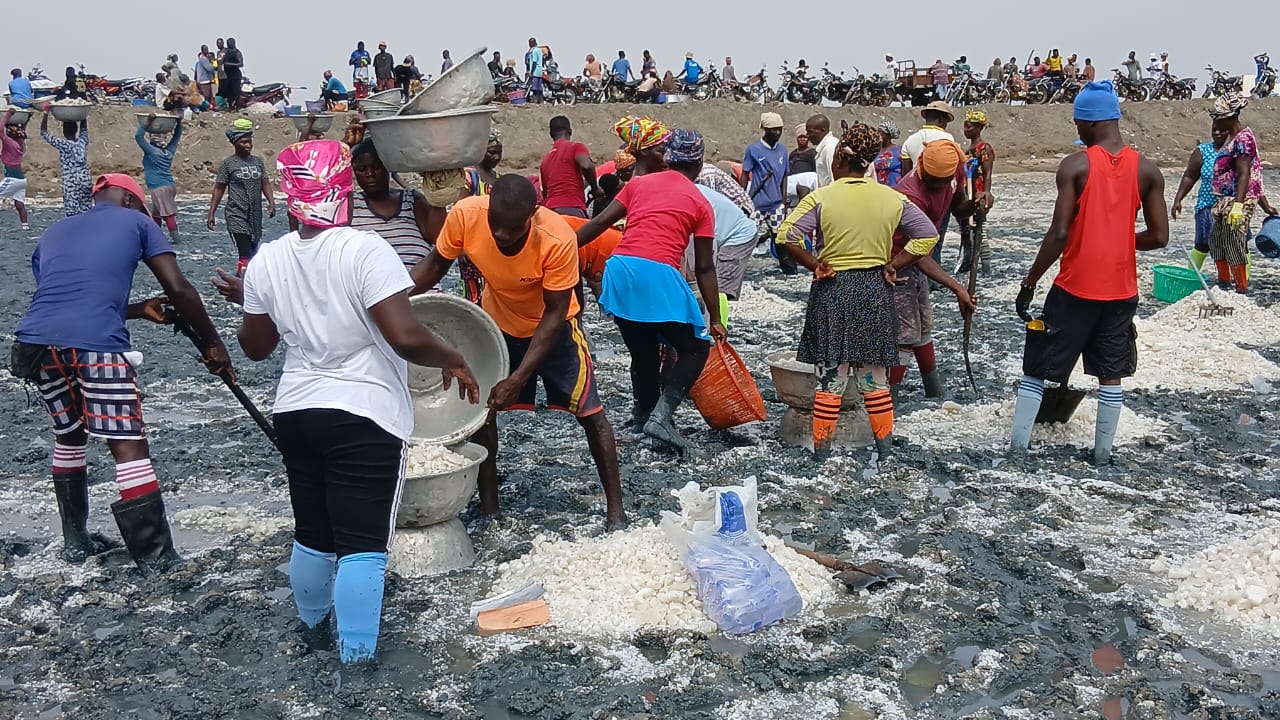
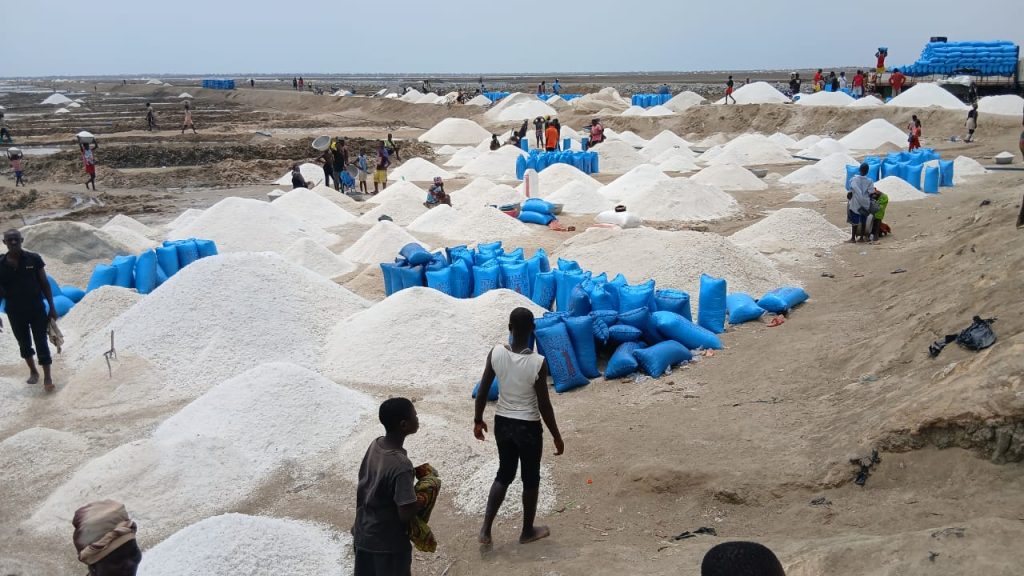
For the first time in years, over 30 communities around the lagoon have resumed their traditional salt mining activities. Families torn apart due to lost livelihoods are reuniting as men who fled have return home.
Ada indigenes engage in salt mining activities at the songor lagoon after regaining access
The renewed access follows the natural crystallization of salt in the lagoon during the dry season, allowing unrestricted mining.
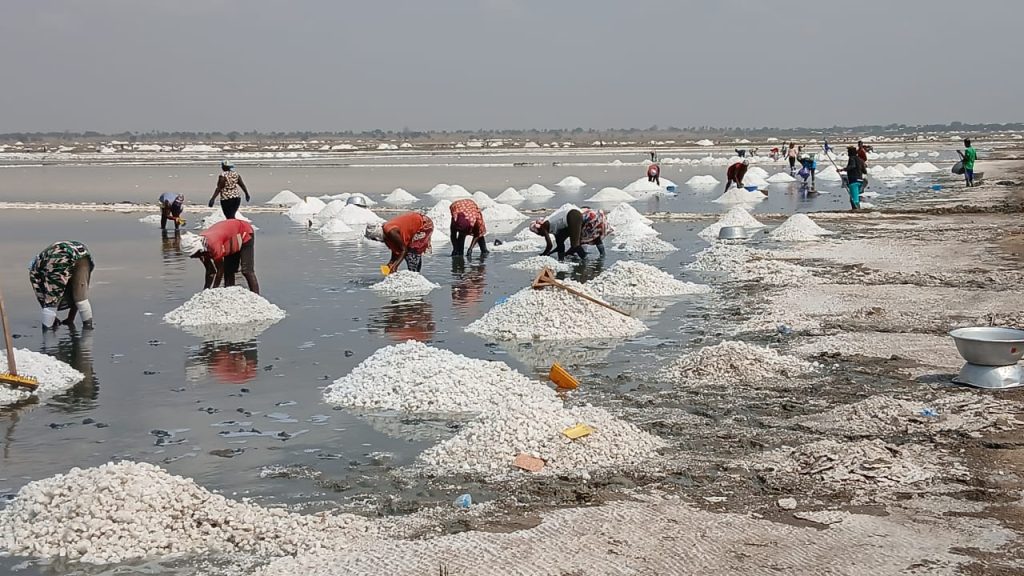
Community members tell The Fourth Estate they are now freely mining salt in the areas outside Electrochem’s designated factory concession, also known as the defunct Vaccum Salt /Songor Salt Project/ Factory.
Ada locals mining salt in the songor lagoon
According to the residents, they were unfairly denied community mining in the lagoon since 2021 when Electrochem claimed ownership of the entire lagoon.
“We are mining salt, and we are very happy,” says Amakie Anim, a salt miner. “This is what we have been fighting for because our ancestors left it for us. Electrochem should also be at Vaccum and work there.”
Since the new government took over in January 2025, residents say security personnel who once enforced Electrochem’s claim and harassed artisanal salt miners, have disappeared, bringing back their livelihood.
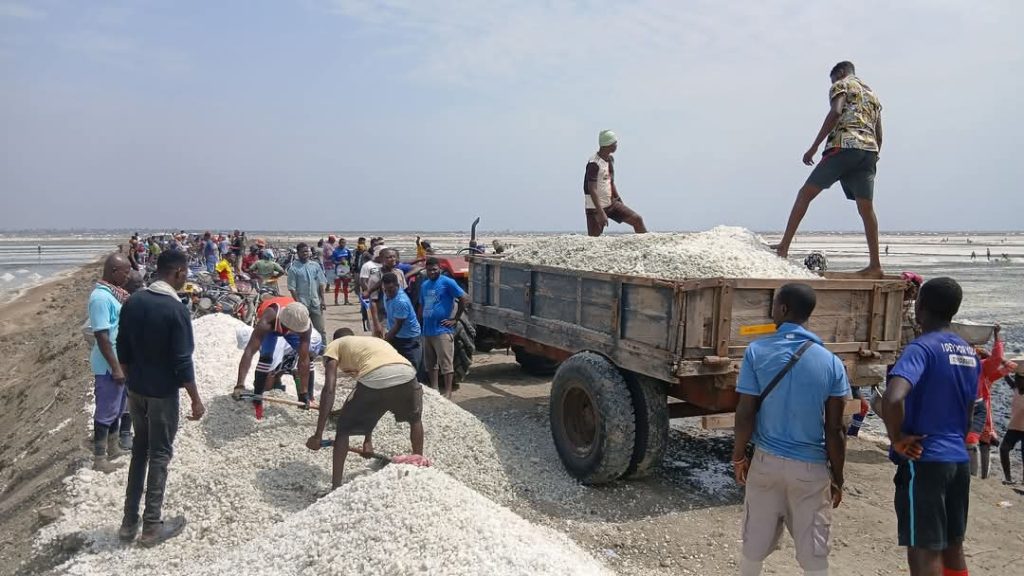
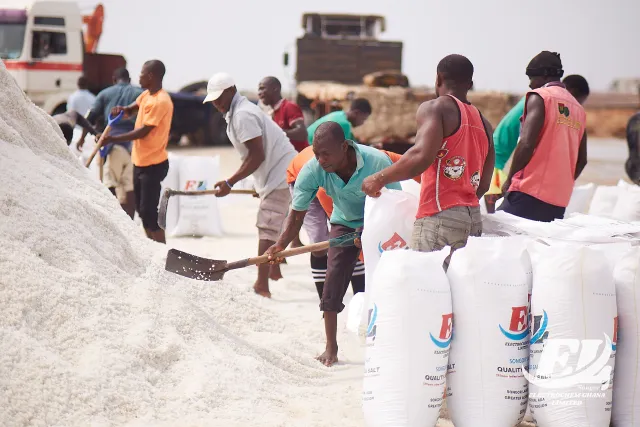
Salt being loaded into a truck after production
“We don’t know if the security forces have been permanently withdrawn or if they will return, but for now and since the new government took over, there is absolute peace here in Ada and our homes,” Emmanuel Adabang, a salt miner and resident of Toflokpo, a community that has suffered series of raids over the years, says. “The entire lagoon has crystallized into salt, and everyone is mining without fear or anxiety anymore.”
Community leaders, however, want a permanent resolution. Vice-Chairman of the Ada Songor Lagoon Association (ASLA), Nene Dadebom Anim II, urged President John Mahama to act decisively.
“We call on His Excellency the President [John Dramani Mahama] to take a decisive action to resolve the Songor Lagoon issue once and for all. We want the Masterplan [Blue-print for salt mining in Ghana] to work,” Nene Anim II who is also the chief of Toflokpo-Salom states.
“There must be an investigation into the brutalities and killings of our people, including Korletey Agormeda, and Noah Dameh, who was incarcerated and later died. Others are still living with bullet wounds today, and the perpetrators must be brought to justice.”
The chief has invited people from across Ghana and beyond to resume salt mining at the lagoon, insisting the resource has always been open to all.
“The Songor Lagoon has been for everyone—regardless of where you come from, whether Ghanaian or foreigner. That has been the tradition for ages. If anyone tries to monopolise it, they are trying to change the order of God and the order of tradition, and that will affect many lives.”
Meanwhile, Electrochem has condemned what it describes as a “violent and premeditated attack” on its facility on January 9, 2025. The company alleges that a group of heavily armed and masked assailants stormed its premises, assaulting staff, ransacking offices, looting residential accommodations, and stealing large quantities of salt. According to the company, the attackers claimed political affiliations and inflicted significant damage to its property. While it failed to mention the political affiliation in question, the Ada and Sege constituencies have consistently voted for the National Democratic Congress since 1992.
Salt mining activities at Electrochem ghana limited as artisanal miners also engages in similar activities at portions of the lagoon that they were previously denied access
Following this incident, the company said it observed an increase in unauthorized salt mining activities within the Songor Lagoon. Electrochem in a written response to The Fourth Estate claims that some community members, emboldened by the attack, began invading its evaporators—large reservoirs used to generate high-quality brine for salt production. The company insists that salt mining within the lagoon itself is illegal and falls under unregulated practices.
Electrochem says it has since worked with law enforcement agencies to restore order in parts of the lagoon and is engaging with local authorities to address security breaches. The company maintains that its priority is the safety of its staff and the integrity of its operations and assures stakeholders that steps are being taken to prevent future disruptions.
However, ASLA has strongly refuted claims by Electrochem that its facility was violently attacked and vandalised by armed assailants. ASLA’s Deputy General Secretary, Ebenezer Adjaottor, describes the allegations as “baseless and must be treated with the contempt they deserve.”
According to Adjaottor, artisanal miners did not invade Electrochem’s facility to destroy property or steal salt, as the company claims. Instead, their actions were aimed at retrieving personal items, including tools and equipment, which had been unlawfully confiscated and hidden in the company’s warehouse by Electrochem officials.
“We didn’t destroy their property. We simply retrieved what belongs to us, which they seized unlawfully,” Adjaottor emphasizes.
Electrochem has repeatedly claimed that the activities of artisanal miners within the lagoon, a rudimentary method of salt harvesting—amount to illegal mining. However, ASLA’s Vice Chairman dismisses this assertion, arguing that artisanal miners have used this method for generations, long before Electrochem’s arrival.
“How can this be illegal when it is the very method our forefathers used to mine salt for decades?” he questions.
On Electrochem’s claim that artisanal miners invaded the company’s reservoirs, the Vice Chairman rejected this characterisation, insisting those parts of the lagoon belong to artisanal miners.
“That is a community resource, not a company reservoir. Electrochem should stick to the areas [Vaccum Salt/ Songor Salt Project/factory] originally allocated to them,” he argues.
Meanwhile, video footage reviewed by The Fourth Estate during the raid showed that only the equipment of artisanal miners was retrieved from Electrochem’s warehouse. This evidence contradicts the company’s claim that offices were ransacked and residential accommodations looted. Electrochem is yet to supply The Fourth Estate with evidence of its claims.
Community pans
When Electrochem took over the salt deposits, it restricted public access to the lagoon. It promised to construct community pans, from which the indigenous people could mine for salt. The pans are basically huge dugouts that can be filled with salt water (or brine) from the lagoon.
With evaporation, brine crystalises into salt. The company claims to have constructed seven of such community pans, but The Fourth Estate found four during its investigations last year. Three of them are actively in use. But there are over 30 communities that depend on salt mining and over 15,000 small-scale salt producers in the area, according to ASLA. If the community pans were meant to make up for their lack of access to the lagoon, then even the seven pans the company claims to have constructed were woefully inadequate.
Background of The Fourth Estate’s Investigations
The Fourth Estate’s investigative series revealed that the Ada Traditional Council engaged businessman Daniel McKorley (McDan) to revive the defunct Songor Salt Project, leading to a 2019 MoU granting Electrochem control over 12,428 acres. However, Parliament later ratified an expansion to 39,126 acres, which Electrochem eventually stretched to 41,000 acres—covering the entire lagoon. This criminalized artisanal salt mining as the miners are accused and charged with trespass. This triggered at least 28 violent clashes between 2021 and 2023, resulting in deaths and injuries.
The exposé ignited public outrage and resistance. ASLA petitioned the Operation Recover All Loot (ORAL) committee to investigate alleged corruption and state capture in the leasing of the lagoon. In February 2025, the group also petitioned Parliament through the speaker, Alban Kingsford Sumana Bagbin to revoke Electrochem’s control over the entire Songor Lagoon.
“We urge you to take these concerns seriously and ensure that the lease serves the best interests of Ada and Ghana,” ASLA’s General Secretary, Anderson Ayornu, states in the petition.