Videos

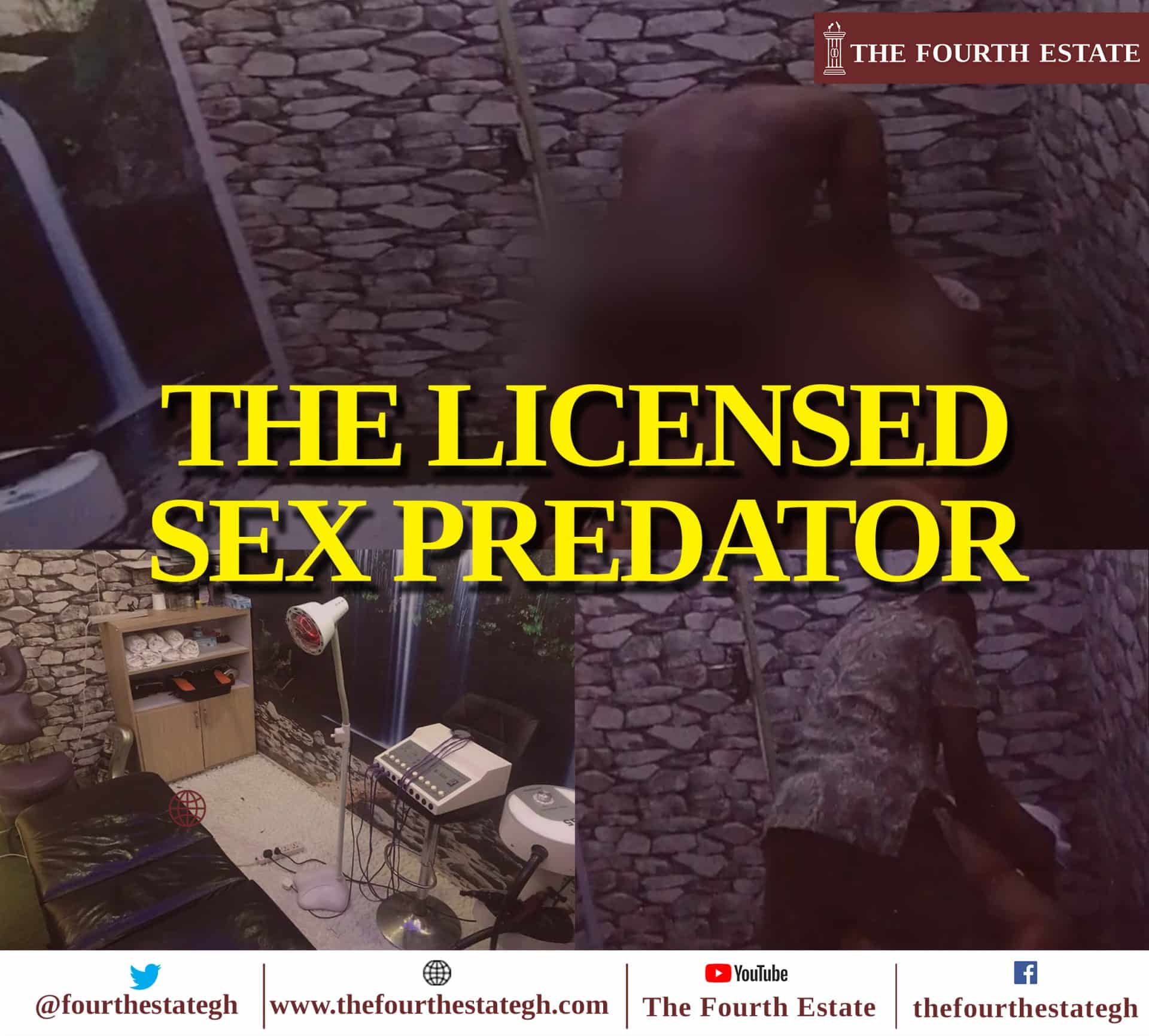
  • THE LICENSED SEX PREDATOR (Part 2): Quack practitioner with 3 licences

    THE LICENSED SEX PREDATOR (Part 2): Quack practitioner with 3 licences

    In the consulting cubicle of Nature’s Hand Therapeutic Centre, one does not have to look too hard to find the documents that “legitimise” the work of “Dr.” Jonathan Ohene Nkunim. His certificates and three licences from a state regulatory body are conspicuous enough to catch the attention of an unconscious eye.

    The certificates and licenses were his fortresses when I visited his facility on April 16, 2021. They were the solid rock on which he stood; the reason he did not hesitate to open up to me when I introduced myself, my mission, and broached the first of the two subjects I had gone there to discuss. 

    Health regulatory bodies often advise patients to keep both eyes wide open when they visit a physician. It can be fatal to shut one’s eyes to unpleasant sights when one visits a health facility, they say.

    It is the reason the Health Institutions and Facilities Act, 2011 (Act 829) mandates health facilities to display licences “in a prominent place which is accessible to patients and clients in the premises of the practice.”

    Clients seek assurance from the displayed credentials. And the practitioners, such as Jonathan Ohene Nkunim, seek validation from them. But, sometimes, displaying the certificates alone is not enough reason to trust a facility.

     Efua saw licenses when she visited Nature’s Hand Therapeutic Centre, but it did not prevent the disturbing “treatment” that eventually resulted in an affair that collapsed her marriage. Suicidal Esi saw them when she visited, but that did not stop her from being “raped” on a massage bed. Stephanie saw those certificates, but they could not insulate her from being sexually abused when she sought treatment. 

    What the three women and others could not or did not see were the circumstances under which those licences were issued. And whether the practitioner kept within his scope.

    Those licences were the reason he was unnerved at the allegation that he was practising without the requisite authorisation. They were the reason he listened carefully and calmly when I broached the subject, without the faintest clue of uneasiness at the suggestion of illegality. 

    When I was done, he did not speak a word. He started to remove half a dozen certificates and licenses that were neatly framed and hung on the wall in his consulting cubicle. 

    “Dr” Jonathan Ohene Nkunim’s False Claims

    Jonathan had told Stephanie Nortey, the undercover agent The Fourth Estate sent to the facility that he was a medical doctor. He said he completed medical school at the age of 23 and went to China to specialise in neuromuscular practice. He then returned to Ghana to work at the Korle-Bu Teaching Hospital before setting up his facility in 2018, he claimed.

    My checks from the Medical and Dental Council showed that the Council did not have any such name ever licensed as a medical doctor in Ghana.

    His age, which varied depending on the age of the woman he wanted to sleep with, did not match the timelines he gave for his education and career journeys.

    When I chatted him on WhatsApp in the name of Stephanie, I asked for specific timelines, to which he replied with the following:

    Finished SHS 2001

    University of Ghana 2002 to 2006

    Chandzou [Chengdu University] 2006 to 2009

    When I asked him whether the duration of medical school was four years in his days, he said no. That was the first time he claimed he had studied physiotherapy at the University of Ghana, and not medicine. But the admission that he wasn’t a medical doctor, but a physiotherapist, would later prove to be false.

    When I asked the hall of residence he had been at the University of Ghana, he named the all-male Commonwealth Hall, before going ahead to say that I sounded like a detective.

    “V-mate!” I said, salutation with which members of the hall greet each other.

    “Kokookokor,” he responded.

    When I asked how he combined physiotherapy and neuromuscular in his practice, Jonathan Ohene Nkunim said he used his expertise in neuromuscular techniques to diagnose his patients but treated them with his expertise in physiotherapy. 

    His set of skills were rare and very much sought after, he had told Stephanie. He could not stand the jealousy and petty squabbles at the Korle-Bu Teaching Hospital, the nation’s biggest hospital, so he left in 2018 to set up his facility.

    However, checks at the human resource department of the Korle-Bu Teaching Hospital revealed that no such person had worked in the hospital in the last five years. Neither the name nor the photograph of Jonathan Ohene Nkunim (which they requested) rang a bell to those who were in a position to know if he had worked there.

    Dr. Paul Amankonah, the President of the Ghana Physiotherapy Association, told me that name did not ring a bell in the physiotherapy space in Ghana. Dr. Amankonah, who works at the Physiotherapy Department of the Korle-Bu Teaching Hospital, also said no such person was known to have worked in the department in recent years.

    Before I confronted Jonathan with the information from my background checks on him, I took interest in his certificates and licences. So, they were not new to me when he placed them on the consulting table in front of me and asked that I go through them and satisfy myself that he was both qualified and licensed to practice.

    The most advanced certificate that represented his professional qualification was a multi-coloured one purportedly from the Chinese National Certification Commission for Acupuncture and Oriental Medicine. It was by the Chengdu University in China.

    The certificate, (R.TCMP) Neuromuscular (Star 4), was awarded to Jonathan Ohene Owoo.

    Jonathan Ohene Nkunim explained that his surname used to be Owoo until he changed it to Nkunim. He also explained to me that the neuromuscular programme was up to 12 Stars, but he stopped at the fourth star.

    He also had two certificates from two free online programmes—Neurological disorders, and Physical Therapy Aide—awarded to him in June 2020 by Alison. Alison describes itself as “one of the world’s largest free learning platforms for education and skills training.”

    Apart from the three certificates, Ohene Nkunim also had three licences from the Traditional Medicine Practice Council (TMPC), Ghana’s regulatory body for traditional and alternative medicine. On its website, TMPC says it “is not relenting in its determination to brand and create a respectable image for Traditional and Alternative Medicine (TAM) practice in Ghana.”

    One of licences the council issued to Jonathan Ohene Nkunim is to enable him to practice as a “Doctor of Alternative Medicine”, while the other gave him the right to practice as a “Herbal Medicine Practitioner”. The third was a licence issued to Nature’s Hand Therapeutic Centre by the Traditional Medicine Practice Council.

    I Lied About My Credentials

    Jonathan Ohene claimed he was a medical doctor and later claimed he was a physiotherapist. The Fourth Estate found both claims to be false

    “Dr.” Jonathan Ohene Nkunim does not tell his clients what kind of “doctor” he is. On social media and in some of his official documents, he creates the impression that he is a medical doctor. He, however, came clean when I confronted him. He told me he was a traditional doctor, which allowed him to use herbal medicine for treatment. He also said he was an alternative doctor, which allowed him to use various forms of therapy for treatment.

    “When we talk of therapy, it combines so many things. We have light treatment, electro-pulse treatment, detoxification, physical therapy and massage,” he explained.

    “Did you study physio itself, physiotherapy as a course?” I asked.

    “No,” he said.

    He said when he returned from China, he was not accepted by the Ghana Physiotherapy Association. 

    “Neuromuscular has no faculty in Ghana. So, when I approached the Ghana Physiotherapy Association, they said they couldn’t place me because what I do is an advanced form of physiotherapy.”

    “Did you work at Korle-Bu?” I asked him.

    “No, I didn’t,” he said.

    “One of your clients told me you said you worked at Korle-Bu—the physiotherapy unit—for two years.”

    “I want to get my facts right,” he said after a long pause. “Am I being recorded?” he asked.

    I told him I wasn’t recording him, but I had come with a camera crew for an official interview if he wanted to be recorded.

    He initially said he would think about it. But after we discussed the sexual abuse of women at his facility, he said a story of that nature would create the impression that he slept with all the women who visited him. It wouldn’t be good for his female clients, he said. So, he declined a recorded interview.

    But he continued. And conceded that he had lied about his credentials and work at the Korle Bu Teaching Hospital.

    Jonathan Ohene Nkunim had also told Stephanie Nortey that he was a medical doctor and later conceded he studied physiotherapy when I chatted him on WhatsApp as Stephanie. When I met him, I asked why he presented himself to his patients as someone he was not.

    “I wanted to inspire her [Stephanie] so I lied to her,” he said.

    “That you went to the University of Ghana, which is not true?” I asked.

    “Yes. Today if she comes…She’s supposed to be here today. I don’t know why she’s not here. When she comes, I’ll tell her that ‘some of the things I said, take it with a pinch of salt’. They’re not true.”

    “If you’re telling your patients what is not true—that you have some qualification which you don’t— doesn’t it breach your ethics?”

    READ ALSO: THE LICENSED SEX PREDATOR (Part 1): Divorce, rape of suicidal woman

    He disagreed that he had told them about qualifications he did not have. He said he had lied about schools he had attended, but not his qualifications.

    He said he did not attend any university or tertiary institution after he completed senior high school. He had the chance to travel to China, where he did a programme in neuromuscular practice and returned.

    He is not a medical doctor as he had claimed to some of his patients. He is not a physiotherapist or licensed to practice it. He has not attended the University of Ghana. And he had not worked at the Korle-Bu Teaching Hospital as he claimed. He admitted he had lied to impress his female client, The Fourth Estate’s undercover agent.

    As of September 2021, Ohene Nkunim said he had between 170 and 200 active patients he was attending to. Asked about the stack of about 500 patients’ folders at his facility, he said those were patients he had treated and discharged.

    Some of his clients, he said, were high-profiled Ghanaians, including some politicians. 

    Traditional Medicine Practice Council’s role in the “fake” license

    Torgbuiga Yaka IV is the Registrar of the Traditional Medicine Practice Council, the regulatory body that licensed Jonathan Ohene Nkunim

    On April 19, 2021, I wrote to the Registrar of the Traditional Medicine Practice Council. I wanted to confirm that the council had, indeed, issued Jonathan Ohene Nkunim with the licenses he was operating with.

    I also asked the Council to confirm whether their licences allowed Ohene Nkunim to offer the range of healthcare services he advertised and offered.

    Jonathan Ohene Nkunim describes himself on social media as “a Doctor by profession and a gosple [sic] minister by calling.”

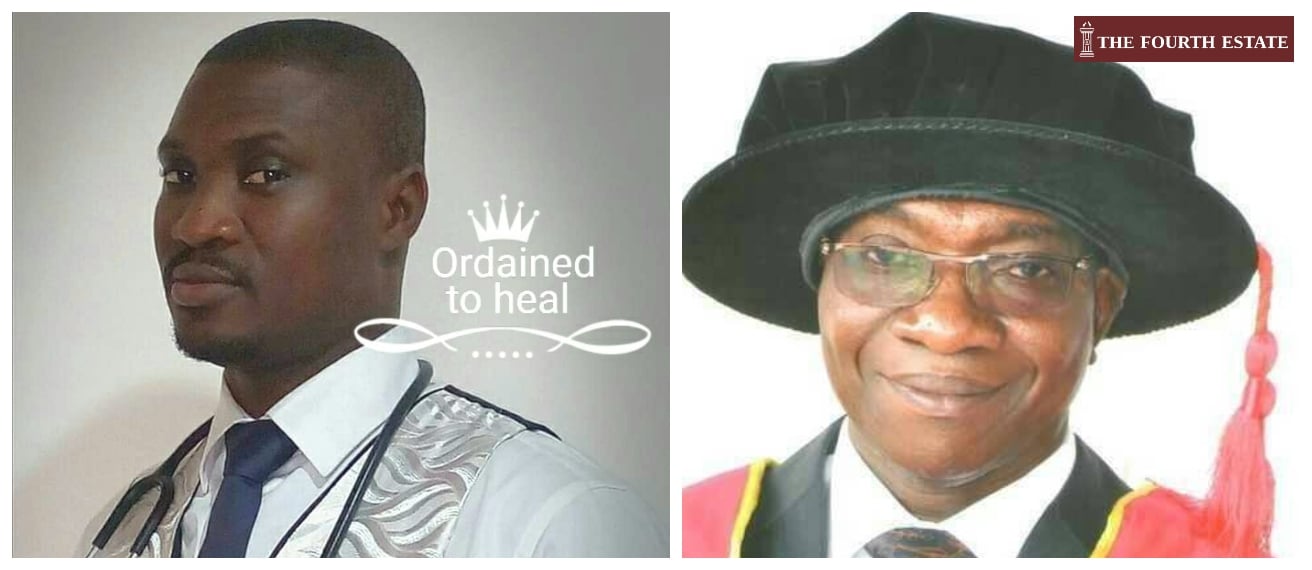
    A Facebook photo of him sporting a white long-sleeved shirt, a black and silver waistcoat and a navy-blue necktie and with a stethoscope around his neck is captioned, “Ordained to Heal.” On his Instagram page, the same photo is captioned, “I may be a Doctor but the worshipper in me is who I really am.”

    A business card with the name “Dr. Jonathan Ohene Nkunim” describes him as a Neuromuscular Specialist. The services he provides at Nature’s Hand Therapeutic Centre, as stated on the card, are: “General Diagnosis, Neuromuscular Therapy, Physio Therapy, Detoxification and Spine Straightening.” A notice at the entrance of his facility as well as the official Facebook page of Nature’s Hand Therapeutic Centre lists additional services as “Oriental Pulse Diagnosis, Herbal Options (Ghanaian and Chinese), Stroke Rehabilitation Therapy, Sports Massage, etc.”

    I wanted to know what basis the TMPC offered the three licences to him to practice and what were the limitations of those licences.

    In a response dated June 9, 2021, the TMPC said it had given Jonathan Ohene Nkunim and his facility two licences. The TMPC said it gave him a licence as a “Herbal Medicine Practitioner” and “that of his facility as an Indigenous Facility. The two licences would expire on 30th May 2021,” the letter signed by the TMPC director of administration, Nelson Menorkpor, said. 

    “According to our records, T/Dr. Ohene Nkunim is not a Doctor of Alternative Medicine but a Herbal Medicine Practitioner,” the letter emphasised.

    On the scope of practice authorised by the licences, the TMPC letter said “he can only work generally on a patient using traditional medicine.”


    Before the TMPC responded to my letter, however, I had a call from Jonathan Ohene Nkunim. He told me that the TMPC had come to close down his facility because one of his licences—the one for alternative medicine practice— was said to be fake. He said the TMPC officials said I had written to them to enquire about the licences and they had acted based on my letter and realised his third licence had issues.

    Asked how he acquired the licence, he said the general secretary of the Ghana Alternative Medicine Practice Association (GAMPA) had offered to assist him to acquire the licence from TMPC when he asked about the process on the association’s WhatsApp platform. He, therefore, paid the money to the secretary, and he later returned with the licence and official receipts covering the payments.

    The TMPC closed down Nature’s Hand Therapeutic Centre on May 12, 2021. William Korlo, an officer at TMPC made a complaint at the Gbawe Police against Jonathan Ohene Nkunim for practising alternative medicine without a licence, the police told me. 

    My checks with the Odorkor Divisional Police Command, which oversees the operations of the Gbawe Police, also revealed that three suspects were being investigated.

    They were Jonathan Ohene Nkunim, the secretary of GAMPA, whose name was given as Hilary; and an officer at the TMPC called Anthony Agyapong.

    According to the police, their investigation had revealed that Hilary took GHc3000 from Jonathan Ohene Nkunim as the fee for the licence. (Ohene Nkunim later said he paid GHc3,500 to the secretary of the association.)

    Hilary then paid Anthony Agyapong of the TMPC GHc1000 to process the licence. Anthony Agyapong, in turn, paid GHc750 to the TMPC as the official charge for the licence, which was processed and printed out for Ohene Nkunim. 

    The disputed license was duly signed by the registrar of TMPC, Torgbuiga Yaka IV.

    Jonathan Ohene Nkunim and his facilities had three licences from the Traditional Medicine Practice Council

    The contention, which is still being investigated at the time of filing this report, is the fact that the licence that was issued to Jonathan Ohene Nkunim by the TMPC, had the same serial number as the one that had been issued to another alternative medicine practitioner named Dora Ntiamoah, a female. The photographs of the practitioners on the licences were, however, different.

    At the time of filing this report, the police had interrogated three suspects. The police said the TMPC’s Anthony Agyapong insisted the license issued to Jonathan Ohene Nkunim was genuine and explained that the serial number was generated by the TMPC’s IT unit and they may have made a mistake.

    These anomalies had come up almost two months before the TMPC responded to The Fourth Estate’s letter. That letter was what triggered the discovery of the anomalies, but the TMPC invited other media houses to cover the closure of Nature’s Hand Therapeutic Centre without inviting The Fourth Estate.

    When TMPC responded to my letter specifically asking about the licences, the TMPC did not mention any of the internally-generated anomalies in which two licences with the same serial number had been issued to two different practitioners. It did not mention the shutting down of Nature’s Hand Therapeutic Center as a result.

    Jonathan Ohene Nkunim later called to inform me that he had reapplied for the licence after the TMPC shut down his facility. He said the council had said it was unable to process his application because of my investigation. He was, therefore, pleading with me to intervene. Officials of the council, he told me, said if I could write to withdraw my letter requesting information on his facility, they would go ahead and process the application.

    New licence issued, Nature’s Hand reopened

    The TMPC issued Ohene Nkunim this licence even while the police were still investigating his previous licence which was acquired under dubious circumstances. The TMPC appeared to have ignored the fact that the services listed on his call cards, notice at the premises of his facility listed services he had no training to provide. The Fourth Estate brought this to the attention of the TMPC before it issued this licence,

    The police are still investigating the circumstances under which Ohene Nkunim obtained the licence that had been declared fake by the TMPC. The registrar of TMPC, Torgbuiga Yaka IV told me on the phone that he welcomed that investigation because there were bad nuts in his institution who were undermining efforts at quality control in the field of traditional and alternative medicine practice.

    A visit to Nature’s Hand Therapeutic Centre however revealed that the facility has been open for operations.

    Torgbuiga Yaka IV said even though Ohene Nkunim’s licence for alternative medicine was still being investigated by the police, the Council had issued him a new license after he presented certificates of online courses he did.

    That new licence was issued on July 31, 2021, and signed by the registrar states the type of practice as “massage therapy.”

    A wide range of services, including physiotherapy, which Ohene Nkunim has said he wasn’t trained, are still advertised at the facility. 

    What qualified Jonathan Ohene Nkunim for the two other Licences

    In my letter to the TMPC, I asked, “What qualifications did Dr. Jonathan Ohene Nkunim provide to the Council before he was given the licences?”

    The TMPC’s response was, “Show evidence of membership of a Traditional Medicine Practice Association.”

    According to the Traditional Medicine Practice Act, 2000 (Act 575), the above reason is not listed as one of the conditions to grant a practitioner and his facility a licence to practise.

    Some trained practitioners of alternative and traditional medicine are worried that the TMPC is licensing quacks without doing due diligence. 

    On April 24, 2021, a traditional medicine practitioner wrote to me to investigate the laxity in the TMPC’s operations. He didn’t know that I was working on a story that involved the council. He was worried that dolling out licences to whoever asked for one portended danger for the unsuspecting public who visit such health facilities.

    “The challenge here is with the regulator. They barely regulate anything. They issue certificates even without coming to inspect premises and they did it to me 2 times. All I needed to do was just pay them after filling the forms and they called me and issued me a licence for operation,” the practitioner said.

    This practitioner was worried that the TMPC was making it difficult to differentiate the fake practitioners from the genuine ones by indiscriminately issuing licences to whoever had money to pay and ask for one

    “Our training in KNUST [Kwame Nkrumah University of Science and Technology] and Mampong [Centre for Plant Medicine] takes us 6 years to be licensed. We are trained in medical school and Pharmacy school and then we do attachment and clinical rotations for additional two years. When you are out, and you see the body responsible for ensuring sanity in the system messing up, it hurts,” the petitioner said.

    More breaches with the FDA and Allied Health Professions laws

    Dr. Samuel Opoku, the Registrar of Allied Health Professions says Ohene Nkunim could not practise as a physiotherapist without being registered by the Council

    In April 2021, I wrote to Health Institutions Regulatory Agencies (HeFRA) to ascertain whether the range of services provided at Nature’s Hand Therapeutic Centre required the licensing of the facility by HeFRA. 

    (HeFRA is responsible for licensing health facilities even if the individuals are licensed by their respective bodies. For instance, medical doctors and dentists are licensed by the Medical and Dental Council, but the facility in which they operate will still have to be licensed by HeFRA.)

    Ohene Nkunim and his facility have advertised that they offer physiotherapy. The President of the Physiotherapy Association of Ghana said whoever practices physiotherapy must first have their facility licensed by HeFRA.

    At the time of filing this report (September 23, 2021) HeFRA had not responded even after several follow-up visits to the registrar’s office.

    The Registrar of the Allied Health Professions Council, Dr. Samuel Yaw Opoku, told The Fourth Estate that HeFRA was responsible for licensing facilities where services such as physiotherapy were offered. However, the practitioner, such as Ohene Nkunim or whoever practised as a physiotherapist in Ghana, had to be licensed by the Allied Health Professions Council.

    When I met Ohene Nkunim, he said he did not practise Physiotherapy. He explained that what he did was physical therapy.

    “I do physical therapy and it doesn’t require license if I’m doing it as alternative medicine,” he said.

     Dr. Samuel Opoku, however, said those were issues of semantics but they meant the same thing.

    What, perhaps, ends any form of controversy in this regard is the fact that Jonathan’s call card lists the services he provides. In that list is “Physiotherapy”.

    Quoting offences contained in the Allied Health Professions Act, Dr. Samuel Yaw Opoku said among others that a person commits an offence under the Act if they: 

     “(a) makes a false declaration in an application for registration as a practitioner; (b) willfully and falsely uses a name, title or an addition implying a qualification to practice as an allied health professional; (c) practices or professes to practice as an allied health professional without prior registration; (d) fails to renew registration and continues to practice; (e) provides unauthorised service in a licenced facility; (f) provides service in an unlicenced facility; (g) fails to conform to practice standards of the allied health profession;…”

    Jonathan Ohene Nkunim lists physiotherapy as part of the services he provides at his facility.

    Jonathan Ohene Nkunim also dispenses medicines that are mainly from China. He initially told me they were registered by Ghana’s Food and Drugs Authority, but when we inspected one of the containers together, there was no sign of any FDA registration.

     He then claimed that the approval had rather been done by an international body called the EPA. Once the EPA approved a medicine, he argued, it did not require any further approval from the FDA.

    This is, however, not true according to the FDA law. Section 118 of Act 851 states: “A person shall not manufacture, prepare, import, export, distribute, sell, supply or exhibit for sale a drug, herbal medicine product, cosmetic, medical device or household substance unless the article has been registered by the Authority.”

    One of the medicines he prescribed and sold at his facility to The Fourth Estate’s undercover agent had all its writings in Chinese.

    According to the 2019 Global Report on Traditional and Complementary Medicine, published by the World Health Organisation, “herbal medicines are used by 80-99% of the population” in Ghana. 

    The establishment of the Traditional Medicine Practice Council and the introduction of herbal medicine programmes in the university were meant to solve this problem and protect patients.

    But it appears the aim to sanitise traditional medicine practice will take much longer to achieve if the likes of Jonathan Ohene Nkunim could get three licences without any proof that they have what it takes to safeguard the patients they are licensed to attend to.

    EDITOR’S NOTE: PART One of this story revealed how Women who visit Nature’s Hand Therapeutic Center were sexually abused and in some cases, raped. You can read it here.

    The full video documentary on this investigation will be published on Monday, September 27, 2021. You can subscribe to The Fourth Estate’s YouTube Channel and be notified.

    This content should not be published in part or in full without the express permission of The Fourth Estate

  • THE LICENSED SEX PREDATOR (Part 1): Divorce, rape of suicidal woman

    THE LICENSED SEX PREDATOR (Part 1): Divorce, rape of suicidal woman

    A woman who wanted a child and went to see “Dr” Jonathan Ohene Nkunim had her marriage ruined

    • A suicidal woman who went to seek a cure for her back pain was raped on the first day
    • He sexually abused The Fourth Estate’s undercover agent and proposed treating her in a hotel
    • Jonathan says he currently has between 170 and 200 active patients he attends to, including high-profile personalities.
    • More than a year’s investigation by The Fourth Estate has unraveled other shocking details about his practice and qualifications.

    The married woman who wanted a child

    In 2018, a woman and her husband walked into Nature’s Hand Therapeutic Centre at Gbawe, in Accra, to seek the healing hand of a man.

    Efua Baiden, a 34-year-old businesswoman (not her real identity), and her husband were optimistic about finding a solution to their problem. This solution, they hoped, would in turn enhance and give more meaning to their seven-year-old marriage. But they would learn—rather too late—that their move was an ill-fated exercise of faith because they swallowed a poisonous bait on their first date with the man they considered a specialist.

    For the sake of her privacy and that of the man with whom she went to the health facility, Efua does not want to disclose the traumatic experience that preceded and necessitated their visit to the health facility. To her, the entire episode has come to represent a gothic monument of regret erected in the museum of her mind. She wishes to forever shut that museum out of her life, but she is too concerned to shut up because of the fear that more women might fall prey as she did.

    To resolve this internal conflict and avoid resurrecting a past that affected other parties, she requested that certain details should not be disclosed in her story. These details include a traumatic loss that destabilised her emotionally, prior to the visit to Nature’s Hand Therapeutic Centre.

    But these and other health details were not hidden from the man whose medical expertise they sought in 2018, for a woman in labour, it is said, does not hide her private parts from the birth attendant.

    Efua was not in labour. They had hoped that Efua would be able to go to the labour ward nine months after that visit. It would have been the second time in her life.

    But, in the end, she did not go to the labour ward. She was taken to court.

    The Predator and his trap

    The man whose expertise they went to seek, “Dr.” Jonathan Ohene Nkunim, is the CEO of Nature’s Hand Therapeutic Centre. He describes himself on social media as “a doctor by profession and a gosple [sic] minister by calling.”

    There are videos of him singing in church, his ministration drawing worshipers to the altar to kneel and lift up their hands in total submission and supplication to God. Social media photos of Jonathan paint a picture of a loving husband and a doting father.

    “Dr.” Jonathan’s professional profile is well promoted on his personal social media pages as well as the official page of Nature’s Hand Therapeutic Centre.

    A Facebook photo of him sporting a white long-sleeved shirt, a black and silver waistcoat, and a navy-blue necktie and with a stethoscope around his neck, is captioned “Ordained to Heal.” On his Instagram page, the same photo is captioned, “I may be a Doctor but the worshipper in me is who I really am.”

    A business card with the name “Dr. Jonathan Ohene Nkunim” describes him as a Neuromuscular Specialist. The services he provides at Nature’s Hand Therapeutic Centre, as stated on the card, are: “General Diagnosis, Neuromuscular Therapy, Physio Therapy, Detoxification, and Spine Straightening.” A notice at the entrance of his facility as well as the official Facebook page of Nature’s Hand Therapeutic Centre lists additional services as “Oriental Pulse Diagnosis, Herbal Options (Ghanaian and Chinese), Stroke Rehabilitation Therapy, Sports Massage, etc.”

    In a letter he wrote in April 2021 requesting permission on behalf of a female client from her employers to enable her to undergo treatment, “Dr. Jonathan Ohene Nkunim” signed as the “head medical officer.”

    Advertising his faith and celebrating his wife on social media present Jonathan Ohene Nkunim as a responsible family man in addition to his profession. But the image he portrays appears to contradict the true character of the man who varies his age depending on the age of the woman he’s dealing with.

    The service Efua and her husband went to seek is among a host of other unnamed health remedies offered at Nature’s Hand Therapeutic Centre.

    “I wanted to have a baby, so I was introduced to him,” Efua recalls, adding that she initially had her doubts but the encouragement from her husband and the dire need of a child eclipsed those doubts.

    At the facility, she was diagnosed in a way she had never seen before. The “doctor” held her hand, touched the back of her palm with his fingers and told her everything that was wrong with her. She said there appeared to be some accuracy in what he said.

    “I won’t say 100%, but some were kind of accurate,” Efua said.

    Beyond telling the “doctor” about the most private aspects of their reproductive health, the procedure “Dr” Jonathan recommended to be performed on Efua involved further prying into her privacy—her most private part.

    “He mentioned that I had a problem with my cervix so I needed to do a procedure which would help me to conceive once a therapy had been done,” Efua recalled.

    To her, this was not too big a deal if that could get her to conceive. What made her uncomfortable was what “Dr.” Jonathan said must precede the procedure. He told her that she had to be sexually aroused before he could perform the procedure.

    Fortunately, she went with her husband. Unfortunately for the couple, however, the environment was not conducive for romance and arousal.

    Nature’s Therapeutic Centre is a single room on the ground floor of a two-storey uncompleted building at Gbawe CP. Apart from the fading signage scrawled in green, nothing gives the indication that it is a health facility. When it is closed with the roofing sheet-like roller shutter, it looks more like a garage or warehouse than a health facility.

    Inside, it is partitioned into three compartments. A third of the compartment serves as the reception and the waiting area. If you stood in the reception area with your back to the entrance, there is a door to the left which opens to the doctor’s consulting room. In the consulting room, there is a compartment to the right with another door. It opens into the treatment cubicle.

    Much of the space in the treatment area is taken up by the only massage table. If Mr. Nkunim isn’t playing loud music in his consulting room—which he often does— a footstep, a cough, or whisper from any of the three compartments could be heard by anyone inside the facility.

    Due to the presence of workers and patients at the stuffy facility, Efua and her husband did not think there was the needed privacy to get her aroused before the procedure started. And they told the “doctor”.

    That did not stop Jonathan Ohene Nkunim from continuing with the treatment. In fact, that response from women, with or without their partners, was not new to him. It was a trap he set often, and his prey almost always fell into it. It was his way of seeking their consent to intimately intrude and violate them.

    Efua was not the first and would not be the last to fall into this trap.

    “He inserted something like a probe—I don’t know what it was—into me and he kept doing his own thing there,” Efua recalled the procedure.

    Efua said, at a point, “Dr” Jonathan sent her husband out of the facility to “go and buy an iced block or something and I realised, though he didn’t penetrate, it was more like he was trying to have sex with you. He was playing with me down there, getting me aroused and I wasn’t feeling comfortable. According to him, that was the procedure.”

    Efua later told her husband that she was not comfortable with the procedure, but she could not bring herself to give him all the details. Her husband encouraged her to continue since she had already started.

    “Once you’ve started a procedure, at least, try and finish. You might never know what would work for you,” Efua remembered her husband telling her. And she continued.

    The procedure to enable her to conceive focused more on what appeared like foreplay, and Efua was convinced the doctor was up to something when he started sending text messages to her phone in-between her visits to his facility.

    “He started sending me messages like, trying to make advances towards me and I was kind of like, I mean, where from this? I just came to your office for help,” Efua recounted her initial reaction.

    While making sexual advances at Efua, Jonathan Ohene Nkunim gave her reason to believe she was at the right place and would conceive after the procedure.

    “And, of course, he sounded convincing. He gave me all the facts I needed to know to prove that it would work,” Efua said.

    The procedure did not work. What worked was Jonathan Ohene Nkunim’s alleged seduction. Efua said she lost her guard as the arousal and sexual advances continued.

    She and Jonathan Ohene Nkunim later had an affair.

    After the affair, her guilt-ridden conscience would not permit her to keep it away from her husband. When she confessed, her husband said he had forgiven her. However, Efua realised from his actions that his heart had forgiven her but his mind still battled with it. She was hoping he could overcome it but feared he might not.

    Her fears were confirmed when a bailiff served her a divorce notice. The affair with “Dr” Jonathan Ohene Nkunim was the reason her husband wanted their marriage annulled.

    And the court granted it.

    Ohene Nkunim apologised to her, but she had wanted him to also apologise to her husband. She still thinks that might have helped to calm him down and perhaps save her marriage.

    But he did not apologise to him.

    “I don’t know whether he is a real doctor or a fake doctor…for him to take advantage of me and not even show any [remorse],” Efua said, regretting the decision to have subjected herself to the “treatment”. “It really affected me and as we speak, my marriage has broken down because of whatever happened with the doctor.”

    After the affair and the collapse of Efua’s marriage, Ohene Nkunim told her that was not his nature. With Efua, however, he said he did not know what had come over him. He could just not resist her, the “Dr” gushed over his client. But Efua does not believe he is the person he claims he is. She suspects others may have fallen prey to the same predatory traps.

    “He claimed he liked me and it just happened. But apparently, I’ve heard cases—I mean it’s a rumour I heard,” she said.

    “I think I’m not the first victim, according to the rumour I heard. I believe that it is something he probably does to innocent women or wives, people who come seeking medical attention. I think it’s something he does to take advantage of vulnerable women in the name of the medical profession,” she explained her reason to open up two years after her experience.

    Efua was not wrong. She is one of three female clients of Jonathan Ohene Nkunim The Fourth Estate spoke to in the course of this investigation. He had made sexual advances at all three. He succeeded in sleeping with two, including a suicidal woman he allegedly raped. It happened on the massage table in the facility. This happened a few feet away from where his wife worked as the administrator of the health facility.

    Stephanie Nortey, the prey who became the predator

    Jonathan Ohene Nkunim trying to arouse The Fourth Estate’s undercover agent, Stephanie

    “Dr” Jonathan Ohene Nkunim was expecting a client—a special client. The client had visited the health facility three times, and the fourth was more significant to Jonathan than all the previous ones.

    Stephanie Nortey, for that, was the name of the client, was visiting to continue treatment for “lumbar spondylosis”, which Jonathan Ohene Nkunim had diagnosed.

    But that was not the reason he eagerly looked forward to her visit that morning. She owed Jonathan Ohene Nkunim a response to a love proposal he had made when she last visited.

    He had wanted a response by the close of the day he proposed, but he didn’t get it. Stephanie had requested some time to think about it. She wanted to get to know him better before deciding whether or not to be in a love relationship with the man whose lasciviousness was not masked the very moment she had met him.

    On the morning of Friday, April 16, 2021, however, Jonathan Ohene Nkunim received a WhatsApp message from the phone number through which he had often communicated with Stephanie. It was on that number that Stephanie had first called him and complained about her excruciating back pain. The pain stretched from her neck and increased in severity at her lower back, she had said. He had asked whether she had taken an X-Ray or MRI scan, and Stephanie had said no.

    “Can you try touching your toes right now?” he had requested.

    “Like I should bend?” she asked.

    Stephanie was lying on a couch while making the phone call and did not make any attempt to even sit up. But she told him she did and felt the pain intensifying in her lower back.

    “It looks like you are suffering from lumbar spondylosis,” he said and recommended treatment when she first visited the health facility the following day, March 23, 2021.

    Stephanie was supposed to have the treatment session twice a week for a month, but the first visit alarmed her. Besides the part of the treatment which sounded weird—a trick  Ohene Nkunim often used to trap unsuspecting and desperate female clients—he “rubbed his erect penis” against Stephanie’s buttocks when she lay on the physiotherapy table to be treated. He placed her sideways so that her butts faced his zip.

    When Stephanie later drew his attention to this in a WhatsApp chat, Jonathan asked whether she had liked it. He then apologised profusely when she said she was uncomfortable with it. But that apology would not end his sexual advances towards her. In fact, Stephanie was not the first recipient of that profusely remorseless apology. Remorseless, because he had done worse things after such apologies in the past.

    After Stephanie’s second visit to the health facility, Jonathan Ohene Nkunim suggested that the next treatment be held at a resort in Lapaz, a suburb of Accra. He had said the treatment for lumbar spondylosis required sexual arousal, and despite touching Stephanie sensually during treatment, she did not “respond”. He then concluded that the setting was not conducive and therefore recommended what he said had worked for some clients in the past.

    The resort in Lapaz, Jonathan Ohene Nkunim said, was where he often went to relax and read when he was not working. Treatment there would come at no additional cost to Stephanie. If she wanted a different hotel or guest house aside from the one in Lapaz, he was prepared to explore that.

    Stephanie said she wasn’t comfortable with going with him alone to a hotel room outside the facility. He then offered a “special session” with Stephanie as the only client for the day and Jonathan as the only worker on duty. This happened on the Saturday between Good Friday and Easter Sunday, this year.

    Jonathan Ohene Nkunim

    It was on that Saturday that he expressly proposed a love after the caressing and sexually touching Stephanie did not yield any results.

    In subsequent WhatsApp conversations that travelled into the heart of the night, Stephanie, in her bid to know Jonathan Ohene Nkunim before accepting his proposal, extracted as much information as possible from him, some of them incriminating.

    “You sound like a detective,” he once said in a WhatsApp message after series of probing. He would, on a later date, call Stephanie “Madam detective”.

    By that Friday of April 19, 2021, Stephanie had known enough, and Jonathan expected a response.

    In the WhatsApp message that morning, Stephanie asked whether he was in the office. When he said he was, Stephanie said she was sorry she could not make it because she was busy at the office.

    That message to Jonathan Ohene Nkunim was typed in a car parked outside his health facility. Three minutes later, the owner of the hands that typed the message entered Nature’s Hand Therapeutic Centre, where Ohene Nkunim was busy in his consulting room.

    A fair young lady in a black T-shirt over a pair of blue jeans was leaving the facility. A few minutes later, a man in his late thirties or early forties laboured, with the support of a walking stick, out of the consulting room into the reception area. He was recovering from a stroke, Jonathan Ohene Nkunim would later confirm. As he sat in the reception area and made a phone call, a woman in her late forties entered to see the specialist.

    She would not emerge until after an hour.

    At the small counter in the reception area, a young man called Eben and a young woman, in green uniforms, were welcoming clients and dispensing medication to those who had seen the “doctor”.

    “Are you here to see the doctor?” the lady asked.

    “Yes.”

    “Have you been here before or this is your first time?”

    “I’m coming for a different issue, not for treatment,” said the person who had sent the WhatsApp message in the vehicle asking if Jonathan Ohene Nkunim was at work.

    Six minutes later, Ohene Nkunim emerged from the consulting room, wearing a dark blue uniform. His two last names, “Ohene Nkunim”, were amateurishly embroidered with a white thread across the right shoulder of his uniform. He called the next person and led the way back to his consulting room.

    In the consulting room hung a number of certificates, including two licenses from a state regulatory agency, which he used to legitimise his illegal operations.

    “My name is Manasseh Azure Awuni, a journalist with The Fourth Estate,” I told him after he beckoned me into a chair where his clients sat for consultation.

    Ohene Nkunim had asked the woman who had entered before I was called in to undress and wait on the physiotherapy table in the treatment cubicle. He wanted to attend to me quickly and go and work on her. But she would lie there for more than an hour, and I would be invited to see her half-nakedness twice before leaving the facility. It was an intrusion to her privacy, which was without her consent.

    I had been investigating Jonathan Ohene Nkunim and his facility for months. My undercover agent, Stephanie Nortey (not her real name) had met him on three occasions. With the phone Stephanie first used to contact him, I got Jonathan, in extensive WhatsApp chats, to contradict a number of things he told Stephanie in the undercover recordings. As I met him that morning, he still thought the “detective” he had been chatting with was Stephanie Nortey.

    When I confronted him and pointed the issues to him, he confessed to some after initially denying them outrightly. The denials he still stood by were not helpful to him. There was strong and abundant evidence to the contrary.

    The suicidal woman raped on the first day

    WhatsApp conversation between Esi and the person who introduced her to Jonathan Ohene Nkunim

    By the time Esi, a 28-year-old banker (not her real identity) was introduced to Ohene Nkunim in 2020, she had been contemplating suicide. She had gone to hospitals but could not find a remedy for her sustained back pain.

    She feared she might be paralysed but it was the unbearable pain that told her that ending her life was a better option.

    “When I take the pain killers, it’s like I haven’t taken any medication at all. The pain is so severe you cannot bear it. Coupled with that I couldn’t move. My body was giving electric shocks and it had gotten to the point that I didn’t understand why I should bear this pain. So, I was considering committing suicide,” Esi recounted.

    Two days after she first thought about taking her life, someone gave her a lifeline—Jonathan Ohene Nkunim’s hotline.

    “She only told me that he is a neuromuscular specialist and that he is also good at these things so I should go and try it,” Esi said a former female client of Jonathan’s had told her.

    Six days after she first called him, Esi was driven by a male friend to Nature’s Hand Therapeutic Centre in Gbawe.

    “The day I got there, to be honest with you, I still couldn’t walk, so I was held on both sides before I could painfully move a leg. So gradually, I got there. And when I got there, he saw me and assured me that I will be better so I shouldn’t worry and that he was going to do his best to ensure that I got better.”

    Jonathan Ohene Nkunim has confirmed Esi was in a very bad state when she first visited. He told me she couldn’t get out of the car on her own. Her condition had deteriorated so badly that he had even contemplated rejecting her.

    Esi said after tapping the veins at the back of her palm, Jonathan Ohene Nkunim’s diagnosis matched the results of her X-rays and scans. She had told him about the scans and X-rays when he enquired about her medical history on the phone. Esi’s treatment that same day.

    “He actually came to assess me and started his therapy, mainly massage… He said all he needed to do was to manipulate my bone, my spinal cord to be back in shape so that the part of the spinal cord that was pressing on my nerves could be released,” she remembered him describing the treatment.

    Esi had gone there to treat back pain and she had not been told that she had any problem with her reproductive system. That was, perhaps, what aggravated her shock when the “treatment” started.

    “I noticed that he actually was massaging my buttocks and inserting his fingers into my vagina. The next I knew, it was his penis, and then at that time, I was at a point of desperation. I was in pain. I couldn’t shout. I couldn’t stop him actually because I didn’t know what he was doing,” she said.

    Esi said she was too shocked to discuss what had happened with the specialist after the session. Later that day, she sent a WhatsApp message to Ohene Nkuhim to complain and ask for an explanation of what had happened.

    His first reaction when Esi made reference to the therapy was to apolgise, “Awwww…sorry for being too pushy ok.”

    He then sent Esi an article on pelvic floor physical therapy, to which Esi asked what that had got to do with her. All she knew was back pain and nothing else. He said, in her case, he was “treating 2 different things here dear…pelvic floor disorder and sciatica due to spondylosis.”

    He then went on to explain that there were four different treatment options — “vaginal dilation by dilators, electropulse therapy by sending pulses to stimulate the muscles, kelgy [sic] exercises to manipulate the muscles, and hands-on stretching and insertion by hand into either the anus or vagina to trigger nerve endings.”

    This was new to Esi because they did not come up before Jonathan asked her to take off her clothes and lie on the massage table.

    “I don’t know if I’m ever going get some closure about this. How do I explain that to my partner?” she told him in the WhatsApp chat.

    His response was that her condition had deteriorated so badly that she risked being paralysed if it was not urgently dealt with. He said his therapy—the sex—was meant “to stimulate the sexual sensory nerves to enhance heavy blood circulation to allow bone and muscular manipulations.”

    The WhatsApp conversation started at 4 p.m. and at 8:46 p.m., Esi told Jonathan Ohene Nkunim the major concern about her nightmare of that day. “I needed you to have given me the opportunity to opt for the requirements of the procedure.”

    “Yes,” Jonathan agreed. “I should have sensitized you more. I was just in a rush to at least save the situation when I noticed it and was at the same time trying not to show my fear in my voice.”

    According to section 98 of the Criminal and Other Offences 1960 (Act 29), rape is having carnal knowledge of a female of not less than sixteen years without her consent.

    When Jonathan Ohene Nkunim was having sex with Esi without her consent, his wife was six feet away. She worked as an administrator at the facility. They were separated by the wooden boards that partitioned the room into three.

    But for loud music, which Jonathan Ohene Nkunim often played when consulting with her female clients or having sex, Jonathan’s wife would have heard the rhythmic squeaking of the massage table as her husband began his weird treatment.

    “I felt so bad your wife was in the next room,” Esi told him.

    “I do understand,” Jonathan said. “The plan was not to go too personal like that…but to put you in the mood and get it done. I just went overboard. Am[sic] sorry I lost control.”

    “How she was nice to me without, not knowing what had gone on,” Esi was still concerned about the innocent woman, a fellow woman whose husband had had sex with her almost in her presence.

    “Yes, I get you,” Jonathan agreed. You did nothing wrong. I did.”

    That night, Jonathan Ohene Nkunim apologised to Esi and told her, “It won’t happen again. I can promise you that.”

    But when Esi lay on the physiotherapy table on her next visit, Jonathan repeated what happened the first time. She said Jonathan had sex with her “every day of the treatment. Just once or twice that there were a lot of people around, so he didn’t have the chance to have sex. I think I’ll just count twice.”

    And how many times did you go for his session?” I asked.

    It was an entire month. And in a week, I could go for three sessions, a minimum of three sessions,” she explained.

    “So, each time he met me,” she went on, “he’d have sex with me and it wasn’t like sex that involved my input. He always made me [lie] face down and he’ll be having sex with me. He starts by massaging you and insert his entire hand in my vagina. And sometimes, I felt his hand in my womb. Then, he’d start having sex with me because he said I was too tensed and he needed to relax my muscle before he started the treatment.”

    I asked Esi why she continued to go to the facility when she knew Jonathan Ohene Nkunim would not repent beyond his profuse apologies and promise not to have sex with her during treatment.

    “I was at the point of desperation,” she explained. “I was in a suicidal mode because the pain was unbearable … I just made up my mind that if that’s what it will take for me to get back to my feet, I’d have to endure it and be with the consequences.”

    “It’s either I walk again or I get paralysed, because that’s what he told me when he met me. I was at the point of paralysis,” explained her decision to endure the sexual abuse.

    But she could not endure forever. She truncated the treatment because she could not cope with the mental and emotional stress that came with having sex with someone she did not love or did not willingly consent to.

    “I felt psychologically stressed or more burned that I came. Physically, I felt I was better than I came, but, psychologically, I felt way down,” she said o. “I feel my fidelity is now being questioned because I am in a relationship and my partner too doesn’t know that this is what I go through during treatment or during the therapy.”

    When Esi stopped the treatment, her condition was still bad despite a marginal improvement. She went to a physiotherapy facility in Accra to continue the treatment, where she said the therapists were quite professional. At no point did anyone talk about arousal or touching her beyond the treatment area, Esi revealed.

    That treatment got her back to her feet, but she would carry the burden of Jonathan Ohene Nkunim a bit longer. She had begged Ohene Nkunim to use a condom even if he would not stop the sex. But he mostly had sex with her without a condom or any form of protection.

    When her menstrual cycle was delayed, she feared she might be pregnant. Ohene Nkunim, on the other hand, said her cycle might have changed because of the drugs she was taking alongside the treatment at Nature’s Hand Therapeutic Centre. He prescribed the drugs.

    Eventually, they agreed that she take a pregnancy test. The results, to her relief, came out negative. But there was something else.

    She contracted a serious infection in her vaginal region and the doctor who diagnosed her at a different health facility was worried about the possible cause. The doctor was convinced that such an infection was very much likely to have resulted from sex. She was also convinced that sex was practically impossible for a woman in such enormous pain for a long time and could hardly walk.

    Esi decided to help the puzzled doctor. She finally broke down and shared her ordeal at Ohene Nkunim’s facility with the doctor. That doctor and the writer of this story are the only two people she has had the courage to tell her ordeal at Nature’s Hand Therapeutic Centre.

    “If it were to be true, I should be in jail by now”

    When I broached the allegation that he sexually abused women, Jonathan Ohene Nkunim did not respond immediately. He opened his mouth, but no word escaped from it. He turned in his swiveled chair, looked at me, and stared at the ceiling. He exhaled before he whispered his response.

    He had been whispering since I entered his consulting cubicle. He had connected his phone to a Bluetooth device and the music drowned our discussion from the woman waiting in the treatment cubicle and his assistants and guests in the reception area.

    This was what he did while discussing his therapy with his victims or while having sex with them in the facility. I politely asked him to pause the music because, even without it, I could barely hear him. He obliged but lowered his voice further.

    He would speak but, he would not allow me to record him. He warned me against secretly recording him because that would violate his “human rights”.

    On two occasions, he asked if it was okay to call or inform his lawyer about my interview. I told him I was okay with it, but he elected to continue without making the call.

    His initial response was a complete denial that he sexually abused any woman. Without the consent of the woman waiting on the massage table for treatment, he invited me inside. The patient was in her underwear— pantie and brassier.

    He started to massage her and asked me to observe the procedure. After a couple of minutes, he led me back to the consulting table and explained that the treatment often involved touching, which could sometimes be uncomfortable.

    “She has a spinal cord problem, so if I have to work on her… I have to touch her,” he told me, pointing to the woman.

    He said, in rare circumstances when he had to treat pelvic floor disorders, it required inserting of the hands into the vagina or anus. Because of this, he often explained to his clients and asked them to sign a consent form.

    He said he “was a bit taken aback” when I mentioned sexual assault because he explained the procedures to those he treated, and they understood, agreed and signed a consent form.

    In Esi’s case, his WhatsApp message confirms he did not seek her consent before he administered that treatment. In the case of Stephanie, she signed the consent form, but that consent did not include sexual advances.

    “So, are you saying it’s not true?” I asked him.

    “Arrrrhh! If it were to be true, I should be in jail by now,” he declared.

    “If it were true that you sexually assault your patients, you should be in jail by now? Is that what you’re saying?” I wanted to be sure I had heard him right.

    “If I have done it,” he started after a little hesitation. “If somebody comes [and tells me] ‘you did this, did this to me, and I explain and things are not in the right way, the person can take me on.

    “I will not say that things like that have not come up. We’ve had people come and say, ‘I really do not understand this and this and this is against how it is done’. I explain to you or you can go for a second opinion to see if I did something out of my jurisdiction,” he explained.

    “Did the person say I fingered her, or how?” it was his turn to ask me.

    “Yes, fingered, tried to have sex. One even alleged that you had sex with her here in your facility. Is it true or false?

    “False!”

    “So, you’ve never had sex with anyone here?”

    “This is a personal question,” Jonathan Ohene Nkunim protested.

    “If it’s your wife or girlfriend, I don’t have any problem [with that], but I’m just asking in relation to your clients,” I reminded him. “Have you ever had sex with your clients here, during treatment?”

    “Never!”

    “And you’ve never handled any of your clients in a way that suggests sexual assault?”

    “If there’s anything, then it is what I have explained.”

    “A lady came here,” I told him about Efua and her husband’s visit in 2018. “They wanted a child. You eventually had sex with her and it led to a divorce.”

    “It’s not true. I have not heard anything like that. If there’s anything like that they should come forward,” he challenged.

    “They should come forward. With evidence?” I wanted to be sure.

    In fact, Efua still has text messages between the two. The day I interviewed Efua, I asked her to text Ohene Nkunim just to confirm whether he would still admit his role in Efua and her husband’s divorce.

    “I’m still wondering what made you sleep with me though you knew I was married,” Efua’s WhatsApp message in October 2020 said.

    “I wish I knew,” Jonathan Ohene Nkunim replied. “I was soo [sic] attracted to you and didn’t know why. I have never been the same since.”

    He went on, “I just don’t know why. Even when I realized things have[sic] gone far I just couldn’t stop myself. I naturally run away from such desire, but with you, all I tried failed. It was my toughest battle yet and I failed miserably.”

    “So how do you feel knowing that I’m divorced because of you?” Efua asked.

    “Soo guilty and broken. Have not been myself and always praying for forgiveness. The inability to tell anyone is the most difficult. I have come soo[sic] close to telling Ohemaa [his wife] so many times but I know the end results will be devastating. I’m suffering in my conscience…” he claimed.

    When I mentioned Efua’s real name and told him that I had spoken to Efua and there was evidence that he had slept with her, Jonathan Ohene Nkunim admitted the affair. He, however, explained that he had known her before she came to his facility and that the affair happened after the treatment, not before or in the course of the treatment.

    “It hit me hard,” he told me after admitting the affair.

    Ohene Nkunim often appeared remorseful when the women he sexually violated at his facility complained about how they felt. He often said he had regretted and would not do that again. But it was not true.

    He had had sex with Esi two years after his affair with Efua resulted in Efua’s divorce. And a year later, he was keen on sleeping with Stephanie Nortey, the undercover agent The Fourth Estate sent to the facility.

    Complete denial of sleeping with Esi, and the sex video

    Jonathan Ohene Nkunim admitted sleeping with Efua. He admitted he liked Stephanie Nortey, who was still going for treatment and who he had proposed to.

    When I mentioned Esi’s name, he said he remembered he treated her and even went to her house to treat her on a number of occasions. He, however, denied ever sleeping with Esi, either at her home or in his facility.

    He confirmed what Esi had told The Fourth Estate; that her condition was so bad that the last thing that would cross her mind was sex.

    “It was almost impossible for her to have sex,” Jonathan Ohene Nkunim told me. “Even if she did, orgasm was going to be painful.”

    He continued, “She couldn’t move from the car. She couldn’t walk at all. I took the risk to work on her. Her problem was pelvic floor disorder? There’s something called spondylosis,” he went on with his lecture on spondylosis and invited me again to the woman who was still lying half-naked in the treatment cubicle for close to an hour while he tried to ward off all the allegations.

    Esi said she knew Ohene Nkunim’s sex with her without her consent was wrong. She also knew that if she ever mentioned it one day, he would deny it. So, when she went for treatment one day, she decided to record the session.

    She said that was a typical treatment session Jonathan Ohene Nkunim offered her at Nature’s Hand Therapeutic Centre.

    The one-hour and 19 minutes video starts with loud background music in the treatment area. Ohene Nkunim plays is heard singing along Michael Bolton’s How Am I Supposed to Live Without You?

    Esi is wrapped in a white towel that covers her breasts down to her thighs. Her brassier, as per the protocols of the treatment, is off.

    She lies on the massage table with her face down. Jonathan Ohene Nkunim enters, wearing a multicoloured shirt and a black pair of trousers. He is wearing blue hand gloves, and his Covid-19 face cloth mask is lowered to his neck. He lowers the towel towards Esi’s waist so that her buttocks and the upper part of her thighs are covered by the towel.

    Her breasts would have been exposed but for the fact that she is lying facedown and cups them with her hands.

    Ohene Nkunim sprinkles massage oil on her back and begins to massage Esi’s spinal cord in the third minute since the beginning of the video. He stands at the end of the massage table, facing Esi’s head, while still singing along the loud music playing.

    At 7 minutes, 50 seconds, of the video, he moves to the side of the table and massages Esi’s shoulders and upper back. A minute later, he lowers himself onto her back and begins to rub her sideways gently. From there, he moves to stand in front of Esi’s head and massages her briefly before kissing her back and sliding his hands under the towel on her buttocks.

    He then pushes his right hand down her buttocks, towards the space between her thighs. He uses his left hand to unzip his trousers before a voice from his consulting cubicle signals that the two bottles of Voltic mineral water he ordered are ready. As he leaves the treatment area, he tries to zip his trousers. He returns briefly with the water and gives one to Esi while tearing the plastic seal around the lid with his teeth before drinking it.

    Esi drinks hers and continues to lie face down. Jonathan continues the treatment. He lifts the towel, massages her thighs and butts for about a minute and inserts his hand into her pantie from behind and tickles the area between her thighs.

    At 22 minutes, 53 seconds of the video, Jonathan notices Esi’s apparent response to the work his hand is doing between her thighs, he lowers Esi’s pantie to her knee, adjusts her, lifts one of his legs across the table and begins to have sex with her from behind.

    His trousers and shirt are both on.

    At 25 minutes, 49 seconds of the video, he pulls out of Esi and takes off his shirt, singlet, trousers, underwear and face mask. He is completely naked now, apart from his pair of striped socks.

    He is wearing a condom and a whitish substance, like semen, is visible at the pointed tip of the condom. After undressing, he pulls down Esi’s pantie completely, throws it on the floor, mounts her from behind and continues to thrust again.

    At 30 minutes38 seconds, he withdraws again. His right hand is still between Esi’s thighs while he takes off the condom from his penis with his left hand.

    He enters her again from behind, the third time since the video started and begins to have sex. At 36 minutes, 48 seconds, he pulls out and begins to massage Esi’s thighs with a hand-held electric machine.

    All this while, he’s still naked and has one hand between Esi’s thighs until 42 minutes 30 seconds of the video.

    Jonathan Ohene Nkunim continues the rest of the treatment completely naked until a minute later when he picks Esi’s pantie from the ground, puts it on her before continuing the treatment.

    He picks his own blue underwear, puts it on and moves to lower himself on Esi’s back and cuddles her before returning his hand into the area between her thighs.

    At 52 minutes, 25 seconds, he leaves the treatment table to put on his trousers while his shirt is still on the floor.

    The rest of the video is shared between dressing up, fidgeting with his phone and the treatment of Esi.

    EDITOR’S NOTE: PART TWO of this story, explores the false qualifications Jonathan Ohene Nkunim claims to have, how he got three licenses from a state regulatory institution as well as how his facility was closed and reopened by that state institution even after The Fourth Estate brought to its attention the anomalies with “Dr” Jonathan Ohene Nkunim and his facility.

    This content should not be published in part or in full without the express permission of The Fourth Estate
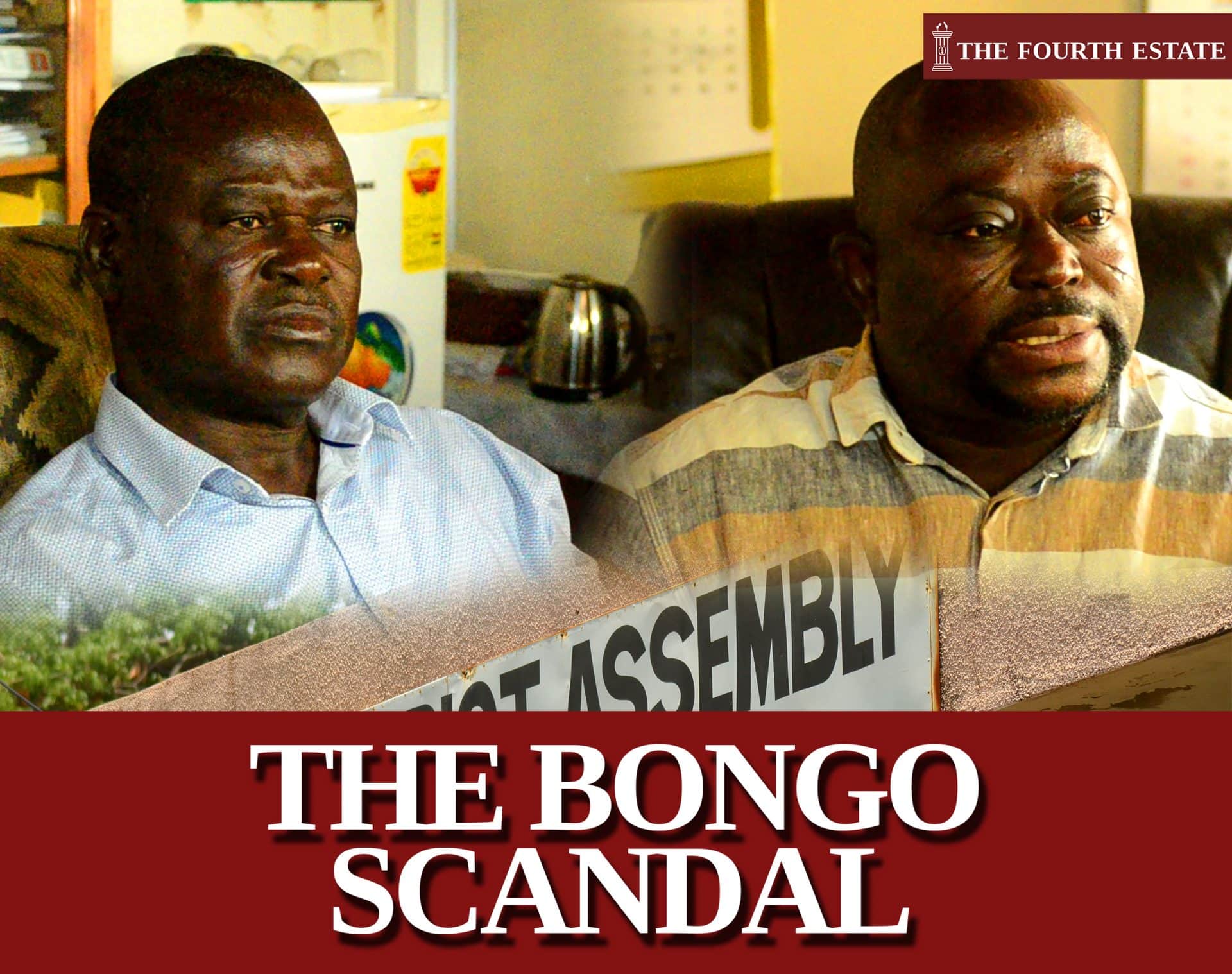
  • FULL VIDEO REPORT: The Bongo Scandal

    FULL VIDEO REPORT: The Bongo Scandal

    On April 30, 2021, the CEO of Aporgan K-A Enterprise, Asumbekere Karim Anagbila, got a notification that GH₵31,000 had been withdrawn from his bank account. But what alarmed him more was the name that came with the alert—David Aruk.

    David Aruk is the Engineer and head of the works department at the Bongo District Assembly. Karim said he had not permitted him to withdraw any money from his account.

    But that was not the last time the Bongo District Assembly was involved in withdrawing cash from the account without his permission.

    On June 14, 2021, GH₵156,520 entered and disappeared from Karim’s account under murkier circumstances than the first withdrawal, this time without any traces.

    Attempts by Karim to get answers about the second withdrawal from the bank failed because not even his bank statement contained the faintest clue about who withdrew the money.

    In the following investigative report, The Fourth Estate’s Manasseh Azure Awuni, investigations revealed that both withdrawals were facilitated by officials of the Bongo District Assembly.

    He also establishes the relationship between the assembly and the bank and why the assembly withdrew a total of GH₵187,520 from Karim’s account without his authorization.

    On Wednesday, we published the text version of the story: THE BONGO SCANDAL: Assembly withdraws GH₵187,000 from contractor’s bank account without permission

    Here is the full video report of the story:

    THE MAIN CHARACTERS IN THE STORY

    The DCE of Bongo, Peter Ayimbisa Ayamga, said he followed the procurement process and awarded a contract to two different people who presented the same business documents in their bid.
    Karim’s company, Aporgan K-A Enterprise, was used by the Bongo District Assembly to award a contract without his knowledge and money was paid into his account and withdrawn without his authorisation
    David Aruk is the engineer and head of the Works Department of the Bongo District Assembly. He used Karim’s Company to award the contract without his permission. He also went to the bank to withdraw the GH₵31,000  from Karim’s account without his permission.
    Baba Nsobilla Sebastian says the head of works at the assembly, David Aruk, used Karim’s company for the contract. He also revealed how the second amount was withdrawn. He said he went to the bank with the Assembly’s Finance Officer (DFO), Fawzia Moro Adamu to withdraw the second amount, GH₵156,000.
    Baba said Karim’s cheque was given to him by Fawzia Adamu, the District Finance Officer of the Assembly, who is also a Board Member of the Maltaaba Community Bank. Baba said he went to the bank with her to withdraw the GHc156,000. The above is her profile on the website of the bank.
    Felix Akwara is the Managing Director of Maltaaba Community Bank
  • Why six former Lighthouse pastors say they won’t appeal SSNIT decision

    Why six former Lighthouse pastors say they won’t appeal SSNIT decision

    The lawyer for six former pastors of Lighthouse Chapel International has said his clients won’t appeal the Social Security and National Insurance Trust (SSNIT) decision that they are not entitled to any outstanding social security contributions.

    Kofi Bentil said his clients would focus on the legal action they had already taken at the Labour Division of the Accra High Court, which decision could override SSNIT’s position.

    In a nine-page response to SSNIT, Mr Bentil described the decision as “grotesque” and questioned the pensions collector’s interest in enforcing its own rules and laws.

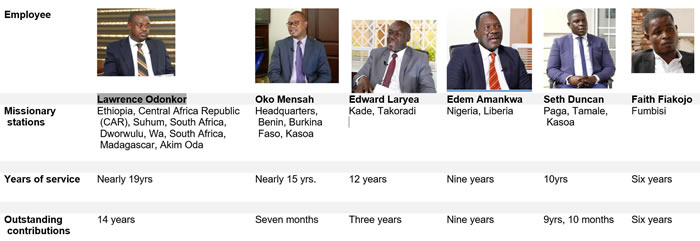
    The six former pastors and bishops had petitioned SSNIT, reporting the church’s failure to pay a cumulative 42 years and five months of outstanding social security contributions.

    Table showing the years of work and outstanding contributions of the six plaintiffs

    The church had insisted that it operates a lay system and describes three former full-time pastors as “volunteers” for all the 11, 10 and seven years they worked. For some, parts of their service were described as voluntary.

    SSNIT had, in a preliminary statement, said it had found the petitioners were workers. SSNIT gave at least three reasons:

    1. “The central church decided when and where a pastor should be moved at any point and took all decisions as an employer in the regulations of the activities of the pastors.”
    2. “It was also the case that the affected pastors worked and reported at all material times to the headquarters of the church in Accra. The various branches of LCI were not independent of the mother church in Accra and that regular policy directives were issued to these pastors on the running of their branches”
    3. “The leave days of the pastors were also scheduled by the Human Resource office of the LCI.”

    SSNIT said that in the light of the above, “an employer and employee relationship had been established between the pastors and LCI, taking into consideration all the factors and circumstances relating to their engagement and the conduct of that relationship.”

    But after three months of “independent investigations” SSNIT finally concluded that; “According to the records currently available to us, we could not establish an employer/employee relationship between LCI Ghana and your good self for the period…. claimed in your petition,” a letter dated August 20, 2021, and signed by its Compliance Manager, Felix Cudjoe Ahiable, said.

    SSNIT said it could therefore not compel Lighthouse Chapel International to pay these outstanding contributions.

    SSNIT made the ruling despite the availability of evidence that implicates Lighthouse Chapel International, especially in respect of Rev. Edward Laryea.

    Founder of Lighthouse Chapel International, Bishop Dag Heward-Mills and The Director-General of SSNIT, Dr John Ofori-Tenkorang

    The lawyer for the petitioners, Kofi Bentil, had earlier indicated that he had “lost confidence” in SSNIT along the way” when it noticed SSNIT’s “strange” posture during meetings with his clients.

    In a formal response to SSNIT following its decision, Mr Bentil said the stance taken by the pensions collector is “indeed inconsistent with applicable law and settled judicial precedent. We disagree entirely with it.”

    “We had occasion during the process to express our dissatisfaction with the conduct of this investigation and the posture of SSNIT, but the outcome still is shocking because it flies in the face of what the laws establishing SSNIT dictate, and indeed undermines SSNIT’s purpose.

    “We have therefore decided that unless SSNIT itself is minded to amend its position, we have elected not to engage with SSNIT further, or appeal the decision under the dispute Sections of Act 766. We will let the Labour court, which is already seized with this matter, rule on it and make consequential orders which will be binding on SSNIT,” portions of the letter reads

    Kofi Bentil explained the law on who is an employee is and the established legal principles in determining employer/employee relationship.

    Received Response to Ssnit Re- Decision by edwin appiah on Scribd

    Kofi Bentil is lawyer for the six former pastors

    The Fourth Estate reproduces the full letter to SSNIT, in which the lawyer for the pastors argued the “basic” and “established” legal principles defining employment relationships.
    You can reach the writer of this story, Edwin Appiah, via email at [email protected]. You can follow him on @edwinologyLB

    Read also:

    “Lighthouse pastors were not employees” – SSNIT rules

    EVIDENCE: How Lighthouse Chapel incriminated itself but SSNIT looked away

  • EVIDENCE: How Lighthouse Chapel incriminated itself but SSNIT looked away

    EVIDENCE: How Lighthouse Chapel incriminated itself but SSNIT looked away

    1. The Social Security and National Insurance Trust (SSNIT) has agreed with the decision by Lighthouse Chapel International not to pay the outstanding mandatory SSNIT contributions of six pastors who resigned and have sued the church for abuse and exploitation.
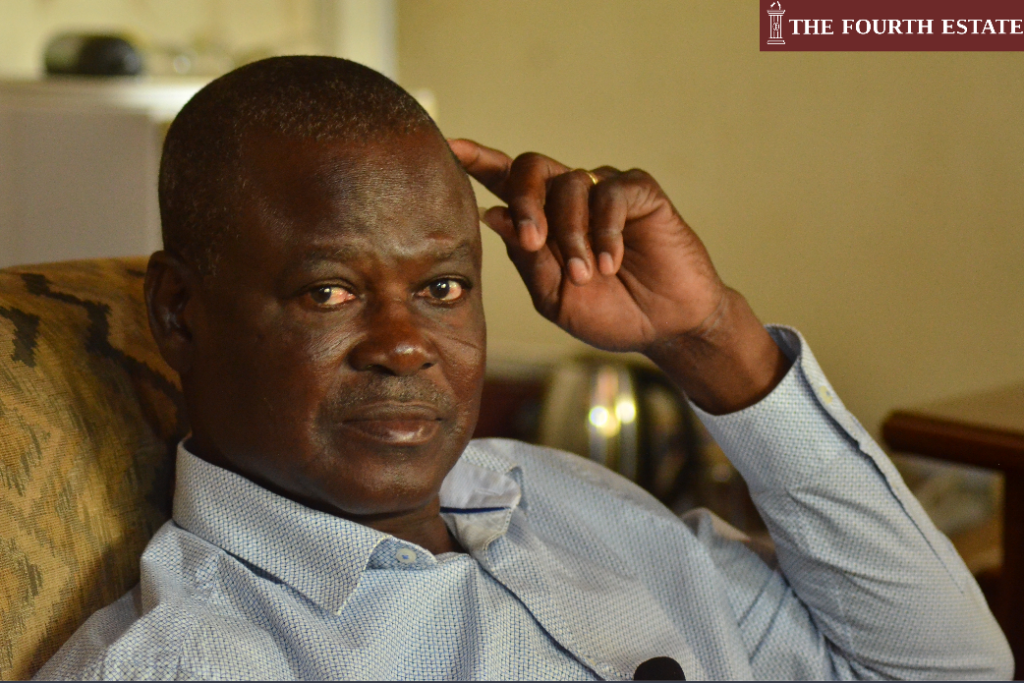
    2. One of them is Rev. Edward Laryea, who was employed by the Lighthouse Chapel International and sent to Kade in the Eastern Region in July 2005 to start the mission there. He was never posted outside the country but three years of his SSNIT contribution was not paid by the church.
    3. Emails from Lighthouse, which Rev. Laryea said he presented to SSNIT, incriminate Lighthouse Chapel International.
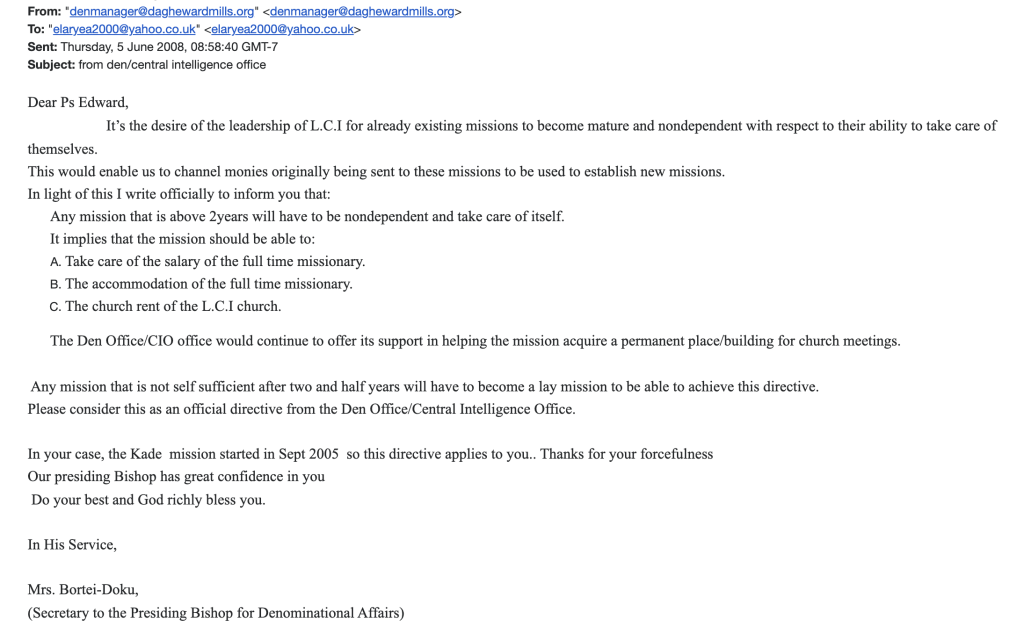
    4. The first email was sent to Rev Edward Laryea on Thursday,  June 5,  2008. It was sent by Mrs. Bortei-Doku, Secretary to the Presiding Bishop for Denominational Affairs. Rev. Laryea recalls that Mrs. Bortei-Doku was one of those who interviewed him in 2005 for his job as a pastor of the church. The rest of the panel included Adelaide Heward-Mills, wife of the founder of the church; Bishop E.AT.  Sackey, and Emelia Aidoo.
    5. Then 28-years old, Edward Laryea said he was successful at the interview and the HR office asked him to submit his SSNIT number to their office at Qodesh. He was told, along with others, that same day to report the following week and for preparation prayers for the mission.
    6. His posting was not through a letter. Bishop Dag Heward-Mills met the newly recruited missionaries at the basement of the Korle-Gonno building of the church and wrote names of the places in a bowl and asked them to pick. He picked Kade.
    Rev. Edward Laryea ministering to his congregation in the Lighthouse Chapel International branch in Kade which he first built.

    7. The church asked him to go and find accommodation and when he did, he was given cash to go and pay. He began the church’s first branch in Kade.

    8. He said Lighthouse started paying his salary of 600,000 cedis (now GHc60)the following month. He was under an overseer (later called Governor) and his salary was paid in cash. He signed a voucher anytime he came for the monthly meeting at Achimota. He said his Overseer/Governor at the time was Bishop Steve Asare.

    9. His salary was next increased to 1000,000 cedis (GHc100). This time it was paid from the headquarters of Lighthouse Chapel into his account at the Ghana Commercial Bank (now GCB Bank) until the middle of 2008.

    10. In the middle of 2008, some three years into his work, the church sent an email to Rev. Laryea, explaining that it had come out with a policy to cease support for some missions that had existed for some time. The email said:  “In that regard, any mission that is above two years will have to be nondependent and take care of itself. It implies that the mission should be able to:

    a.Take care of the salary of the full-time missionary.

    b. The accommodation of the full-time missionary.

    c. The church rent of the L.C.I church.”

    An email from LCI to Rev. Edward Laryea in June 2008, explaining that he was effectively on his own.
    1. Until this letter came, Rev. Laryea, who had been working in Kade for three years was receiving his salary from the headquarters of the church in Accra. This letter meant that he was now going to be paid from the funds he generated at Kade to run the church and open more branches.
    2. This letter suggested that Rev. Laryea was being paid a salary by the church he worked for. The new policy required that he would start paying his salary from Kade, and no longer receive it from the church’s headquarters.
    3. Before Rev. Laryea could start implementing the new directive from the church, he had another email from the headquarters of Lighthouse Chapel International in Accra, giving him specific instructions on what to do.
    4. The information was sent on Wednesday, 27 August 2008 by the same email address that sent the June 5 email: “[email protected]. The message of this email was:

    1.A letter explaining your ssf and IRS payments.

    2.”The actual payments you need to do based on your salary. This has already been calculated for you and it’s the one that is bolded or highlighted.”

    “PASSWORD FOR THE IRS SHEET IS ‘adminscale”

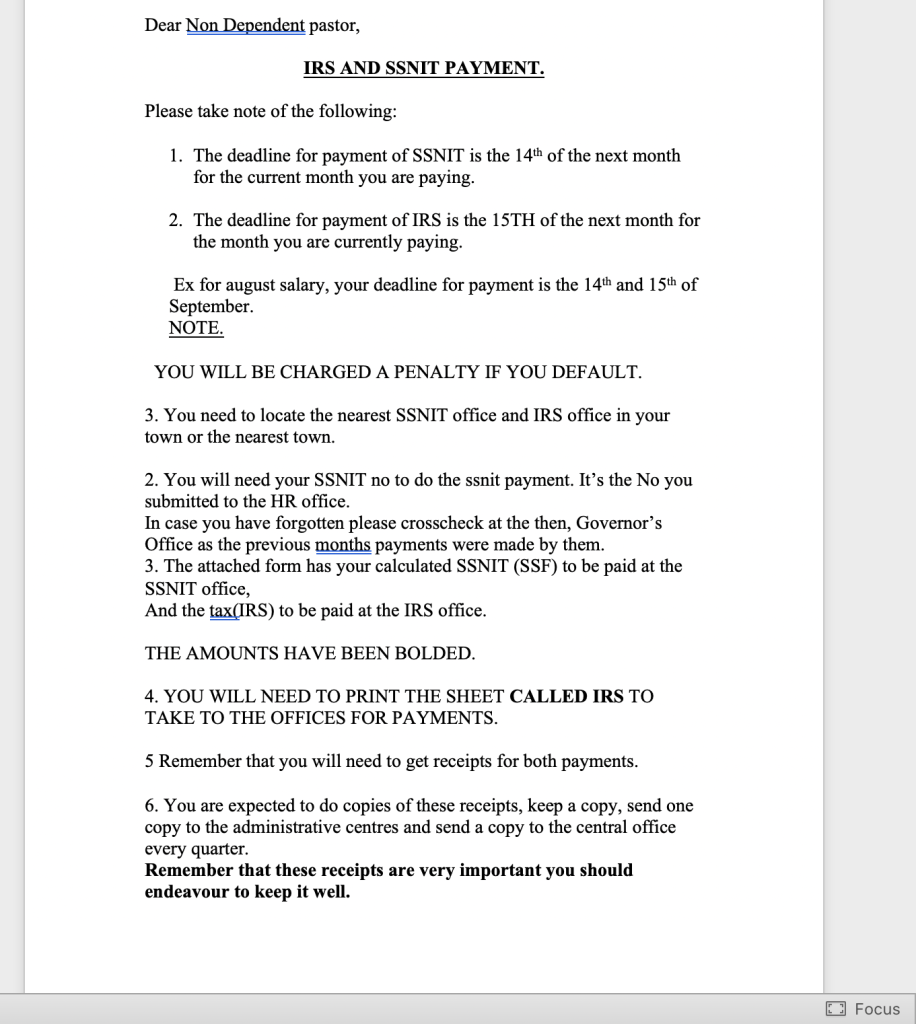
    17. The word document on SSNIT and Tax payments asked Rev. Laryear to “take note of the following:

    a.”The deadline for payment of SSNIT is the 14th of the next month for the current month you are paying.”

    b.” The deadline for payment of IRS is the 15TH of the next month for the month you are currently paying.”

    c. “Ex for August salary, your deadline for payment is the 14th and 15th of September. NOTE. YOU WILL BE CHARGED A PENALTY IF YOU DEFAULT.”

    Letter from the church to Rev. Laryea instructing him on the payment of SSNIT and tax before his salary started being paid from Kade.

    18. Part of that message gave this specific instruction: “You will need your SSNIT No. to do the SSNIT payment. It’s the No. you submitted to the HR office. In case you have forgotten please crosscheck at the then, Governor’s Office as the previous month’s payments were made by them.”

    19. Laryea said when he was employed in 2005, the church took his SSNIT number. The church has confirmed that and asked him to crosscheck with the relevant department of the church for the SSNIT number he had submitted.

    20. The church also claimed that the SSNIT contributions for Rev. Laryea had been paid in previous months.

    21. Laryea paid himself for the first time in August 2008 and followed the instructions to pay the tax and SSNIT contributions as the church had directed and calculated.

    1. Laryea realised that contrary to the claim by Lighthouse that it had paid his previous months’ SSNIT contributions, it did not pay.
    2. SSNIT has confirmed that the first time any SSNIT payment for Rev. Laryea was made was in August 2008, when he himself started supervising his payment.
    3. From the above, it is clear Lighthouse Chapel International knew its SSNIT contribution obligation to Rev. Laryea before August 2008. The church knew that it was an offence to delay payment of SSNIT contributions after a specific date of the next month, so it definitely knew that not paying the SSNIT at all was a bigger offence.
    4. Lighthouse in their letter directing Rev. Laryea on how to pay his SSNIT suggested they had been paying it for him since he was employed. But it turned out to be completely false.
    5. Rev Laryea petitioned SSNIT to compel Lighthouse Church to pay his SSNIT contribution from July 2005, when he started working for the church, to July 2008, the moment he took over the payment of his salary and SSNIT.
    6. SSNIT, after reviewing this evidence from Rev. Laryea,  still said the Lighthouse Church was not liable to pay for the three years it had failed to pay the SSNIT contribution for Rev. Laryea.
    7. Edward Laryea is now 44 years old.

    His other colleagues are Rev. Seth Duncan who resigned from the Ghana Navy and served as a full-time pastor of Lighthouse for 10 years. Rev. Edem Amankwa worked for Lighthouse for 11 years, serving in Nigeria and in Liberia during the Ebola Crisis.

    Pastor Faith Makafui Fiakojo Graduated from Anagkazo Bible College and was posted to Fumbisi in the Upper East Region, where he worked from November 2013 to December 2019. Lighthouse did not pay the SSNIT contribution for any of these three pastors for even one month. The Church claimed they were volunteers.

    Bishop Larry Odonkor and Bishop Oko Mensah had parts of their SSNIT contributions paid. For the periods they were transferred by the church to its branches outside Ghana, Lighthouse said it’s not liable for their SSNIT because Lighthouse Chapel’s headquarters in Ghana is “legally, financially, administratively and governmentally independent organisation from other LCI ministries outside the borders of Ghana and only shares a spiritual relationship with the others.”

    SSNIT makes U-turn

    When the former pastors petitioned SSNIT on February 1, 2021, SSNIT wrote in a letter addressed to Lighthouse Chapel International dated May 5, 2021, in which SSNIT laid down the law.

    In a three-page letter, SSNIT said, “The LCI is an organization registered under Act 766 hence had a responsibility and obligation under the law to ensure that all workers were registered and contributions paid on their behalf at all times, whether they were in Ghana or outside the country.”

    SSNIT, for the avoidance of doubt on whether the former pastors could be categorized as workers, quoted the law’s definition of a worker. SSNIT in that letter said,

    “A ‘worker’ includes a person who is employed for salary in any kind of work, manual or otherwise, in or in connection with the work of an establishment, and who gets his salary, directly or indirectly from the employer, and any person employed ….. (ii) outside Ghana but employed by an employer in Ghana.”

    SSNIT, in that letter which The Fourth Estate sighted, said it had done preliminary investigations and found that the petitioners were workers. SSNIT gave at least three reasons:
    1. “The central church decided when and where a pastor should be moved at any point and took all decisions as an employer in the regulations of the activities of the pastors.”
    2. “It was also the case that the affected pastors worked and reported at all material times to the headquarters of the church in Accra. The various branches of LCI were not independent of the mother church in Accra and that regular policy directives were issued to these pastors on the running of their branches”
    3. “The leave days of the pastors were also scheduled by the Human Resource office of the LCI.”

    SSNIT said that in the light of the above, “an employer and employee relationship had been established between the pastors and LCI, taking into consideration all the factors and circumstances relating to their engagement and the conduct of that relationship.”

    In its final decision, however, the SSNIT concluded that it found no evidence of this relationship between LCI and the pastors during the disputed periods of their working lives, especially when they worked outside the church’s branches outside Ghana.

  • The Returned Bribe: Full Story with Video Documentary

    In April 2020, the Chief Executive Officer of COA FS, Samuel Ato Duncan, had an invitation to meet the Head of Legal Affairs at the Food and Drugs Authority (FDA), Mrs. Cynthia Dapaah-Ntow in Accra.

    That meeting did not take place in the office of the FDA, where Mrs. Dapaah Ntow worked. The FDA’s lawyer led the producer of the popular food supplement to a restaurant near the Ghana Institute of Management and Public Administration, a location Samuel Ato Duncan does not know.

    The meeting was not official, but the reason the subject matter that necessitated it was official. Samuel Ato Duncan had suspected foul play in attempts by the regulator to suspend his product and had called the FDA’s lawyer to complain.

    According to Samuel Ato Duncan, he had developed the product after researching into a potential cure for HIV/AIDS. Some research and regulatory institutions had done some work on the product and concluded that it had some efficacy.

    Researchers at the Kwazulu Natal University in South Africa conducted further studies on COA FS and said it had great potentials that needed further attention in the area of research and development.

    Due to the difficulties in getting authorities to support him,  he was advised to register COA FS as an immune booster.

    In March 2020, the Director of Noguchi Memorial Centre for Medical Research, Professor Abraham Kwabena Anang, told journalists that COA FS as an immune booster could prove useful in managing Covid-19 until a cure was found.

    On 25th March, a link to the story on Professor Anang’s COA FS comment was posted on a WhatsApp platform, which had some top officials of Ghana’s regulatory institutions. One head of a state regulatory institution said:

    “Director, is that true? This story is trending on myjoyonline.com and we need to be ready to provide robust, evidence-based answers.”

    Another head of a regulatory state institution said, “So bad.”

    The following day, March 26, officials of the FDA were at the COA FS manufacturing facility in the Central Region to pick samples for the testing.

    At the Head Office of the FDA, the Head of Laboratories, Eric Karikari Boateng, took me through the process of how the COA FS tests were conducted with samples from the factory and from the market.

    Mr. Boateng said the FDA conducted two tests on COA FS. The first was on samples the FDA collected from the market on March 19, and the second test was conducted on samples that the FDA collected from the COA FS factory on March 26. It entered the records of the FDA on March 30 and the results were ready on the 7th of April. The report is dated April 8.

    According to Mr. Karikari, the first test which was conducted on samples collected from the market did not establish the presence of ecoli in the COA FS.

    The FDA, based on the tests and visits to the factory, suspended the production license of COA FS and ordered the company to recall its products. The visit to the Cape Coast office of the company saw hundreds of cartons of the product.

    The letter suspending the production of COA FS was dated March 31st, 2020. It among others stated that the reason for the suspension was that the product contained Ecoli. Ecoli, according to the FDA, causes diseases such as diarrhoea, abdominal pain, nausea, and vomiting.

    Meanwhile, the result establishing the presence of ecoli in the product was dated April 8, 2020. Going by this date, it means the letter was written and the reasons were stated even before the results of the test establishing the presence of ecoli were ready.

    THE CEO of the FDA Mrs. Delese Mimi Darko said she would not comment on the COA FS matter when I contacted her.

    These were the circumstances that made the producer of COA FS suspect foul play and had called the lawyer of the FDA to intervene.

    The lawyer asked him to come to Accra with the necessary documents to meet her. After telling her why he felt the regulator was maliciously targeting his product, he said the FDA’s lawyer said she could help her but asked how much he would pay to the CEO of the FDA.

    Mr. Duncan said he initially said he would pay GHC200,000 cedis, but the FDA lawyer said it was “too small.” She, therefore, proposed $100,000 as the money to be paid to the FDA CEO.

    The two also agreed that Mr. Duncan would also pay 100,000 to Cynthia Dapaah-Ntow. What the two, did not agree or understand each other was the currency of the payment. While FDA’s lawyer thought her payment was also in US dollars, the COA FS CEO thought hers was in cedis.

    “I said I would give her a cheque and she said she needed cash,” Mr. Duncan recalls the mode of the payment.

    The following day, on April 9, 2020, Mr. Duncan returned to Accra with cash of GHC600,000. He said the GHC500,000 was the cedi equivalent of the $100,000 for the CEO and an additional GHC100,000 for Mrs. Dapaah-Ntow.

    A photograph and a short video secretly taken showed Mrs. Cynthia Dapaah-Ntow taking the money into the boot of a VW Salon Car with a green number plate.

    When I visited the Head Office of the FDA, the Head of Legal’s designated parking slot had a VW Saloon Car parked there.

    Samuel Ato Duncan said he was in touch with the Greater Accra Regional Director of the Bureau of National Investigations (now National Bureau of Investigations).

    He said after negotiating and taking the money, the head of legal at the FDA called him later in the day to come back for the money. In a phone recording between the two, the head of legal is heard saying among other things that the amount agreed was not what the COA FS CEO  presented.

    Here is an excerpt of the dialogue, which began with Mrs. Dapaa-Ntow accusing Samuel Ato Duncan of deliberately varying the amount agreed on:

    You’re a business person and you did this deliberately. I’m very certain of that.

    –No. No. Listen.

    I’ve dealt with all sorts of clients so I know…

    –Listen to me. I am not like that. Seriously, I am not like that.

    Prof.

    –Yes?

    The whole discussion we had, there was no, there was nothing about 100,000 cedis. There has not been any agreement about 100,000 cedis. That’s just it. There was never a mention of 100,000 cedis.

    –Oh, that was…

    I am a lawyer and I’m an astute lawyer. I do serious practice.

    –You know…?

    So all the tricks in the books I know but I’m not interested in… so I don’t want to get involved in this…

    –There were no tricks in this. First, I mentioned 200,000 cedis.

    For her…!

    –For her. And you said it’s small so I said okay, then let me… So, when I said $100,000, I meant the 500,000 cedis figure. Then you asked, so how much do I give you? And I said 100,000 cedis but you didn’t hear me…

    No Prof.! You never said that. You said same. Prof., I’m a lawyer, I do cross [examination]… I meet my own clients. I meet them [laughs] so what you’re doing, it’s…

    –Am I not your client?

    No, you’re not my client. It’s an FDA … You’re not my client.

    ***

    Cynthia Dapaah-Ntow said even if the CEO of COA FS was giving the CEO of the FDA the cedi equivalent of 100,000 US dollars as agreed, the amount would have been more than 500,000 cedis.

    Here is another excerpt of the dialogue:

    When are you leaving Accra?

    –Oh, I’m going back to Cape Coast.

    Awww Jesus Christ! No, so you can always come and pick it up, right?

    –Okay.

    We’ll call you. Uhuuh, I did this as a test. Prof. you see, you said you were bringing her 500 [500,000 cedis] and bring me the same, but you brought different amounts. So, I was testing your honesty.

    –Oh!

    Yes, Prof. That’s what we agreed.

    –Dabi [No]! What I said was…then I didn’t hear it. I said I was bringing her 500 [500,000 cedis], that’s $100,000, but you, I’d bring you 100,000 cedis. So pardon me. I didn’t get it that way. Sorry!

    Prof., I did that deliberately just to…remember I’m a lawyer.

    Dabi! Dabi! Dabi! No no! why would I do that deliberately.

    You didn’t start even start with giving her 500 [500k cedis]. You started with giving her 200,000 [cedis]. Is that not correct?

    –Yes.

    And I said how can you give her that?

    –Yes.

    And we said okay bring her $100,000. And I asked you a specific question; [about mine] how much? Then you said the same amount

    –Oh no.

    That’s what you said, Prof. We never discussed 100,000 cedis at all.

    –No. No. Then I didn’t get it that [way]. Look, what I thought was… I said 100,000 cedis.

    You didn’t say anything. When I said the 500,000, I said I would make it 500,000 [cedis] round [figure]. So instead of the 100,000 [$], it would be 500,000 [cedis] round figure.

    What does that mean? Because $100,000, if you were giving her that, would translate into 587 [587,000 cedis]. Is that not correct? Assuming you were giving her cedi equivalent, that’s 587 [587,000 cedis]. That is it. But me, I just wanted to test the person we are working with to see if you would be faithful because as I told you, I would help industries grow without anything, basically. Basically. And I cannot even be sure that you won’t, assuming I give it to her, you will not go and mention our names based on what has transpired.

    –Not at all! Never!

    ***

    Even though the FDA said state investigative bodies were investigating the case as of April 2020, when I went to interview officials of the FDA, my checks in October revealed that no such investigation was ongoing. A number of questions still remained unanswered:

    Why did the head of legal negotiate and take the money in the first place when she knew it was a bribe?

    Why did the CEO of the FDA not make any attempt to investigate and punish her head of legal affairs when it came to her attention that the head of legal had taken money in the name of the CEO?

    In a letter dated August 7th, 2020, the FDA lifted the suspension on the manufacturing of COA FS after the company addressed what the FDA said were the “most critical deficiencies” identified by the regulator.

    In another letter dated 1st September 2020, the FDA ordered COA FS to limit the indication of the product to “general wellbeing”. According to the FDA, evidence does not support the claim that COA FS could support the immune system.

    The FDA later asked the manufacturers of COA FS to change the name to COA Mixture, a prerequisite for the granting of a new production license.

    Broadcasting the Documentary

    On November 12, 2020, the radio version of the documentary was broadcast on Joy FM. The television version was to be aired that night, but Cynthia Dapaah-Ntow went to seek an injunction on the TV broadcast and also sued Manasseh Azure Awuni, The Multimedia Group and Samuel Ato Duncan for defamation.

    An Accra High Court, on June 4, 2021, gave Manasseh Azure Awuni and JoyNews the greenlight to show “The Returned Bribe” investigative documentary. The ruling by Justice William Boampong came seven months after the documentary was scheduled to be broadcast on JoyNews.

    Cynthia Dapaah-Ntow denied admission by US-based university

    While Cynthia Dapaah-Ntow was fighting the publication of the documentary in court, some institutions had already taken note of it outside the country. The Thomas R. Kline School of Law at the Drexel University in Philadelphia, USA, denied her admission because of “The Returned Bribe” scandal.

    Mrs. Dapaah-Ntow had applied to study the LLM in Healthcare & Pharm Compliance for the Spring Semester of 20-21, but the admission team sent her the following response in an email:

    “Thank you for applying to Drexel University. After careful consideration of your application, the Admissions Committee has determined that we are unable to offer you admission.”

    Unsatisfied with the response and curious to know the reason for the denial of admission, the FDA lawyer wrote to the university to find out.

    “I am passionate about the programme and would want to reapply,” she said in her letter. “I hope you will be kind enough to point to me what worked against me in my last application so I do not repeat the same in my next attempt.”

    In a response sent by the Assistant Dean of Enrolment Management, Audrey Woods, on December 17, 2020, the university explained that the denial of admission had nothing to do with her academic credentials.

    “We found you to be a very qualified candidate, however, it came to the attention of the admissions committee that you were under investigation for allegations of bribery which is not in line with our values and code of conduct,” the university said in an email to the FDA lawyer.

    FDA sacks Cynthia Dapaah-Ntow

    A week after The Fourth Estate broke the story of the denial of admission by the US-based University, the Food and Drugs Authority (FDA) terminated the appointment of Mrs. Cynthia Dapaah-Ntow. The decision was taken after a disciplinary committee found her guilty of misconduct.
    The FDA instituted internal disciplinary proceedings against Cynthia Dapaah-Ntow following an investigation by the Editor-in-Chief of The Fourth Estate, Manasseh Azure Awuni, that implicated her in a bribery scandal.

    The disciplinary committee requested and was given the television version of Manasseh’s investigative documentary even though Mrs. Cynthia Dapaah-Ntow, had sought a court injunction against the broadcast.

    An internal memo sent to the staff of the FDA said:

    “Management would like to inform Staff that effective 18th May 2021, Mrs. Cynthia Dapaah-Ntow, Head of Legal, will cease to be a staff of the FDA. The decision was arrived at after Mrs. Cynthia Dapaah-Ntow was taken through the internal disciplinary process of the Authority, following a charge of misconduct leveled against her.

    “The Disciplinary Committee recommended to the Board that the appointment of Mrs. Cynthia Dapaah-Ntow be terminated. The Board has subsequently accepted the recommendation and given her the required notice of termination of appointment.”

    Police Investigation

    After the airing of the radio documentary in November 2020, the Criminal Investigations Department of the Ghana Police Service began a “bribery and extortion” investigation into the matter.

    The police have questioned the CEO of the FDA, Delese Mimi Darko, and Mrs. Cynthia Dapaah-Ntow on the issue. The police have also taken statements from Samuel Ato Duncan of COA FS and other relevant persons in the bribery allegation.

  • Special Report: CCTV footage captures National Security raid in Asankragua, and why DSP Azugu is leaving

    More than two years after the Emile Short Commission into the Ayawaso West Wuogon electoral violence recommended the disbandment of the National Security SWAT team, the group and other armed civilians in the National Security Secretariat still operate in a manner that appears contrary to standard procedures.

    The Fourth Estate has spoken to multiple sources and obtained videos of the National Security operatives’ recent “rampage” in Asankragua in the Western Region, where a journalist was assaulted when he went to the scene.


    Time: 3:40pm

    Day: May 7, 2021

    Location: Xing-Di Casino, Asankragua, Western Region

    The Toyota V8 Land Cruiser had hardly halted inside the Xing-Di casino when the doors and the boot flung open. Five armed men hurriedly disembarked.

    One of them, who was in a hoodie, rushed to secure the main gate before returning to join his colleagues. He was wielding an AK-47 assault rifle. He sported his trousers the “Ottophista” way—the deliberate sagging of trousers—exposing his boxer shorts.

    Photo: CCTV footage captured the operatives, armed, some of them in mufti

    Another AK-47-wielding man in a mufti and hooded—handcuffs secured to the right of his sagging black jeans that displayed pink boxer shorts—pranced the yard before entering the main reception of the building.

    The men wore what appeared like Covid-19 face masks, which had the convenient benefit of masking their faces. The masks are used in the pandemic for reasons of health.  For the National Security operatives, who looked like an armed gang in a robbery scene, it gave them stealth.


    Photo: A hooded man said to be an operative of National Security stands in front of the casino, armed.

    DSP Samuel Kojo Azugu, the poster boy of Ghana’s brutish national security SWAT team, got down and made for one entrance of the building. DSP Azugu, the only uniformed man, was led by yet another ununiformed man.

    Two other men in smocks—one lanky, the other bulky—both made mighty by their gun-induced confidence, roamed around the reception area of the casino.

    Their menacing movement paralysed the casino staff with fear.

    The operatives targeted the CCTV cameras in the guest house that shares the same compound with the casino, said some eye-witnesses to the operation.

    Inside the casino, they shut down the electricity meter, plunged the place into darkness, cutting off the recordings of the CCTV cameras.


    Photo: Two National Security operatives in the reception area

    According to workers at the casino, they destroyed the CCTV cameras and disabled any form of recording of the operation before moving to the control room to seize whatever the CCTV had captured. But they did not know there were two CCTV control rooms.

    The Fourth Estate has obtained the videos of the operatives when they first got to the scene as well as the aftermath of their operation. From the account of the people, they were like bulls in a China shop. And these were state security agents inside a Chinese casino in one of Ghana’s mining communities.

    Charles Mensah, a man in his 30s, is the Ghanaian manager of the casino. He told The Fourth Estate he dared not question who the gun-wielding men were, especially when he had not yet seen the uniformed DSP Azugu to confirm whether it was a state security operation.

    “If they were police or soldiers, that one I could speak to them because I know I have not done anything wrong. But in Fugu top and jeans trousers, with the nose mask and AK-47, my gut couldn’t move me to speak,” he said.

    “We all got frightened because they were with guns, and they were in a mufti, so in my mind, I was asking: Who are these people? Are they armed robbers? Or who are they?”

    In principle, they were not armed robbers. It was an operation by the National Security. The Fourth Estate has spoken to sources within the National Security who said the operation was sanctioned “from the very top.”

    It was led by DSP Azugu, the man who had led the National Security SWAT team in the infamous Ayawaso West Wuogon by-election violence in January 2019. This time, they struck in Asankragua, where they were accused of stashing their pockets with dollar bills.

    “When they came in, some of the Chinese guys were playing table tennis. So those of us who were there, they took our phones and they searched their [the Chinese] pockets and took the money they saw there. For these monies, they didn’t account for it. I was here personally so I saw it,” Maxwell Yeboah, another eye-witness, said.

    Maxwell claimed his phone and those of the others were not returned even when they requested them. “They didn’t return our phones. My phone and that of my brother, which were being charged were taken. I had my Ghana card behind my phone and they’ve taken it away. When they were leaving, one of the ladies asked them for the phones, but they said phones have [sic] been placed beneath the items and that they did not have the time to take them out.”

    Maxwell Yeboah, a driver of the Chinese businessmen, said he was in what they called the gold office of the guest house when Azugu and his men filled the room.

    “They were like I should give them the money and I told them I don’t [sic] know where the money is. Because the Chinese people didn’t understand the English and they had their own way of speaking it, I was trying to explain to them what the national security officers wanted,” he recounted the incident to The Fourth Estate.

    Maxwell Yeboah had difficulty in understanding the mission of the armed men, so he hesitated and asked questions, but a few slaps gave him an understanding of their demands. And he complied without further questioning.

    “When they entered and demanded the money, we were trying to check the money with them. There was this one policeman, I don’t know if you’ve seen his pictures… the one errm…when the Sam George issue happened, he was the one they questioned…Azugu. He was the one I was checking the money with,” Charles recalled.

    The operatives destroyed a metal safe of the casino

    Charles said he was made to record the cedi notes, but not the dollar notes.

    “The office had some few dollars 100-dollar bills. Some 15 of them and that’s $1,500. I was about to record it and one policeman took the money and put it inside his pocket so he didn’t make us record that one.”

    Charles Mensah, recounting his mistimed zealousness for accountability, said, “…I was telling him that he should bring it out so we record.” But the response came in a slap, not words. “That tall man in the batakari [smock] and jeans slapped me for saying that.”

    Done inside, the men moved out, a sack full of items from the ransacked rooms.

    “And they took one of the [casino’s] V8 vehicles away. I know the car was registered in 2021 and the car number was 666.” The Fourth Estate checks confirm that the vehicle has been impounded and is at national security.

    The security operatives arrested six Chinese. Maxwell was to be taken along. But he said he was too dizzy from the slaps and was considered unfit for the 8-hour ride to Accra.

    “Due to the severity of the slaps I received, I was feeling dizzy, so they left me alone to go take care of myself.” He is now recuperating in Kumasi.

                       Alleged assault of journalist and Immigration officers

    Outside the casino, word had spread that some armed men from the National Security had stormed the facility and residents in small pools of curiosity stood outside the building.

    Among the curious onlookers was Peter Tabiri, the Western regional correspondent of Accra-based Pent TV, a television channel run by The Church of Pentecost.

    Peter Tabiri works for Pent TV

    In an interview with the Media Foundation for West Africa (MFWA), Peter Tabiri said his troubles started when he pulled out his phone to inform the Amenfi Divisional Police Commander.

    “They smashed my phone and proceeded to slap and hit and kick me several times. Not satisfied, they pressed me to the ground and poured water on me, amidst curses and insults on journalists.”

    The Amenfi Divisional Commander, Chief Superintendent Nana Kumi, confirmed the incident. He said when he arrived at the scene in response to Tabiri’s call, the security operatives had put the journalist in the bucket of their pick-up.

    A medical report from Father Thomas Allan Rooney Memorial Hospital in Asankragua after the assault says Peter Tabiri has a “perforated eardrum.” Peter says he now has trouble with his right ear after the assault.

    Another journalist with Ahobrase FM in Asankragua, Ebenezer Blay, tried to record the scenes from the relative safety of a Petroland fuel station, some distance from the casino. But standing on a bench, Blay was spotted and received barking instructions to leave.

    “When I was leaving, I found out one of the vehicles had its number plate changed using masking tape [used by electricians]. If the number was to be 2, it was changed to 8 and if it was 1, it was changed to 7 using the masking tape, the one used by electricians,” he recalled.

    “So I wanted to take a picture of the vehicle to verify what I was thinking was right so as I took out my phone, one of the officers came out of the car and asked what I was doing and I was like… nothing. Another person from behind came to snatch my phone from me and asked me to follow him. I followed him to the filling station and he gave my phone to another officer then asked me to sit down and whilst being kicked in the back.”

    The final set of assaulted professionals were two officers of the Ghana Immigration Service who had been dispatched to investigate the upheaval in town.

    Assistant Control Officer II Frank Attah, one of the immigration officers who were assaulted by the National Security operatives, recounted their ordeal in an interview with The Fourth Estate.

    “When we got there, my senior man paid compliment to the seniormost in police uniform but then he snubbed him.” He would later learn that this police officer was DSP Azugu.

    “We were trying to talk to them but they weren’t minding us,” he said.

    Photo: DSP Azugu captured by the CCTV at the premises

    At this time, they spotted the Divisional Police Commander of Asankragua, Chief Superintendent Nana Kumi. He had been called in by the Pent TV reporter, Peter Tabiri.

    The two immigration officers approached the divisional police commander, who explained that the men were from national security. The officers now had something to report.

    “So, immediately, my senior man had to call my boss and give him the info [information] as to what the people are [sic] there doing. As my senior man was giving the information to my boss, they just rushed on us.”

    “Some were in uniform some were not in uniform – fully armed, sidearm, bulletproof, and then with their AK47. They just started pushing us, pushing us down, hitting us here and there. They even slapped my senior colleague, took his phone and his car keys.”

    At this stage, the immigration officer recounted hearing DSP Azugu shouting, “Handcuff them! Handcuff them! We are sending them to Accra.”

    They were handcuffed behind their backs and their bodies embraced the ground in a 45-minute public humiliation, they said.  Assistant Control Officer II Frank Attah said after they were released, an officer in a police uniform approached him and said, “Such operations you people shouldn’t come close. This thing, if we come and we are being killed, we are killed for free. No one will ask any questions.”

    MP for Amenfi West, Eric Afful, has petitioned the Inspector-General of Police (IGP), Mr. James Oppong-Boanuh, detailing the rampage within his constituency, the brazen lawlessness, and the sense of insecurity and fear in the wake of the National Security raid. He alleged the National Security team stole money and a number of valuables during the raid.

    Our sources say the IGP has started an investigation into the petition and has written to DSP Azugu to respond to the MP’s allegation.

    Eric Afful also wants the Interior Ministry to conduct a thorough investigation on DSP Azugu and his team.

                                 A response from the National Security

    The Fourth Estate spoke to highly-placed sources within the National Security Ministry, who are familiar with the Asankragua operation. They want to remain anonymous.

    The sources say 25 men from the National Security’s SWAT team, as well as armed civilian national security operatives, took part in the exercise.

    When The Fourth Estate asked why some of the National Security operatives dressed in mufti with some hooded, our sources said it was allowed.

    “The operatives are civilians,” one source said. “They are not in the police or military so they wear mufti. They choose what to wear for an operation. It’s allowed.”

    “If they are civilians, why are they holding AK-47 and other weapons?” The Fourth Estate asked.

    “They are trained to use guns,” the sources explained.

    The sources denied the allegation of assault by the National Security operatives. The sources, however, admitted they initially held two officers of the Ghana Immigration Service, but later released them when the District Chief Executive and the Police Commander in the area identified them.

    The Fourth Estate’s sources say the operation was conducted simultaneously at two locations in Asankragua—at the Xing-Di Casino and another facility behind the Petroland fuel station. This second facility, the sources say, had a casino and an entertainment centre, as well as a secret gold refinery facility and a gold trading centre.

    The operation, according to our National Security sources, was meant to clamp down on illegal activities such as illegal gold refinery, gold trading, and other illicit activities undertaken by the Chinese, with the tacit endorsement of compromised Ghanaian officials including some in the security services.

    In all, six Chinese nationals were arrested and have been remanded in custody while undergoing trial. They are:

    1. Chen Gui Bin, born on February 5, 1990, and arrived in Ghana in 2016.
    2. Lu Xian Chu, born on December 25, 1985, and arrived in Ghana in 2013
    3. Wu Xiao Bin, born on August 17, 1981, arrived in Ghana in 2016
    4. Yao Zheng Shan, born on August 2, 1975, and arrived in Ghana in 2015
    5. Xue Lian Hua, born on May 22, 1987, and arrived in Ghana in 2012
    6. Cheng Chun Rong born on January 2, 1969, and arrived in Ghana in 2021

    Our sources say six unlicensed pump action guns, gold, and other evidence of their illegal activities were seized in the National Security Operations.

    According to The Fourth Estate’s National Security and police sources, the Criminal Investigations Department of the Ghana Police Service has taken over the investigation and prosecution of the people arrested in the Asankragua raid.

    The six Chinese are standing trial for illegal possession of arms, illegal trading, and refinery of gold without a permit, among other charges.

    Unending abuse by the National Security operatives and why DSP Azugu is leaving

    The Ghana Police Service has recalled DSP Samuel Kojo Azugu, who until Friday, May 29th, 2021,  served as the Commander of the Special Weapons and Tactics (SWAT) team at the National Security Ministry.

    He will now work at the Operations unit at the headquarters of the Ghana Police Service, sources told The Fourth Estate.

    Sources within the National Security say DSP Azugu received the news of his removal from the National Security with jubilation. They say he had been fed up with the negative publicity that characterized his name and the work of the National Security SWAT team and had started asking to be sent back to the mainstream policing work.

    DSP Azugu and his team at the National Security Ministry have often been in the news for assault or acting in a manner contrary to established national security protocols.

    In January 2019, DSP Azugu led a team of National Security operatives to the Ayawaso-West Wuogon by-election. The election which was reported peaceful until their arrival was marred by a shooting incident.

    Operatives of the National Security Ministry recently assaulted Citi FM’s Caleb Kudah. The journalist said they slapped and kicked him in the groin. They also seized his phone and used the WhatsApp application on the phone to try to lure and arrest Caleb’s colleague, Zoe Abu-Baidoo, who had received videos and photos Caleb took of abandoned MASLOC vehicles at the premises of the National Security. They sent her messages as though it was Caleb who was chatting with her.

    When they failed, they raided Citi FM to arrest Zoe in a manner that attracted wide condemnation from Ghanaians.

    The public uproar which greeted Caleb’s incident caused the termination of Lt. Col. Frank Agyeman’s secondment to the National Security Ministry. He was to report to the Chief of Defence Staff for further investigation and action. A day after that announcement, however, Lt. Col. Frank Agyeman landed a top job as the Commander of the 64 Infantry Regiment of the Ghana Armed Forces.

    Three other policemen who were involved in the Caleb Kudah assault were referred to the IGP for further investigation and possible punishment.

    Our sources say DSP Azugu was not involved in the Caleb Kudah assault, a reason he was not named in the press statement released by the National Security Ministry. That, therefore, cannot be responsible for his recall from the National Security, they said.

    However, both the MP for Amenfi West as well as some eye-witnesses in the Asankragua operation say he led the team there and cannot be absolved of wrongdoing in the brute force and violence that was visited on people in the area. That investigation has just begun and our sources in the police say it could not be the reason for his removal from the National Security, either.

    Our sources said the National Security operatives and the SWAT team have become notorious for human rights violations. Since DSP Azugu, like other trained police officers, cannot insist on professionalism when there are “orders from above” to be obeyed, he had been lobbying to get out of the place in order to save his face.

    EDITOR’S NOTE: This story shall not be republished or broadcast, in part or in full, in any form or shape without the express permission of the Editor-in-Chief.

    https://thefourthestategh.com/2021/05/24/national-security-director-sacked-over-caleb-kudah-assault-given-top-military-appointment/