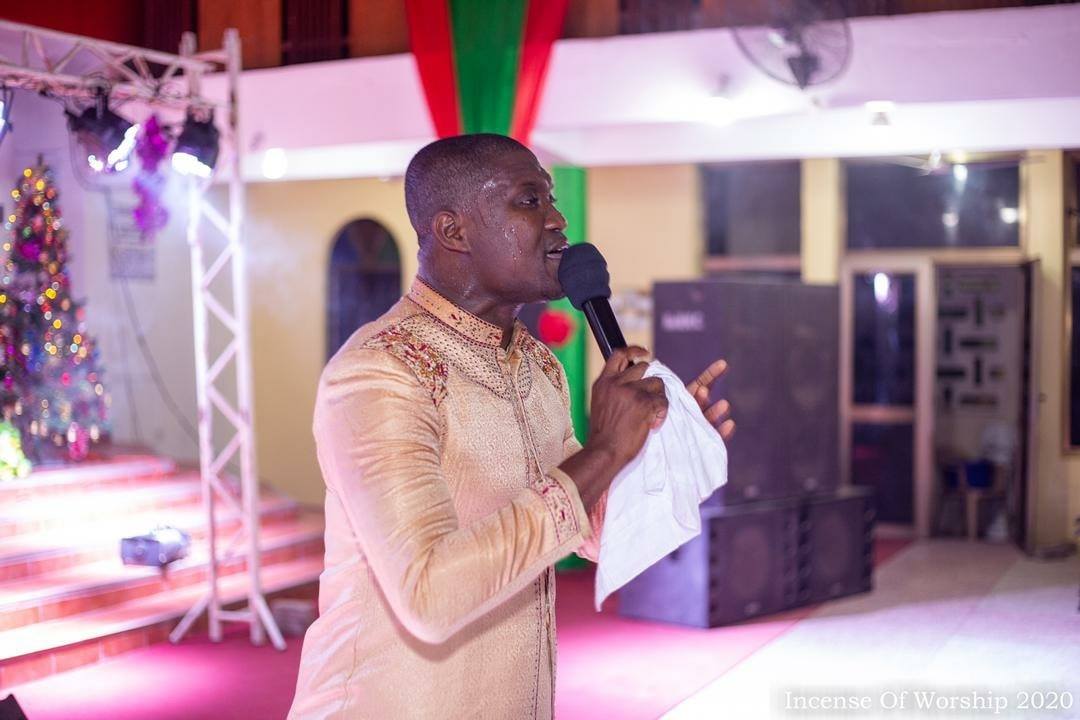
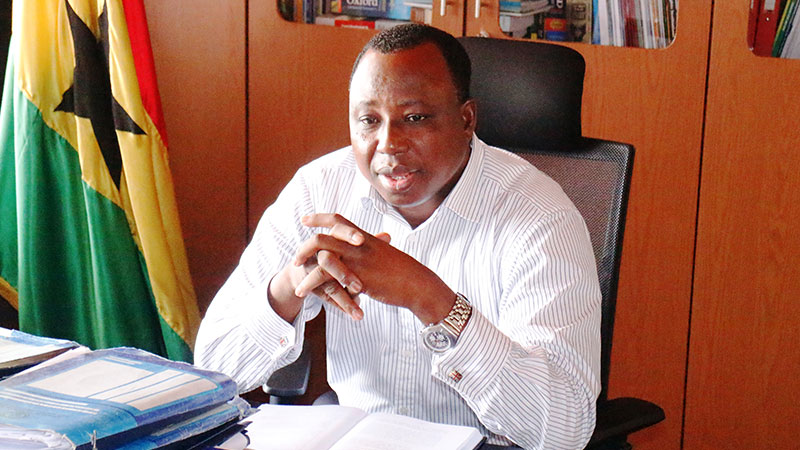
The Commission on Human Rights and Administrative Justice (CHRAJ) has added 10 more years to the earlier five placed on the dismissed CEO of the Public Procurement Authority, Mr Agyenim Boateng (A.B.) Adjei, from serving in public office.
Mr A.B. Adjei was banned from serving in public office for five years in an earlier report released by CHRAJ in 2020 as part of recommendations to President Akufo-Addo.
“Having abused public office to illicitly enrich himself, Mr Adjenim Boateng Adjei has demonstrated that he can no longer be entrusted with public office. Consequently, the Commission hereby disqualifies him from holding public office for a period not less than 10 years, to run concurrently with the earlier disqualification in the decision of the Commission in the case of OOP V CEO of PPA,” CHRAJ said.
This was contained in a report by CHRAJ as a response to a petition from the Ghana Integrity Initiative, Ghana’s chapter of Transparency International, to investigate the activities of the PPA CEO and the board following the “Contracts for Sale” investigative documentary by The Fourth Estate’s Editor-In-Chief, Manasseh Azure Awuni.
In the investigative piece, Talent Discovery Limited (TDL), a company owned by Mr Adjei, was found to be getting government contracts through restricted tendering and selling those contracts to others for profit.
This new report has also directed Mr AB Adjei to declare his assets within three months. The Commission said Mr A.B. Adjei ignored article 286 of the Constitution and section 5 of Act 550 despite warnings by the Auditor-General.
“However, having been removed from office and disqualified from holding public office for a period of not less than 5 years in the case of the OOP V CEO of PPA, after serving his term of disqualification. He has 3 months from the date of this decision within which to provide evidence before the Commission that he has complied with Article 286(1)(c),” CHRAJ directed.
The Commission said it found Mr Adjei’s response to cash paid into his bank accounts “completely unsatisfactory and unresponsive to the allegation of illicit enrichment or illegal wealth.”
“Mr Adjei received huge cash deposits into his Universal Merchant Bank Cedi account between August 2017 and August 2019 amounting to GHS 5,697,530.00, whilst he was holding public office as CEO of PPA. Although he was given every opportunity to rebut the presumption that those assets were not illegally acquired contrary to section 5 of Act 550, he was unable to show that those monies were reasonably attributable to income, gift, loan, inheritance or any other reasonable source, and therefore deemed to have acquired illegally in contravention of the Constitution.”
The Commission has thus directed him to refund the unexplained wealth because he chose to ignore the Public Procurement Act due to “the personal benefits he gained from it”.
“Consequently, the Commission directs Mr Adjenim Boateng Adjei to refund the sum of GHS 5,697,530.00 being cash deposits made into his Universal Merchant Bank Cedi account between August 2017 and August 2019 to the State within 6 months of the date of this decision. The said amount should be paid into the Consolidated Fund and the receipt evidencing the payment be produced before the Commission, failure to do which the Commission shall take the necessary action to recover the money from Mr Adjei’s known properties and assets.”
Ghana’s Special Prosecutor, Kissi Agyebeng has said he is committed to dealing with unexplained wealth during his vetting before Parliament in July 2021.
“If we are to place unexplained wealth in proper context, I will say that if the person cannot reasonably explain as matched against his lawful income the amount of money in question, then that aspect, in my opinion, should be criminalised. But if you can reasonably explain how you came by that amount of money, then that should be acceptable.
“If I were to place the burden on you; matched against your lawful income, and you cannot reasonably explain the shortfall as to how your lawful income falls short of your wealth, then I will be asking you questions and calling you in,” the Special Prosecutor said.
Mr Agyebeng’s predecessor, and Ghana’s first Special Prosecutor, Mr Martin Amidu, said policing unexplained wealth was the best way to tackle graft.
“A new Ghanaian law modelled after the UK’s Unexplained Wealth Order (UWOs) could correct the defects in our current laws. Instead of relying on citizens to report omissions to CHRAJ, a Ghanaian UWO law would place the burden on public officials and private individuals to explain the sources of their wealth; failure to do so would lead to prosecution to prove that their assets were acquired using legitimate sources of wealth. These measures would complement Ghana’s existing asset disclosure regime, which is difficult to enforce,” Mr Amidu said in an article.
There is quite a stir on social media over statements made by American Televangelist, Bishop Thomas Dexter (TD) Jakes, about Ghana and the Akufo-Addo administration.
In a video widely shared on social media, the bishop of the US-based church, Potter’s House, said Akufo-Addo has transformed Ghana through some initiatives since assuming office including making Ghana a destination for Americans and setting aside pieces of land for African-Americans to settle.
Bishop T. D. Jakes made the claim while promoting President Akufo-Addo as one of the speakers at the 2022 International Leadership Summit (ILS), which he is hosting in the United States.
Fact-check Ghana has verified the claim and presents the verdict and explanation below.
Claim: “President Akufo-Addo is also working to transform Ghana into key travel destinations for Americans, but particularly for African-Americans and the African diaspora and progressively promoting investment in the country. Over the last couple of years, Ghana’s government has set aside 500 acres of land for foreigners looking to resettle there.”
Verdict: Completely False
Explanation: Ghana unveiled “The year of Return” and “Beyond the Return’ Programmes and threw a lot of appetising deals the way of African-Americans for the past two years, but this does not include the setting aside 500 acres of land by government for foreigners looking to resettle in Ghana.
Fact-Check Ghana reached out to the Ministry of Lands and Natural Resources for clarification on the issue. Technical Director of Lands at the Ministry of Lands and Natural Resources, Mr Adu-Nsafua, who responded to the team said he does not have knowledge about government setting aside 500 acres of land to African-Americans or Africans in the diaspora.
“I am not aware of this,” he said.
Fact-Check Ghana was directed to a statement by Annabelle McKenzie, Director and Manager of “Beyond The Return” on the issue when we reached out to the Ghana Tourism Authority for clarification. Ms. McKenzie said the gesture was offered by the Omanhene of Asebu Traditional Area in the Central Region of Ghana.
“The Okatakyie Dr. Amenfi VII, Omanhene of Asebu Traditional Area in the Central Region of Ghana, allocated the land for a pan African village during the “Year of Return”. I believe that it is 5000 acres. The cost is $1,200 per plot for the registration fee. Over 200 people have purchased plots of land,” she said.
This is not the first time the claim of government providing lands for African-Americans has come up. In June 2020, Chief Executive Officer of Ghana Tourism Authority, Akwasi Agyeman, told the US Today in an interview that the purported offers of land and money to African-Americans “is categorically” untrue.
The Fourth Estate has dragged Ghana’s presidency to the Right to Information (RTI) Commission for its failure to provide information the publication requested using the RTI law.
The Editor-In-Chief of The Fourth Estate, Manasseh Azure Awuni, had written to the presidency for information on contracts awarded to Zoomlion Ghana Limited to fumigate and disinfect schools in the wake of the COVID-19 outbreak.
The right to information request to the presidency on December 6, 2021, was to, among others, know the justification, cost, scope of work and other related information on the COVID-19 fumigation/disinfection carried out in schools across the country.
The information officer at the presidency failed to respond within the stipulated period of 14 days.
Manasseh Azure Awuni then appealed to President Nana Addo Dankwa Akufo-Addo, the head of the institution, for an internal review in accordance with section 31 of the Act, 2019, (Act 989).
The president failed to respond to the appeal.
President Akufo-Addo and his administration have often cited the passage of the RTI law as one of the successes of the government in the areas of transparency and the fight against corruption.
Fifty-six (56) days after the passage of the law, on May 21, 2020, President Akufo-Addo assented to it within 24 hours of receiving it. The assent was broadcast on national television.
“I am very happy that this law has finally been passed, and I did make the commitment that, when it was brought to me, I would give my assent to it right away. It was, in fact, brought to me yesterday afternoon,” the President said.
“But, on second thought, I felt that I should sign it in the plain view of the Ghanaian people, for you to know that this long, winding parliamentary process has finally come to an end,” he added.
Even though many state agencies have failed to respond to The Fourth Estate‘s request for information using the RTI law, this is the first time The Fourth Estate made an RTI to the presidency.
The presidency, however, responded to a different request which was submitted on the same day the request for information on the Zoomlion COVID-19 fumigation contract was made. That response explained why it could not release information on the other subject matter.
Fumigation/disinfection scandal involving the presidency
Four days after Ghana recorded its first COVID-19 case in March 2020, President Akufo-Addo ordered the closure of all schools in Ghana.
When the schools were about to be re-opened after three months, the president directed an indiscriminate nationwide fumigation/disinfection of schools against the coronavirus.
In August 2020, Manasseh Azure Awuni wrote to the Ministry of Education for information on the science backing the exercise and contractual arrangements about the COVID-19 fumigation exercise in schools across the country.
The ministry responded a year later— in August 2021—but said the presidency was responsible for the contractual arrangements for the school’s fumigation.
The Ministry of Education’s letter, signed by the sector minister, Dr. Yaw Osei Adutwum, said it could not give the cost or details about the Covid-19 schools’ fumigation.
“It is pertinent to note that the 2020 fumigation and disinfection exercise was done under a Presidential Initiative by the Nationwide Re-opening of Schools and Educational Institutions Co-ordinating Committee.
“The Ministry, therefore, had little role in the exercise for which reason we are unable to provide the information requested,” the letter said.
This prompted the RTI request to the presidency.
Other scandalous Covid-19 fumigation/disinfection exercises involving the presidency and Zoomlion
A similar request was sent to the Ministry of Local Government and Rural Development (MLGRD) in August 2020, demanding to know how much it cost Ghana to undertake the fumigation and disinfection of markets in order to curb the spread of Covid-19. The ministry responded swiftly.
That exercise was ordered by the Presidency.
In a letter dated August 25, 2020, and signed by the then sector Minister, Hajia Alima Mahama, the Ministry said it spent GH₵ 76, 561,681.06 for Phase One of the exercise and another GH₵ 76, 561,681.06 for Phase Two of the exercise.
This means the Ministry spent GH₵ 153,123,361 on the two exercises.
Less than a month earlier when the Minister of Finance, Mr Ken Ofori-Atta, presented the supplementary budget to parliament on July 23, 2020, he said the government had spent GH₵ 122 million, being “allocation from Budget to support Fumigation and management of landfill sites.”
The GH₵ 122 million the finance minister presented on only Phase One is close to the total cost of Phase One and Phase Two that the Ministry gave.
When Manasseh wrote a follow-up letter to the ministry in September 2020 for an explanation on why its figure was lower than the one presented by the finance minister, the ministry did not respond.
In a documentary titled “The Covid-19 spraying scandal initiated by president Akufo-Addo” published by Manasseh Azure Awuni in December 2021, Scientists at the University of Ghana and the Kwame Nkrumah University of Science and Technology said even if there were Covid-19 cases in the schools before they were shut down, the virus would have died after three months. This position was supported by the World Health Organisation (WHO).
The WHO said routine application of disinfectants to environmental surfaces via spraying or fogging (also known as fumigation or misting) is not recommended.
“Spraying or fumigation of outdoor spaces (such as streets, sidewalks, walkways or marketplaces), is not recommended to remove or inactivate SARS-CoV-2 or other pathogens. Streets and sidewalks are not considered as routes of infection for COVID-19. Moreover, disinfectants are inactivated by dirt and debris, and it is not feasible to manually clean and remove all organic matter from such spaces. Even in the absence of organic matter, chemical spraying is unlikely to adequately cover all surfaces for the duration of the required contact time to inactivate pathogens,” part of the statement read.
It however recommended that “if disinfectants are to be applied, manual surface cleaning with detergents and water using applied friction (brushing or scrubbing) must be performed first to ensure physical removal of organic material, followed by use of cloth or wipe”.
This did not form part of the fumigation exercise that was carried out in schools and markets across the country as trucks loaded with disinfectants sprayed public roads and covered surfaces of traders in the markets.
The Right to Information Commission has directed the Ministry of Finance to supply The Fourth Estate with names of institutions that have disbursed ex-gratia to Article 71 office holders since 1992.
The Commission said the information must be supplied to The Fourth Estate within 14 days upon receipt of the Commission’s determination.
RTI Application to the Ministry of Finance
On July 13, 2021, The Fourth Estate’s Evans Aziamor-Mensah made an RTI request to the Ministry of Finance requesting the following pieces of information.
How much was released to the Right to Information Commission for operational expenses;
The total amount of money released for the payment of ex-gratia for Members of Parliament whose tenure came to an end during the 1st Parliament, 2nd Parliament, 3rd Parliament, 4th Parliament,5th Parliament,6th Parliament, and the 7th Parliament; and
The total amount of money released for the payment of ex-gratia for other Article 71 Office holders for the years 1997,2001,2005,2009,2013, and 2017.
After 14 days, the Ministry of Finance released a part of the information on the operational expenses of the Right to Information Commission in an August 2, 2021 letter to the Fourth Estate.
It, however, failed to release the rest, citing some existing protocols between the Ministry of Finance and the beneficiary institutions as an excuse.
“However, in respect of releases for payment of Article 71 Officeholders, it is our view that the Ministry of Finance is not in the position to provide this information given the protocols used for such a release. We, therefore, kindly advise that you contact the respective institutions for the information,” the Ministry told The Fourth Estate.
Unsatisfied with the reason given by the Ministry, The Fourth Estate petitioned the RTI Commission for a review.
When the RTI Commission wrote to the Ministry of Finance following the request for review by The Fourth Estate, the Ministry of Finance responded on 8th September 2021, explaining that it was uncomfortable about releasing the requested information.
“Our view is that the disclosure of this information, especially on compensation packages, should be the responsibility of the relevant institutions. We are particularly mindful of the independence of the institutions covered by Article 71, especially the Judiciary and the Legislature, as well as other independent governance organisations, and the possible complications the release of such information on their compensations by this Ministry may occasion”
The Ministry of Finance asked The Fourth Estate to “directly access the information from the relevant institutions.”
The Commission said the respondent (Ministry of Finance), based on the protocols listed should, have given written notice to The Fourth Estate, a provision enshrined in Section 20(1)(b) of the RTI law.
The law makes provision for situations a public institution is unable to deal with an application because the information requested “is in the custody of the public institution but it is more closely related to the functions of another public institution.”
In that case, the public institution should “refer the applicant to the relevant public institution; or transfer the application to the relevant public institution and give a written notice of transfer to the applicant.”
The RTI Commission said the Ministry of Finance could have at least given The Fourth Estate the names of the specific institutions from which it received “requests or notifications for the calculations of ex-gratia and releases of money for the payment of same”. This, the Commission said, would have enabled The Fourth Estate to know where to direct its requests.
This ruling was contained in a document dated January 5, 2022, addressed to The Chief Director of the Ministry of Finance, and Evans Aziamor-Mensah of The Fourth Estate.
“Proceeding on the basis of this power, and consequent upon the foregoing observations, the Commission hereby orders the Respondent Ministry of Finance, through the Chief Director Mr. Patrick Numo, to furnish the Applicant with the names of the institutions that made the ex-gratia disbursements or payments to their entitled employees,” the Commission told the Ministry.
The RTI Commission recently fined the Ghana National Fire Service (GNFS) GHS50,000 and the Health Facilities Regulatory Agency (HeFRA) GHS30,000 when they failed to provide information to The Fourth Estate.
Hajia Munira runs a restaurant in Accra New Town. It is often packed at noon. A swarm of patrons, mostly hungry workers nearby meander their way through an unplanned community and collect under her eatery each day to be served.
The boom in her business erases the memory of March 2020 when the government announced movement and business restrictions in response to the outbreak of the 2019 novel coronavirus pandemic. Life is back to normalcy for Hajia Munira.
But in a distant town from Accra New Town, a booming business is now a distant memory for Regina Atisu, another restaurant operator. Regina is in Aflao a bustling border town that did not sleep at night, but now appears to be sleeping even at noon.
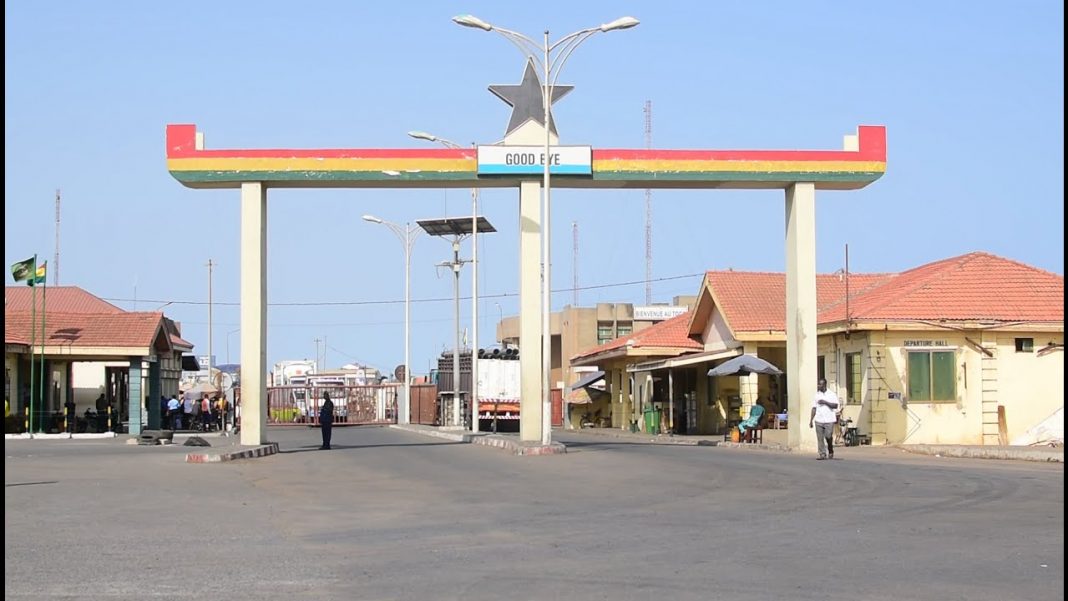
Ghana’s land borders have remained closed since March 2020 and this is sniffing the economic life out of Aflao.
“My business is dying,” Regina told The Fourth Estate.
“I didn’t know that coronavirus would get to Aflao, to the extent of disturbing my restaurant business,” Regina Atisu, a mother of three, said. Her small business of more than 20 years is winding down.
“When the border was open, I could sell as much as GHS 500 per day, but, now, I make less than half of that. I make around GHS 200. We are struggling to make a living,” the 49-year old woman said.
Unlike Regina, Esther Sapey makes less as a sachet water vendor at the border. At 58 years, the woman looks frail, but this does not stop her from traversing the streets to as far as Kodjoviakope in Togo to sell her water.
“I brought two bags of sachet water to sell today, but I’ve been able to sell just three pieces,” distraught Esther told The Fourth Estate.
Kodjoviakope is the first community you’d enter just after crossing the border at Aflao.
Pre-COVID-19 days, Esther said she could sell an average of three bags a day. “Whenever my items got finished, I would run quickly to Togo to stock up,” she said.
But now that the border is closed, business has dried up. She said her supply line has been cut and demand for sachet water has dropped because the border is no longer swarming with people.
On an ordinary day, Regina says the lorry park of Aflao, which is now as quiet as the cemetery would have been buzzing with activities.
The Aflao lorry station once a beehive of activity before COVID-19 is now as quiet as a cemetery
Customers would have thronged her restaurant to fill their belly before embarking on their journeys. Now, her place is filled with employees who are hoping for a miracle for their employer’s business.
“It’s frustrating. I just don’t know what to do. The burden is too much,” she said, sadly.
“We are incurring a lot of debts because passengers no longer come around. Now our food goes waste because there’s no one to buy them.”
“We are unable to pay our suppliers,” she lamented. She said other food centers had closed down because not everyone could cut back.
Some 19 months into the border closure, Regina said her job is almost gone. “We struggle to sleep at night due to long hours of thinking,” she added.
Regina said the situation is direr with those who have lost partners.
“Many of my colleague traders have stopped selling due to this situation. Of particular concern to me are the widows among us who have had to take care of several children in the absence of their husbands. It’s troubling”.
Esther’s children and grandchildren are students at the Kodjoviakope basic school in Togo.
She said the idea was to get them to a certain stage in school before being brought to Ghana to continue.
With the borders closed, they have had to pay GH₵ 10 per person to be able to cross border. On days that she can’t afford to pay, the children simply stay at home.
Esther said the kids who would have been her ticket out of poverty are now on the verge of dropping out of school.
“We are dying slowly,” she says quietly, sitting up.
Francis Kuvedzo, a commercial motorbike rider, said he now earned between GH₵50-GH₵60, half of what he used to make in the pre-pandemic era. “There is poverty and pain. The government needs to put in measures to open the border,” he said.
In Aflao, motorbike riders, popularly known as okada, drive the economy but COVID-19 has reduced them to idle hands.Credit: myjoyonline.com
Why the borders remain closed
The government has said its measures against the COVID-19 pandemic are meant to limit and stop the importation of the virus, contain its spread, provide adequate care for the sick, and limit the impact of the virus on social and economic life.
With the closure of the borders, the government achieved its first objective to limit and stop the foreign importation of the virus. While the land borders remain closed, the airport has been opened since September 1, 2020. President Nana Akufo-Addo has explained why.
“There are lots of our people who are doing this coming and going daily [at land borders], how are we going to test people? Until we are sure that we have strong control over it, we need to be careful,” he said.
To contain the spread, the government’s strategy has been to run tests and trace contacts.
The Fourth Estate team visited the Aflao and Leklebi Kame borders in the Volta Region and observed that many of the reasons for the closure of the borders have been ignored.
The team observed that all manner of travelers were given a pass, ignoring even the basic test of people’s temperature.
Aside from this, there were no handwashing basins at vantage points of entry during the visit.
At one point at the border, a port health official, instead of checking our temperature, gave us a pass after taking GH₵ 10 each from the team members.
A businesswoman from Benin, who asked to remain anonymous said prior to COVID-19 and the closure of borders, she paid about GH₵ 150.00 to journey through all the checkpoints to Accra but now, the situation has changed.
She said, on her last visit to Accra, she has had to pay a little over GHS 1000.00 to Ghanaian security officials at the various checkpoints along the Accra-Aflao Road.
“They are simply enriching their pockets, other than following the government’s directive,” she told The Fourth Estate.
At the Leklebi border post, which is about 15 kilometres from Golokwati in the Afadzato South District Assembly, the immigration and customs officials let us in without observing any of the protocols at the border.
The Immigration and Customs Officials at the two borders sat with no sense of urgency, chatting away the day.
And out of the over 10 officials present at the time of our visit, none of them was wearing a nose mask. For those who attempted, it ended up on their chin.
COVID-19 testing in Aflao
When The Fourth Estate spoke to the Ketu South Municipal Health Director, Joseph Kwami Degley, he said the Gene-X press machine used in testing for coronavirus at the Ketu South Municipal Hospital was not working.
It is a “major challenge,” he confessed. Essentially, at the border town of Aflao, no testing could be done.
“If you come to the hospital, we will take your samples and send them to Ho, we should have done it at Aflao,” he said. Ho is 109km and about three hours’ drive from Aflao.
“It’s the cost to me, the wear and tear because I am sending my pick-up truck every day to Ho to send the specimen. The road is very bad and every day, I have to send the specimen there. I think it’s a countrywide something[problem],” he concluded.
Ketu South Municipal Hospital where COVID-19 samples are taken and tested.
While the population of the Ketu South Municipal Assembly is estimated to be 203,000, less than 0.1% have taken the first jab of the AstraZeneca vaccine.
“We were able to vaccinate 3,000 residents as of August 2021,” the Ketu South Municipal Health Director, Joseph Kwami Degley, said.
Out of that, Mr Degley said just a fraction have had their second jab. In essence, those who are fully vaccinated in a population of 203,000 residents are less than even the 3,000 who took the first jab.
He, however, added that a new consignment of the vaccine would be administered in the coming days.
“Last week, the regional health directorate informed us that the region had taken delivery of some quantity of vaccines and our share has been allocated,” he said.
In essence, in a town where the border is the economy and the economy is the border, very little is being done to implement the government’s second strategy of containing the virus.
Despite the weak enforcement of the COVID-19 protocols, the lack of testing and the slow pace of vaccination, Aflao has a comparatively low number of cases, even at the height of the pandemic.
Experts say Ghana has recorded the third-wave of COVID-19, sending the number of COVID-positive cases recorded in Accra through the roof, but the Ketu South Municipal Assembly of the Volta region, where Aflao is located, has recorded 307 cases and 15 deaths as of August 2021, way below the national average.
While COVID-19 may not be killing the residents, the people say they are dying from a closed economy.
The government’s fourth and final strategy has been to limit the impact of the virus on social and economic life. But at Aflao, residents say despite the biting effect of a closed border, the government does not appear interested in limiting the negative socio-economic impact.
No relief package for border communities
An inscription on a poster during a demonstration at Aflao in September this year.
Demonstrators made a case for the opening of the borders in Aflao in September this year.
The government has rolled out some socio-economic measures to mitigate the impact of the COVID-19 pandemic. The president, in April 2020, announced free water, reduced electricity tariff, and later gave out soft loans to businesses through the NBSSI.
These measures were implemented nationwide.
Residents of Aflao who spoke to The Fourth Estate explained that in the metropolitan centers of the country, people were allowed to go about their business in addition to the benefits of the government’s mitigation measures.
But in Aflao, their business is the border and the border is their business and so the closure of the border means the closure of the city. “We are not office workers to be receiving a monthly salary and so we are struggling,” a resident said.
The main economic activity in Aflao hinges on the movements in and around the border.
The other activity is fishing. But for two times within the 19 months of border closure, there were bans on fishing activities. When The Fourth Estate team visited Aflao, it was in August and “the sea had been closed” as they put it.
Robert, a motor rider and fisherman, said they attempted a few times to fish, but the security officials at the beach imposed a curfew of fear among residents. “We are suffering, and nobody is listening to us,” he said.
The sub-regional picture on the border closure.
In the West African sub-region, countries such as Senegal, Mali, The Gambia, Sierra Leonne, Liberia, Guinea Bissau, Cote D’Ivoire, Burkina Faso, Niger and Nigeria have opened their land borders for free movement of persons and goods.
Elliot Agbenorwu, Immediate past MCE, Ketu South Municipal Assembly, believes Aflao has not been treated differently from other border communities.
Responding to the concerns of residents, Elliot Edem Agbenorwu, the then Municipal Chief Executive (MCE) of the Ketu South Municipal Assembly, acknowledged the difficulties residents are faced with. He said he had had cause to write to the government on the border closure and its economic implications.
“I wrote letters, but I am unable to push it to the end because it wasn’t done to Elubo, it wasn’t done to Paga and so the question is why Aflao?”
He said there is nothing special about the Aflao community to be given special treatment. “What is good for the goose must be good for the gander,” he added.
The Fourth Estate found that, unlike the other border towns, Aflao is very close to the capital of Togo, Lome, making economic activities between the two cities and countries more crucial than the Ivorian and Burkinabe borders.
While Aflao is 3.5km from Lome, the capital of Togo, Elubo is more than 400km from Yamoussoukro, the capital of Ivory Coast. Paga, on the other hand, is 167km from Ouagadougou, the capital of Burkina Faso.
This reality means that Aflao falls within the strong business influence of Lome. The economy of the Ghanaian town is heavily linked with the economy of the Togolese capital, which is the business hub of the country.
This explains why Regina Atisu, the restaurant owner barely gets customers, while Hajia Munira, in Accra, is swarmed by customers.
The government has eased COVID-19 restrictions in both towns. For Regina Atisu, however, a closing border means a closing business.
The MCE said the municipality is resigned to its fate. “Once the president spoke [referring to the president’s defense for the continued closure of the border], we accept it. He is acting in good faith and the best interest of the state,” the MCE said.
This report is produced under the project: COVID-19 Response in Africa: Together for Reliable Information being implemented with funding support from the European Union.
The victims are varied. They include a police officer, a teacher, a former NABCO employee, and the reigning second runner-up of “Ghana’s Strongest” bodybuilding competition. But their aspirations, journeys and fates are similar.
They were promised mouth-watering salaries in France and Dubai. They were asked to pay money they didn’t have. They were directed to go to Cote d’Ivoire for the final preparation for their journey. With borders closed due to Covid-19, they embarked on perilous journeys through unapproved routes. But they all ended up wasting away in Bondougou and Abidjan, some sending SOS calls to Ghana, while others engage in the criminality that landed them in the mess.
The Fourth Estate learns, through the eyes of some victims, of an illegal network that lures youths from across West Africa to Cote d’Ivoire in a massive scam and now reports.
When Richmond Odum arrived in Cote d’Ivoire, his intention was to spend two or three days processing his documents for his much-anticipated travel to Dubai.
He was full of expectations and made a mental note of how to celebrate an end to his hustles. His new elevation from a cleaner, whose salary could barely last for two weeks, to an employee of the global logistics firm, DHL, in Dubai, was a dream come true.
But he would be rudely awakened by the shocking realisation that Cote d’Ivoire was going to be his final destination. His new job, home, and the benefits he looked forward to would forever remain a distant, elusive dream.
He had been trapped in a web of deceit that had proven inescapable to some victims that had been caught in the same scam. And he would spend the next few weeks fighting for and plotting his escape.
While Richmond was still struggling to take in all that had happened to him, his supposed employers shocked him even more with another instruction. He was asked to lure two more people to do the same job he was brought to Cote d’Ivoire to do–scamming. They claimed it was network marketing, but saying so would not entice people to pay so much to get to Cote d’Ivoire. So he was to lie to them the same way a trusted friend had lied to him. That was the only way, they told him, he would get the money they had taken from him back.
His two would-be victims were to pay the same amount Richmond had paid to arrive in Cote d’Ivoire to enable him to recoup his money, they told him.
To help him execute this scandalous plan, the ring leaders of the network took Richmond through a “re-orientation” after they told him that there was nothing like jobs in Dubai or Paris as he had been promised.
Richmond said the “re-orientation” was the beginning of a battle with his conscience. He could not accept the new offer.
“This place was not meant for me,” he told The Fourth Estate. He was not a scammer. He believed in honest labour. It was the reason he was dedicated to his job as a cleaner until, one day, a seemingly more ambitious former colleague at the cleaning business messed him up.
Richmond was busy at work that fateful afternoon when he received a WhatsApp message from Ebenezer, a friend, and former colleague. Ebenezer used to work with Richmond in the same cleaning company in Ghana’s capital, Accra.
Screenshots of WhatsApp conversations Ebenezer had with Richmond, announcing the job opportunity.
Richmond, 28, a supervisor at the Cities Facilities Management Company had not heard from Ebenezer in a long while until that afternoon of June 14, 2021.
“There is an opportunity at the record-keeping department. It is Dubai,” the first message from Ebenezer said.
Richmond was promised a monthly salary of GH¢4,000, more than three times his GH¢1,200 monthly pay at the time. It had taken him five years into his job to reach that salary level. He had started as a cleaner and risen to a supervisor.
Working as a janitor was supposed to be a means to an end. So, while at it, Richmond completed a certificate course at the National Film and Television Institute (NAFTI) in 2017. He tried to top this up with a diploma from the same institution. The tuition fee was GH¢3,000, but he said he was only able to pay GH¢2,000. For falling short of GH¢1,000, his goal of furthering his education was cut short.
He channeled all his energy into his cleaning job and earned a promotion. That was when he met Ebenezer. The two bonded very well and trust was not a deficit in their friendship. It was the reason Richmond did not doubt the message he received from Ebenezer about the DHL job offer in Dubai.
His challenge was the fee of GH¢ 8,000, which, according to Ebenezer, he was supposed to pay DHL’s agents to facilitate his travel. It was more than six times his monthly salary. But the offer was too tempting to ignore.
“It is fees for processing of documents,” Ebenezer told him. The deadline for the payment was June 28, 2021.
Richmond’s fundraising abilities, which had failed him in trying to get a Diploma at NAFTI, were tested again.
“Even if it loans you can get it. So, make ward [wild], and let’s see what will happen,” Ebenezer urged.
On June 18, Richmond said he reported his fundraising progress to the supposed agent of the company Ebenezer had recommended to him.
“Good morning. Please I have been able to get GH¢4000 of the amount. Can you help me get the job?” Richmond said in his initial message to the supposed agent, who was said to be based in the Ivory Coast office of DHL.
The agent would not help Richmond with that amount of money, which was only half of the required “processing fee”.
Richmond said he did not give up. He reached out for assistance from his father, a cocoa farmer in the Eastern region of Ghana who managed to give him GH¢2,000, making a total of GH¢6000. He was still left with GH¢2000, but the agent was prepared to help him on grounds of compassion.
On June 19, 2021, at noon, Richmond bid goodbye to his work and began his journey from Accra to the western border town of Elubo, about 423 kilometres away. From there, he would figure out how to get to the Ivorian capital even though the borders were closed.
At 09:39 the following morning, Richmond arrived in Abidjan through cross-border transits, some illegal. At Abidjan, Richmond said he was met by a woman, only known as Priscilla, who ushered him to a temporary place of stay.
He said on arrival, his host demanded the GH¢6,000, which he paid without being given any receipt. She told him the name of the organisation hosting him was Qnet.
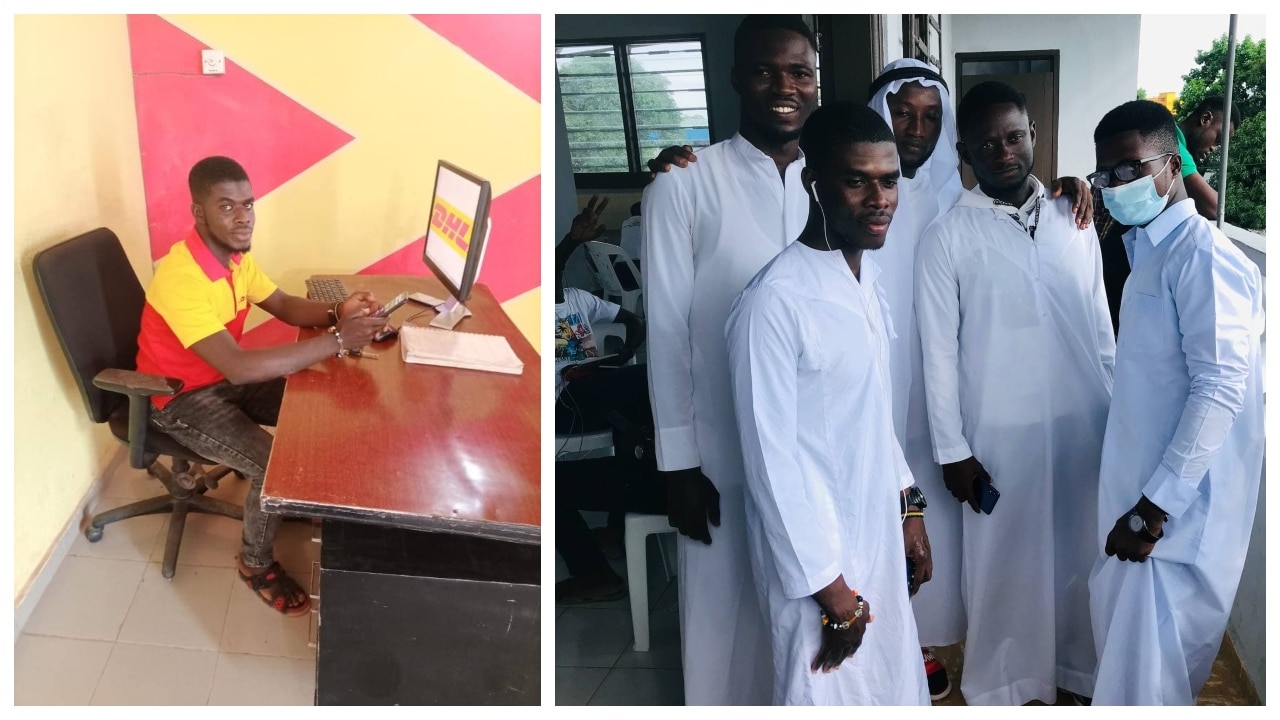
Qnet runs two offices for their operation. The one in Bondougou is painted in DHL colours. The other one in the Ivorian capital, Abidjan, is not painted in DHL colours, but Richmond said the staff wore DHL-branded attires. All other gadgets in the office, including screensavers of their computers, had the DHL logo and colours.
This was to lure many others into believing that the company was indeed DHL when they took photographs and sent them to their potential victims back in Ghana.
A “victim” at the Qnet office at Bondougou, painted in DHL colours,. They have no connection with DHL nor have the permission of DHL to use the company’s coloursAnother “victim” posing in front of the DHL office in Abidjan in order to deceive others back home that he is, indeed, working for DHL in Dubai or France
Richmond said there is a place in Cote d’Ivoire called Plateau, with high-rise buildings, suggestive of a well-developed European city. The Qnet scammers in Abidjan often took photographs here, sometimes at the offices of DHL in order to lure their victims.
Like Richmond, many others fell for the scam and got trapped.
Some of the high-rise buildings in Plateau in Abidjan, where Qnet operatives take photos used to scam unsuspecting QNet victims.
An ill-fated faith in Pastor Faith
When the opportunity to travel to Paris was put before 28-year-old Grace, she initially rejected it in her head, but she could not do so with her heart.
Grace is a third-year Purchasing and Supply student of the Kwame Nkrumah University of Science and Technology (KNUST). Like Richmond, the stark reality hit her when she got to Cote d’Ivoire.
“It was a surreal scene,” she told The Fourth Estate.
“My thoughts were in a swirl. I felt disoriented; my head was throbbing. But my mind raced through options to get out of this situation without being hurt,” Grace recalled her anguish when she finally discovered she had been scammed.
Grace had completed Ho Polytechnic in 2017 with a Higher National Diploma in Logistics and Procurement. But the only procurement she was doing was buying ingredients and making local drinks at home for sale in Hohoe, Volta Region. She said she had always felt underemployed at home and was desperate for an opportunity in the formal working environment.
When she was not making or selling drinks, Grace was often in the Baptist International Church, leading the congregation to worship and praise God. It was her attachment to church activities that helped her see the ‘job advert’ posted on the church’s WhatsApp platform. Grace said she felt her prayers for an elevation had been answered.
Grace reached out to her pastor for details about the job. She was not the only person interested. She said her pastor, who shared the message, also wanted the opportunity and was ready to abandon the congregation for greener pastures too. Her pastor referred her to the actual source of the information he had posted on the platform.
The original source of the message, according to Grace, was Faith Amevor, also a pastor.
Grace knew Faith Amevor very well. He had been a family friend for almost two decades. Grace’s father owns a private school and Faith’s mother also runs a private school. These mutual interests united the two families and that’s how come Grace knew Faith quite well.
Pastor Faith, as Grace called him, left his pastoral work in Ghana and said he was working in France, where he had found better economic opportunities. That’s what he said when Grace contacted him. He said he had even found a job for her too. It was to be in the packaging department of a company in Paris, France.
Pastor Faith told Grace she would be paid GH¢2,800 a month. To facilitate her travel, she had to raise GH¢6,000 and move to Cote d’Ivoire, where her documents would be processed for her final destination in Paris.
Pastor Faith Amevor, at a worship session at Church.
Based on their relationship, Grace said her faith in Pastor Faith and his offer was high. After all, Faith is a pastor. And his father is a pastor.
“Because he is a pastor, nobody was expecting that he would do something bad. We didn’t even think about it,” Grace’s twin sister, Lai Lumor, told The Fourth Estate. “All we were thinking about was how to raise the money,” Lai Lumor said.
Grace said she asked her twin sister, Lai, to assist her to raise the GH¢6,000 and an extra amount for the journey. Lai contracted a loan of GH¢4,000 from her workplace, a savings and loans company in Hohoe. She got an additional GH¢2,000 support from their father.
When the money was ready, Grace abandoned her small drinks business and set off to Abidjan, carrying with her the hopes of the family. Grace said pastor Faith had impressed on her to send the money to him even before she arrived in Cote d’Ivoire.
The journey to Cote d’Ivoire was another ordeal. Ghana’s land borders had been closed since April 2020 due to the Covid-19 pandemic, so she had to use unapproved routes. She traveled from Hohoe to Kumasi and boarded a bus to Sefwi- Osei Kojokrom. At a point, she had to be transported on a motorbike, riding through a forest in Sefwi at 4 a.m.
From the torturous journey through the forest of Sefwi-Osei Kojokrom in the Western-North Region of Ghana, Grace arrived at Nyable, a community bordered by the Comoé District in Cote d’Ivoire. There, she boarded a car to Abidjan, completing a journey of almost a thousand kilometres away from Hohoe.
A day after arrival, her real job was introduced to her. She was supposed to lure others to Cote d’Ivoire the same way she had been lured.
“All my documents were taken from me,” she said.
She said the so-called agents seized all forms of identification from their victims. Richmond said his IDs were taken from him too.
He said about seventy other colleagues who were held against their will in Cote d’Ivoire had no means of escape if they wanted to return to Ghana. They had no ID cards, travel insurance, or money for the purchase of personal effects.
“This place is not meant for me”
Richmond said the first meeting he witnessed was in a compound, like a porch. He said he could count at least 27 youths, many of them Ghanaians and several English-speaking West Africans.
Before the “class”, a young woman in her late 20s stood in front of a whiteboard to teach. That day’s lesson was on network marketing.
“Well, they call it a ‘strategy’,” Richmond said, “but I call it a lie, and they will teach you how to lure your friends into the business.”
Part of the strategy was make-belief. Richmond explained that all recruits were taken to Plateau for picture sessions, which they would use to convince their circles of friends that they were either in Dubai or Paris.
“Those friends are your circle of influence who can believe anything you tell them,” Richmond explained.
Grace Lumor also explained her shock at the purpose of that session. “They were introducing network marketing, Qnet, to me that that’s what I was supposed to do. What I had to do was bring two people and then I would get a commission.”
Another victim, who wants to remain anonymous told The Fourth Estate a similar story. “Upon my arrival, she [Priscilla] took me to a hotel for about three days before sending me to their office to make the payment for 520,000cfa [ an equivalent of GH¢7000 at the time the payment was made].
He said the following day, he was introduced to the job offer.
“I was introduced to the business and it is Qnet, which I had never heard about in my life. I was told to bring two people with the same amount of money before I could start earning money because my success depended on the two,” he recounted to The Fourth Estate.
There was no mention of actually working in Dubai or Paris.
Impersonating Qnet
Qnet Ltd, formerly known as QuestNet, GoldQuest, and QI Limited, is a Hong Kong-based multi-level marketing company owned by the QI Group. According to the company’s website, it deals in products that include energy, weight management, nutrition, personal care, home care, and fashion accessories on an e-commerce platform. Their activities have, however, been outlawed in countries such as the USA, Canada, Australia, Rwanda, Iran, Sri Lanka, Syria, Afghanistan, and La Cote d’Ivoire.
For Richmond and Grace, until that meeting in Abidjan, they had never heard of Qnet.
Richmond said when he enquired about when he was to begin the real work in Dubai, all he got was excuses. He then texted Ebenezer, his friend, and former cleaner who had sent him the “job opportunity”. But Ebenezer asked Richmond to remain calm.
On July 10, 2021, Richmond texted one of his “bosses” again to ask her about what exactly the job offer was.
“Good afternoon, please. I want to go home ASAP,” Richmond said in the text message. When asked what the problem was, Richmond said, “Nothing. I just want to go home. I’m not okay with this place.” His boss tried to calm him down, but Richmond said he was determined to leave with his money.
On July 15, 2021, Richmond sent another lengthy message asking for a refund of the GH¢ 6,000 he had paid on arrival.
“You can’t get your money back. Talk to your leader,” he was told. That leader was the person who had invited Richmond to his new job. In this case, Ebenezer, who was supposedly enjoying his non-existent work in Dubai. Ebenezer was in Bondoukou while Richmond was in Abidjan.
Richmond said he was firm in demanding his money. He said his Abidjan bosses tried other ways to get him to stay, but they failed.
“I told them that we could talk for years, but the only thing I needed was my money. They then asked that we go to the office so they give me my money.”
A screenshot of a WhatsApp conversation between Richmond and Ebenezer, a friend and former colleague at the City Facilities Management, Accra with Richmond bent on retrieving his money.
The company offered to pay him in installments, the first of which was a GH¢1,000 refund. Richmond refused and asked for the full amount. He was given GH¢4,000 at last when a scuffle ensued and he threatened to go to the police to report the matter.
Unlike Richmond, Grace got nothing back.
Grace sends SOS from Abidjan to Hohoe
Making calls in the camp was forbidden to the recruits unless the call was about convincing others on their contact list to join the network. Otherwise, Qnet agents kept the phones of their victims against their will.
Grace, however, came up with a plan. She told her “boss” that she wanted to send money home via mobile money. Sending that money would indicate that she was fine and working.
It sounded convincing enough so she was allowed a moment with her phone. While sending the money, the subscriber would be asked to enter a point of reference. At the point of reference, she wrote an SOS message, calling for her rescue.
A mobile money payment reference by Grace read: “Send me money for us to communicate. This work is a scam. Don’t tell anyone.”
Her family got the hint. Back at Hohoe, Grace’s family was preparing to meet Ghanaian National security officials and Officials of Ghana’s Embassy in Cote d’Ivoire to help rescue their daughter.
The rescue effort took two days.
Grace said her manageress, Priscilla Adzadzah, and pastor Faith Amevor tried to convince her not to meet her family. In order not to give away the location of Qnet’s ‘camp’, she said her ‘bosses’ also took her to a facility far from the Qnet hostel to meet her rescuers, which included her family.
Her twin sister is surprised why the embassy officials, the National Security and the rescue team did not arrest the leaders of Qnet since.
On Sunday, August 21, 2021, Grace arrived in Ghana. But Qnet would not give up on getting her back. Grace said one of her bosses, Priscilla, called to warn her not to disclose their trade secrets to her family.
In a telephone conversation made available to The Fourth Estate, Priscilla advised her to get back to Cote d’Ivoire as early as possible.
“They can take care of you and all that but they can’t build a house for you,” she tried to get Grace to see things the Qnet way.
“Just accompany your family to Ghana. When you settle a bit, run back to Cote d’Ivoire and change your SIM card so that they cannot get through to you,” Priscilla urged Grace to abscond.
“If you don’t have money, you can call me so that I can send you money…..we are also your new family, we can take you as our new family member,” she said, not knowing Grace was the one who instigated her rescue.
But Priscilla would not end the conversation without asking Grace to recommend another person for the non-existing job in Paris.
“If you get any person who may be interested, kindly convince him and give my number to him so that by the time you get back, your account would have been credited.”
Another anonymous victim who also narrated his account to The Fourth Estate said most of them were unable to return home because of the debts they left behind.
“Most of us are here just because we feel if we go back, it will be a shame. I talked to a few people and one Togolese told me if she returns, the father will die because of the money he borrowed. Food to eat is a problem,” he said.
Picking up the pieces
Grace’s twin sister, Lai Lumor, used to take home GH¢ 642 as a salary. Last month, however, Lai’s take-home pay did not get her home due to the loan repayments. She said her salary, after deductions, was now GH¢ 342 and her loan repayment is expected to end in August 2022.
Richmond is back in Ghana and is putting his pieces together.
“I met with a friend who also cleans so we could put up our own company,” he said
His father is yet to know he is back in Ghana. “I am waiting to go and see my dad and tell him, face-to-face,” he said in July 2021.
It is not clear if it is the same Qnet that is sponsoring the CAF Club competitions –CAF Champions League, Confederation Cup, and Super Cup.
The Fourth Estate sent written questions to the Qnet Headquarters via mail since October 5, 2021, but did not receive a response at the time of filing this report.
However, global logistics firm, DHL, has dissociated itself from QNet when The Fourth Estate reached out to them via email, promising to investigate the matter further.
“DHL can unequivocally confirm that we are not affiliated with QNET Business, and under no circumstances has DHL instructed QNET Business to recruit people for positions in Dubai, Côte d’Ivoire, France, or any other region. Until today, DHL was unaware of any scheme by supposed agents of QNET Business in Côte d’Ivoire recruiting applicants for job opportunities in the name of our organization,” part of the statement read.
The Fourth Estate contacted Priscilla Adzadzah and Pastor Faith Amevor, but they both said they had no response to our questions.
Police arrest Qnet agents over fraud
Back home in Ghana, the Adweso District police arrested two agents of Qnet for allegedly swindling a pastor and holding a 26-year-old man hostage on August 23, 2021.
According to the victim, [name withheld] who is a factory hand at a block-making factory, he was lured by his close friend, Wisdom.
“One day, my friend Wisdom called me and said he was doing business at an airport [abroad] that he transports and offloads imported goods to a warehouse which the company pays him GH¢ 800 every week.
“He later convinced me that the company needs three persons to employ which they’ve gotten two and left with one so I should quickly come. I arrived in Koforidua on Sunday and they took me to their place.
“They took all monies I had on me and my mobile phone. They policed me even when I want to urinate. I ate gari all day because I didn’t have money,” the victim told the press.
The uncle of the victim Prosper Tsormana also narrated an account given to him by his nephew.
“They defrauded the guy. They pressed him under duress, asked him to call family and friends. They took his phone, went through the contact list asked him who is this, who is that then they sat on his neck to call them to demand money from them.
“This kind of business is illegally being operated, it is a fraud, it is a scam, we are calling on the government to as quickly as possible and urgently dissolve this Qnet business.
“When you go to where they operate it is an eyesore. The children don’t have food to eat, they don’t allow them to visit their relatives. They police them like prisoners,” he said.
Attorney-General petitioned the court to wind up Quest International (Qnet)
Ghana’s Attorney-General, Godfred Yeboah Dame, petitioned the Commercial Division of the Accra High court in July 2021 to dissolve the Qnet for “engaging in dishonest, illegal, and fraudulent business activities.”
The Attorney-General further said investigations had confirmed Qnet’s fraudulent operations.
“Investigations by the National Security Council Secretariat disclosed that the respondent (QNET) operates in a manner akin to a Ponzi scheme by luring clients to make deposits and investments with them which they eventually lose,” part of the petition read.
“The respondent [Qnet] lures unsuspecting members of the public to pay the sum of about GH¢5, 000 place them in various jobs which turned out to be a hoax,” the petition added.
Two weeks later, the company responded stating that it did not run a get-rich-quick scheme.
“In Ghana, QNET works through distributors termed as ‘Independent Representatives’ or ‘IRs’, who market the company’s products online on a commission basis. It is therefore important to bring to the immediate attention of the public that our Company; QNET is not an Investment Company, Ponzi Scheme, or B2B and does not support any get-rich-quick schemes.”
It further stated that it does not have an office in Ghana. “Our company is in the process of engaging with the authorities of Ghana to establish an office in Ghana in accordance with the laws of the Republic of Ghana, which is hopeful to suffice soon after.”
Who wants to travel?
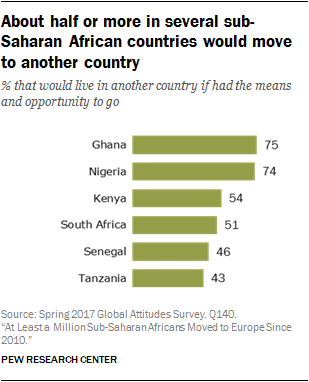
U.S-based fact-tank and social science research Institute, Pew Research Center, carried out a study in 2018 among citizens in Nigeria, Senegal, Kenya and Ghana. It wanted to know from the respondents that if circumstances permitted, would they seek to migrate abroad?
It found that about 75% of Ghanaians are likely to travel to another country should they get the opportunity.
Source: Pew Research Center
The study also finds that while African economies appear to be growing, it is characterised by high unemployment rates and low wages. Aside from that, the Center finds that due to high fertility levels in sub-Saharan Africa, many people would be competing for limited jobs.
This is what makes the youth vulnerable to schemes such as Qnet.
Source: Pew Research Center
These findings are not new. Non-governmental and non-profit research and advocacy institute, Afrobarometer in Nigeria and Ghana, have also announced similar findings in 2017.
Grace’s twin sister, Lai, echoed the sentiments of these respondents when she said she did not believe she could succeed in Ghana, lamenting a lack of economic opportunities. “In Ghana, you don’t become what you want to become. You become what you have, what you are given,” said Lai.
Grace and Richmond say many Ghanaian youths have become agents for Qnet and are stuck in Abidjan, fearful of the very thing they desire to do – escape.
Some victims of QNet in Cote D’ivoire dressed for Eid Fitr 2021.
PHOTOS: Some other QNet victims in during a class session, and some pictures of strategies they were taught.
Grace told The Fourth Estate that although she regained her freedom, her friends were now at risk. Qnet agents harvested all her contacts while she was held in captivity.
Somewhere in Abidjan, they are scrolling through to find among her friends, the next victim.
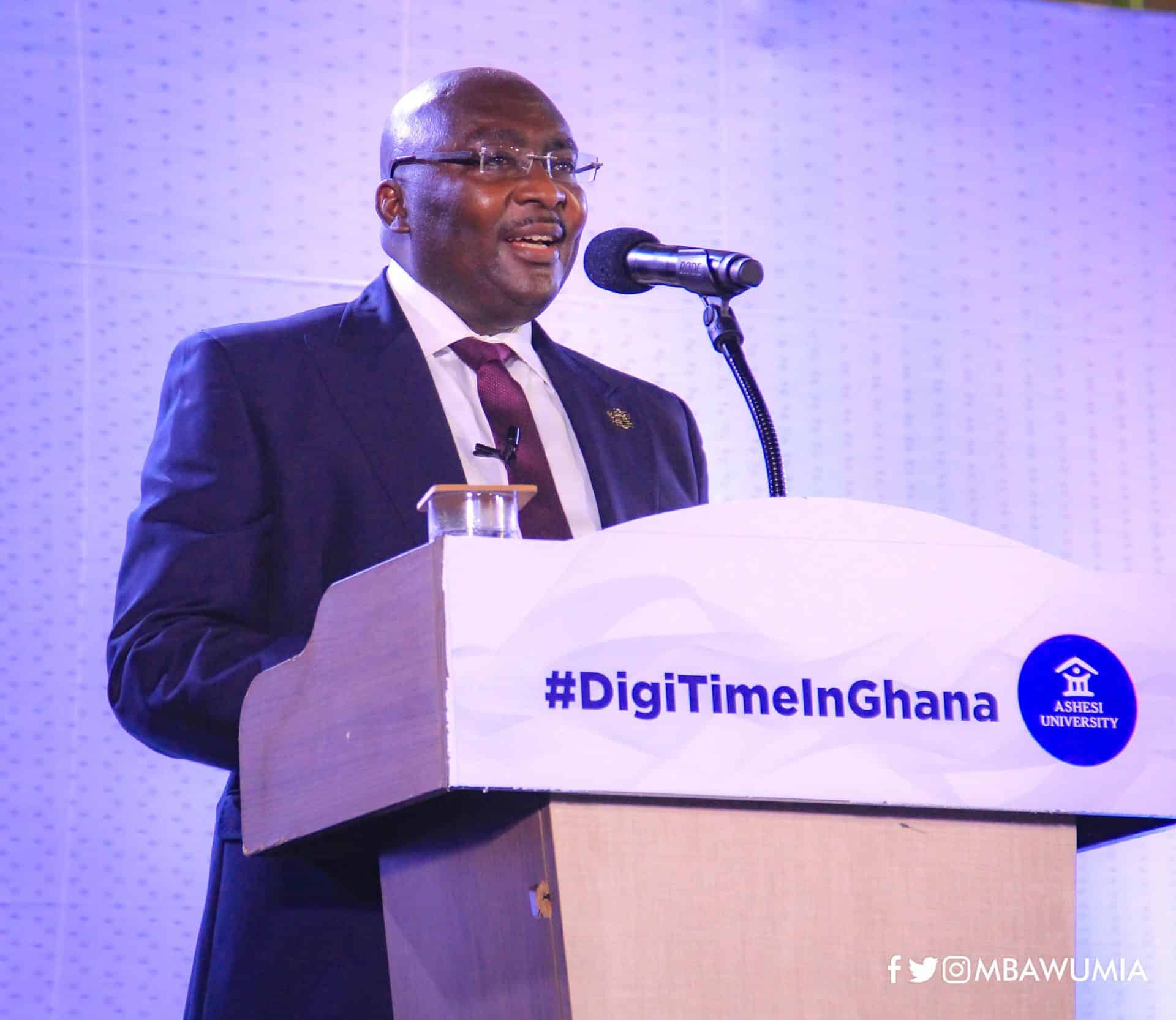
Vice President Dr Mahamudu Bawumia delivered a public lecture on Ghana’s digital economy on Tuesday, November 2, 2021, at Ashesi University. He said the current administration had made some monumental gains at digitising Ghana as never witnessed since independence.
Fact-Check Ghana has verified some of the claims and found them to be false and misleading. Here are the claims and the verdicts:
Claim 1: “Again, I believe the motor insurance database I believe I don’t know of any African Country that has put together this motor insurance database. Ghana is the first to do so.”
Verdict: Completely False
Explanation: Ghana began implementing the Motor Insurance Database on January 1, 2020, to provide a centralised system from which security agencies and the general public, including passengers of vehicles, could check the validity of vehicle insurance instantly.
But before Ghana took this initiative, some African countries had undertaken massive projects that compiled a comprehensive database of the motor insurance sector 10 years before Ghana’s rolled out.
One of such countries is Nigeria.
Nigeria’s Insurance Industry Database (NIID) was meant to get rid of fake motor insurance certificates on Nigerian roads, the menace of fake insurance papers and insurance racketeers.
The Director-General of the Nigerian Insurance Association, Yetunde Ilori, in an interview with the media in July 2020 said “the NIID system, now in its 10th year of implementation, has been effective in transforming the motor insurance policy landscape of the industry,” adding that the NIIP – a unified platform for the sale of Motor Third Party Insurance cover, had since been deployed and is running live for business transactions.
In 2019, the Association said it generated about N196 million from data upload on the Nigerian Insurance Industry Database (NIID) in the 2019 business operation.
A screenshot of the website of the Nigerian Insurance Industry Database
Claim 2: “…Ghana is the first country in Africa … to achieve this type of interoperability between bank accounts and mobile wallets…”
Verdict: False
Explanation: The Ghana Chamber of Telecommunications, together with the Government of Ghana, the central bank, GhIPSS and commercial banks on 10th May 2018, launched the first phase of the mobile money interoperability system.
The Mobile Money Payment Interoperability is the service that allows direct and seamless transfer of funds from one mobile money wallet to another mobile money wallet across networks. It was developed by Ghana Interbank Payment and Settlement Systems (GhIPSS) with the active collaboration of the telecom industry.
Six months later, on Wednesday, November 28, 2018, the second phase of the project was launched.
Dr Bawumia said the launch completed the “Financial Inclusion Triangle because it interconnects three payment platforms; mobile money, bank account and e-zwich.”
Before Ghana had contemplated this move, Tanzania was already benefiting from the usage of the mobile money interoperability system.
In September 2014, a GSMA report on Tracking the Journey Towards Mobile Money Interoperability noted that Tanzania effectively launched Account to Account interoperability to facilitate payments by mobile networks.
“Indeed, there’s precedent in Tanzania, the first African country to adopt interoperability, where there has been increased transactions among users. It’s a measure that’s also been adopted in Kenya and Ghana,” the report partly reads.
An excerpt of the report
Fact-Check Ghana also spoke with some Tanzanian citizens to confirm if indeed the type of interoperability between bank accounts and mobile wallets works in the country.
“Yes, it’s very convenient to send money from one’s mobile account to a different mobile account or bank,” Hussein Bin, a photographer and youth activist in Tanzania, said. He added that the “charges for the services differ depending on the bank”.
Asked if the type of interoperability works in Tanzania, Lilian Alex, a programme assistant with the East African Civil Society Organisations Forum (EACSOF), based in Arusha, said “Yes, it does.” She confirmed that she has ever used it.
That same report, Tracking the Journey Towards Mobile Money Interoperability, also mentioned Pakistan as the country where Mobile Money Payments and banks were made interoperable through an interbank switch in 2014.
Two other African countries Madagascar and Kenya followed next in 2016 and 2017 respectively.
Far away in Jordan, JoMoPay, an interoperability platform was fully implemented in 2016, all in the bid to promote financial inclusion.
It is, therefore, not true that “Ghana is the first country in Africa … to achieve this type of interoperability between bank accounts and mobile wallets.”
Editor’s note: In the initial report, we indicated that South Africa in 2008 rolled out a National Insurance Database before Ghana. Further checks indicate that the South Africa database was for salvaged vehicles.
In his presentation, on Tuesday, November 2, 2021, at Ashesi University, Vice President Dr Mahamudu Bawumia said the current government’s investment in technology was unmatched.
He said the government had installed 10,000 CCTV cameras across the country to assist the police with fighting crime.
Fact-Check Ghana has verified the claim and finds inconsistencies in similar claims made by the president and national security minister on the number of CCTV cameras installed.
Claim: “…You are likely to be caught if you break the law. This is why we have installed 10,000 CCTV cameras since 2017. The cameras have helped the police to solve a number of crimes such as the arrest of suspects in a recent bullion van robbery. At the beginning of 2017, we only had 800 CCTV cameras in operation.”
Verdict: Contradictory
Explanation: According to the government of Ghana, the installation of CCTV cameras is aimed at ensuring border vigilance and boosting crime fighting by the security agencies. The initiative which is called the Alpha project has received US$ 3 million support from the United States government and is being implemented by the National Security.
Before the November 2, 2021, statement at Ashesi University, Dr Bawumia had said on May 2019 that 1000 cameras were being deployed in the first phase of this project. The entire project, according to the vice president, was to ensure the installation of almost 10,000 cameras across the country in 18 months.
“We’ve deployed about 1,000 cameras across the country with a central monitoring centre in Accra, Tamale and Kumasi. The three centres will monitor all the 16 regions. So, the 1000 cameras is [sic] just the first phase. The second phase will be a deployment of 8,000 additional cameras. We want to have a situation where the police are helped very much in their fight against crime with real-time data…,” Dr Bawumia said at a Business Roundtable forum.
National Security Minister says 6,500 CCTV cameras have currently been installed
On the same day Dr Bawumia said 10,000 cameras had been installed (November 2, 2021), when the Minister for National Security Minister, Albert Kan Dapaah said in Parliament that 6,500 cameras have currently been installed. The Minister appeared before Parliament to respond to a question by Mr Peter Lanchene Toobu, Member of Parliament (MP) for Wa West, on the state of the CCTV installation project.
“To date, installation works of 6,500 cameras have been completed, with a little over 4,000 cameras powered and online, mainly in Accra, Kumasi and other regional capitals, and this has aided us to achieve many successes in detecting many infractions and criminal activities, including helping us solve recent violent crimes such as armed robbery and killings,” Mr Dapaah said.
A screenshot of part of the statement delivered by the National Security Minister on Tuesday, November 2, 2021.
The National Security Minister also said that the completion date for the project, which was meant to install a total of 10,000 cameras, had been extended to December 2021. This, according to Mr Kan Dapaah, was due to “logistical challenges introduced by the COVID-19 pandemic”.
If all the 10,000 cameras had been installed as Dr Bawumia claimed, there would not be the need for an extension of the completion date.
Akufo-Addo also envisages the installation of all 10,000 CCTV cameras by December
Exactly a month ago, on October 1, 2021, President Akuffo-Addo speaking at the graduation ceremony of the 50th Cadet Officers’ Course, at the Police Training Academy also commented on the installation of the 10,000 CCTV cameras.
“At the beginning of my mandate, in 2017, there were eight hundred (800) CCTV installations in the country for surveillance. At the end of my first term, the figure had gone up to six thousand, five hundred (6,500), and, by the end of the year, another three thousand, five hundred (3,500) would have been added, making a total of almost eleven thousand (11,000) in the country,” the president said.
The president’s addition was wrong. But what was clear in the statement is that he envisages the completion of the installation of the 10,000 cameras by end of the year, December. This contradicts Dr Bawumia’s claim that the 10,000 cameras have already been installed. The president’s claim is consistent with the Kan Dapaah, the National Security Minister’s claim.
The Royalhouse Chapel has said Jonathan Ohene Nkunim, the rape suspect who was exposed in the “Licensed Sex Predator” investigative documentary, is not a member of the church.
The Director of Administration of Royalhouse Chapel, Rev. Dzifa Gakpleazi, issued a disclaimer after Jonathan Ohene Nkunim was seen in the documentary singing in a branch of the Royalhouse Chapel.
“Leadership of the RoyalHouse Chapel wishes to inform the public and all interested persons that the said ‘Dr’ Jonathan Ohene Nkunim is neither an officer nor a member of the church and has never been”, the statement said.
The church said although “Dr” Jonathan Ohene Nkunim was seen in the video footage, he was only a part of a ministerial team of a guest pastor who had been invited to minister at one of the local churches of Royalhouse.
“After his opening worship for the guest pastor, he immediately left the service without any interaction with the host pastor [the local Royalhouse pastor] or the leadership of our local church,” the church added.
“The leadership of the church is deeply saddened by the actions of this supposed minister of the gospel and prays for mercy and true repentance for his soul. We also pray for the emotional, spiritual and psychological healing of all victims affected by the actions of the aforementioned ‘Dr.’ Jonathan Ohene Nkunim, even as the law to take its cause,” the statement said.
Jonathan Ohene Nkunim, until his arrest, operated the Nature’s Hand Therapeutic Centre at Gbawe in Accra. He claimed to perform general diagnosis, neuromuscular therapy, physiotherapy, detoxification, and spine straightening.
Background
In an investigation that lasted over a year, The Fourth Estate‘ Manasseh Azure Awuni spoke to women who had been sexually assaulted at Ohene Nkunim’s Nature’s Hand Therapeutic Centre.
Aside from these, he sexually assaulted The Fourth Estate’s undercover agent at the facility and sent her several flirtatious messages and a proposal on her last day of visit to the facility in April 2021.
Jonathan Nkunim was arrested following The Fourth Estate’s publication.
On the day of his arrest, Jonathan told Manasseh Azure Awuni that he had made efforts to tame his sexual desires three months earlier and was now in control.
The Fourth Estate’s sources at the police say when he was asked how many women he had violated, he reportedly said he had lost count.
Jonathan Ohene Nkunim was charged with rape and denied bail when he made his first appearance in court on Tuesday, September 28, 2021,
He is due to reappear at the Kaneshie District Court on October 12, 2021.
The Allied Health Professions Council has said the self-styled physiotherapist “Dr Jonathan Ohene Nkunim, who has been arrested for using his facility as bait to sexually assault scores of women, has committed a number of offences.
In a statement signed by the Registrar of the Council, Dr. Samuel Yaw Opoku, the council said Jonathan Nkunim violated section 21 of the Health Professions Regulatory Bodies (HPRB) Act, 2013 (act 857).
The Council stressed that the practices of Jonathan Ohene Nkunim run contrary to their laid down rules.
The Allied Health Professions Council’s statement is in reaction toThe Fourth Estate investigations by Manasseh Azure Awuni, who uncovered the illegal activities at Jonathan Ohene Nkunim’s Nature’s Hand Therapeutic Centre.
“Unequivocally, we wish to state that the said “Dr.” Jonathan Ohene Nkunim is not licensed to practise as a physiotherapist. We further wish to state that the activities of Jonathan Ohene Nkunim as captured in the publication are in clear violation of Section 21(b, c, f &j) of the HPRB Act, 2013 (Act 857; Part One)”, part of the statement read.
Section 21 of Act 857 states the offences that are associated with Allied Health Professions. According to the Act, a person commits an offence if they:
“(a) makes a false declaration in an application for registration as a practitioner; (b) willfully and falsely uses a name, title or an addition implying a qualification to practice as an allied health professional; (c) practices or professes to practice as an allied health professional without prior registration; (d) fails to renew registration and continues to practice; (e) provides unauthorised service in a licenced facility; (f) provides service in an unlicenced facility; (g) fails to conform to practice standards of the allied health profession; (j) engages unqualified persons to practice;…”
The act stipulates that a person who commits any of the offences “is liable on summary conviction to a fine of not more than five hundred penalty units or to a term of imprisonment of not more than two years or to both…”
The Allied Health Professions Council said it “is collaborating with the law enforcement agencies to take the appropriate actions permissible under the law against “Dr” Jonathan Ohene Nkunim.”
The Ghana Physiotherapy Association last week said “the practices of Jonathan Ohene Nkunim are against the ethics of our profession”, and “neither is he a registered member of the Ghana Physiotherapy Association.”
The services provided at Nature’s Hand Therapeutic Centre, as stated on Mr. Ohene Nkunim’s card, are General Diagnosis, Neuromuscular Therapy, Physio Therapy, detoxification, and Spine Straightening.
When The Fourth Estate confronted him, he confessed he had no training in medicine or physiotherapy as he claimed. He also confessed he had not worked at the Physiotherapy Unit of the Korle-Bu Teaching Hospital as he had claimed.
Background
In an investigation that lasted over a year, The Fourth Estate spoke to women who had been sexually assaulted at Ohene Nkunim’s Nature’s Hand Therapeutic Centre.
“Dr” Jonathan Ohene Nkunim’s victims included a couple who had gone to Nature’s Hand Therapeutic Centre, Gbawe, Accra in 2018 to seek his help to be able to conceive. He ended up sleeping with the woman. Feeling guilty about the affair, she confessed to her husband and that was how the seven-year-old marriage ended.
A young woman was on the verge of suicide because the heart-wrenching pain from her spinal cord convinced her that ending her life was a better option. Someone offered her a lifeline, Jonathan Ohene Nkunim’s hotline.
Ohene Nkunim raped her the first day she entered the facility in pain and lay on the massage bed.
He left incriminating evidence in his WhatsApp conversation with her after the ordeal. He admitted he did not seek her permission before having sex with her.
Nkunim claimed the procedure he wanted to perform required sexual arousal. He said he should have “sensitised” her before proceeding. Nkunim then apologised profusely. But he did not stop.
The next time she visited, he had sex with her. It happened until she left for another facility to continue the treatment.
He was arrested following The Fourth Estates publication.
On the day of his arrest, Nkunim said three months earlier, he had taken steps to deal with his sexual desires and was now in control.
The Fourth Estate’s sources at the police say he did not deny the allegations leveled against him when the police interrogated him. When he was asked how many women he had violated, he reportedly said he had lost count.
On Tuesday, September 28, 2021, Jonathan Ohene Nkunim was charged with rape when he made his first appearance in court.
He was denied bail and is due to reappear at the Kaneshie District Court, near the Ministry of Information, on October 12, 2021.
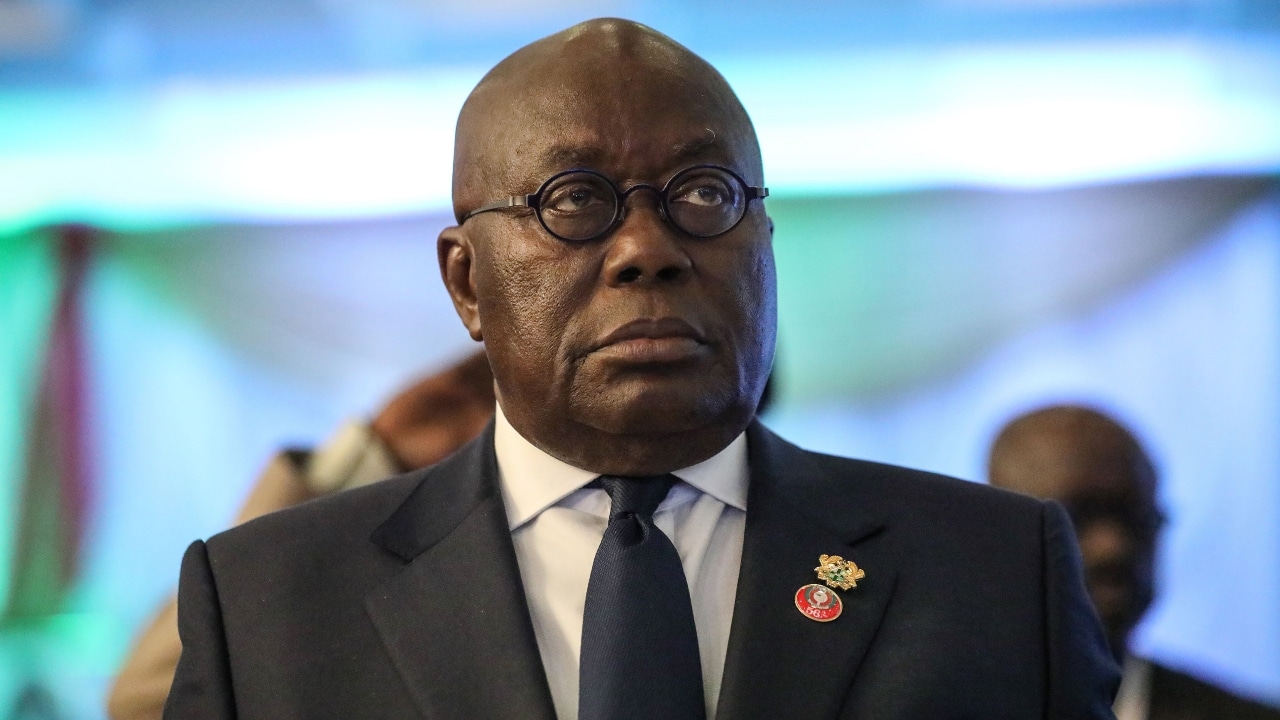

 In Aflao, motorbike riders, popularly known as okada, drive the economy but COVID-19 has reduced them to idle hands. Credit: myjoyonline.com