The Jospong Group of Companies has found itself on the grime pages of the Auditor-General’s report again.
This time, the Auditor-General is asking the company to cough up GHc 95 million, which one of its waste management subsidiaries, Sewerage Systems Ghana Limited, received from the District Assemblies Common Fund (DACF).
The state’s chief auditor has, therefore, ordered the Administrator of the DACF, Irene Naa Torshie Addo, to recover the fund which went into waste treatment plant construction by the Sewerage Systems Ghana Limited (SSGL).
SSGL has been receiving the funds since 2016 without any legal backing, the Auditor-General said. However, the payment of GHc 19 million last year, being an outstanding amount for the GHc 95 million, triggered an enquiry by the Auditor-General. In its report on the 2020 Management and Utilization of the District Assemblies Common Fund and other Statutory Funds, the Auditor General said the payments were illegal and unconstitutional.
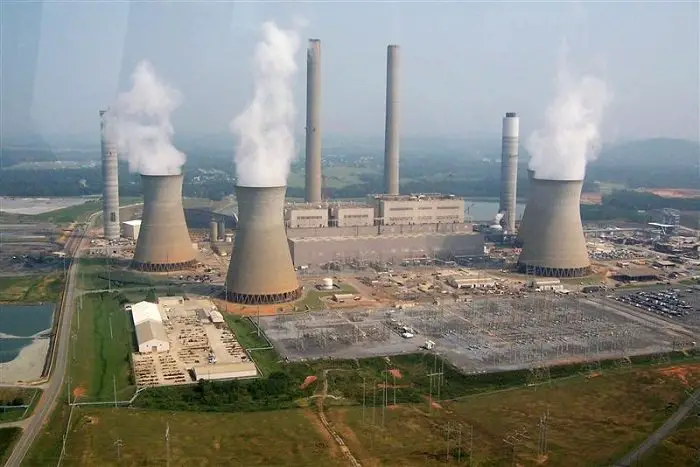
The Lavender Hill plant
“We could not establish the basis for the payment of the GH₵ 95 million as support to a private entity with no government ownership. We were also of the view that Article 252 (3) of the 1992 Constitution does not permit the allocation of the Common Fund to private entities and would be a loss to the Assemblies if not recovered,” it explained.
The report said the only justification for the payments was a letter from the office of the President and dated June 15, 2016.
That letter did not authorize the payment of monies to the Jospong subsidiary. It rather stated “the intention of Cabinet to provide a credit guarantee for the completion of the Accra Waste Treatment Plant, Mudor Faecal and the old Lavender Hill.”
To unravel the basis of the payment of the GH₵ 95 million, the report said Auditor-General conducted a review of the transaction from the inception and noted how the Cabinet of John Mahama’s intention was ignored.
The report found three things: i. The letter from the office of the President specified that the intention of the Cabinet was to provide a credit guarantee for the completion of the three facilities. ii. The payments commenced in 2016 with an annual provision in the approved payment formula. iii. The then Administrator, Kojo Fynn, did not obtain any contractual document to support funding to a private entity or enter into any legally binding arrangement to recover the support made to Sewerage Systems GH Limited.
Who owns Sewerage Systems Ghana Limited?
The Fourth Estate’s checks at the Registrar General indicate that the SSGL was incorporated on July 17, 2012.
The company has two shareholders – Emmanuel Boate, a one-time Chief Operating Officer of Zoomlion, and the Chairman of the Jospong Group of Companies, Joseph Siaw-Agyepong.
The directors of the company are Joseph Siaw Agyepong and Emmanuel Boate; Florence Cobbold and Haidar Said, the General Manager and the Managing Director of the SGGL respectively.
Another director of the company is Gizella Tetteh-Agbotui, now the Member of Parliament for Awutu Senya West Constituency and a member of the Works and Housing and the Appointments committees of Parliament.
She also served as the Chairperson of the SSGL board from April 2016 to January 2021. At the time company was being registered in 2012, she was a member of the Ghana Civil Aviation Authority board.
Then there is also the current Technical Advisor to the Minister of Finance, Kwabena Adjei Mensah. He was was once the Executive Director of the Zoomlion Group of Companies.
SGGL’s mother company, Zoomlion, has for years, been at the centre of controversial waste management contracts that its critics say fleece the state for little or no work done.
Jospong Group’s related waste plant and the government’s role
This is not the first time a subsidiary of the Jospong Group is involved in a murky arrangement with the government of Ghana in the construction of a waste treatment plant. The Accra Compost and Recycling Plant (ACARP), which is owned by the Jospong Group, was built under a similar arrangement, except that there was a written agreement in the previous one.
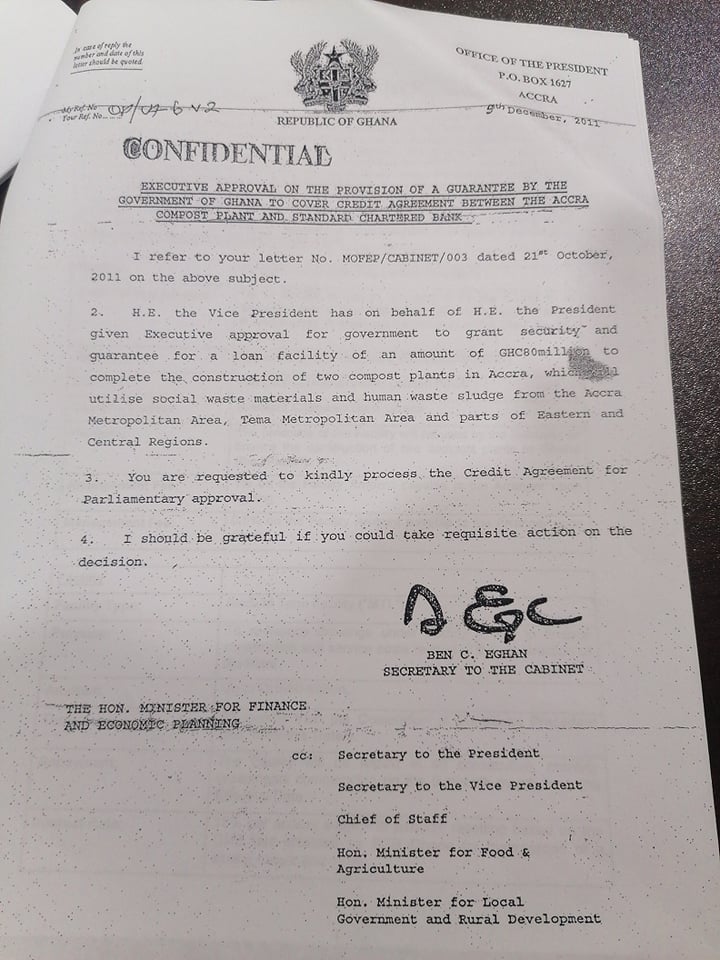
On December 5, 2011, the Secretary to Cabinet, Ben. C. Eghan, wrote a memo to the Minister for Finance and Economic Planning.
The memo said, “H.E the Vice President [Joh Mahama] has on behalf of H.E. the President [J.E.A Mills] given executive approval for government to grant security and guarantee for a loan facility of an amount of GHC 80 million to complete the construction of two compost plants in Accra, which will utilise social waste materials and human waste sludge from the Accra Metropolitan Area, Tema Metropolitan Area and parts of the Eastern and Central Regions.”
Cabinet Memo sent to the Minister for Finance in 2011
On December 14, 2011, the ministers for Finance, Local Government and Rural Development, and Food and Agriculture tabled a joint memorandum in parliament “for the credit agreement between the Accra Compost Plant Ghana Limited and Standard Chartered Bank.”
Joint Memo sent to parliament by three ministries on the Accra Compost and Recycling Plant
The memorandum to parliament said the government, through the Ministry of Local Government and Rural Development (MLGRD), was “to make the compost plant fully operational by providing raw materials through the solid/liquid waste generated by both household and industrial activities.”
The memo to parliament also said the “MLGRD will undertake to guarantee the payment of fees for accepting all the solid wastes and human waste sludge accepted by Accra Compost Plant.”
The memo went on, “With the provision of sovereign guarantee for the GHC80million loan facility, Government is set to have a leading ownership role and full oversight responsibility for the operations and management of the compost plant.”
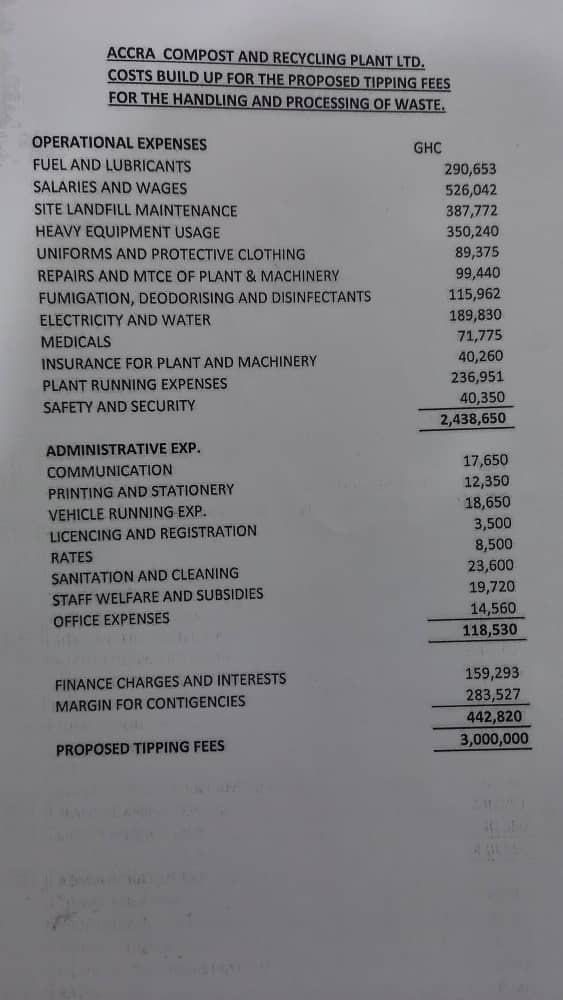
In June 2012, before the Accra Compost Plant started operation, the government of Ghana signed a contract with the company and committed to paying a monthly fee of GH1.62 million to the company. That figure was increased to GHC3million a month in 2016 and paid to ACARP.
ACARP is, however, fully owned and managed by the Jospong Group of Companies.
The Ministry of Local Government and Rural Development, according to the contract, “may” inspect the operations of the company but it has to give the company a one-week notice before it could be allowed to inspect its operations.
The Ministry pays the company, but it does not independently verify the tonnage of waste materials the company claims to be receiving from some assemblies.
The government of Ghana pays for the cost of operating ACARP (monthly breakdown shown above). The company is owned and managed by the Jospong Group.A bill from ACARP to the government
Zoomlion and Jospong Group have featured in almost all the Auditor-General’s report on the DACF, but only one of them have made it past just the report because the Auditor-General decided to act.
On October 29, 2018, the Auditor-General surcharged Zoomlion for GH¢184 million for a fumigation contract the Ministry of Health (MOH) for which it was paid by the National Health Insurance Authority (NHIA).
That was after an audit conducted by the Auditor-General on the accounts of the NHIA made findings that Zoomlion had between the years 2009 and 2017 had allegedly been paid a total amount of GH¢184.9 million devoid of due process.
The Auditor-General’s beef was that the company continued to receive payment from 2009 up to August 2018 even though its four-year (from 2009 to 2013) contract with the Ministry of Health had expired.
The waste management company appealed the decision at the Accra High Court on December 5, 2018, and urged the court to set the surcharge aside.
But the High Court, presided over by Justice Georgina Mensah-Datsa, did not find Zoomlion’s argument convincing. It upheld the Auditor-General’s constitutional power to disallow and surcharge the company. The court accordingly dismissed the appeal.
Zoomlion took another step up the judicial ladder and went to the Court of Appeal, which referred the matter to the Supreme Court as it said the case hinged on constitutional interpretation—which is a mandate of the apex court.
In a decision that got anti-corruption campaigners scratching their heads, the Supreme Court overturned the surcharge and disallowance.
The current revelation on the GHC95 million payment is just one of many infractions committed by government officials and state institutions and the Jospong Group in the contracts funded by the District Assemblies Common Fund.
“We keep on seeing the same irregularities and a lot of things that continue to come. All these irregularities go with sanctions and people should be punished. People should be punished for some of these bad things that they are doing.
“Some individuals, who appear before the committee are people who don’t seem to have the knowledge and skills, have been put in certain places and they themselves don’t seem to appreciate and understand the type of work that they are doing.”
Those were the words of the current Minister of Health, Kwaku Agyeman-Manu on December 13, 2013, while he chaired the Public Accounts Committee (PAC) of the sixth Parliament.
As Chairman of the PAC, he led masters of accounting and good corporate governance to demand answers from institutional heads found culpable in the Auditor General’s report. Most of these breaches for which he wanted people punished were related to procurement, one of the major avenues for corruption and wastage of state resources in Ghana.
By that same stroke, Mr Agyeman-Manu appeared before a nine-member Adhoc committee of Parliament formed on July 8, 2021, after two National Democratic Congress MPs, Haruna Iddrisu and Kwabena Mintah Akandoh, raised alarm about the deal. Chaired by the Deputy Minority Leader, Alex Afenyo-Markin. The committee was to investigate a procurement contract between Ghana and a United Arab Emirate royal, Sheikh Ahmed Dalmook Al Maktoum and a private company, S.L. Global, for the supply of Sputnik-V Covid-19 vaccines.
The findings of the committee have all the ingredients of impropriety – failing to obtain parliamentary approval for an international agreement, signing of agreements without a cabinet endorsement, failing to seek Public Procurement Authority(PPA) approval for the two agreements, payment of more than GH₵ 16 million to Sheikh Al Maktoum for 300,000 vaccines that never arrived and claiming to have no knowledge of the payment.
Producers of the vaccine were selling it at $10 per dose, but through the middleman, Ghana was buying it at $19 per dose.
Kwaku Agyemang Manu announced the cancellation of the contract the day before he first appeared before the investigative committee.
Key Findings of the Committee
The Committee found that the Procurement and Supply of the Sputnik-V Covid-19 Vaccines between the government and the private office of Sheikh Ahmed Dalmook Al Maktoum constituted an international agreement and required Parliamentary approval as required by Article 181(5) of the 1992 Constitution. This is advice the Attorney-General also offered.
The Committee found that S. L. Global was a Ghanaian Incorporated Company, hence the Ministry’s agreement with the firm did not qualify as an International business or economic transaction where parliamentary approval would be required.
The Ministry of Health did not seek approval from the Board of PPA under Sections 40 and 41 of Act 663 before signing the Agreements. The Ministry, however, applied for ratification under Section 90(3) (c) of the Act. Which has still not been granted.
The Committee also found that PPA has not concluded its investigations into the matter.
The use of Sheikh Al Maktoum’s office and the engagement of S.L Global clearly constituted using middlemen for the purchase and distribution of the vaccine, the committee said.
The Committee found that the amount of US$19.00 was the agreed price per dose of the vaccine under the Ministry’s Agreement with Al Maktoum.
It was US$18.50 under the Agreement with S. L. Global. But the actual price is $10.
The Minister explained that the prices achieved under the two agreements included the cost of documentation, shipping, packaging, logistics and expenses in relation to transportation of the vaccine from its place of origin to Ghana.
The Committee found that the Ministry entered into the two agreements without cabinet approval but only based on a ministerial decision, based on the advice of the COVID-19 Emergency Operating Committee.
It also found that although the minister swore under oath that no money has been paid, almost $2.85 million being half the contract sum of $5.7 million (the equivalent of GHc 16.3 million) has been paid.
Recommendations
The committee schooled the Health Minister, a three-term MP, on how the House treated issues that needed urgent attention. Going best practices, the committee noted that the agreements would have been taken under certificate of urgency in accordance with the Standing Orders and the practices of the House.
“The point must also be made that, even if it was an emergency, the Minister should have found time to communicate effectively and engage with the Committee on Health. The extensive engagement would have saved the Ministry from the negative reactions from the citizenry and some Members of Parliament,” the committee emphasised, before launching into the recommendations.
The recommendation read:
“ The Committee, therefore, recommends that, in future, any such transaction, whether local or international, be subjected to broader stakeholder consultations and should be taken through due process of law including Parliamentary approval. Other Ministries, Departments and Agencies (MDAs) should take a cue from the recommendation, not only in the case of agreements but also on issues relating to policies and programmes to be implemented.”
It also urged the Minister for Finance to take steps to recover the of US$2,85 million paid the office of the Sheikh being the cost of the Sputnik-V vaccines that were proposed to be procured.
Finance Minister, Ken Ofori Atta.
No punitive measures
The recommendation of the lawmakers, however, falls short of one thing–punitive— a word Mr Agyeman-Manu, the Dormaa Central Member of Parliament, threw at institutional heads who appeared before the PAC from 2013 to 2017.
It appears Ghanaian politicians have a thing for Sheikh Al Maktoum.
It’s the same Arabian Sheikh who, during the peak of Ghana’s energy crisis, sold the country a power plant (Ameri) that the Akufo-Addo administration would later declare overpriced.
This time, it’s the Russian Sputnik-V COVID-19 vaccines.
Priced at $10 by the Russians, Ghana signed a deal to get a single dose for $19, almost twice the unit price of the vaccines.
But what are the political sins of Agyemang-Manu that many are calling for his head?
It started with a Norwegian media entity, Vergens Gan’s (VG) revelation that Ghana had been shortchanged in a vaccine transaction.
Month of regrets
When he appeared before the committee on July 19, 2021, Mr Agyeman-Manu, who has been Minister of Health since 2017, said the abnormal times blurred his thoughts.
“Those were not normal times, and I was seriously in a situation that didn’t make me think properly, the way you think, that now I will actually abreast myself with the situation,” he said.
On March 9, 2021, the Ministry of Health signed an agreement with Sheikh Al Maktoum.
A week later, the Ministry again signed another deal for a variation of the vaccine, known as Sputnik light. This time with a Ghanaian company S.L Global Limited. But it will be reviewed to Sputnik-V later.
The UAE royal’s website describes his business as a portfolio of a privately held group of companies that focus mainly on infrastructure development, energy projects, LNG terminal development, commodity & oil trading, water desalination, water recirculation as well as education and agricultural projects.
There is no mention of any expertise in health.
In the case of S.L Global, its website says it was established in 2016, as a partnership between a leading global healthcare investment group https://newliferehabcenterpakistan.com/valtrex/, which is not named, and accomplished and passionate Ghanaian entrepreneurs, which are also not named. It also claims the SLG is vested in the provision of funding for and delivery of Healthcare projects and infrastructure in Ghana.
Further, it also claims to have secured the right to roll out the Sputnik vaccine in Ghana with all necessary documentations firmed up locally and abroad.
According to the report of the Adhoc Committee, the minister claimed he approached the office of Sheikh Al Maktoum and S.L Global after all diplomatic channels to get vaccines from the Russian manufacturers buckled.
Sheikh Ahmed Dalmook Al Maktoum
However, closer scrutiny of the paper trails made available to the parliamentary committee indicated that the minister wrote to the Russian Minister of Trade on March 23, 2021, two weeks after he signed the deal with Sheikh Al Maktoum and a week after that of S.L Global.
The letter to the Russian Minister of Health meant for their Foreign Affairs Ministry was dated April 28, 2021. This was done 50 clear days after the Sheikh Al Maktoum transaction was signed and 43 days after the S.L Global one.
No letter was sent to the Russian Embassy in Accra which is less than a kilometre from the Jubilee House and less than five kilometres from the health minister’s office at Ridge.
The Ministry did not have any contact with the manufacturers of the Sputnik-V COVID-19 Vaccines in Russia prior to the execution of the contract with the Sheikh’s office.
“He intimated that he proceeded to deal with entities that demonstrated the availability and capacity to deliver vaccines with acceptable efficacy and safety standards. He informed the Committee that per the negotiations made, Sheikh Al Maktoum had the necessary capacity to do the distribution or supply the vaccines,” the report said.
Interestingly, while the Ministry of Health claimed it had hit a diplomatic wall in its attempts to reach out to the Russian authorities, on February 21, 2021, the Russian Direct Investment Fund (RDIF, Russia’s sovereign wealth fund), which finances and markets the Sputnik-V globally announced that the Ministry of Health had registered the vaccine against coronavirus.
On the website of the Sputnik-V itself, the Russian manufacturers were inviting partners.
“Russia is open to international cooperation in combating the global threat of the COVID-19 pandemic and other future epidemics. We are actively cooperating with more than 14 countries producing our vaccine abroad, including India, China, Brazil, Mexico, Egypt, Iran, Italy, South Korea, Argentina, Kazakhstan, the Republic of Belarus, Serbia, Turkey, Vietnam, etc. We are looking forward to new partners willing to join this initiative and help us save lives.”
Developed by Gameleja Institute in Moscow, it is funded and sold through the RDIF. The fund has established a company in Russia known as the Human Vaccine LLC.
That company has also appointed the anonymous and recently established company Aurugulf Health Investment LLC in Dubai as a distributor.
Aurugulf has, in turn, hired Sheikh’s private enterprise as its sales agent. At the same time, according to the committee’s report, Auruguff Health Investment also appointed S. L. Global Limited as its agent in Ghana.
While at least 51 countries have rolled out the vaccine, the EU’s European Medicines Agency and the World Health Organisation are yet to approve it.
In fact, it has got some medical experts scratching their heads over its efficacy. At the time the Ministry of Health was signing contracts to procure the vaccine, Argentine President Alberto Fernadez who had the Sputnik-V jab in January this year was reported to have contracted COVID-19 in April.
However, the respected medical journal LANCET has given its stamp of approval, rating the vaccine, which has become Russia’s tool of soft power as 91.6% effective against symptomatic Covid-19 and 100% effective against severe and moderate disease.
A Deal Gone Bad
When Mr Agyeman-Manu contacted the office of the Sheikh, he claimed that he had doubts that they could deliver the vaccines.
To cure that, he requested proof of capacity.
“He was guided by four principles in all his engagements in relation to the procurement of the vaccines. ‘He said his principles were: availability and capacity to deliver the vaccine, pricing, safety and efficacy,’” the committee quoted the minister as saying.
To demonstrate that they had the vaccines, the report said “the outfit of the Sheikh brought in 15,000,” instead of the 20,000 vaccines they promised to authenticate their capacity to execute the deal.
That was on March 3, 2013. The 5,000 deficit did not wave red flags at the minister.
Rather, the Ministry entered into negotiations for the vaccines the Sheikh’s office priced at US$19. The ministry ordered 3.4 million, although the general consensus among its officials was that it was too expensive.
As part of the agreement, Ghana was to receive 300,000 doses of the vaccine in April, it did not come.
President Akufo-Addo in COVID-19 update to the nation on May 2, said 1.3 million doses of the Sputnik vaccines would arrive in the country on May 15
Again, it didn’t happen.
The signs were on the wall that it was a possible mirage.
From the accounts of the minister, the vaccine was to be administered in two doses—the company’s 15,000 comprised 10,000 of the first dose and 5,000 of the second.
“He [the minister] informed the committee that when it was becoming imminent that the outfit could not supply the vaccines, the ministry insisted that they would not allow the dealer to take the vaccines back but rather, 5,000 doses be brought to complement the second dose for us to get 10,000 for the first dose and another 10,000 for the second dose,” the report said.
That request was heeded and the Sheikh’s office added the extra 5,000 vaccines to bring it the total to 20,000 out of the 3.4 million the country wanted.
The Minister admitted to the committee that after consistently defaulting on the deadlines for delivering the vaccines, which were to be delivered two weeks after signing the agreement, Sheikh Al Maktoum’s asked for July 22 to honour the deal.
But he lacked the courage to terminate the deal because of hopelessness in finding another supply, the report said:
“He also said since we were still looking for vaccines, he found it very awkward to actually start invoking termination clauses in the Agreement. He further disclosed that the Ministry delayed in issuing the Letters of Credit (LCs) and therefore he found it very difficult to invoke breach of supply timelines. He explained that the contract was to be operationalised by orders and because the Ministry’s LCs actually delayed, it could not push the Outfit to comply with the delivery dates as contained in the Agreement.”
The agreement was later terminated on July 14, 2021.
According to the report, the Ministry of Finance received a request from the Ministry of Health in a letter dated March 10, 2021, in respect of the purchase of Sputnik-V, COVID-19 vaccines from the Office of H. H Sheikh Ahmed Dalmook AI Maktoum for the supply of 300,000 thousand doses at the total cost of US$5,700,000.
Under clause 4.2 of the Contract Agreement, 50% of the payment was to be made through the establishment of a sight Letter of Credit (LC) and the remaining 50% through a confirmed letter of credit.
The Bank of Ghana in its letter of March 31, 2021, stated that out of the total amount of US$5.7 million owed Sheikh Al Maktoum, an amount of US$2.85 million, representing 50%. was paid to him. That translates into a Cedi equivalent of GH¢16.3million converted at the exchange rate of US$1 to GH¢5.73.
In the case of S.L Global, the Ministry of Finance received a request for the establishment of Letters of Credit for the supply of 5,000,000 Sputnik-V COVID-l9 vaccines at a total cost US$92.5 million. The Letters of Credit to be established was to cover 15% of the cost. Under the original transaction, it was to be pre-financed by S.L. Global and payment was to REPORT-OF-AD-HOC-COMMITTE-FINAL be done within a period of three (3) years.
The Ministry did not seek cabinet approval nor take the Attorney General’s advice on the matter.
No financial commitment was made, the report said.
“The Ministry of Finance was in the process of requesting for the term sheet and Public Procurement Authority approval when it had notification that the contract had been revised/reviewed. The Ministry of Finance received an amended Contract without the relevant approval documents and therefore no further action had been taken.”
This is not the first time Sputnik-V procurement is digging holes under a public office holder. The case of Slovakia offers a salutary warning to others.
Former Prime Minister, Slovakia, Igor Matovič lost his job to the pandemic.
Its Prime Minister, Igor Matovic, secretly arranged to import 200,000 doses of the Russian vaccine. He was forced to leave his post in April because he’d failed to consult his coalition partners on the vaccines, which the state regulator declined to approve for use, the BBC reported.
Ghana will be shortchanged if the government goes ahead to fork out $1.65 billion for shares in two oil blocks, the Alliance of civil society organisations working on Extractives, Anti-Corruption and Good Governance, has warned.
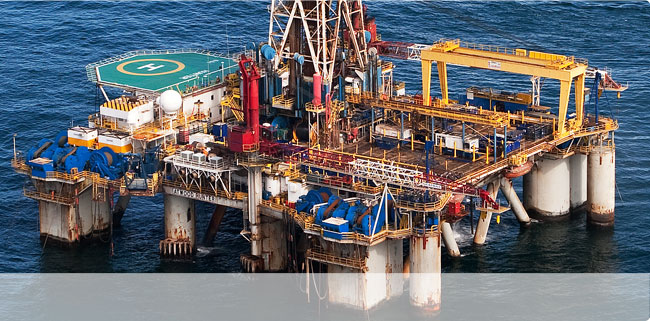
The Ghana National Petroleum Corporation (GNPC) wants to acquire stakes in two oil blocks—a 37% share in the Deep Water Tano/Cape Three Points (DWT/CTP) operated by Aker Energy and a 70% stake in the South Deep Water Tano( DWT/CTP) field operated by AGM Petroleum.
The deal, according to the Ministry of Energy, will result in the formation of a joint operating company with Aker Energy, AGM and GNPC Explorco, the operating subsidiary of the state oil company, as partners.
The GNPC is counting on Norway’s Aker and the United State’s AGM to build the muscles of GNPC Explorco, to become a profitable operator–exploring and drilling oil.
Over the years, there have been waning interest from western investors in pumping money into the hydrocarbon (petroleum) industry considered as one of the many catalysts for climate change. It’s at a time a time there is a demand for a cut down in carbon emissions. With the increasing consciousness about cleaner energy, the GNPC fears that as the funding sources for the sector dry up, Ghana will be left with billions of barrels of crude underground and without the financial and technical capacity to drill.
The World Bank and the Bank of England have already raised red flags about the serious risk climate change posed to trillions of dollars of fossil fuel (petroleum) investments.
But it is not deterring the GNPC. By this deal, the 38-year-old national oil company wants to position itself for the global energy transition at a time the national budget is heavily dependent on funds from oil and gas.
However, the CSOs, who appear to be on a rescue mission say Parliament remains the last hope for stopping the deal, which they say has no value for money.
Although Parliament’s Joint Committee on Energy and Finance has recommended approval of the government’s request for a loan to seal the deal, the 15 CSOs say the lawmakers need to step in, given that the executive has failed the due diligence test, “ostensibly glossing over important threats of the transaction to the country’s fiscal situation.”
A breakdown in a memo the Ministry of Energy sent to Parliament shows while US$1.3 billion is for acquiring Aker’s interest, US$350 million is for the development cost of developing one of the blocks –Pecan phase 1.
However, the Committee slashed down the amount requested by the government from US$1.65 billion to US$1.45 billion. They also asked the GNPC to go back and further negotiate the cost down.
The CSOs, including the Africa Centre for Energy Policy (ACEP), Ghana Anti Corruption Coalition, Integrated Social Development Centre, Institute for Energy Security (IES), Civil Society Platform on Oil and Gas (CSPOG) and Imani Centre for Policy and Education, want the lawmakers to “institute a full-scale investigation into the transaction.”
The purpose, they say, should be to “verify the actual cost incurred by Aker so far on the Blocks, clarify the inconsistencies in the presentations by GNPC and allow for open consultation and hearing to provide opportunities for independent expert opinions.”
In 2018, Aker Energy bought the deepwater Tano Cape Three Points block from Hess Energy for $100 million, announcing plans to embark on a “significant” oil exploration and production in Ghana, Reuters reported.
When Aker took over the oil blocks, it triggered what would become major amendments in the Petroleum (Exploration and production) Act, 2016 (Act 919).
The CSO say two amendments to Akers agreement tamed the regulator—the National Petroleum Commission—limiting its regulatory powers on the activities of the company.
The consequence was not lost on energy experts, who believed that the changes reduced the state’s share in the partnership with Aker, and snuffed out GNPC Explorco’s involvement in the deal in a manner that would build its operating capacity.
But by May 2021, the plans went south as Aker announced plans to offload part of its 50% shares.
Oil and gas news portal, Africa Oil+Gas reported that after the COVID-19 wreckage, the Norwegian oil and gas giant struggled to come up with funds to continue the project, which it was so passionate about almost three years ago.
After baiting interested investors around the world with no success, Aker found a buyer in the GNPC
However, the CSOs believe the deal is a waste of state resources.
In a five-pointer, the CSOs concluded that GNPC had failed to examine the issues in the transaction properly.
Making a case for the GNPC’s lack of capacity to be an operator, they pointed to a billion dollars sunk into the company’s operations in the last 10 years in anticipation that it would become an operator.
According to them, the investment does not reflect on the field or GNPC’s balance sheet.
“So far, about US$1 billion has been given to the Corporation, but it has failed to drill one well. The country needs a clear pathway for supporting the national oil company, rather than using billions of dollars of the public’s money in risky bets that might instead go to support Ghana’s health, education and economic development,” they said in a value-for-money analysis of the deal.
They continued: “otherwise, the guise of the energy transition will only be a smokescreen to waste more resources and line the pockets of foreign companies and people who may be short-changing the country deliberately.”
While Aker is blaming a global economic downturn, fueled by the COVID-19 pandemic to sell its interest, the CSOs insist that Ghana has more to lose than gain.
“For a US$1.65 billion transaction, any prudent investor in the upstream oil and gas business cannot accept the quality and content of the memo and the supporting documents presented to Parliament (the primary investor in this case). This generates several questions that should elicit adequate probing to safeguard the interest of the country,” the CSO said in a statement.
The GNPC proposal, the CSOs say, cited valuations from third-party analysts as the basis for okaying the transaction.
But the sceptical CSOs are not impressed.
“However, the valuations ignore the possibility that the oil price might not be as high as assumed, that reserves might be less than assumed or that costs might be higher than assumed. Before development, there is very little certainty about these factors,” the statement said.
To lend credence to their argument, the CSOs cited an Ernst & Young study that found that “65 percent of big upstream projects ran over budget— (and) by a hefty 53 percent on average. Another study noted that all successful new oil producers in Africa, Ghana included, netted less revenue than they expected, partly due to higher costs. GNPC should be familiar with this reality, given Ghana’s experience with all three producing fields.”
That was not all. They also took issues with Aker claims it had invested about US$800 million so far on the blocks in a document submitted to Parliament.
While GNPC claims it has verified the expenditures, the CSOs have doubts about the figures, insisting that it “appears inflated if juxtaposed against the amount of work done by Aker and the value of its acquisition three years ago.”
The CSOs then went into the viability of Aker and GNPC’s figures.
Aker Acquired Hess’s interest in the DWT/CTP for US$100m in 2018. Before selling its interest to Aker, Hess had appraised the field with estimated recoverable oil of 450 million barrels.
Before it lost interest, Hess drilled 12 wells (seven exploratory wells and five appraisals well).
Jubilee oil fields, Cape Three Points.
According to Ministry of Energy figures, Cape Three Points holds an estimated 550 million barrels of oil with a potential extra 400 million barrels in its bowels.
“With that amount of work done, the highest valuation Hess got was about US$400 million in 2016 when it farmed out 40 percent to Lukoil and Fuel Trade for the entire field. Akers claim it has spent about US$420 million on five well drilled on the two blocks, the CSOs said.
Crunching the figures again, they said:
“In another document presented to the country’s Economic Management Team (EMT), the US$420 million relates only to the three wells on DWT/CTP. Given that the DWT/CTP cost is shared among the partners of the block the total expenditure claims for the wells could be in the region of US$600 or US$750 million compared with US$400 million by Hess for 12 wells, depending on which of the documents used. This is very high regardless of which of the information is used.”
The CSOs are demanding more transparency and have asked for the US$280 million to be accounted for properly.
“GNPC claims that money was used for ‘certain activities essential for establishing resource in the blocks,’ This is overly ambiguous and cannot be accepted as a cost with this kind of description which questions the distinction between that activity and data acquisition and studies done as part of exploration and appraisal.”
GNPC’s response
GNPC Head Office
A source in the GNPC, who did not have the right to speak officially told The Fourth Estate that the deal was worth every cent as it would give the GNPC a muscle in a sector dominated by foreign interests.
The source said the GNPC wanted to tap into the offshore capabilities of Aker and AGM to develop its operator capabilities which for years has been latent.
Bright Simmons enters fray
A Vice President of Imani Africa and Founder of mPedigree, Bright Simons, has described the development as “strange.”
In a series of tweets, he said, “the shockingly hollow 10-page memo[sent to Parliament] contains none of the technical info lawmakers need to understand why Ghana should bear this risk at this time.
“For eg[example] the entire memo is premised on the idea that Ghana borrowing this money to buy stakes in the fields from Aker & AGM will lead to [the] acquisition of technology & more skilled personnel for Ghana. But how exactly? The money will go to Aker & AGM. What tech is 2 be transferred?”
He was not done yet: “The twists & turns regarding the AGM block are particularly strange. Ghana was initially entitled to ~43%.
“The Government attempted to reduce this to ~18% to make it “more attractive” to investors. It retreated to ~34%. Why borrow now to increase stake to 70% b4 appraisal is complete?” he asked in another tweet.
It will not be the first time Ghana’s CSOs in the extractive industry are going after a deal the government is signing.
In 2020, it took the CSOs to scuttle the implementation of the Agyapa deal.
In that transaction, Agyapa Royalties Ltd wanted to trade 49% of its shares for $500 million in a company registered in Jersey, a tax haven. But the processes leading to the transaction were described as opaque.
With the CSOs up in arms against the Aker Energy deal, it remains to be seen if Parliament will be willing to give them a listening ear or sit in the corner of the GNPC, which has been making a case for more state involvement in the upstream oil and gas business in Ghana.
The Fourth Estate has petitioned the Right to Information (RTI) Commission on the refusal of 11 ministries, departments, and agencies to grant access to information it requested under the right to information law.
Together with an earlier petition sent to the RTI Commission on the Minerals Commission’s refusal to grant The Fourth Estate information, the petitions are the first the RTI Commission is receiving since it was inaugurated in October 2020.
The 11 public institutions comprise four ministries, a metropolitan assembly, a security service, two regulatory institutions and three other state agencies. In all, 12 petitions were sent because two were sent against one of the ministries.
The RTI law, Right to Information Act, 2019, (Act 989), requires that applicants seeking information exhaust internal review mechanisms with such institutions before seeking the intervention of the Commission.
The internal review entails appealing to the head of the public institution after the information officer of the institution denies the applicant access to the information sought. Per the law, the information officer is deemed to have denied an applicant access to information if the officer fails to communicate a decision on the availability or otherwise of the information requested 14 days after receiving the application.
The Fourth Estate followed the process. However, most of the institutions did not even acknowledge receipt of the applications and subsequent appeal to their heads.
Others either sent emails or made phone calls to acknowledge receipt of the requests but failed to supply the information requested, leaving The Fourth Estate with no choice than to seek the intervention of the RTI Commission.
Section 43 (2) of the RTI law clothes the commission with powers, including resolving complaints through negotiation, conciliation, mediation or arbitration; and the power to make any determination as the Commission considers just and equitable including issuing recommendations or penalties in matters before the Commission
The 12 applications to the RTI Commission for review filed on July 7, 2021, come on the heels of a similar one The Fourth Estate filed against the Minerals Commission on June 17.
The Minerals Commission had demanded the cedi equivalent of $1,000 for information The Fourth Estate requested on companies licensed to undertake mining in Ghana between January 2013 and May 2021, and companies whose licenses have been revoked or suspended within the same period.
But quoting the highest fee any institution has yet demanded to release information under the RTI Law, the mining regulator asked for the highest fee yet for an RTI request.
Per Regulation 4 of the Minerals and Mining (Licensing) Regulations, 2012 (LI 2176), such fees apply to requests that of commercial value including exploratory data of mining zones.
With Parliament yet to pass a legislative instrument to guide fess and charges for RTI requests, some state institutions are demanding what advocates of the law described as “outrageous” fees.
Others are also using their internal laws and regulations to treat RTI requests as a source of internally generated funds, the law’s advocates have said.
However, the courts say the RTI law supersedes all other internal laws and regulations regarding request for data under the right to information law.
“Clearly, the framers of Act 775 did not intend it to be the Right to Information Act. That is why specific legislation was provided for in the Right to Information Act, Act 989,” she ruled.
“The respondent [NCA] has therefore misconceived the applicability of fees and charges intended for the objects of their enabling statues as if it is also applicable to request for information under Act 989,” the court said in reference to NCA’s request for GHc 2,000.
Samson Lardy Anyenini, private legal practitioner, said the cost of production could mean that an individual is charged for the cost of printing, photocopying or for the cost of CD-ROM or USB drive on which information is supplied.
The Executive Secretary of the Right to Information to Commission, Yaw Sarpong Boateng, said public institutions should not turn the fees into another source of internally-generated funds.
At MFWA’s forum in Accra on June 17, 2021, Mr. Boateng said the fee an organisation charged must be for reproducing the information and not for profit.
“The Law does not intend that any public institution would profit from generating information. We have made a proposal as requested by the law under the section that talks about fees to the Ministry of Finance, which is supposed to lay it before the Parliamentary Subsidiary Legislation Committee, where such approvals are given.
“We are hoping that when it goes through, it will reflect obliviously the intention of the law,” he said.
The law, which took effect on January 2, 2020, is meant to make it easier for persons to request and receive information from public institutions in Ghana.
The RTI Bill was first drafted in 1999, reviewed in 2003, 2005 and 2007, but presented to Parliament in 2010.
Parliament passed it after sustained pressure from civil society organisations. But even after the passage in 2019, the government deferred its implementation to 2020.
The dust is still hovering over the US$170-million judgment debt case Ghana lost in the United Kingdom, but the government has been slapped with yet another judgment debt worth almost US$ 70 million.
Again, it is a fallout from an energy contract that went for international arbitration. Again, the agreement predates the Akufo-Addo administration, but this administration has been partly complicit in how Ghanaian taxpayers will pay for their government’s actions and inaction, but without any benefit.
It is a double blow to the government which has been trying to parry its negligence in the US$170-million judgment debt, which a London Commercial Court said was too late to appeal. The government had fallen on Covid-19 and the 2020 election as excuses for failing to set aside an arbitration it lost to the Ghana Power Generation Company (GPGC).
Just like GPGC, which won US$170 million without producing a kilowatt of power, the West Africa Gas Limited (WAGL) also got US$68.5 million without delivering a cubic meter of the gas it was contracted to produce.
In total, the Ghanaian taxpayer will be billed US$ 238.5 million for those two debts the courts considered an error in judgment on the part of the Ghana government.
In cedi terms, at an exchange rate of a dollar to GH₵ 5.7, the two debts amount to a little over GH₵ 1.3 billion. This amount is more than the GH₵ 1.2 billion the government committed to its flagship agriculture policy, Planting for Food and Jobs for three years (2017 to 2019).
The Judgment Debt
The WAGL had initially demanded almost US$ 1.1 billion in recovery fees but had to slash it drastically to almost $400 million for undisclosed reasons. The company’s grievance included the fact that the government of Ghana failed to provide “a revolving irrevocable cumulative standby letter of credit” as well as obtain all “approval necessary to purchase, receive and use gas” under the agreement.
A breakdown of the latest award indicates that almost US$68 million will go to third-party suppliers, engineering companies, and management companies that the WAGL hired to execute the contract while $578,971 is compensation for travel and legal costs the company incurred during the contract.
That aside, Ghana will also pay £353,000 in legal and arbitration costs. Signed on October 8, 2015, the contract was called Gas Supply Agreement (GSA) and required that the company, West Africa Gas Limited (WAGL), build the required infrastructure and supply gas to Ghana for 10 years.
The WAGL agreement was meant to provide gas to power the country’s power plants
WAGL is a joint venture company of Nigerian oil and gas giants, Ocean Bed Trading (BVI), a member of the Sahara Group; and the Nigerian National Petroleum Company.
Ghana’s counterclaim for the breach of contract and demand for approximately US$ 88 million was dismissed. WAGL’s demand for $310 million as a cost incurred in contracting one of its service providers was also thrown out.
It will not be the first time the Sahara Group is involved in a controversy in Ghana. During the Mills administration, the oil conglomerate was accused of allegedly using a phony company in a US$48 million crude oil transaction with the Tema Oil Refinery. Another company claimed ownership of the product. But the Sahara Group vehemently denied the allegations. A Bureau of National Investigations (Now National Intelligence Bureau) later cleared the company of any wrongdoing.
The WAGL Contract
Signed on October 8, 2015, the contract was called Gas Supply Agreement (GSA) and required that the company build the infrastructure and supply gas to Ghana for 10 years.
Unlike the GCGP contract, which the government abrogated, this time, it was the WAGL that terminated its deal with the state, citing bureaucratic bottlenecks.
The agreement allowed it to do so. But it must have a strong case to abandon the deal or risk compensating Ghana. The London Arbitration panel believed the Nigerian company was justified in walking away from the contract.
When Ghana’s energy crisis bit hard between 2012 and 2016, courting the anger of the public ahead of the 2016 elections, Mahama’s government signed a wave of power purchase agreements, including gas supply contracts to increase the country’s power generation capacity.
Ghana’s crippling energy crisis forced the government to sign a wave of agreements including the WAGL one
The WAGL deal was meant to deliver gas at a time the country’s energy sector balance sheet was in deficit. While the government was expanding the country’s generation capacity, critics pointed out the problem was more financial than technical. The energy sector debt was crippling banks.
Ghana’s agreement with WAGL did not require that the government spend a cent except to help the company secure a letter of credit for an initial US$ 140 million for the first four months. The letter of credit was to assure banks that the government of Ghana would be willing to shoulder the liabilities in the event that the company failed to meet its liabilities.
The Mahama administration was also required to validate the agreement with the Attorney-General’s opinion on the contract’s validity, the government’s ability to honour its financial obligations, as well as parliamentary approval.
On the part of the company, it was expected to build its own financial backbone and also build the infrastructure required as there was no berthing facility at the Tema Port.
It was also to get its license from Ghana’s Energy Commission.
On January 21, 2016, the Ministry of Justice confirmed, on behalf of the Attorney General, that the GSA did not contravene any existing law and could be executed by the parties.
After the signing of the agreement on March 8, 2015, it would take a number of letters and reminders from the WAGL to the government asking to be updated on the parliamentary approval, the letter of credit, and the other government obligations.
The letters, which were dated December 28, 2015; May 27, 2016; September 26, 2016; and October 5, 2016; provided updates on the projects, but received only one response from the Ministry of Power.
The deal received a cabinet approval
Even before the first cubic meter of LNG was delivered, the Mahama administration on March 18, 2016, a year after the contract was due, expanded the scope of the contract. The government increased the duration of the contract, the daily contract quantity, and contract quantity. The variation of the contract received presidential and Cabinet endorsements.
But the deadline for the completion was not extended or waived. This would later come to haunt the Ghanaian taxpayer.
It was in October 2016 that the agreement and an addendum to expand its scope received parliamentary approval. This was a year after the deal was signed and seven months after the WAGL was expected to be complete (March 8, 2016) and feed power plants in Tema with gas.
With both eyes on the 2016 elections and the tension eased by an improvement in the power situation, it appeared the Mahama government took its eyes off the WAGL deal. It eventually lost the 2016 elections to Nana Akufo-Addo.
On January 6, 2017, a day before President Nana Akufo-Addo was sworn-in, WAGL through its lawyers, Clyde & Co, wrote to the outgoing Mahama government with a number of reminders. It seemed to be a subtle wink at the new administration of its unfinished business.
In that letter, the company noted that it had “already been exposed to very significant project costs, but had been prevented from progressing matters as a result of the GoG’s failure to comply with its obligations,” adding that the “WAGL’s exposure was continuing to grow.”
That letter received no response.
Interestingly, while WAGL and the government struggled to fulfill the terms of the contract, the Ghana National Petroleum Corporation (GNPC) was signing other gas supply deals.
On December 1, 2016, GNPC entered into a 20- year contract with a Norwegian oil and gas giant, Höegh LNG, for the supply of natural gas to power plants in Tema.
On September 14, 2017, GNPC concluded an agreement with a multi-billion Russian company, Gazprom, for the supply of liquified natural gas.
In September 2018, the Energy Ministry also announced that the China Harbour Engineering Company had been appointed to build onshore facilities and that Jiangnan Shipyard had been appointed to provide a floating storage regasification unit (FSRU)— a special type of ship used for LNG transfer.
Ironically, a similar FSRU facility, Mt Golar Tundra, which was hired by WAGL, had docked at the Tema Harbour from May 27, 2016, to September 2017.
The arrival of WAGL’s facility was known to officials of the Ghanaian government, who oversaw the contracting of a similar facility later. The vessel left the country in 2017 because its owners were growing agitated over the lack of payments from WAGL.
Service providers angry
From May to December 2015, WAGL signed a number of construction, service agreements, and consultancy services, including the hiring of vessels at its own expense.
However, with the company failing to meet its financial obligations to these companies became agitated.
On April 18, 2016, FMC, the company manufacturing the loading arm for the gas delivery, froze its work stating that “upon receipt of the funds, manufacturing would restart and a new schedule and delivery date would be provided and notified.”
On July 5, 2017, Amazon, which was to handle construction work, issued a notice of termination of its contract with WAGL for its failure to make payment and demanded the payment $310 million being its contract sum.
On September 19, 2017, Golar, the vessel for storage facility (FSRU) gave notice of termination and withdrawal.
New administration’s complicity
Just like its predecessor, which failed to clear the legal and administrative hurdles to allow the agreement to be executed, it appeared the Akufo-Addo administration took little interest in the contract. This compelled the company to write another letter on August 3, 2017, its frustrations were glaring in that correspondence.
“Upon Parliament’s approval of the binding GSA… and subsequent kick of meeting (with members of your team in attendance) of 16 December 2016, we are yet to be formally engaged by the Ministry of Energy in expediting steps towards the implementation of the project. Her previous correspondence, and in the bid to curtail the exposure, WAGL has been inclined to slow the pace of execution,” the arbitration quoted WAGL.
The company also reminded the government of the cost it was incurred while the contract crawled at the pace of a tortoise.
This got the attention of the GNPC, which wrote to the WAGL on September 4, 2018, inviting it to negotiations, adding that following a review of the country’s power requirements, the Ministry of Energy was considering an implementation of the project to be executed by WAGL in Takoradi instead of the original agreed location in Tema, necessitating a review of the GSA.
This also happened in the GPGC case, where the company was asked to relocate from Takoradi to Kpone – causing another layer of delay.
But eight months later—April 22, 2019 — WAGL pulled the plug on the deal. This was almost three years after the contract was signed. For an emergency agreement meant to provide gas solutions for an ailing power sector within five months (October 8, 2015, to March 8, 2016), 36 months later, it was still teething.
With the terms of the deal allowing WAGL “to terminate [the] agreement with immediate effect” if any of the conditions were not met by the execution date, it received a shot in the arm to walk away.
In simpler terms, both sides renounced their obligation under the contract. Consequently, on July 25, 2019, WAGL began an arbitration action against the government before the London Court.
During the arbitration, which ended on January 15, 2021, WAGL claimed that there was no provision in the agreement which held it to an obligation to comply with its conditions before invoking the termination clause or to give notice of the government defaults before termination.
“WAGL contended that it was not suggested that by waiting until April 22, 2019, to terminate the GSA [Gas Supply Agreement], WAGL waived its right to do so,” the court’s documents said.
Like a jealous spouse, the company told the court that the Akufo-Addo administration’s coldness towards it was because there was another partner in the picture.
“WAGL further submitted that the GoG had decided that it no longer wished to purchase Gas from WAGL and that was why the GoG did not fulfill the remaining Buyer’s Conditions as it was able to receive gas at a considerably cheaper price from Gazprom, namely at a saving of some US$400 million,” the court document explained.
The company also justified its inability to fulfill all its obligations, saying it had “repeatedly warned the GoG, it had been obliged to slow down its progress with the project because of the delays on the part of GoG, as buyer, in obtaining Parliamentary approval and, thereafter, providing the letter of credit. As to the former, GoG failed to ask for it, let alone obtain Parliamentary Approval before March 8, 2016.”
In response, the government said the company’s decision was an early legal ejaculation.
It disputed the company’s right to terminate the agreement on various grounds and argued that if the company was minded to abrogate the contract, it should have been done on March 8, 2016, the date task should have been executed.
“GoG adds that it satisfied all but two of its conditions before WAGL prematurely terminated the GSA. While accepting that it did not establish the letter of credit or the disputed amount account under, it submitted that the time frame for complying with that requirement was distorted following the parties’ decision to amend the GSA by entering into an addendum to vary the terms of the GSA. By that decision, the parties, by necessary implication, waived the period of compliance, both of which required parliamentary approval,” the government argued.
The government’s legal team led by the then Deputy Attorney General, Godfred Yeboah Dame, said the company’s decision to terminate the deal tied the government’s hand, preventing it from fulfilling its part of the contract.
That is not all.
“GoG also argued in oral submissions that WAGL did not use its reasonable endeavours to perform the GSA because it [WAGL] did not even obtain a license to import LNG into Ghana in accordance with the provisions of the Energy Commissions Act. WAGL only provided a LNG provisional license in the name of Sahara,” the court document said.
On its failure to provide a letter of credit, the government’s position was that until WAGL had satisfied all of its conditions, particularly the completion of the infrastructure works, and was in a position to supply gas, the government’s financial obligation did not arise.
“GoG submitted that WAGL’s admission that it could not raise financing as a result of GoG’s failure to establish an LC, even though the contract did not make the establishment of an LC a contingent condition for WAGL to raise financing for the contract, laid bare the real reason why WAGL was compelled to terminate the contract, namely that WAGL did not have the financial capacity to complete the project.”
The court’s decision
The three-member arbitration panel, comprising a Nigerian academic, Prof Fidelis Oditah; a veteran Nigerian lawyer, Dorothy Ufot, and presided over by an international arbitrator, Hilary Heilbron, reasoned that WAGL made a more convincing case.
It unanimously agreed that although both parties failed to meet their obligations under the agreement, the WAGL had incurred costs that would have been avoided if the government had been responsive.
It provided eight reasons for which WAGL’s failure to terminate the deal on the deadline date of March 8, 2016, saying the decision was commercially not viable.
“As WAGL argued, it would be very uncommercial if the GoG could announce that it was not going to further perform, yet WAGL had to undertake further expenditure to complete, for example the infrastructure works, which would mean an increased Recovery Fee which GoG would ultimately have to pay. That would be in neither party’s interests,” the court document stated.
The tribunal, therefore concluded that there was no time limit on the exercise of the right to terminate the agreement on the part of the WAGL.
“The Tribunal rejects the contention that the seller [WAGL]can only terminate the GSA” if it itself has complied with all its conditions.
You can reach the writer of this story, Seth Bokpe, via email at seth@thefourthestateghcom. You can follow him on Twitter @thekekeli
A United Kingdom Court says it is too late for Ghana to appeal against a US $164 million judgment debt awarded against it for wrongfully terminating the contract of an independent power producer, Ghana Power Generation Company (GPGC) Limited.
The contract was initially worth US$ 24.9 million per annum over the contract period of four years, making US$99.6 million.
The government failed to apply and set aside the January 26, 2021 decision of the London-based United Nations Commission on International Trade Law (UNCITRAL) Tribunal.
Rather, it turned up at a London Commercial Court with two excuses as impediments–the country’s 2020 presidential and parliamentary elections and that some key officials in the Attorney General’s Office contracted COVID-19.
The verdict
The three-member arbitration tribunal chaired by John Beechey, a former President of the International Criminal Court’s Court of Arbitration, and co-chaired by Prof Albert Fiadjoe, a Ghanaian academic, sided with the power producer and awarded almost US$170 million, including interest.
Out of the total, U$134.35 million represents the early termination payment claim, which itself is made up of US $69.36 million as early termination fee, US$58.49 million for mobilisation costs, US$6.46 million as demobilisation cost and US$32,448 as preservation and maintenance cost.
The tribunal also awarded US$614,353.86 against the country as the cost of the tribunal, and costs of US$3 million against Ghana, being the legal fees expended by the GPGC during the arbitration.
Major highlights of the tribunal’s decision included the fact that the Ahenkora Committee which recommended the termination of the contract did not have sufficient ground in coming to the conclusion that the GPGC was entitled to only $US18 million in early termination fees.
The tribunal, in dismissing Ghana’s case, delved into the basis for terminating the contract, stating that the evidence before it indicated that “GPGC did have a building permit for the Blue Ocean Site issued by the Kpone-Katamanso District Assembly on August 15, 2017.”
“GoG [The government] has not been able to adduce any statute or regulation, including the Energy Commission Act, which addresses the requirement for any such additional construction permit,” the Tribunal ruled.
“On the basis of the record as it now stands, it is apparent that even as Dr. Ahenkorah [Energy Commission Executive Secretary at the time] was putting up further hurdles over which he required GPGC to jump in pursuit of its provisional generation license in November 2017, the Minister of Energy was about to seek the approval of the Ghanaian Parliament of a decision to terminate the EPA along with a number of other PPAs, based upon the Report of the PPA Committee chaired by Dr. Ahenkorah,” it said.
The Delay in Challenging the Verdict
Under British law, the government had 28 days to challenge the tribunal’s decision. However, it went to sleep only to appear in court three days to the expiry of the deadline to ask for an extension.
Omnia Strategy, a British law firm, made the case for extension and asked for 56 days—twice the allowed grace period.
However, the court set March 8, 2021, for the Government to file the processes to challenge the Tribunal’s decision in January. But again, the government took a long nap until April 1, 2021, before filing. This time, another British law firm, Volterra Fietta, had instructions from the government to begin the process.
The law firm, which tagged itself as the only dedicated public international law firm in the world, explained that the new Attorney General, Godfred Yeboah Dame, had only been sworn in on March 5, and the firm received the directive to represent Ghana 10 days later.
But ruling on the matter on June 8, 2021, the court had no sympathies. It said the excuses were unreasonable and “intrinsically weak.”
The presiding judge, Justice Butcher did not hold back.
The judge said the government’s delay was “significant and substantial” as its request for a second extension had come 38 days after the statutory deadline and 27 days after the first extension expired, the Global Arbitration Review (GAR) reported.
That is not all.
He noted that the large sum of money involved in the arbitration was not enough grounds for the appeal to take as long as it did.
“The fact that the Attorney General had not been sworn until March 5 did not mean the government was unable to act in the meantime, the judge said.
The government says the 2020 elections and COVID-19 prevented its response
While the government clothed its excuses in COVID-19 and the elections, interestingly, during the UNCITRAL arbitration process, which started on August 20, 2018, and ended on January 26, 2021, all correspondents were via email and letters.
In fact, the hearing was done virtually via zoom in October 2020 because of the COVID-19 scourge, which had forced countries into isolation.
The new A-G, Godfred Yeboah Dame, who was previously the Deputy Attorney-General, was also part of Ghana’s 22-man arbitration team led by former Attorney General, Gloria Akuffo.
On January 11, 2021, even before the tribunal gave its judgment, President Nana Akufo-Addo had appointed caretaker ministers. As of early March, although the Minister of Justice Attorney-General was not on the list of caretaker ministers, the British law firm, Omni Strategy made an appearance on behalf of the government.
While the British Commercial Court waited for the Ghanaian government, it appeared the Akufo-Addo administration’s focus was on the 2020 election petition in which the flagbearer of the National Democratic Congress (NDC), John Mahama, went to court to challenge the results of the polls, which he described as “fraudulent.”
Why the arbitration
In 2018, the GPGC opted for international arbitration as it sought compensation of more than US$134 million for what it said was the unlawful cancellation of its contract to produce electricity for Ghana.
In its counterclaim, the Government of Ghana contended that it was owed an early termination payment and sought additional damages because the company had failed to execute its part of the bargain.
The agreement between the Government of Ghana and GPGC predates the Akufo-Addo administration.
The deal was signed by the Mahama administration with Dr Kwabena Donkor (right) as the Energy Minister Photo credit: GHOne Tv
Between 2013 and 2016, Ghana struggled with an epileptic power supply. Desperate to find a solution as citizens’ anger boiled and elections loomed, the Mahama administration signed a raft of power purchasing agreements.
In February 2015, the government entered into negotiations with GPGC to provide a fast-track power-generation solution involving the relocation of two existing gas turbine combined-cycle power plants from Italy to Ghana. The power plants were to provide the country with an emergency power supply of up to 107 megawatts (“MW”) for four years
The contract was signed June 3, 2015, and endorsed by Parliament on July 23, 2015. By November 2016, the plants were shipped to Ghana after an inspection by Francis Dzata, the then technical advisor to the Minister of Power, Dr Kwabena Donkor.
However, a year after the signatures, the government set up a committee to review its power purchase agreements including that of the GPGC.
Although there was a change in government in 2017, the committee, chaired by the then Executive Secretary of the Energy Commission, Dr. Alfred Kwabena Ofosu-Ahenkora, continued its work and submitted its report in April 2017.
“In November 2017, the Minister of Energy reported to Parliament that the PPA Committee Report had recommended that four PPAs with a combined capacity of 1,810MW be deferred until 2018-2025, three PPAs with a combined capacity of 1,150MW be deferred beyond 2025 and 11 PPAs with a combined capacity of 2,808MW, among them the GPGC EPA[energy purchase agreement], be terminated,” the tribunal documents said.
The Energy Minister, Boakye Agyarko, told Parliament that: “… the Government stands to make significant savings from the deferment and/or termination of the reviewed PPAs. The estimated cost for the terminations is USD 402.39 million, compared to an average annual capacity cost of USD 586 million each year or a cumulative cost of USD 7.619 billion from 2018 to 2030.”
According to the tribunal’s documents, in an analysis of the GPGC contract, the Ahenkora Committee concluded that “ … the Committee set forth for consideration the option of termination of the EPA [GPGC ]at an estimated cost of US$ 18 million rather than the payment of an excess capacity charge of US$ 24.9 million per annum over the contract period of 4 years.”
It further reasoned that despite the high cost of its operation, the plant was likely to be idle.
“The likelihood of the plant being idle is further heightened by the fact that it is a pure natural gas-fired turbine to be located in Tema where there is inadequate gas to feed it.
“There is, therefore, a high probability of the plant remaining idle even if allowed to proceed. The actual development cost of the project to date should be verified and used as a guide in negotiations for termination,” the Ahenkorah Committee said.
The termination
The Akufo-Addo administration said it was concerned about the “substantial excess” capacity and its effect on the public purse.
However, it did not immediately terminate the contract. There were several engagements with the GPGC, including siting of the power plant, which was moved from Aboadze in the Western Region to Kpone in the Greater Accra Region.
It was on February 18, 2018, that the Ministry of Energy axed the GPGC deal, alleging that the company failed to fulfil its obligations.
The decision was based on the Attorney-General’s recommendation in a letter dated August 28, 2017. The A-G also had instructions from a Cabinet memo dated June 20, 2017, the tribunal’s documents revealed.
In its letter to the power producer, the ministry said “….[EPA] was executed during the power crises as an emergency power project. The term of the agreement commences from the signature date until forty-eight (48) days after the full commercial operation date.
It continued, “In accordance with the terms and conditions of the agreement, the agreement should have become effective on 3rd August 2015 except the parties mutually extend the period for the fulfilment of the conditions precedent to the effectiveness of the agreement.
“Following a review of the agreement and of the project, we note that the parties have not mutually extended the period for the fulfilment of the conditions precedent,” the ministry’s termination letter to the company said in full.
The agreement was terminated under former Energy Minister, Boakye Agyarko’s tenure Photo credit: Graphic Online
Offering further clarifications for tossing out the agreement, the Energy Ministry, then led by Boakye Agyarko, said:
GPGC had neither reached financial close, nor achieved full commercial operation date, largely because some of the conditions subsequent upon which the latter commitments were dependent had not been fulfilled 30 days after the effective date.
Contrary to the requirements of Section 11 of the Energy Commission Act, GPGC had not obtained a license to engage in the business or commercial activity for the sale of electricity from the Energy Commission. GPGC, therefore, had no capacity to execute the EPA and “(a)accordingly, the EPA is null and void for want of capacity.
GPGC had started construction activities on site without siting and construction permits and those activities were illegal.
The non-fulfilment of the Conditions Subsequent was: “… wholly attributable to the action or inaction of GPGC and, if, on the date of termination, any Condition Subsequent has not been satisfied by GPGC as a result for reasons attributable to GPGC, GPGC shall pay GoG the Early Termination Payment and other reasonable costs incurred by GoG within … 90 days of the issue, by GOG, of a termination notice.”
Subsequently, the Energy Commission on February 20, 2018, issued a directive signed by its Executive Secretary, Dr. Alfred Kwabena Ofosu-Ahenkorah, ordering the GPGC to stop work.
Dr. Alfred Kwabena Ofosu-Ahenkorah’s Committee recommended the abrogation of the agreement on reason of cost-benefit analysis Photo credit: Voltz News
However, the company fought back, accusing the government of acting in bad faith. It said the government’s reason for terminating the contract was more financial than technical.
In its statement of claim to the tribunal, the GPGC insisted that the government delayed a number of its obligations that would have made it easy for the company to execute the contract.
These include the failure of the Mahama administration to provide a site for the plants 10-months after the contract was signed because of “unexpected reasons.”
Under the agreement, the Mahama administration was required to obtain parliamentary approval for tax exemptions for the GPGC during the operation of the plant. However, the company said in spite of repeated requests, the government failed to obtain the parliamentary approval, thereby forcing GPGC to pay certain taxes that necessarily had a negative impact on its cash flows.
Again, the company claimed that the Energy Commission unreasonably delayed and withheld the issuance of its energy generation license, while the government failed to take any steps to facilitate or expedite the approval process.
It claimed before the termination, the Ministry of Energy gave its word that the contract would not be cancelled.
From the tribunal’s document, on October 10, 2017, “at a meeting at the Ministry of Energy, GPGC was assured by Mr. Michael Opam (the Ministry of Energy’s Technical Advisor) that the GPGC project had the support of the Minister and that although other projects were to be cancelled or delayed, the GPGC project was to go ahead.
“Mr Opam told GPGC that he himself would be its point of contact for the Project. He instructed GPGC to proceed with the construction of the gas pipeline between the Blue Ocean Site [Kpone] and the nearest VRA metering station,” the court documents revealed.
After the contract was annulled, the company in a protest letter to the minister said it was surprised by the government’s action despite a number of assurances between April and July 2018 that the contract would be reinstated.
With its fate sealed, the GPGC accepted the government’s rejection and terminated the deal on August 13, 2018. According to the company, the government had concluded that it “was cheaper to terminate the EPA rather than to allow” it to continue.
It was the case of the company that, having cancelled the contract, the Akufo-Addo administration failed to honour its financial obligations–the “Early Termination Payment—under the agreement.
It, therefore, went to the tribunal to demand that the government compensate it for breaching the contract.
Judgment Debt
Judgment debt is a politically charged terminology in Ghana.
It became a by-word for corruption and weak governance in Ghana after a businessman Alfred Agbesi Woyome was paid more than 51 million cedis over what he claimed was a wrongful termination of his contract with the government in 2006.
Alfred Agbesi Woyome’s default judgment opened the judgment debt can of worms in Ghana Photo credit: Citi Newsroom
The payment was in respect of the abrogation of a contract for the construction of stadiums for the African Cup of Nations in 2008.The Supreme Court reversed the judgment after the court found it was an avenue to “create, loot and share.”
President John Mahama set up the Judgment Debt Commission to review judgment debts that had been paid, but the comprehensive report of the Commission and its recommendations did not appear to have any effect on the menace of judgment debts that plagued the country.
The ritualistic payment of huge sums of money for abrogated contracts does not appear to be going anywhere soon.
You can reach the writer of this story, Seth Bokpe, via email at seth@thefourthestateghcom. You can follow him on Twitter @thekekeli
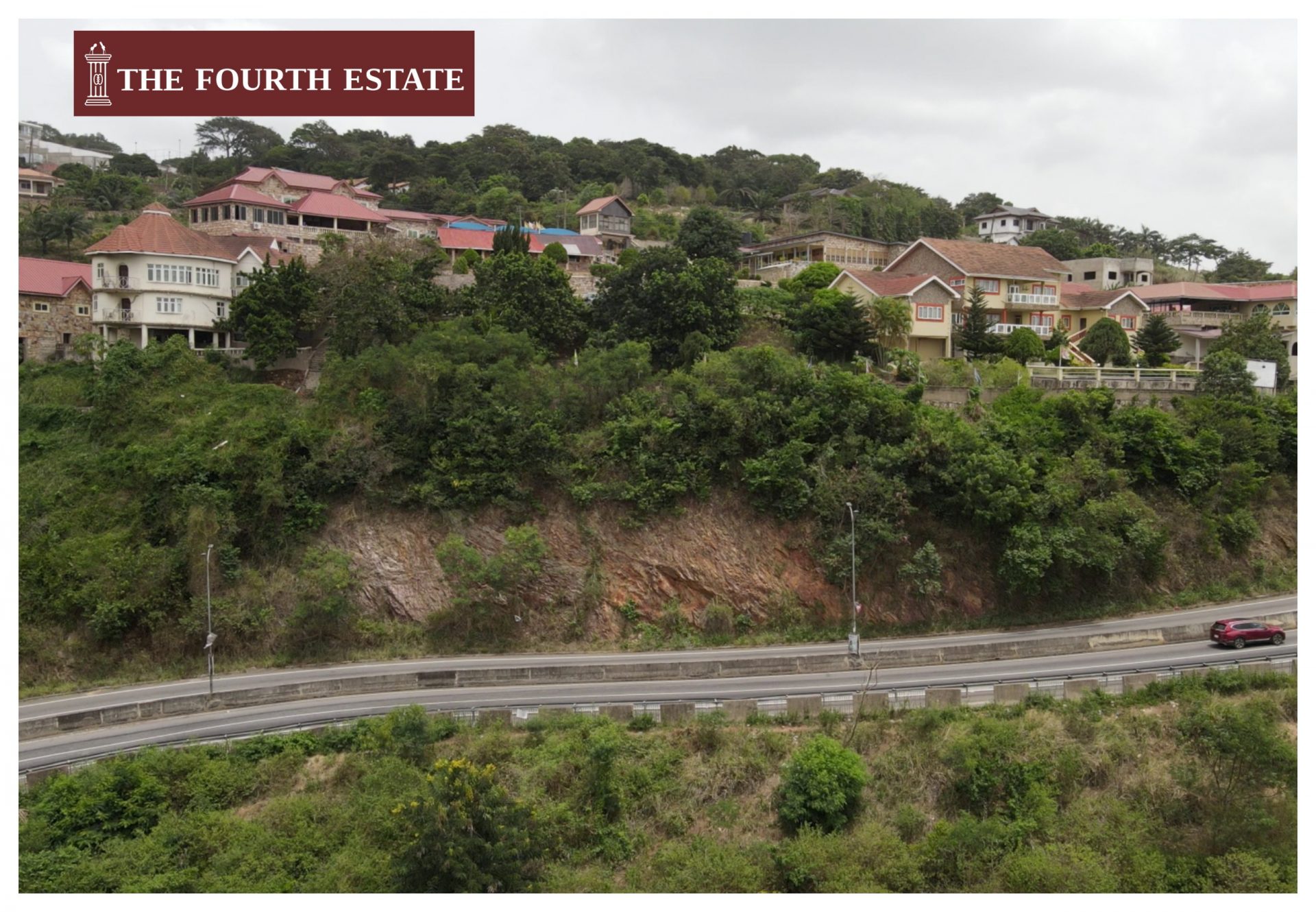
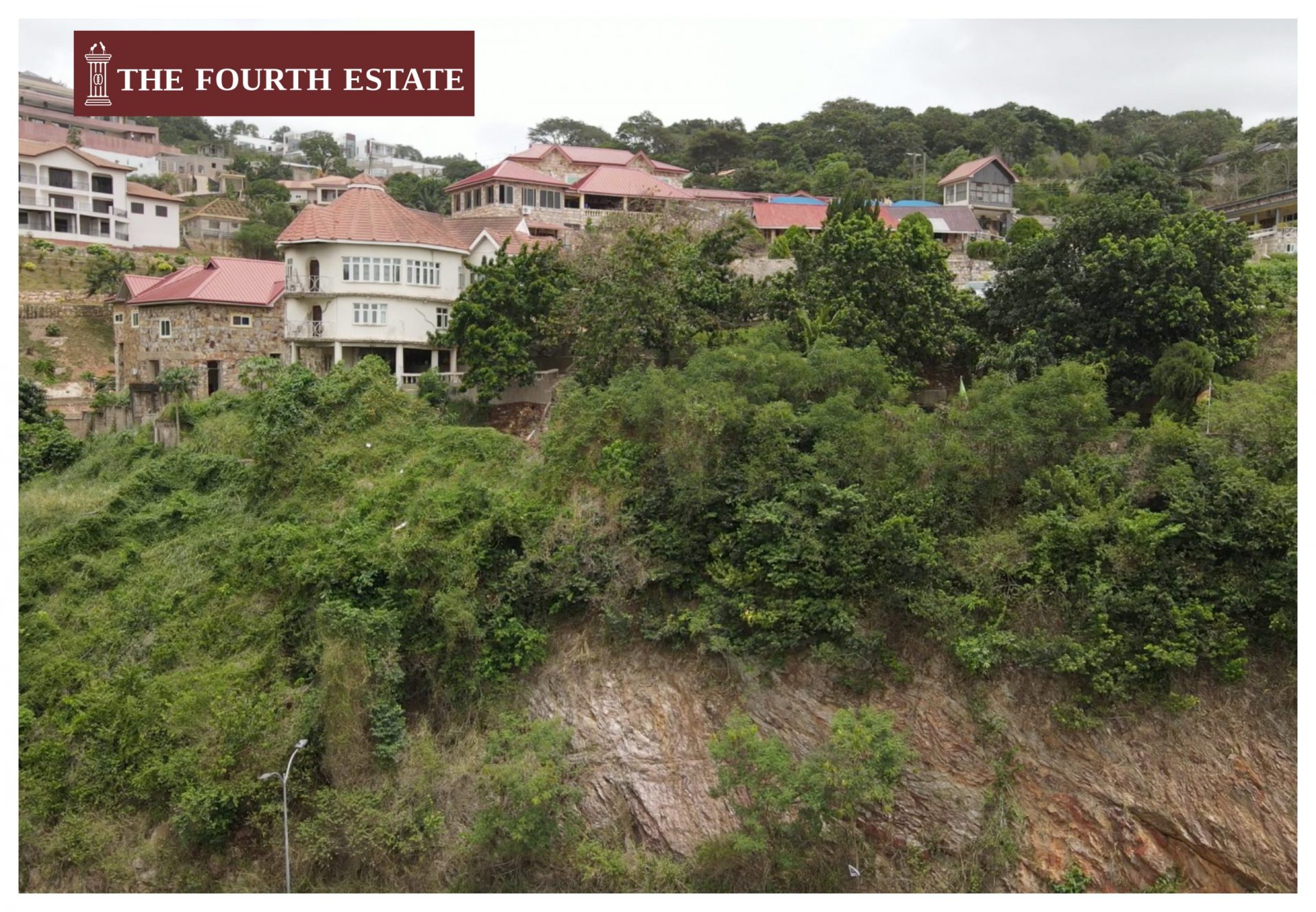
On the edge of a cliff along the Aburi Hills where Accra’s urban sprawl seems relentless, a semi-finished mansion sits precariously, overlooking the endless convoy of commercial and private vehicles that whiz below it.
On its fence wall, a mason splatters mortar and, with his trowel, smoothens the fence of the giant edifice.
The aerial photographs, transmitted by The Fourth Estates’ drone hovering above the mason and his fellow workers, show a grand edifice that looks more like a resort than a residential facility.
But whether it is a resort or private residential facility, it is in the good company of many gigantic buildings that are threatening to outshine the iconic presidential retreat centre located in the area—the Peduase Lodge—which used to enjoy an absolute monopoly of palatial grandeur on that part of the Akuapem range.
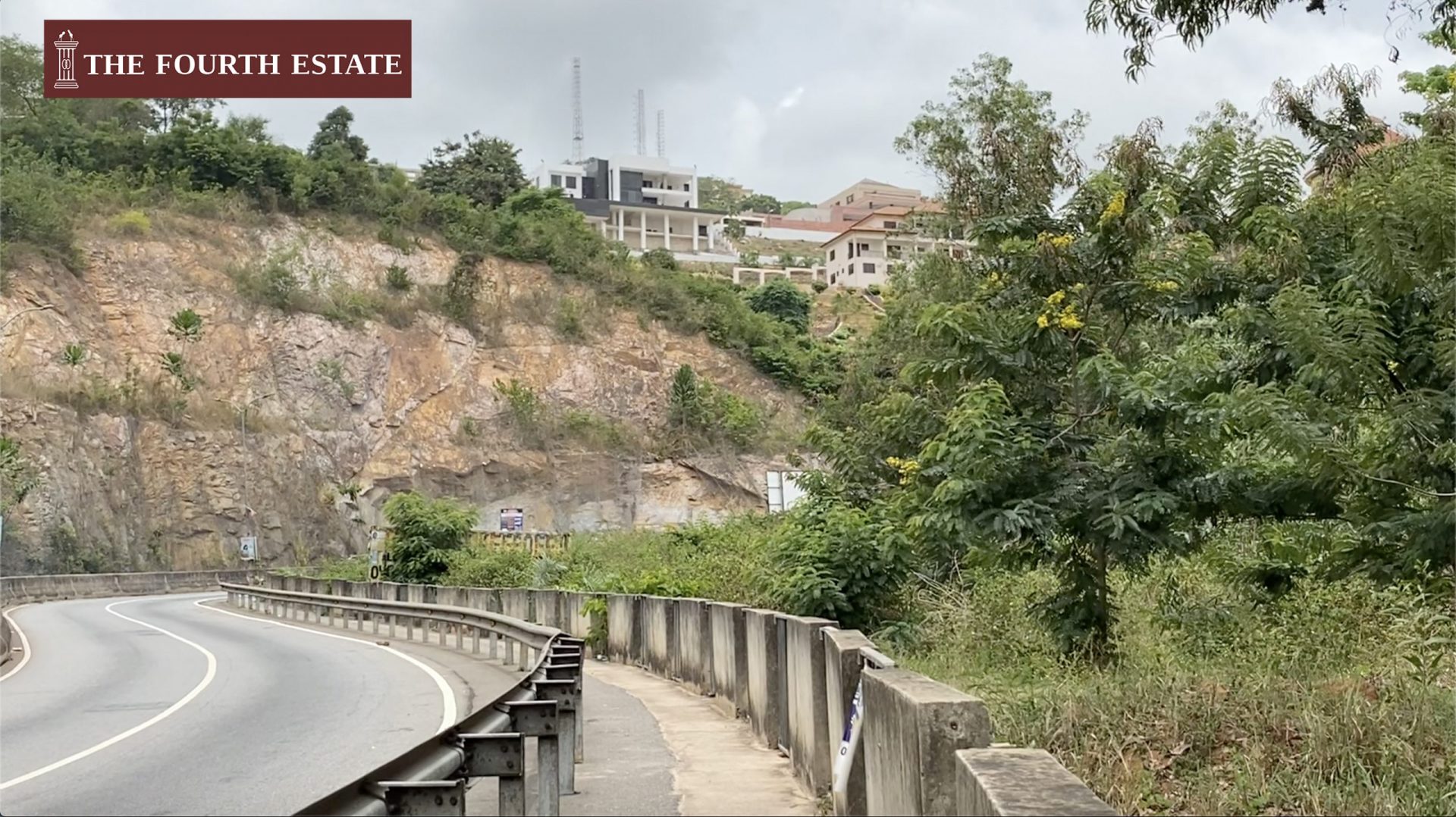
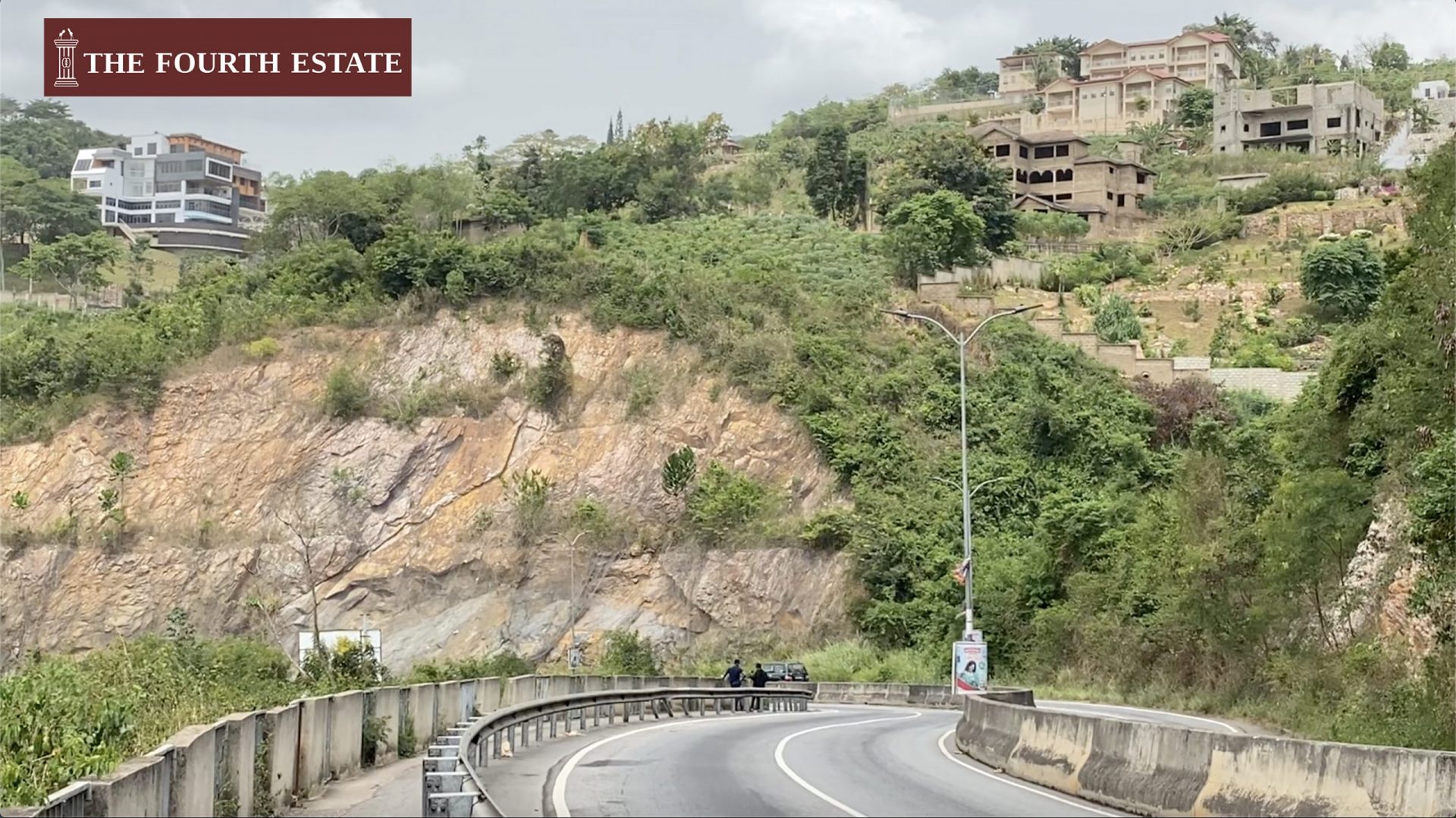
This building in question is one of the many buildings sprouting along the Accra-Aburi highway. The road meanders along this section of the Akuapem range like a giant snake. The highway lies beneath most of the houses because the contractors working on the road had to cut through the edge of the hills to build the road.
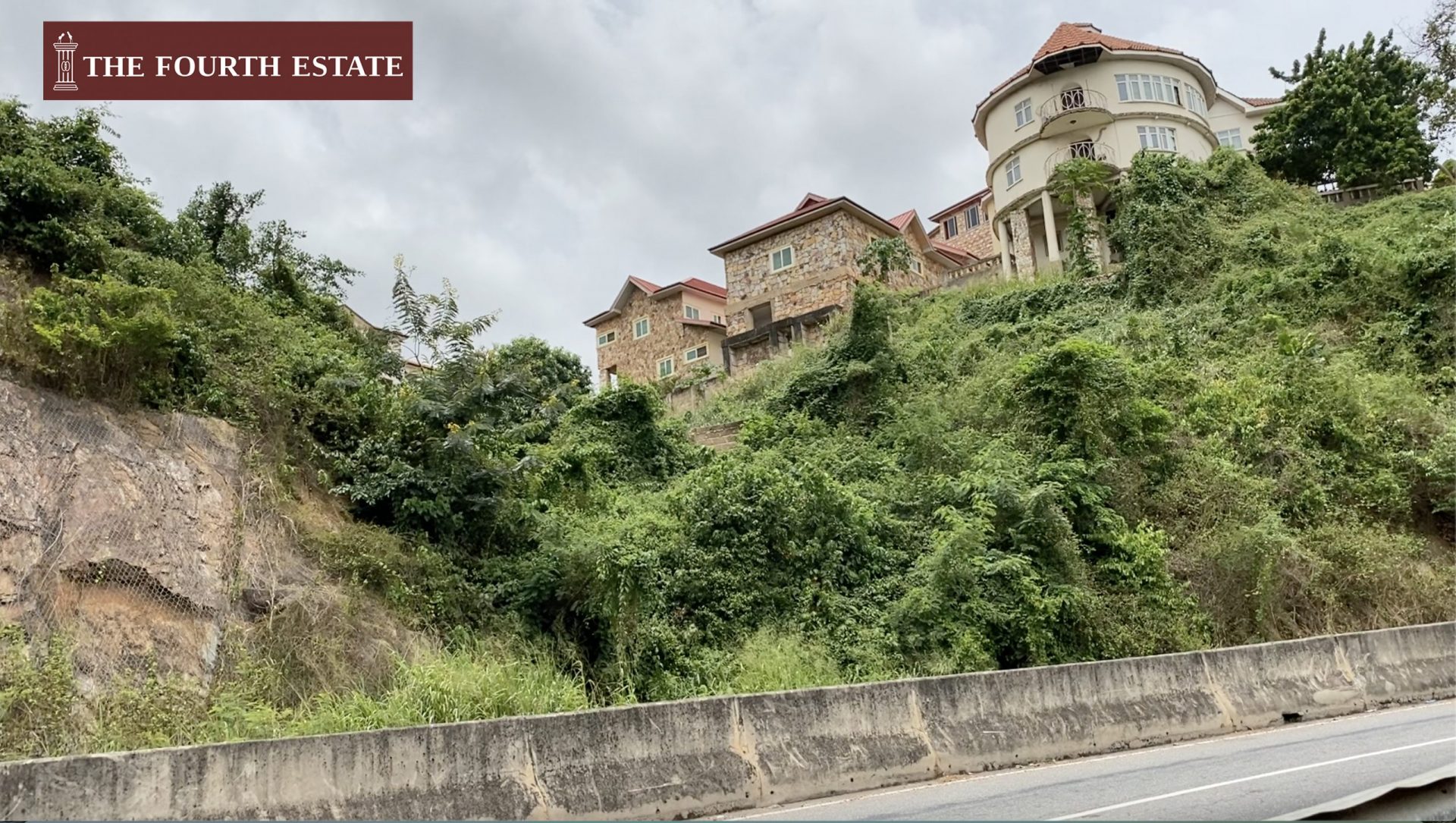
The Geological Survey Authority has warned that the slopes are too dangerous to build on
If the mason dropped a tennis ball outside the fence wall of the building, the probability that it would find its way onto the Aburi-Accra section of the dual-carriage highway would be ten out of ten.
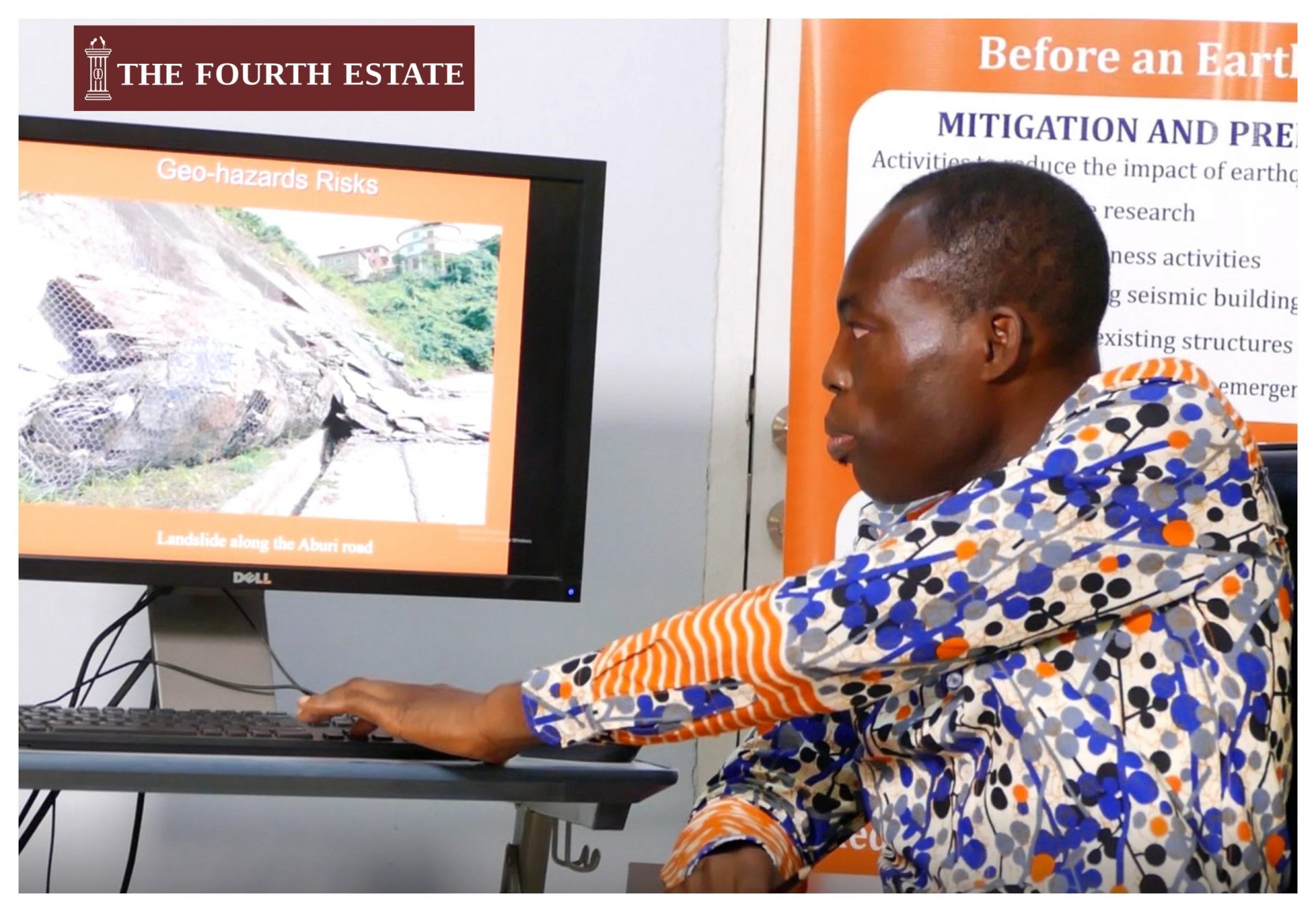
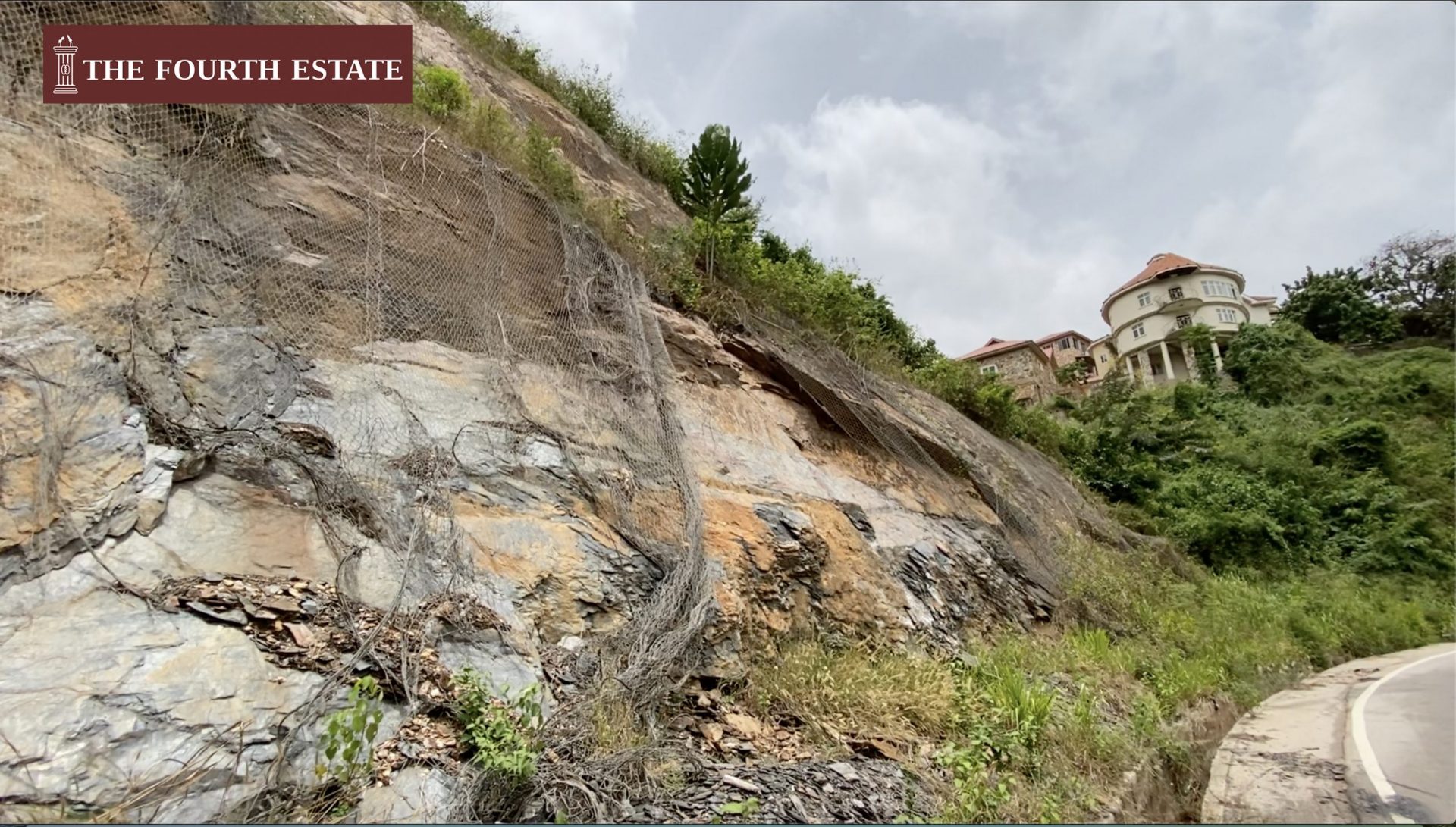
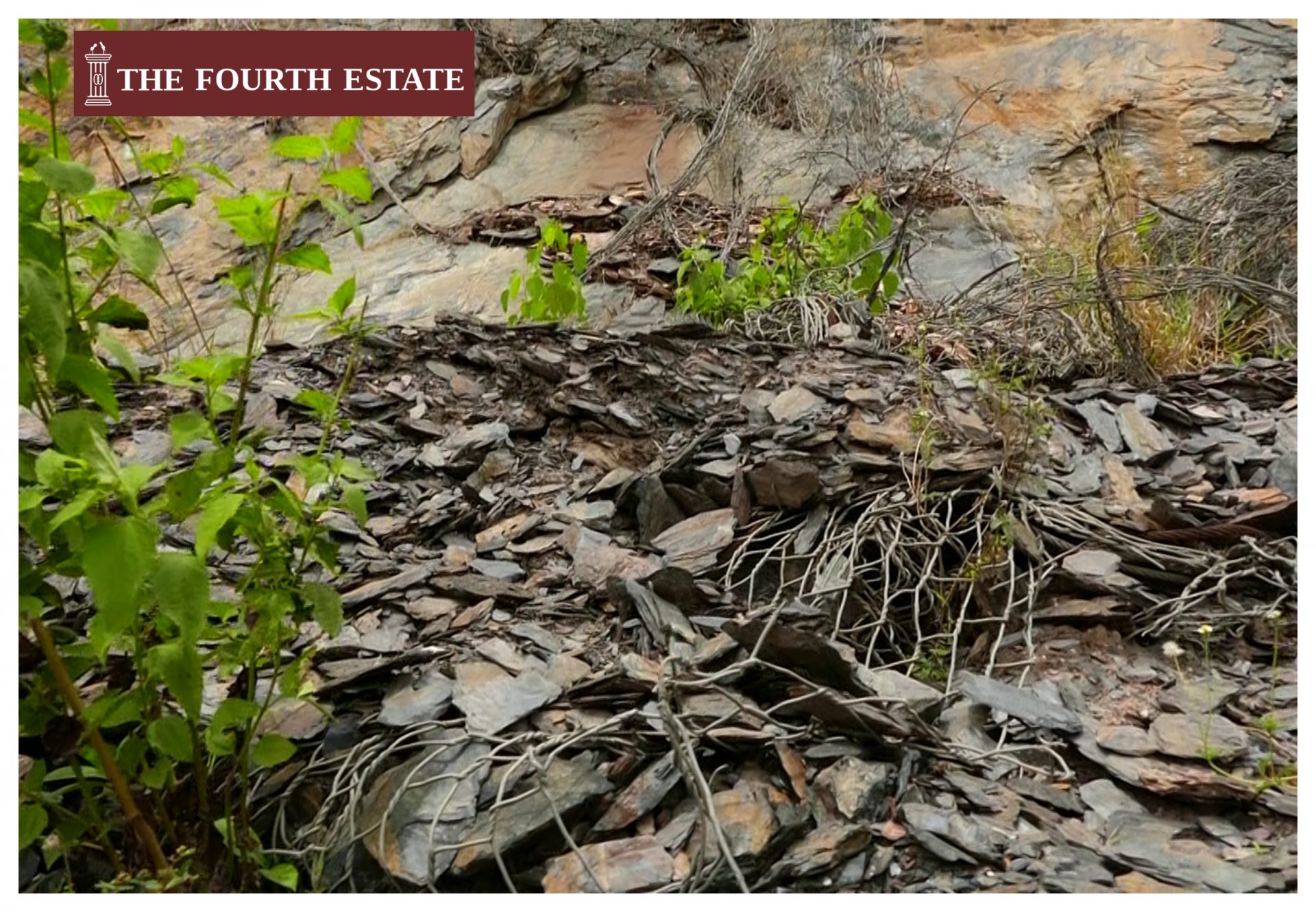
The boulders between the houses above and the road below are held from falling by giant metallic mesh, a project that cost the nation 11 million cedis to undertake when, in 2016, the falling rocks posed an immense danger to motorists on the Aburi-Accra section, forcing authorities to close the road for about a year.
The house the mason and his fellow workers were finishing when the news crew of The Fourth Estate visited the area in March 2021, as well as other such buildings along the edge of the Aburi Hills, were among the main reason authorities gave for the falling boulders.
The scores of houses and hotels scattered up the hills and the cliffs along the road are the glamorous investment of some of Ghana’s wealthy folks on the serene Aburi Hills. But beneath the veneer of affluence is chaotic and unbridled destruction of the vegetation.
Hundreds of buildings like these ones are competing for space with the lush green vegetation, a major attraction of the Aburi Mountains
From afar, the dangers are not visible, but a closer look shows hair-raising environmental degradation, an obscene desecration of the verdant vegetation, which portends greater danger than what has been experienced in the past, according to experts.
After the contractors cut through the mountainous stretch during the reconstruction of the road about 14 years ago, the boulders acted as a retaining wall.
But, today, just like the buildings, the boulders perch precariously on one another, ready to fall at the least disturbance, onto the Accra-bound section of the road.
Along the stretch, some of the rocks are seen falling onto the road despite attempts by contractors to restrain them with the giant mesh.
While the buildings might be contributing to reducing Ghana’s burgeoning housing deficit—more than two million— the loss of vegetation comes with enormous cost to those living beneath the hills.
Earthquake warnings
The Head of the Geological Survey Authority’s Earthquake Monitoring and Geo-Hazards Division, Nicholas Opoku, agrees that there are gloomy days ahead for buildings on the sloping side of the Aburi Mountains.
For years, the Ghana Geological Survey Authority (GGSA) has been warning that the series of earth tremors in parts of the Greater Accra Region signal a possible earthquake of greater magnitude in the future.
Mr Opoku shows a landslide from the past
Its principal seismologist, Nicholas Opoku, who has studied the situation on the Aburi Mountains, warns that its sloping parts are a dangerous place to build. According to him, it connects to the epicentre of Ghana’s earthquakes, which runs from Gomoa Fetteh in the Central Region, through McCarthy Hill in Accra toward the Akuapim range, all the way to Ho in the Volta Region.
“That stretch of the mountain [Aburi] is actually a fault zone, meaning it is a potential source of earthquakes. But these earthquakes are much more prominent along the coastal areas, that is [Gomoa] Nyanyano where the mountains meet the coastal boundary fault. It is the reason we have a lot of earthquakes around the Weija area.”
But there is more to the littering of buildings on the Aburi Hills than the dangers of earthquakes.
Threat to life down the Aburi Hills
Charles Kwadam, a resident of Oyarifa UT Estate down the Aburi Hills, says those of them who live in the area have been at the receiving end of the vagaries of the depleted hills, especially during the rainy season.
Mr. Kwadam relocated to the countryside due to what he terms “excessive noise” in the part of Accra where he used to live.
But the peace of mind he craved now remains a remote dream as brick and mortar continue to increase on the sloping mountain with the developers stripping the mountain of its dense, green vegetation.
With the mountain barely able to hold torrents of rain as the buildings on the highland increased, erosion has created deep gullies, pushing down the debris of floodwater and soil into the walled estate through the entrance, which faces the hills.
Mr. Kwadam observes that the degradation has been so inimical to the residents that it has become necessary to reengineer their homes by raising concrete slabs, fixing new tiles, and creating waterways to escape the wrath of water whenever it rains.
“Trees which hitherto served as water blocks and prevented soil erosion have been chopped down for construction purposes,” he says, pointing to a thick cloud of smoke from a nearby clearing on the hill.
“All the water that collects on the mountain now comes down to the estate because there are no drains to collect the water from there,” he tells The Fourth Estate.
Erosion has eaten away parts of the entrance of the Estate down the mountain
With the flood pounding the entrance of the estate, half of it has been beaten into a gully, making it almost impossible to drive into the community.
Mr. Kwadam says although their plight has been reported to the authorities, “nothing useful has ever come out from our complaints.”
“This house located at the junction here lost its beam due to the amount of water it has to contend with every time it rains,” Mr. Kwadam says of a house outside the entrance of UT Estates. It bears the unrestrained brunt of the raging water from the hills when it rains. The owners, he says, have had to carry out additional works by laying PVC pipes to create a pathway for water that collects in the compound.
Along a dusty road outside the estate towards the top of the mountain, Baba Salifu, a carpenter, says the dust is the least of his concerns. Rainy nights are vigil nights for his family; they stay awake to collect and throw out floodwater that inundates their home after each heavy downpour.
To him, life was better some years back in the then virgin-green valley beneath the picturesque mountain. With the current spate of developments on the mountain without any proper drainage system, he fears the worse might happen if there is no intervention from the authorities.
“[The] government should come in to help with a proper drainage system big enough to collect water from atop the mountain,” he says.
Possible landslide like the deadly one in Sierra Leone
Nicholas Opoku cautions against siting buildings carelessly along the mountain. He says the it is equally dangerous in the event of landslides.
“My fear is that these landslides are activated by major rainfalls because when you have a major downpour, they destabilise the slope and move materials down the slope. So, buildings that are on such slopes will lose their foundation when the materials are coming down, leading to the collapse of the building. It can cause major damage to the buildings, injuries, or even death. We’ve seen it in Sierra Leone.
Debris from the mudslide being cleared after more than a thousand people lost their lives in the Freetown disaster. Credit: Anadolu Agency
“The prevailing conditions which caused theSierra Leone landslide or mudslide is almost the same as what is happening along our fault zones, especially in Aburi. The entire mountain has an inherent weakness because it is an earthquake-prone zone. Most of the rocks there are fractured. There are a lot of cracks in the rocks, so with a little disturbance, these rocks fall down,” he explains.
On August 14, 2017, more than 1,000 people lost their lives in a devastating twin disaster—mudslide and flood—which swept through the Sugarloaf Mountain in Sierra Leone’s capital, Freetown.
The outlook of the Sierra Leonean hills mirrors Aburi Mountains in many ways –up on the hills, multi-storey houses either have either been built or are being built on dangerously steep slopes once covered by a forest.
A World Bank report points to a multifaceted issue that caused the Freetown slide. These include heavy rainfall, the steep nature of the sloping mountain as well as human interference.
File photo: Residents look on as rescue workers remove wreckages at the Regent region of Freetown after a landslide struck on August 14, 2017. Credit: Anadolu Agency
The report also observes that the area the landslide occurred was within a protected forest reserve. However, over time, the development of large houses had occurred, some illegally (without permits) and some with permits.
The Aburi Mountain has had its share of the landslide from 2010 to 2019, compelling the Roads and Transport Committee of Parliament to call for the urgent demolishing of buildings along the mountains as a solution to recurring landslides.
The boulders between the houses above and the road are held from falling by a giant metallic mesh
Some rocks tore through the wire mesh
Their call was as a result of a landslide, which induced flooding, displacing 559 residents after four hours of rain, Graphic Online reported on October 28, 2019.
But nothing happened.
With little land planning or enforcement of building codes to guide the built environment on the mountain, Mr. Opoku says the rate at which buildings are springing up on the mountain, “is increasing the risk each day as we keep developing those areas.”
He says as real estate developers prepare the foundation for buildings, they cut sections of the mountains and over-steepen the slope, which increases the risk of landslides.
“They are also removing the vegetative cover which helps check the landside. The development is endangering the place and making it prone to landslide,” he adds
Although the newly passed Geological Survey Act 2016 (Act 928) requires that site investigations be carried out before any construction work is done, the law is restricted to only major state projects.
Mr. Opoku says none of the buildings on the Aburi Mountain have had their site assessment done because the buildings would have to be of a particular height before a developer is required to do a site assessment.
When contractors cut through the rocks to construct this road, it attracted a lot of real estate developers
“In a landslide-prone area, you don’t need to put a massive building because there can be a failure of the foundation,” he adds.
Asked if the authority has projections on when such a disaster might happen, Mr. Opoku is of the expert view that “geohazards are very difficult to predict but the activities will let us know whether we are increasing the risk of having it.”
He also indicates that it is too late to reduce the risk in the heavily built areas but is quick to add that future developments should be controlled.
Ghana’s earthquake red flags were recently raised when it came out that key national assets, including the Jubilee House, Kotoka International Airport, Tema Harbor, the Akosombo dam, and others, are at risk of collapsing if an earthquake occurs.
A committee set up by the government to assess Ghana’s disaster preparedness earmarked the earthquake-prone zones in a report. President Nana Akufo-Addo issued a call to action to the stakeholders in the emergency preparedness space.
Ghana’s earthquake and landslide history
Ghana has had earthquakes dating back to more than 200 years, according to a document titled the “Gold Coast Geological Survey Bulletin 13”. The significant ones were in 1862, 1906 and 1939 with smaller ones in 1858, 1863, 1883, 1907, 1911, 1918-19,1923,1925,1930 and 1933-1935 and 1939.
The country also has a long history of landslides dating as far back as 1933. These include:
March 5, 2005
The entire Afram Plains District and part of the Kwahu South District were cut off from the rest of the country as a result of a landslide at Kam, a village near Pitiku Junction in the Eastern Region, after a heavy downpour.
The first landslide in the area occurred in 1972.
June 20, 2010
A heavy downpour triggered a landslide on the Peduase-Water Works road, a stretch of the Ayi-Mensah-Aburi dual carriageway in the Eastern Region.
The landslide occurred close to a two-storey building on the edge of the rocky mountain, blocking part of the road.
October 6, 2010
A landslide that occurred during a heavy downpour at Adukrom-Yensi in the Eastern Region killed three people and destroyed many properties.
October 25, 2012
Twenty acres of cocoa farm was destroyed at Wassa Asikuma and Wassa Nkran in the Prestea Huni/Valley District in the Western Region following heavy rainfall. It affected 60 cocoa farmers.
June 2013
Loose parts of the mountain fell and blocked the Kasoa-Weija portion of the road after a heavy downpour, resulting in a traffic jam for hours.
October 18, 2019
After nearly an hour of heavy rains, some rock particles and debris eroded from the Aburi mountain and landed on the highway blocking a part of the road.
EDITOR’S NOTE: This story shall not be republished or broadcast, in part or in full, in any form or shape without the express permission of the Editor-in-Chief.