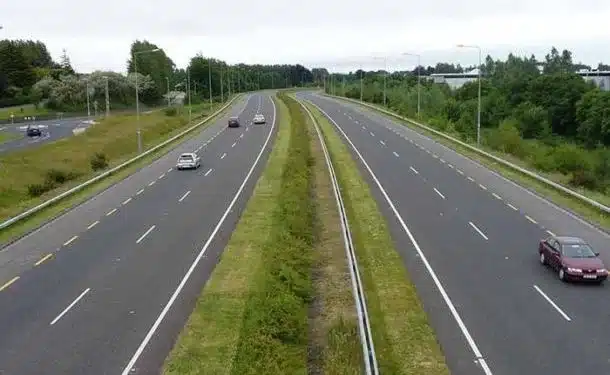
The Fourth Estate on Wednesday published a full list of road contracts published under the government’s Big Push Programme – an initiative aimed at transforming Ghana’s road sector.
The publication scrutinised the procurement methods used by the Ministry of Roads and Highways in awarding 81 contracts through sole-sourcing, a method the National Democratic Congress heavily criticised in the past, but has now indulged in.
The Fourth Estate provides an analysis of cost per kilometre for these contracts worth over GHS 80 billion, according to data from the Ministry of Roads and Highways. More than 73 billion of this went to contracts from sole-sourcing.
Some of these roads have been divided into multiple lots and given to either one contractor or multiple contractors, which the Minister of Roads and Highways, Kwame Governs Agbodza, has said was meant to ensure early completion of the projects.
What goes into cost per kilometre?
According to experts in the road construction industry, who asked for anonymity, the cost per kilometre for roads is affected by multiple factors, including topography, road classification and width, drainage and bridge requirements, land acquisition, compensation for landowners, and the distance materials must be hauled to the site. Additionally, the cost of labour and equipment costs, regulatory compliance, and project management costs.
To determine the cost of each road project, the contract sum of each project has been divided by the number of kilometres of the road.
Using this calculation, the dualisation of a 25-kilometre road, awarded to M.A & Constant Company Ltd on September 29, 2025, at a cost of GHS 3.86 billion, translates into approximately GHS 154.4 million per kilometre (about $14.2 million).
The same company is handling another 24-kilometre stretch of the same road, also awarded in September 2025, for GHS 1.87 billion—bringing the cost per kilometre down to about GHS 78.2 million (approximately $7.2 million).
Similarly, the rehabilitation of the 18.3-kilometre Tema–Aflao road, awarded in September 2025 to First Sky Limited for GHS 1.47 billion, works out to about GHS 80.7 million per kilometre (around $7.4 million).
The reconstruction of the 24.8-kilometre Dodowa–Afienya–Dawhenya road in the Greater Accra Region, along with selected town roads, was awarded in September 2025 to Oswal Investment Ltd for GHS 1.1 billion—equivalent to about GHS 45 million per kilometre (approximately $4.1 million).
In the case of the 32.6-kilometre Techiman–Nkonsia–Wenchi road, awarded to Volta Impex in November 2025 for nearly GHS 1.2 billion, the cost per kilometre is estimated at GHS 36.4 million (about $3.3 million).
The upgrading of the 8.6-kilometre Kabonwule–Blajai road in the Northern Region, awarded in August 2025 to Aawerco Construction Limited, has a total contract sum of GHS 270.3 million, translating into approximately GHS 31.4 million per kilometre (around $2.9 million).
Meanwhile, the rehabilitation of the 17.5-kilometre Atimpoku–Asikuma Junction Road, awarded in September 2025 to Ussuya (GH) Limited, costs nearly GHS 25 million per kilometre, with a total contract value of GHS 433.7 million.
Cost of roads per kilometre in the past
In June 2021, the Ministry of Roads and Highways released a statement clarifying the cost of roads per kilometre. The figures were pegged as follows:
Surface dressed costs $300,000- $9000,000 per km (depending on the number of seals and base material).
Asphalt overlay costs $200,000 -$250,000
Below is a full list of the cost per kilometer for other roads under the Big Push
During his first State of the Nation Address (SONA) on February 27, 2025, President John Mahama pledged to prioritise Ghana’s infrastructure to address the “pressing backlog of poor roads.” He announced the “Big Push” programme as the flagship initiative to deliver the promise.
He vowed his government, unlike previous ones, would do things differently in the award of contracts under the Big Push programme. The President promised that his government will “Minimise sole-source procurement to encourage competitive bidding and enhance public transparency in procurement processes.”
Four days later, the President made this vow again while addressing the National Economic Dialogue (NED) in Accra. He described the excessive abuse of sole-sourcing of public sector contracts as an act that leads to inflated contracts and causes a major drain on the country’s finances.
“Single-source procurement must be the rare exception rather than the norm,” President Mahama said.
One year into his administration, he remained committed to his vow, at least in words. At the 2026 SONA, he repeated his vow and commitment to ending the practice of excessive and unjustified awards of government contracts through sole-sourcing.
“Mr Speaker, we are bringing legislation to this House to tighten our procurement processes by banning sole-sourced contracts, except in exceptional circumstances,” the President told Parliament.
The promise to stop the abuse of sole-source procurement is one that President Mahama and his governing NDC party have been making since they were in opposition.
In the 2020 People’s Manifesto, the NDC pledged to “make single-sourced procurement (sole-sourcing) an exception and not the rule.” The pledge was repeated in the 2024 Reset Agenda Manifesto.
But in what appears to be a bold and complete disregard and defiance of the President’s vow and promises to the nation, the Ministry of Roads and Highways has literally become a factory for sole-sourced road contracts. The Ministry has been churning out what translates into almost 12 sole-sourced contracts per month.
Not a single one of the 107 contracts was awarded based on competitive tendering
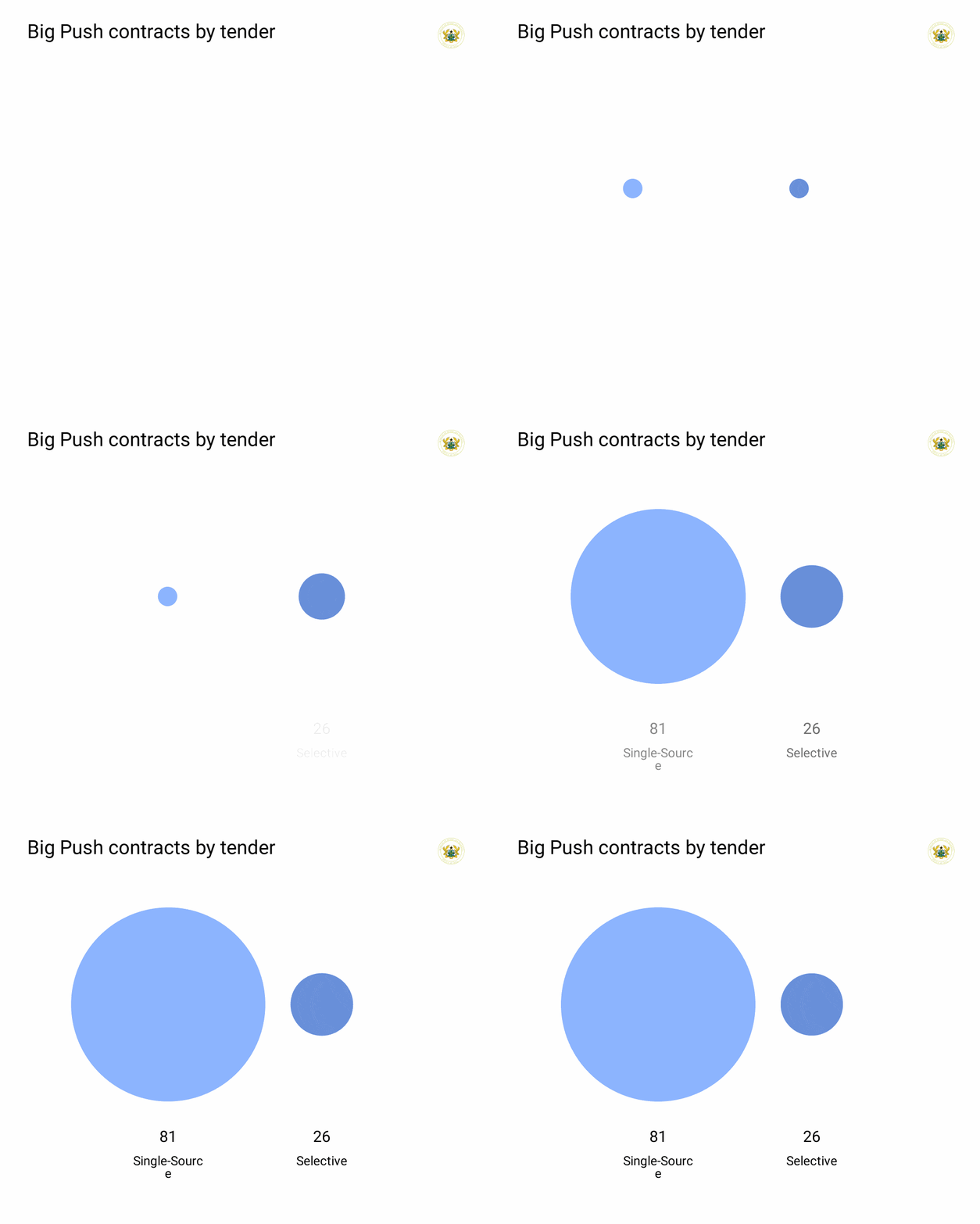
Data available to The Fourth Estate indicates that in the last seven months, the ministry has awarded 107 road contracts. Contrary to the President’s promise to ensure competitiveness and transparency in the awarding of public contracts, not a single one of 107 contracts was awarded based on competitive tendering.
A whopping 81 out of the 107 road contracts worth over GHS73 billion were awarded through sole-sourcing. The remaining 26 contracts worth about GHS8 billion were awarded through selective tendering. This means over 90% of the amount of money expected to be spent on roads under the Big Push programme so far was given out through sole-sourcing.
Despite this glaring contrast, the majority leader and leader of government business in Parliament, Mahama Ayariga, audaciously proclaimed to Parliament on March 11, 2026, that “let it be known, the era of the sole-sourced contract is dead.”
Minister’s response
When asked how contracts under the Big Push programme were awarded, the Minister of Roads and Highways, Kwame Governs Agbodza, said they resorted largely to selective tendering.
“Contracts were procured predominantly through restrictive tendering to ensure rapid project commencement,” he said. “Before procurement, the Ministry and agencies conducted extensive engineering studies, including feasibility studies and seal of quality and commitment authorisation for each project.”
Mr Agbodza’s claim that the contracts were mainly awarded through restrictive tendering, however, is counter to data obtained from his Ministry and the Ghana Highway Authority. The data available to The Fourth Estate, obtained through Right to Information (RTI) requests, reveals that about 76% of the contracts awarded from September 2025 to January 2026 were through sole-sourcing.
The Minister does not believe that the manner in which the contracts have been awarded contradicts his party’s avowed position of avoiding the abuse of sole-sourcing.
“Contracting under the Big Push fully aligns with the National Democratic Congress (NDC) manifesto and government policy. Public contracts are awarded to competent, experienced, and well-resourced contractors, prioritising Ghanaian firms to build local capacity,” he said.
It is instructive to note that, while in opposition and serving as the Ranking Member of Parliament’s Roads and Transport Committee, Mr Agbodza was an ardent critic of sole-sourcing of road contracts.
In 2021, he addressed a major press conference on the issue of sole-sourcing and proclaimed: “Part of the reason why the government is unable to build more roads is because of the use of sole-sourcing in the award of road projects, [which] inflates the cost of such contracts.”
What the Public Procurement Law says
Ghana’s public procurement law (Act 663) frowns on the regular and unjustified use of sole-sourcing or single-source procurement. It only permits it under exceptional circumstances.
Section 40 (1) of the law prescribes exceptional cases to include circumstances where goods, works, or services are only available from a particular supplier or contractor who has exclusive rights to them.
The law also makes room for sole-sourcing only when there is an urgent need for the goods, works, or services during catastrophic moments or emergencies during which using other procurement methods would be impractical.
Many, therefore, wonder the circumstances that justify the overwhelming resort to sole-sourcing in the award of road projects under the Big Push initiative.
Civil society leaders react
Multiple civil society leaders who spoke to The Fourth Estate condemned the ministry’s over-reliance on the sole-sourcing as it undermines transparency and value for money, and betrays the President’s promises.
Mary Addah, Executive Director of Transparency International Ghana
Mary Addah, Executive Director of Transparency International Ghana, bemoaned that despite the existence of a law and a procurement authority, public officers continue to flout procurement rules.
“It’s sad, and the double standards are just too many. And it’s becoming worrisome for those of us who do this on a daily basis. It’s sad that people who stand on the pulpit to say one thing carry on and do other things.”
She added that these breaches continue to happen because public officers believe they will not be penalised when they do it.
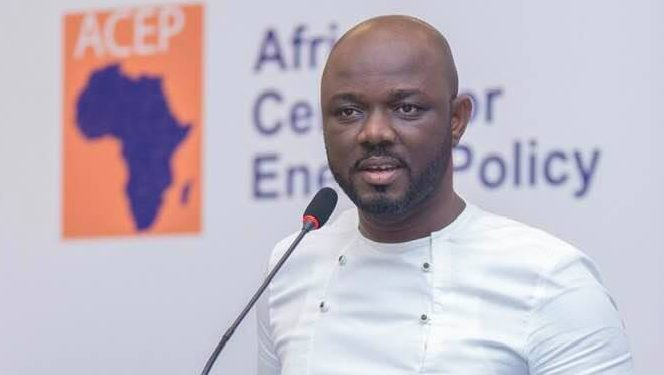
Ben Boakye, Executive Director of the Africa Centre for Energy Policy
The Executive Director of the Africa Centre for Energy Policy, Ben Boakye, shared similar views, noting that the findings were not what Ghanaians were promised.
He said it has become obvious that those in charge now did not condemn sole-sourcing in the past out of concern for the public interest, but because they were not the decision-makers and beneficiaries at the time; now, they are benefiting from it.
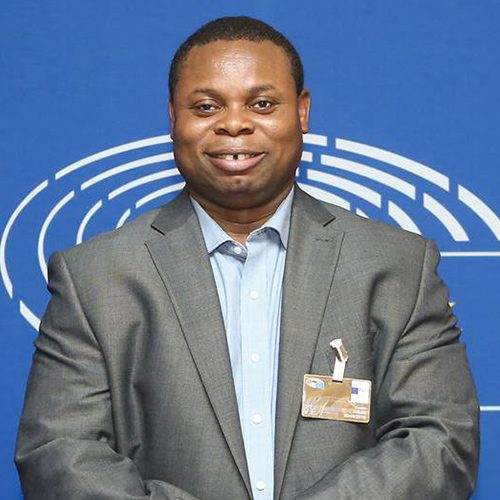
franklin cudjoe, president of imani africa
Imani Africa’s president, Franklin Cudjoe, decried that it had become increasingly clear that the current public procurement system is a major revenue leakage point for the government.
“We know the integrity of the procurement process has been compromised by weak institutional and regulatory frameworks, inefficient quality assurance measures, and a cultural tolerance for abuse and unethical behaviour of public officials,” he said.
“We were hoping that these abuses were going to be curtailed in this new reset agenda. With these dizzying numbers, we are lost.”
vitus azeem, anti-corruption crusader
Anti-corruption crusader Vitus Azeem told The Fourth Estate that it was disappointing to see that the findings contradict President Mahama’s pledge in the State of the Nation Address to introduce legislation that reduces sole-sourcing.
Mr Azeem noted that “it’s surprising that just one year into power, such situations exist. Because, you see, the procurement law talks of competitive bidding. And sole-sourcing or restricted bidding is not a norm.”
NDC’s past rhetoric on sole-sourcing
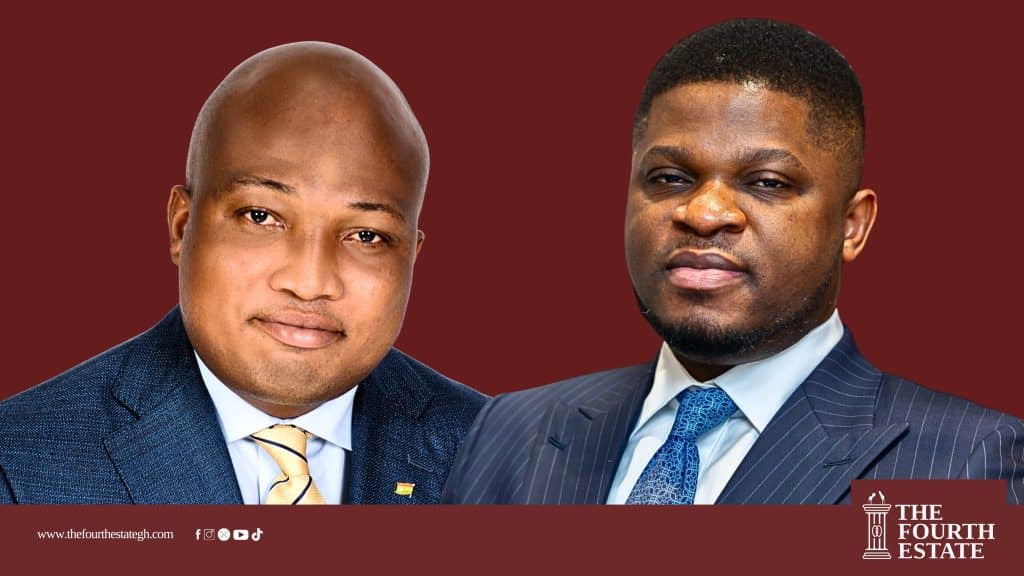
Samuel okudzeto (l) ablakwa and sammy gyamfi criticised the previous administration for abusing sole-sourcing
While in opposition, some leading members of the NDC deplored the Akufo-Addo administration’s abuse of sole-sourcing.
In May 2024, MP for North Tongu, Samuel Okudzeto Ablakwa, now Foreign Affairs Minister, said Dr. Mahamudu Bawumia had engaged in “deplorable conduct” on the allegation that a contract had been awarded to a company said to belong to the former Vice President’s siblings on a sole-source basis.
Sammy Gyamfi, CEO of GoldBod, who was then the National Communications Officer of the NDC, reiterated Agboza’s concern that inflated sole-sourcing contracts were causing Ghana to lose billions of cedis. He made this claim in one of his moments of truth series on TV in August 2024.
A year into the Mahama administration, the government’s sole-sourcing record in the road sector alone shows the government may be copying from the very script NDC officials criticised and condemned.
More than half of the lawmakers in Ghana’s current Parliament have failed to declare their assets and liabilities in breach of major anti-corruption legislation.
151 out of the 276 Members of Parliament, including some leaders of the House, have failed to fulfil the key constitutional requirement meant to ensure that public officeholders do not use their offices to enrich themselves.
An analysis of data The Fourth Estate obtained from the Audit Service, and verified twice, through a Right to Information request, shows that approximately 55 % of MPs have not complied with the mandatory asset declaration requirement as of December 2025.
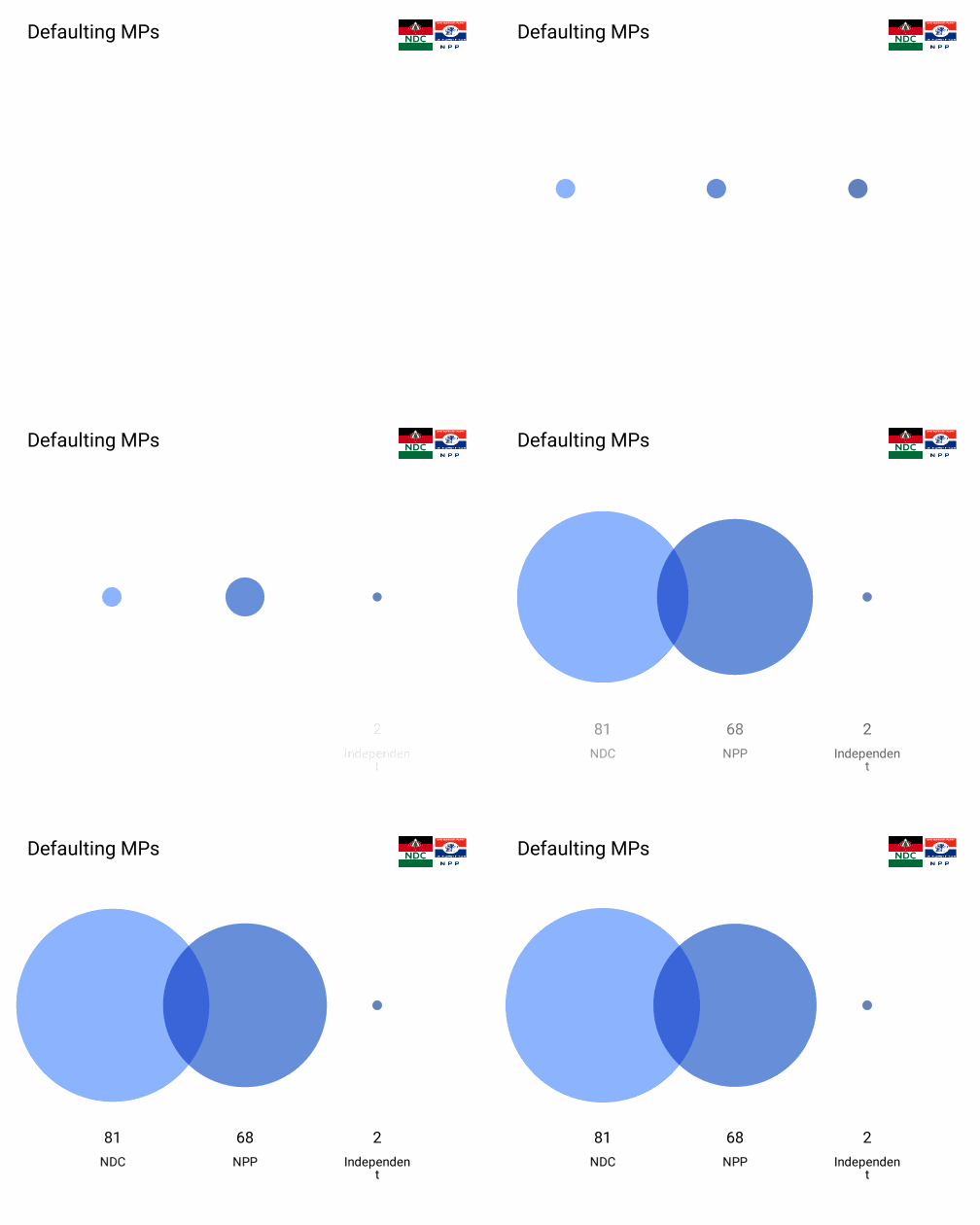
Of these defaulters, 81 (54%) are from the ruling National Democratic Congress (NDC), 68 (45%) are from the opposition NPP. Two independent MPs have also defaulted.
The data also highlight a higher rate of noncompliance among newer lawmakers, as 87 defaulters (58%) are first-term MPs. Among continuing MPs, 38 are serving their second term; 13 are in their third term; 11 are in their fourth term, and one each in their fifth, sixth, and eighth terms.
Notable names among the defaulters include the immediate past Defence Minister and MP for Bimbilla, Dominic Nitiwul, who is serving his sixth term, and veteran MP for Asutifi South, Collins Dauda, who is in his eighth term.
The non-compliance extends to parliamentary leadership. Five House leaders have failed to declare: on the NDC side, Deputy Majority Leader Kweku Ricketts-Hagan and Majority Chief Whip Rockson-Nelson Etse Kwami Dafeamekpor; on the NPP side, Deputy Minority Leader Patricia Appiagyei, First Deputy Minority Chief Whip, Habib Iddrisu, and Second Deputy Minority Chief Whip, Jerry Ahmed Shaib.
In 2022, The Fourth Estate revealed that 180 MPs had failed to declare their assets.
Following that exposé, some leaders, including then-Deputy Majority Leader, Alexandar Afenyo-Markin and former Deputy Minority Leader, Dr. James Klutse Avedzi, immediately complied.
Compliance in the Seventh and Eighth Parliaments (2017–2021) was dismal with only 20 MPs fully declared (a 7.2% compliance rate), with 129 making no declaration and 126 making only partial declarations.
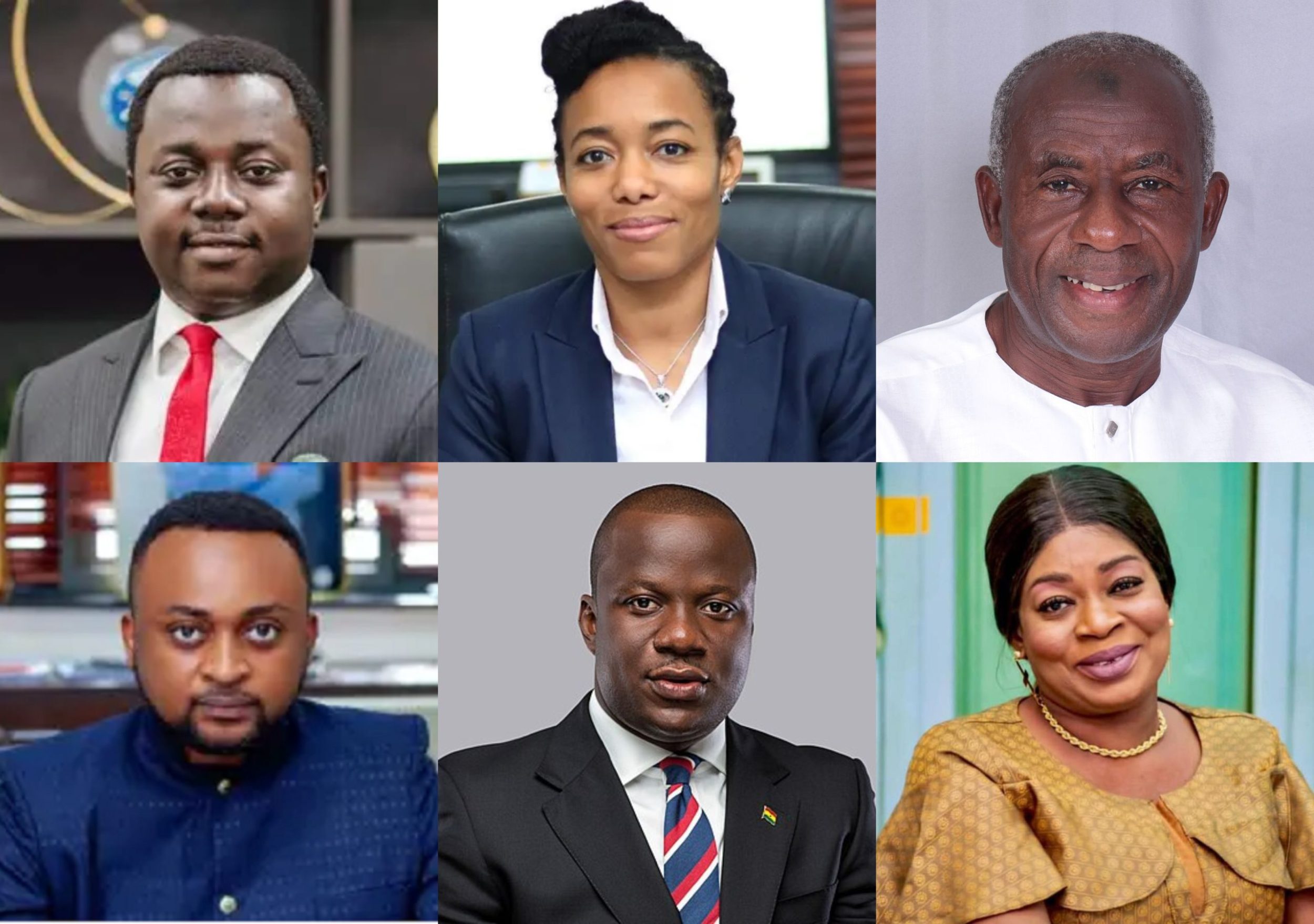
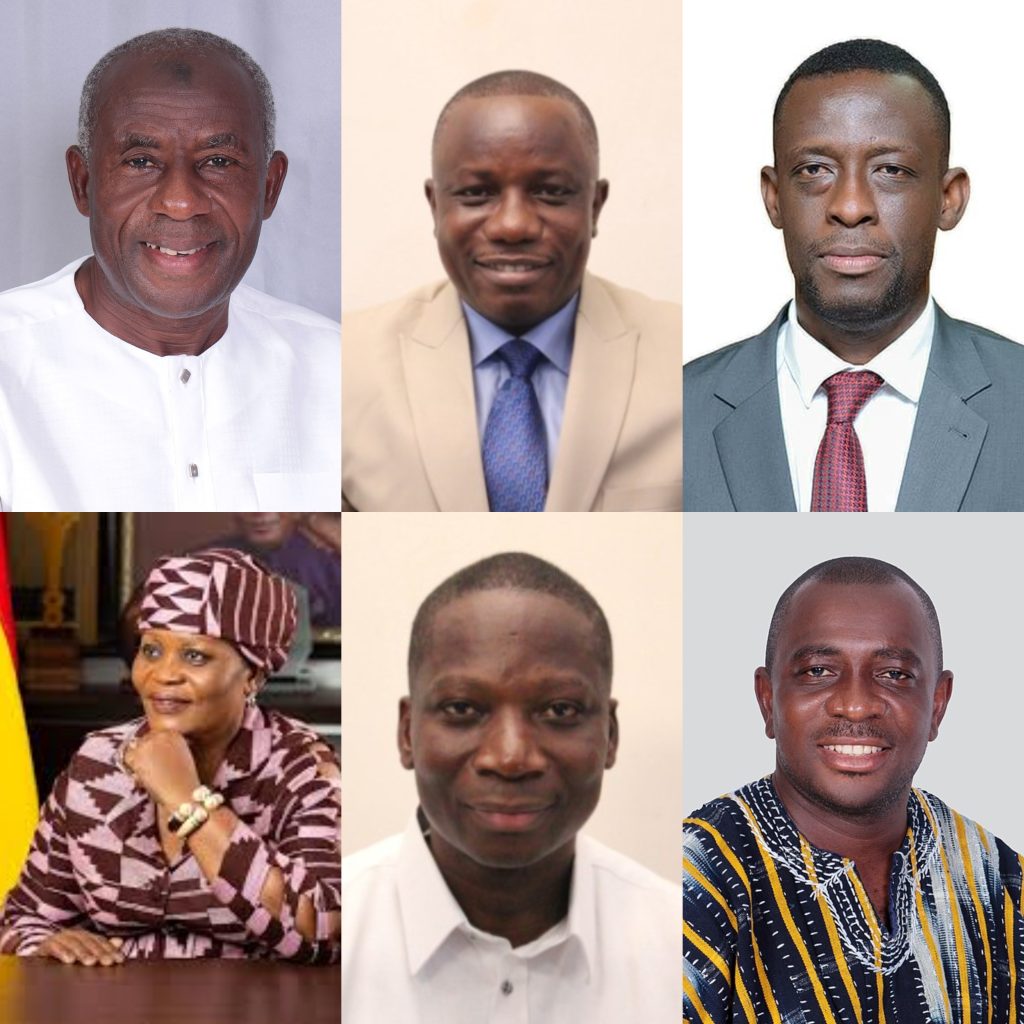
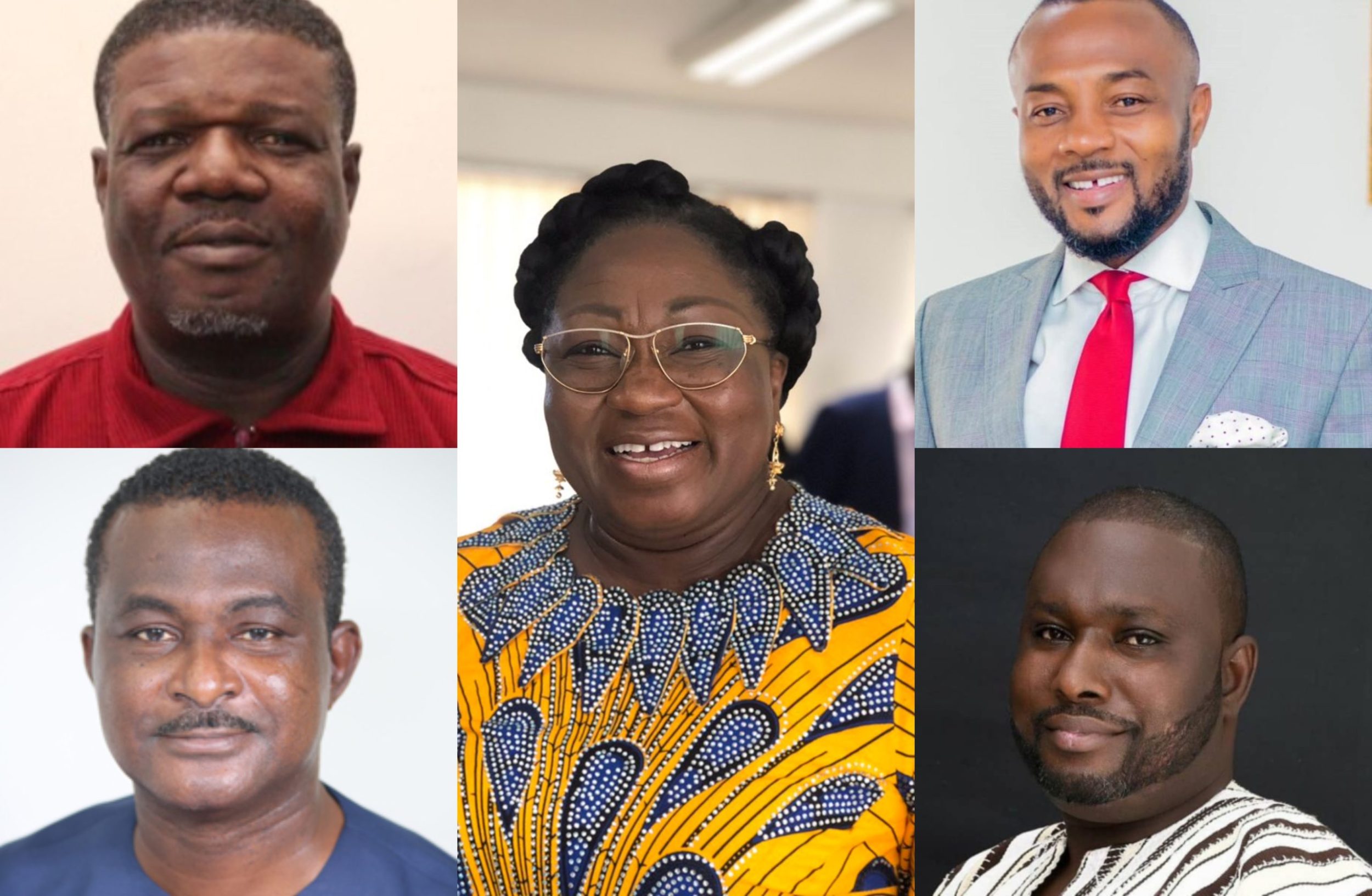
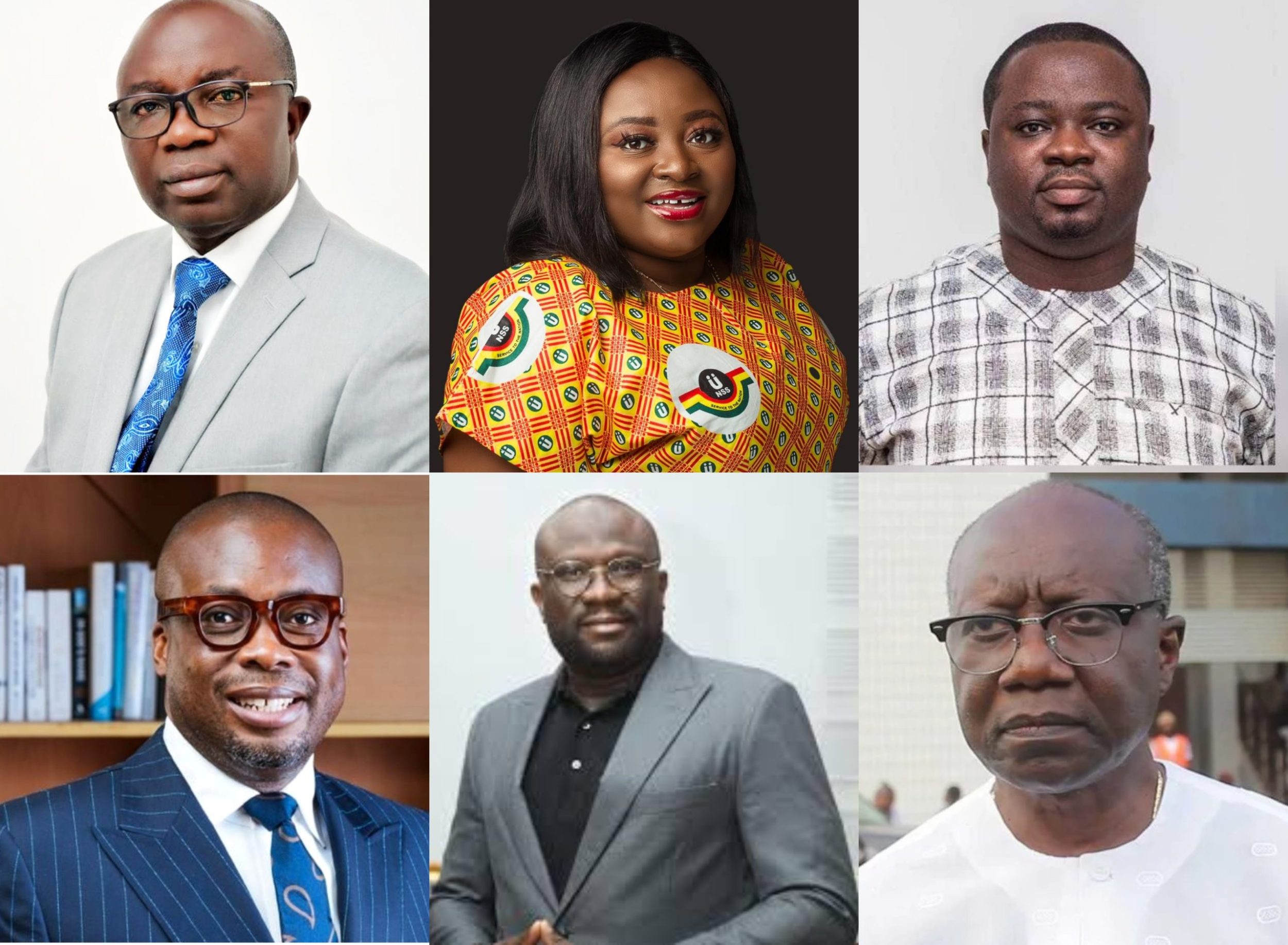
Some of the countrY’s long-serving MPS, Collins Dauda(top LEFT), Dominic Nitiwul (top middle), Kwabena Okyere DARKO (top right), Helen Ntoso (Down left), John Oti Bless (down middle), and Kennedy Osei Nyarko, who are serving terms ranging from 4th to 8th, have not declared their assets and liabilities
Civil society worries
Executive Director of the Ghana Anti-Corruption Coalition, Beauty Emefa Nartey, told The Fourth Estate that the persistent non-compliance is the result of weak enforcement.
“The reality is that when eligible declarants perceive little to no consequences for failing to comply with the asset declaration regime, they naturally do not take the process seriously,” she said.
The anti-graft campaigner called for the urgent passage of the Conduct of Public Officers Bill, which would introduce robust verification, clear enforcement mechanisms, and consistent sanctions.
“Ultimately, we should build a culture where asset declaration is embraced as a civic duty, and not as a burden. This is essential for strengthening integrity and public trust in governance,” Ms Nartey added.
What the law says
According to the Public Office Holders (Declaration of Assets and Disqualification) Act, public officers (including MPs) are required to declare their assets within six months of assuming office and within six months after Parliament is dissolved.
“The declaration shall be made by the public officer – (a) before taking office; (b) at the end of every four years; and (c) at the end of the term of his office and shall, in any event, be submitted not later than 6 months of the occurrence of any of the events specified in this subsection,” the law says.
Legislators, like other public office holders covered by the law, are required to declare their assets, including land, houses, vehicles, securities, bank balances, and jewellery.
Almost half of Parliament’s leadership has failed to declare their assets and liabilities more than a year after assuming office as lawmakers. This raises concerns about transparency and accountability at the very top of the legislative arm of government.
Five out of 13 leaders from both the Majority and Minority sides in the legislature failed to comply with one of the anti-corruption laws meant to ensure that public officeholders do not use their office to enrich themselves illegally.
Out of the five, three are from the New Patriotic Party (NPP) and two from the National Democratic Congress (NDC), data The Fourth Estate obtained from the Audit Service through a right to information request shows.
The defaulters are Deputy Majority leader, Kweku Ricketts Hagan; Majority Chief Whip, Rockson-Nelson Etse Kwami Dafeamekpor, on the NDC side, and Deputy Minority leader, Patricia Appiagyei; First Deputy Minority Chief Whip, Habib Iddrisu and Second Deputy Minority Chief Whip, Jerry Ahmed Shaib on the NPP side.
The Fourth Estate’s analysis of the data shows that the five leaders have been inconsistent with their declarations.
The Deputy Minority Leader, Kweku Ricketts Hagan, and MP for Cape Coast South, who has been an MP since 2013 has declared his assets and liabilities only once in October 2016. Mr Defeamekpor on the other hand, entered Parliament in 2017 and has done two declarations in December 2017 and February 2023.
The Deputy Minority Leader, Patricia Appiagyei, who is also the MP for Asokwa, has also been in Parliament since 2013 but has also failed to fully comply with the law. She did the declarations in September 2016, April 2021 and September 2024, which shows she only fully complied when she became a deputy minister in the Akufo-Addo government.
The last time Jerry Ahmed Shaib declared his assets and liabilities was in December 2020 when he was the CEO of the Coastal Development Authority. When he left office, he did not, neither did he comply with the law when he became an MP.
Similarly, Habib Iddrissu, the First Minority Chief Whip and MP for Tolon, became an MP in 2020 but has declared his assets and liabilities only once in May 2023.
GACC reacts
Executive Director of the Ghana Anti-Corruption Coalition, Beauty Emefa Nartey, told The Fourth Estate compliance rates are so low because there are no consequences for defaulters.
“The reality is that when eligible declarants perceive little to no consequences for failing to comply with the asset declaration regime, they naturally do not take the process seriously,” she said
She made a strong case for the long-awaited Conduct of Public Officers Bill, describing it as a game-changer for the country’s anti-corruption architecture.
“It offers a real opportunity to address the persistent weaknesses in our current asset declaration framework,” she said.
“We need the president to champion the enactment of a law that includes robust verification mechanisms, clear enforcement procedures, and the consistent application of sanctions. Ultimately, we should build a culture where asset declaration is embraced as a civic duty, and not as a burden. This is essential for strengthening integrity and public trust in governance.”
What does the law say?
Article 286 (1) of the 1992 Constitution states that “a person who holds a public office mentioned in clause (5) of this Article shall submit to the Auditor-General a written declaration of all property or assets owned by, or liabilities owed by, him whether directly or indirectly (a) within three months after the coming into force of this Constitution or before taking office, as the case may be, (b) at the end of every four years; and (b) at the end of his term of office.”
The Constitution requires the declaration to be made before the public officer takes office. However, Section 1(4)(c) of the Public Office Holders (Declaration of Assets and Disqualification) Act directs the public office holder to meet this requirement “not later than six months after taking office, at the end of every four years, and not later than six months at the end of his or her term.”
Currently, Liberia, South Africa, Tanzania, Cape Verde, and São Tomé and Príncipe are the only African countries that allow the publication of assets declared.
Who must do the declaration?
The asset declaration laws require that the President, Vice-President, the Speaker of Parliament, Deputy Speakers of Parliament, Members of Parliament, ministers and deputy ministers of State, ambassadors, the Chief Justice and Judges of the superior courts submit to the Auditor-General, written declarations of all property or assets owned or liabilities owed by them, whether directly or indirectly. Others required to make similar declarations are managers of public institutions in which the state has shares.
However, The Fourth Estate’s investigations last year showed ministers, judges and other public officeholders disregarded the law.
When Osei Assibey Antwi was appointed Executive Director of the National Service Scheme in 2021, he was required by law to declare his assets and liabilities before he assumed office or within six months after taking the job.
However, The Fourth Estate has found that five years on, Mr Assibey, who is facing 14 counts of financial crimes for his role in the NSS ghost names scandal, never declared his assets and liabilities.
Through a right to information request, we also found that as of January 19, 2026, Mr Assibey’s two deputies, Gifty Oware-Aboagye and Kwaku Ohene Djan, also had not complied with the anti-graft law, which is meant to ensure that public officeholders do not use their office to enrich themselves.
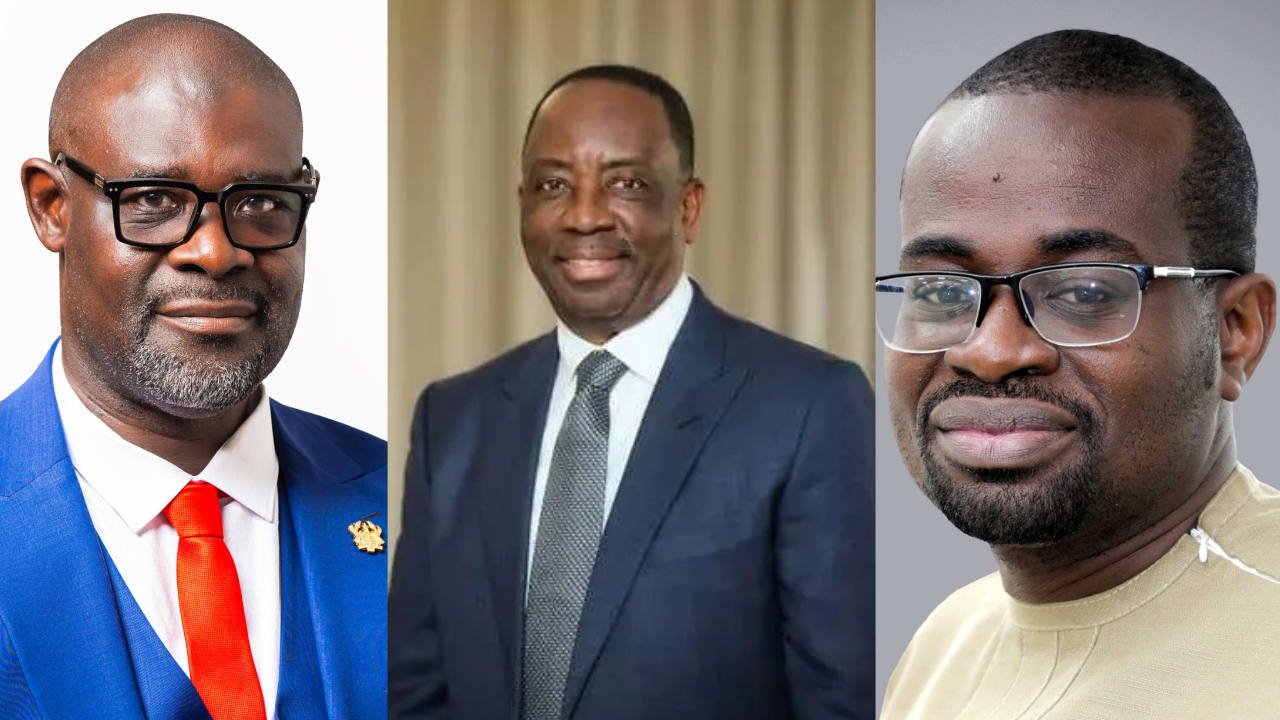
Osei Assibey Antwi (middle), Gifty Oware-Aboagye (Left), and Kwaku Ohene Djan, all failed to declare their assets
The trio are among 13 former appointees of former President Akufo-Addo who are currently either standing trial or are under investigation for various acts of financial improprieties.
Three others who have never fulfilled the constitutional obligation, according to the Audit Service data, include Col Kwadwo Damoah (retired), a former Commissioner of Customs, who has been charged alongside the former Finance Minister, Ken Ofori-Attah, for allegedly causing financial loss of more than GHC1.4 billion in the Strategic Mobilisation Limited (SML) contract saga, and Paul Adom-Otchere, former Board Chairman of the Ghana Airports Company Limited.
Before he was elected to Parliament in 2024, Col Damoah served as Commissioner of Customs from May 2019 until his removal in August 2022 but did not comply with the asset declaration law. He also did not declare his assets upon assuming office as a Member of Parliament, data from the Audit Service shows.
Similarly, The Fourth Estate found that Solomon Asamoah, a former CEO of the Ghana Infrastructure Investment Fund who is being prosecuted for his role in the $2 million “Sky Train” scandal, has not complied with the law.
And then, there is Paul Adom-Otchere, who was appointed as Board Chairman of the Ghana Airport Company in 2021 and is being investigated for his role in the award of a revenue assurance contract between the Ghana Airports Company Limited (GACL) and a private company owned by EvaTex Logistics Limited, a company owned by the proprietor of Strategic Mobilisation Ghana Ltd (SML). SML was awarded a similar contract in the petroleum downstream, which has since been terminated.
Paul Adom-Otchere was the Board chairman of GACL for four years, but failed to declare his assets and liabilities
Partial declarations
Beyond the six who made no declarations, six others made partial declarations either at the start or end of their tenures, making it difficult to possibly track their properties and liabilities before and after assuming office.
Among those in this category is Kwabena Adu-Boahene, the immediate past Director-General of the Signals Bureau, who was appointed in 2017. It took him more than eight years to declare his assets and liabilities, a flagrant violation of the law, which requires asset declaration within six months of assuming office and within six months after leaving office. Adu-Boahene, who is facing 11 charges, including using public office for profit and stealing, only declared his assets and liabilities for the first time on August 22, 2025, according to the Audit Service data.
The former Finance Minister only did his declaration once in eight years
Fugitive former Minister of Finance, Ken Ofori-Attah, only once declared his assets and liabilities – two months after he was sworn into office on January 27, 2017. For the almost eight years he served in office as Finance Minister, Mr. Ofori-Atta should have declared his assets and liabilities four times. He faces criminal charges, including causing financial loss to the state, using public office for personal profit, and directly influencing the procurement process to obtain an unfair advantage in the award of contracts.
The CEO of the National Food Buffer Stock Company, Abdul Hanan Wahab, who was appointed in 2017, also did not make his declaration until September 5, 2024, nearly eight years after his appointment.
Abdul Hanan Wahab only declared his assets and liabilities months before the end of his tenure
There is also the former Managing Director of the Bulk Oil Storage and Transportation Company (BOST), Edwin Alfred Provencal, who was appointed in August 2019 but did not do his declaration until April 27, 2022.
Mr Provencal’s asset declaration history is not different from that of Professor Christopher Ameyaw-Akumfi, who chaired the board of the Ghana Infrastructure Investment Fund for eight years but declared on a date mistakenly captured as June 9, 1930, which the Audit Service admits is an error. Professor Ameyaw-Akumfi has been charged with conspiracy to commit a crime – specifically, willfully causing financial loss to the state.
Dr. Ammishaddai Owusu-Amoah, former Commissioner- General, GRA, who left office in March 2024, also did not declare his assets and liabilities after leaving office. His initial declaration was done in March 2020.
Rev. Dr. Ammishaddai Owusu-Amoah did not declare his assets when he left office
In the case of the immediate-past Chief Executive Officer of the National Petroleum Authority (NPA), Mustapha Abdul-Hamid, he declared his assets in February 2023, almost two years after he was appointed to lead the petroleum regulator.
The Fourth Estate’s findings come on the back of a recent disclosure from the Office of the Special Prosecutor (OSP) that Mustapha Hamid failed to declare all his properties, as a house he claimed former President Akufo-Addo gifted him was not listed among the assets he declared.
GACC reacts
The Executive Director of the Ghana Anti-Corruption Coalition, Beauty Emefa Nartey, says that The Fourth Estate’s findings “reinforce our long-standing assertion that a weak asset declaration enforcement regime signals permission for non-compliance.”
“The reality is that when eligible declarants perceive little to no consequences for failing to comply with the asset declaration regime, they naturally do not take the process seriously,” she added.
Ms. Nartey, therefore, made a strong case for the passage of the Conduct of Public Officers Bill, which she believes is critical to the fight against corruption.
“It offers a real opportunity to address the persistent weaknesses in our current asset declaration framework,” she said. “We need His Excellency the President to champion the enactment of a law that includes a robust verification mechanism, clear enforcement procedures, and the consistent application of sanctions. Ultimately, we should build a culture where asset declaration is embraced as a civic duty, and not as a burden. This is essential for strengthening integrity and public trust in governance.”
What does the law say?
Article 286 (1) of the 1992 Constitution states that “a person who holds a public office mentioned in clause (5) of this Article shall submit to the Auditor-General, a written declaration of all property or assets owned by, or liabilities owed by, him whether directly or indirectly (a) within three months after the coming into force of this Constitution or before taking office, as the case may be, (b) at the end of every four years; and (b) at the end of his term of office.”
The Constitution requires the declaration to be made before the public officer takes office. However, Section 1(4)(c) of the Public Office Holders (Declaration of Assets and Disqualification) Act directs the public office holder to meet this requirement “not later than six months after taking office, at the end of every four years, and not later than six months at the end of his or her term.”
Currently, Liberia, South Africa, Tanzania, Cape Verde, and São Tomé and Príncipe are the only African countries that allow the publication of assets declared.
Who must do the declaration?
The laws require that the President, Vice-President, the Speaker of Parliament, Deputy Speakers of Parliament, Members of Parliament, ministers and deputy ministers of State, ambassadors, the Chief Justice and Judges of superior courts submit to the Auditor-General, written declarations of all property or assets owned or liabilities owed by them, whether directly or indirectly. The laws also mandate appointees of other state institutions to declare their assets and liabilities.
However, The Fourth Estate’s investigations last year showed a worringly low compliance rate among ministers, judges, and other public officeholders.
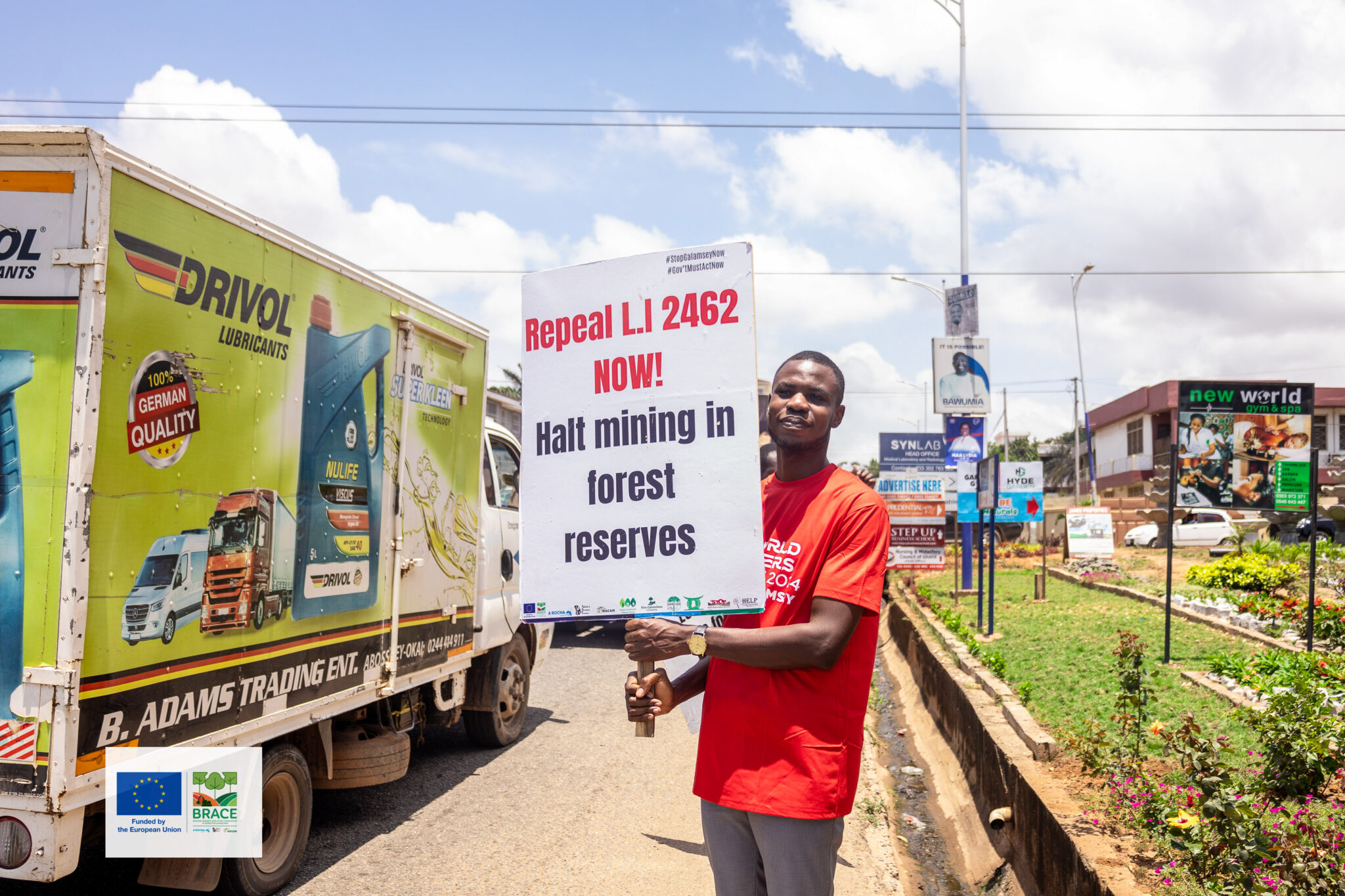
After sustained pressure from environmentalists and journalists, the John Mahama government has finally revoked the contentious Legal Instrument (L.I.) 2462 that opened up Ghana’s ecologically sensitive areas, including forest reserves for mining.
This follows the maturing of the Environmental Protection (Mining in Forest Reserves) Revocation Instrument, 2025. The Minister for Lands and Natural Resources, Emmanuel Armah-Kofi Buah, laid the instrument in Parliament on October 31, 2025.
In accordance with Article 11(7) of the constitution, the regulation was revoked on December 10, 2025 after 21 Parliamentary sitting days.
Reacting to the revocation of the Legal Instrument, the Deputy National Director of A Rocha Ghana, Daryl Bosu, said:
“This is a crucial victory for Ghana’s forests. Yet even now, as we celebrate, forests continue to be destroyed by artisanal mining, illegal farming, and logging activities with no effective action in sight,” he said. “To secure this win, we must urgently halt illegal activities, grow back our forests, and in the long term, develop and implement a progressive national forest protection program, while upgrading the Forestry Commission to effectively deal with these new age threats.”
When the minister laid the Revocation Instrument in Parliament, he said the regulation had been amended due to intense public outcry. The amendment resulted in the creation of L.I. 2501, which came into force on June 2, 2025, he said.
But civil society advocates and concerned citizens opposed the amendment. They argued that the new regulation still left the country’s forest reserves vulnerable.
Mr Armah-Kofi Buah said the government gave in to the demands after consulting with experts and the groundswell against the regulation.
“We are showing Ghanaians that we are committed to protecting the environment, our forest, and our water bodies,” he said.
With The Fourth Estate revealing the faces behind the forest invasion, the National Democratic Congress, then in opposition, promised to revoke the law.
However, the Mahama government made a U-turn on the issue and rather amended part of the regulation, taking away the power of the president to waive the protection of protected forest reserves, including globally significant biodiversity areas.
The decision incensed environmental activists who accused the government of not living up to its word. This compelled the Ministry of Lands and Natural Resources to re-lay the law before parliament for revocation.
Background
In early 2023, a coalition of civil society organizations (CSOs), including A Rocha Ghana and Nature & Development Foundation (NDF), raised the alarm about how the L.I.
However, their concerns fell on deaf ears.
Their demands remained unheeded to until The Fourth Estate revealed in September 2024, how officials of the then ruling party, the New Patriotic Party, and government appointees of that regime, were granted concessions to mine and prospect in forest reserves.
The expose uncovered the identities of NPP officials and government appointees who were scrambling for mining licences in Ghana’s forest reserves. The owners of some of the companies that have obtained these licences included the mayor of Ghana’s second biggest city, Kumasi, Sam Pyne, and a Parliamentary Candidate for the NPP in Juaben, Francis Owusu-Akyaw.
The Ashanti Regional Chairman of the NPP, Bernard Antwi Boasiako, the District Chief Executive of Wassa East, Emmanuel Boakye, and the NPP’s Women’s Organizer in the Western Region, Angela Bint Ntaama, including a presidential staffer, Harriet Kyeremanteng, all had companies whose licences were waiting ministerial approval to mine in forest reserves.
The Fourth Estate’s investigations also revealed that since 2023 at least 10 companies have been granted mining leases to mine in 11 mining forest reserves. Four of the companies were to operate in globally significant biodiversity areas. As of August 13, 2024, our investigations also uncovered that at least 25 companies had filed 32 applications to mine and prospect in 24 forest reserves.
The investigative report produced a groundswell for the immediate revocation of the regulation. A month after publication, the Attorney General of the past government instructed the Ministry of Environment, Science, Technology, and Innovation, along with the Environmental Protection Agency (EPA), to “suspend the enforcement of the Environmental Protection (Mining in Forest Reserves) Regulations 2023 (LI 2462) with immediate effect”.
However, it took the incumbent government to actually revoke the law, reverting the regulation of Ghana’s forest reserves to an administrative framework for mining called the Environmental Guideline for Mining in Production Forest Reserves, which permits limited mining of not more than 2% of timber production reserves.
Millions of Ghanaians are required by law to pay property tax, yet many say they see no benefit from it.
Roads remain broken, drains unfinished, and streets dark, feeding public mistrust for the mandatory tax required under Section 152 of the Local Government Act.
The law states that ” The amount of a general or special rate due in respect of any premises shall, until paid, be a charge on the premises and that charge shall have priority over any other claims against the premises except claims of the Government.”
In 2023, the Akufo-Addo government rolled out a digital property tax system, selling it as a fix for years of poor property tax collection. It was meant to make payment easier, seal leakages, and boost local development.
Instead, something went wrong. Assemblies across the country began recording a sharp decline in revenue, even as property owners received higher and sometimes unexplained bills.
Behind the system was a private company most taxpayers had never heard of, operating with little public scrutiny. Local revenue officers watched helplessly as their collections declined.
This documentary follows the money, the data, and the decisions behind Ghana’s digital property tax experiment—and asks how a reform meant to build trust ended up breaking it.
The National Communications Authority (NCA) has directed all telecommunications companies in Ghana to provide the National Lottery Authority (NLA) with information on all financial transactions related to KGL Technology’s operation of NLA’s 5/90 lottery.
MTN, Airtel Tigo (AT) and Telecel (Vodafone) are to furnish the NLA with records of funds that passed through the *959# short code, the Director-General of NLA, Mohammed Abdul-Salam, has told The Fourth Estate in an interview.
The NCA’s directive comes on the heels of investigations by The Fourth Estate, which prompted the NLA to write to KGL, the telecom companies, and the NCA to reconcile accounts that have been unavailable to the NLA since 2019, when the NLA-KGL deal became operational.
As the issuer and regulator of the USSD short codes, the NCA’s directive is aimed at ensuring that the telecom companies comply with the NLA’s request.
Mr. Abdul-Salam explained that the NCA’s directive also aims to prevent the telecommunication companies from giving the excuse that they cannot provide the data requested by the NLA without the authorization of their regulator.
“The NCA’s letter is to reinforce the position that they needed to make that data available to us,” Mr. Abdul- Salam told The Fourth Estate.
Investigations by The Fourth Estate had revealed that the state was losing revenue through a questionable series of licensing contracts that were signed between the NLA and KGL under the previous government. The contracts essentially handed over the NLA’s most lucrative business to KGL for what amounts to a pittance in commercial terms.
In 2024 for example, KGL made GHC3 billion in revenue from operating the NLA’s 5/90 lottery online via USSD. Per the licence granted by NLA, KGL was to pay a paltry GHC 157.6 million in total as license fees and contributions to the Good Causes Foundation, the corporate social responsibility unit of the NLA.
A 15-year exclusive license that was granted KGL mandates that the NLA and KGL shall conduct weekly reconciliation of revenues.
Paragraph 17 of the Exclusive Licence granted to KGL states: “The parties shall conduct weekly reconciliations on transactions (pre- and post-draw, revenue, wins, prize and prize payments) during the term of this licence. For the avoidance of doubt, the reconciliation is to ensure that there are no discrepancies in the financial records of the NLA and the Licensee (KGL), pursuant to Section 51 of Act 722.”
Despite this clear provision requiring reconciliations every week, such weekly reconciliations have never been carried out since the licence was granted to KGL in early 2024. As a result of the disregard for the weekly reconciliations, the NLA does not even know how much sales and revenue KGL is making from the sale of its 5/90 lottery.
When NLA wrote to demand the records from KGL, their reply was to request that the reconciliation be deferred to 2026. But NLA refused, insisting that the terms of the contract must be complied with. KGL then wrote to plead to be given additional time to submit the data.
Background
In 2019, the then Director-General of the NLA, Kofi Osei Ameyaw, signed a controversial three-year contract with KGL Technology Limited to operate the NLA’s 5/90 lottery online via a USSD code. Upon expiration of the contract in 2022, Samuel Awuku (who succeeded Osei Ameyaw as director general) and his board renewed the contract with KGL for a 10-year period.
But before the expiration of the 10 years, in 2024, the then Director-General of the NLA, Mr. Awuku and his Board, chaired by Gary Nimako Marfo, signed a new contract with KGL, granting the company exclusive rights to operate the 5/90 lottery online via USSD. This new contract is for 15 years (from 2024 to 2039) with an automatic renewal for another five years.
Mr. Awuku and his board also signed two other contracts for KGL to operate the 5/90 online lottery in Nigeria and Cote d’Ivoire. These two contracts were for 10 years each.
The Fourth Estate’s investigations revealed that annual revenue to KGL from the NLA’s 5/90 online lottery in 2024 alone was over GHC3 billion or over GHC250 million each month.
In an interview with the Group Chairman of KGL, Alex Apau Dadey, he confirmed to The Fourth Estate that the company’s 2024 revenue from the NLA’s 5/90 online lottery was over GHC3 billion.
Under the terms of the deal, however, KGL was supposed to pay a total of just GHC157.6 million to NLA in 2024, for all three contracts in Ghana, Nigeria, and Côte d’Ivoire. This amount was to be increased annually by just 10% each year. The amount that was to be paid in 2024 represented a paltry 5.2% of the revenue KGL generated from the NLA’s prime business.
The National Lotto Act, 2006 (Act 722) does not allow any private company to operate any form of lottery in Ghana. It makes the operations of the lottery in Ghana the sole preserve of the NLA. Section 4(1)-(2) of the law states: “A person other than the Authority shall not operate any form of lottery.”
“A person who contravenes subsection (1) commits an offence and is liable on summary conviction to a fine of not more than two thousand and five hundred penalty units or imprisonment for a term of not more than three years or both.”
The law, however, requires the NLA to contract private companies to sell lottery as Lotto Marketing Companies (LMCs).
The NLA Act also requires that all proceeds from the sales of lottery by LMCs should be paid into what is called the Lotto Account of the NLA. From this account, the NLA is then supposed to pay stipulated commissions to the LMCs.
The Fourth Estate’s investigations, however, showed that NLA’s deals with KGL are unusual at best and illegitimate at worst. First of all, KGL’s revenues do not go into the Lotto Account. In fact, the NLA does not even know how much KGL makes in sales. Secondly, while the law requires all LMCs to be paid a commission by the NLA, under the current deal, KGL is paying the NLA what the licence agreement describes as “revenue share.”
In 2024, the NLA was paying LMCs a commission of 25% on their sales. In these exclusive and monopolistic contracts, what KGL paid the NLA in 2024 amounted to just 5.2% of the company’s 2024 revenue.
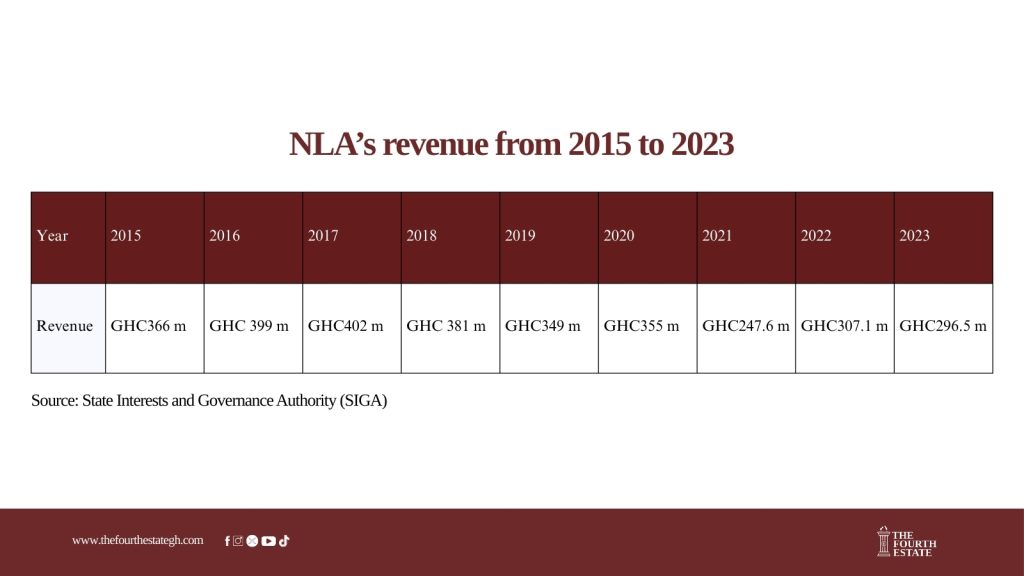
Meanwhile, official documents from the State Interests and Governance Authority (SIGA) have revealed that NLA’s revenues have been on a steep decline from GHC366 million in 2015 to GHC296.58 million in 2023.
The KGL Group says it received GHC200,000 from the NLA Good Causes Foundation as a donation to the KGL Foundation and not GHC400,000 as contained in the disbursement records of the NLA.
The KGL group said it received the GHC200,000 from the Good Causes Foundation during the launch of its foundation in 2023.
The Fourth Estate has been investigating the disbursements of funds from the NLA’s Good Causes Foundation since it was established in 2021, and found several questionable expenditures that deviated from what the law intended it for.
Section 2(3) of the National Lotto Act, 2006, (Act 722) states that: “There shall be conducted as part of the operation of National Lotto, a lottery with the object of providing care and protection for the physically or mentally afflicted, the needy, the aged, orphans and destitute children.”
The Fourth Estate’s analysis of the disbursements of funds from the NLA Good Causes Foundation showed that, a substantial part of the nearly GHC50 million that the foundation disbursed went into questionable enterprises. It included sponsorships for conferences, awards nights, gala dinners, comedy shows, festivals, and donations to political and business elites.
According to the NLA’s data, two separate payments of GHC300,000 (cheque number: 689432) and GHC100,000 (cheque number: 306453) were made to the KGL Foundation to support its activities. However, the company insisted it received only half of the amount captured in the NLA’s database.
“Our review of the KGL Foundation account indicates that GHC200,000.00 received from Good Causes Foundation was donated by the former Director-General, Mr. Sammy Awuku, on behalf of the NLA during the KGL Foundation’s formal launch event as part of its fundraising initiatives, which was open to all partners of the Group,” the company said in an email response to The Fourth Estate.
“No records of any other transactions from the Good Causes Foundation to the KGL Foundation have been found.”
KGL Foundation operates exclusively NLA’s multi-billion cedi 5/90 lotto, which in 2024 alone generated more than GHC 3 billion in revenue. Through the arrangement between the two, the NLA does not even know how much KGL makes in sales.
In an interview with The Fourth Estate, KGL Group Chairman, Alex Appau Dadey insisted that the foundation was not a beneficiary of the GHC 400, 000 mentioned as being contained in the NLA Good Causes Foundation’s database. He said the KGL Group invited the NLA to contribute to the KGL Foundation as a reciprocation for the millions the company spent on the NLA.
But many have questioned why funds meant for orphans and the mentally afflicted are being spent on an endowed organisation such as KGL that is said to be a financial lifeblood of the NLA. Others wonder why KGL can give and take from the same NLA even if what was received was GHC200,000 as claimed by KGL or GHC400,000 as contained in the NLA’s data.
Samuel Awuku’s response
The immediate past Director-General of the NLA, Samuel Awuku, while he said he could not recall the exact amount given to the KGL Foundation, justified the expenditure.
He said, given the contributions of KGL as a partner to the NLA, it was normal for the NLA to support the activities of KGL.
“So, the NLA receives a chunk of support per the contract with KGL, and we receive some support as part of Good Causes. I think it was once or twice. I think it was a collaboration, if I recall. It was something in the area of sports and development,” he guessed.
“There was no time I did that without informing the board. KGL gives in terms of support is over two million cedis every year as Good Causes, and when they also requested collaborative support, I don’t think it was anything out of the ordinary, looking at what we get from them.”
Mr. Awuku maintained that the NLA’s expenditures on collaborations never crossed the GHC200,000 mark. However, data from the Good Causes Foundation showed that the KGL Foundation received twice that amount.
In the end, KGL insisted it got half the money, while the NLA’s records show it was double. Between the denials, justifications, and fuzzy recollections, one thing is clear: the figures don’t add up – the vulnerable, who were supposed to benefit, are left with nothing but mathematical games.
On February 6, 2025, the immediate past Director-General of the National Lottery Authority (NLA), and now Member of Parliament (MP) for Akuapem North, Samuel Awuku, delivered his maiden statement to the Ghanaian Parliament.
The focus of his statement was on how to enhance proceeds from the Lottery to support Ghana’s development.
In that grand speech, eloquently laced with examples of how the Lottery has contributed to the development of other countries, he cited as an example how funds from the lottery supported the construction of the famous Great Wall of China.
“As the immediate past Director General of the National Lottery Authority (NLA), I would like to bring to our attention the significant; yet overlooked, ways the Government can optimise the use of lottery proceeds, implement stricter measures against illegal lottery operations, and maximise revenue through innovative fiscal strategies, including tax incentives. This statement is also to highlight the best practices around the world that I believe Ghana could also learn from,” Mr. Awuku summarised the purpose of his speech to Parliament.
He then made recommendations on how to increase lottery proceeds and how proceeds can be spent.
But what the 41-year-old first-time MP did not disclose to Parliament was that, during his leadership, he signed off the most lucrative business of the NLA – the 5/90 online lottery – to a private company for peanuts.
In 2019, the then Director General of the NLA, Kofi Osei Ameyaw, signed a controversial three-year contract with a private company called KGL Technology Limited, to operate the NLA’s 5/90 lottery online via a USSD code (on mobile phone). Upon expiration of the contract in 2022, Mr. Awuku and his board renewed the contract with KGL for a 10-year period.
But before the expiration of the 10 years, in 2024, Mr. Awuku and his Board, Chaired by Gary Nimako Marfo, signed a new contract with KGL, granting the company exclusive rights to operate the 5/90 lottery online via USSD. This new contract was not for five years; not 10 years; but 15 years (from 2024 to 2039) with an automatic renewal for another five years.
Mr. Awuku and his board also signed two other contracts for KGL to operate the 5/90 online lottery in Nigeria and Cote d’Ivoire. These two contracts were also not for one year; not for two years; and not for five years. They were for 10 years each.
The Fourth Estate’s investigations revealed that annual revenue to KGL from the NLA’s 5/90 online lottery in 2024 alone was over GHC3 billion or over GHC250 million each month.
In an interview with the Group Chairman of KGL, Alex Apau Dadey, he confirmed to The Fourth Estate that the company’s 2024 revenue from the NLA’s 5/90 online lottery was over GHC3 billion.
Under the contracts, however, KGL was supposed to pay a total of just GHC157.6 million to NLA in 2024, for all three contracts. This amount was to be increased annually by just 10% each year. The amount that was to be paid in 2024 represented a paltry 5.2% of the revenue KGL generated from the NLA’s prime business.
The National Lotto Act, 2006 (Act 722) does not allow any private company to operate any form of lottery in Ghana. It makes the operations of lottery in Ghana the sole preserve of the NLA. Section 4(1)-(2) of the law states: “ A person other than the Authority shall not operate any form of lottery.” “ A person who contravenes subsection (1) commits an offence and is liable on summary conviction to a fine of not more than two thousand and five hundred penalty units or imprisonment for a term of not more than three years or both.”
The law, however, requires the NLA to contract private companies to sell lottery as Lotto Marketing Companies (LMCs).
Lotto Marketing Companies have, for ages, sold lotto on behalf of the NLA
The NLA Act also requires that all proceeds from the sales of lottery by LMCs should be paid into what is called the Lotto Account of the NLA. From this account, the NLA is then supposed to pay the LMCs a stipulated commission on their sales.
The Fourth Estate’s investigations, however, show that NLA’s contracts with KGL may be special ones. First of all, KGL’s revenue does not go into the Lotto Account. In fact, the NLA does not even know how much KGL makes in sales. Secondly, while the law requires all LMCs to be paid a commission by the NLA, under the contracts, KGL is rather paying the NLA what may be called a commission, but which the contracts describe as a “revenue share.”
In 2024, the NLA was paying LMCs a commission of 25% on their sales. In these exclusive and monopolistic contracts, what KGL paid the NLA in 2024 amounted to just 5.2% of the company’s 2024 revenue.
Meanwhile, official documents from the State Interests and Governance Authority (SIGA) have revealed that NLA’s revenues have been on a steep decline from GHC366 million in 2015 to GHC296.58 million in 2023.
The Fourth Estate could not obtain figures for 2024, but sources close to the NLA say the NLA’s financial situation was not different in 2024.
As shown in the table below, our analysis indicates that since the contract with KGL, the NLA’s revenues have been going down.
Source: State Interests and Governance Authority (SIGA): The table above provides details of NLA’s revenue earned from 2015 to 2023.
Despite the huge decline in the NLA’s revenue since its deal with KGL, Mr. Awuku, told The Fourth Estate that he left the NLA in a better financial position than when he took over.
He explained that before he was appointed the Director-General in 2021, the NLA was already in a pilot contract with KGL under which it paid the NLA GHC20 million in 2019 and GHC25 million in 2020 as collaboration revenue.
He said after the initial contract, there was to be a substantive contract in 2022, under which KGL would have been expected to pay GHC30 million in 2022 and an increment of GHC5 million every year until 2025 when the amount would have increased to GHC45 million.
He stated that instead of sticking with this contract, he renegotiated with KGL and got a better deal.
Mr. Awuku claimed he renegotiated the KGL contract from GHC26 million to GHC173 million even though he did not indicate where the GHC173 million was coming from since this amount does not reflect in the contract document.
“I believe that under the circumstances, the board got a better deal for the NLA. Nothing stops this [current] board from sitting down and also renegotiating,” he said.
While Mr. Awuku boasts that he had a better deal with KGL, he admitted that under his leadership NLA did not know how much KGL was making in revenue. It is, therefore, quite curious how Mr. Awuku and his board determined the amount KGL was to pay and on what basis he thinks he got a better deal for the NLA.
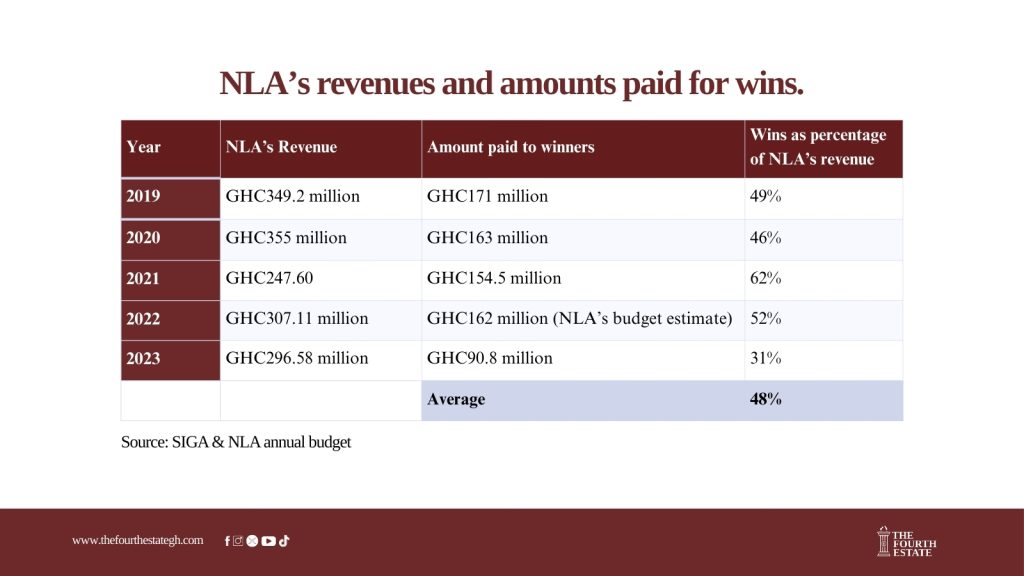
He also said the KGL deal took off the burden of payments of wins by the NLA. “Sometimes, you can have 200% wins against you. My time, there was a time I even recorded more than 200% win. My predecessors, some even recorded more. And there are times that is low. So, the average we pay is 55%,” he claimed. Mr. Awuku added that apart from the burden of paying wins, the NLA also has to pay commissions to the LMCs.
The Fourth Estate’s analysis of the NLA’s data shows that the average winnings of 2019 to 2023 is 48%.
Source: SIGA & NLA annual budget
Defending the deal, the Group Chairman of KGL said out of the over GHC3 billion his company earned in 2024, the company paid GHC87 million to the Ghana Revenue Authority and claimed GHC176 million was paid to the NLA. Even though he did not disclose any further expenses, he claimed the company made only GHC70 million as profit.
When asked to disclose further details of the company’s expenditure, Mr. Dadey, who is reported in the media as a former Finance Committee Chairman of the New Patriotic Party (NPP) in the UK ahead of the 2016 general elections, declined. “That data, you are not going to get it,” he said.
KGL uses the short code, *959#, to sell the 5/90 lottery and its Group Chairman told The Fourth Estate that the system requires a huge investment, which the NLA lacks.
“The NLA doesn’t have the resources to run the system; this is not a kid’s game. The government doesn’t have the capacity to do what we do. This is technology, and we hold the highest data in this country,” he bragged. “Can the NLA hold that data? Did they prove to you that they could hold such data? The cost of doing this is huge if you want to do it properly.”
Former Board Chairman declines interview
When The Fourth Estate contacted the NLA’s immediate past Board Chairman, Gary Nimako Marfo, he declined to comment and said all the details the team needed were captured in the minutes of the board.